Many pet food packaging specs look “strong” on paper and still fail in the real world. The reason is simple. Wet food and dry food do not fail shelf life the same way.
Wet food and dry food fail shelf life for fundamentally different reasons, so one spec sheet cannot cover both. Dry food risk is dominated by oxygen-driven fat oxidation and aroma loss, moisture pickup, and seal micro-leaks during distribution. Wet food risk is dominated by pack integrity after thermal processing, hermetic seal performance, and process-to-package compatibility.
Compare wet and dry pet food packaging formats with a spec-first checklist

This report-style article explains where failures differ, what measurable specs predict fewer complaints, and what buyers should request in RFQs for wet and dry formats.
Why do wet and dry foods “go bad” differently?
Some buyers treat shelf life as one problem. They ask for “high barrier” and assume the result will be stable.
Dry foods typically fail by gradual quality drift after oxygen and moisture ingress. Wet foods typically fail by integrity problems tied to thermal processing and hermetic sealing. A correct spec starts by matching the failure mechanism to the product type.
Different products, different failure engines
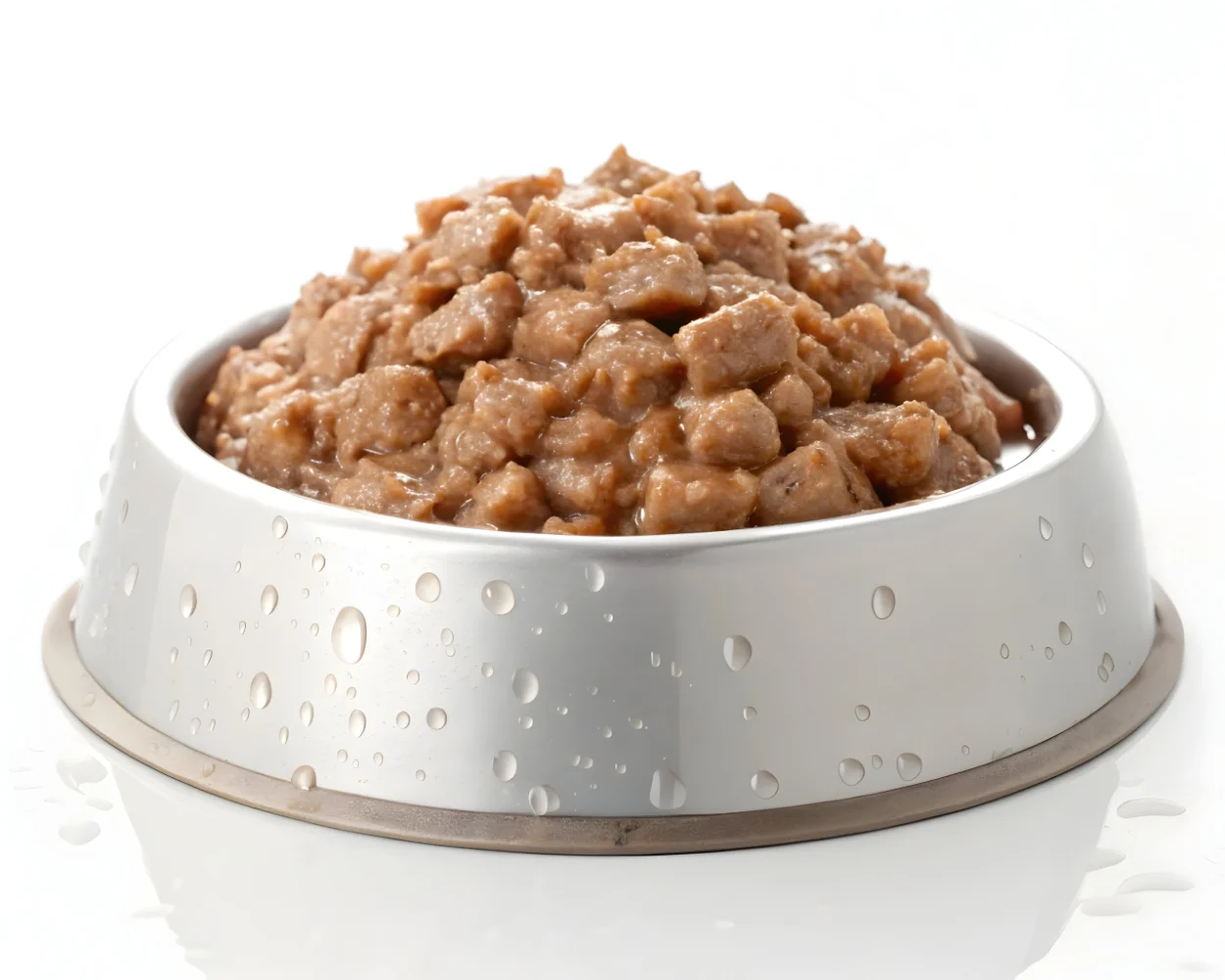
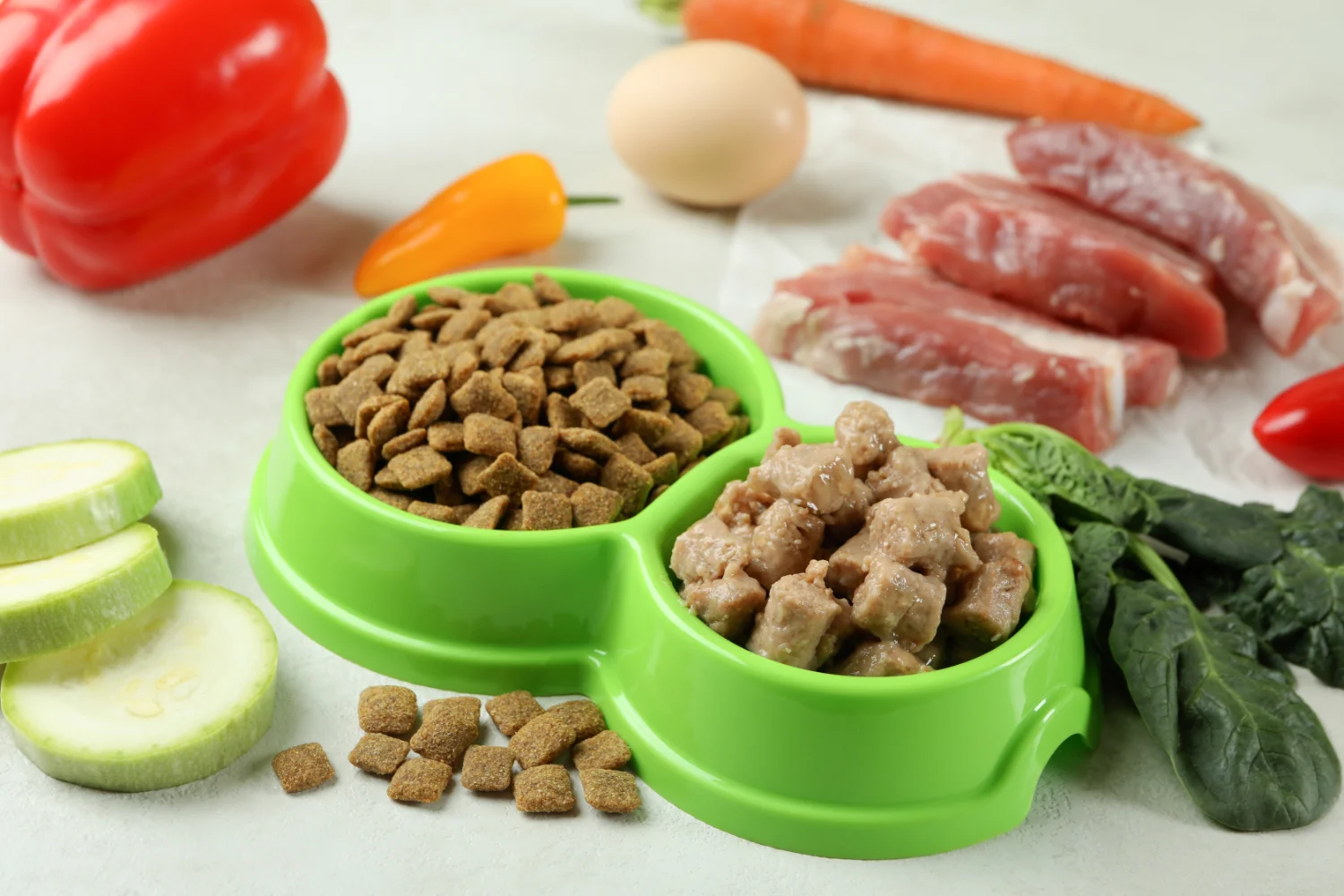
Dry pet foods carry fats, aromas, and textures that change with oxygen and moisture exposure. When oxygen enters, fats oxidize and aromas drift, which can present as “rancid” or “stale” smell and reduced palatability. When moisture enters, kibble can lose crunch, clump, or drift in texture and appearance. These changes often accelerate when the package has seal micro-leaks, because micro-leaks bypass the film barrier and create localized pathways for rapid ingress. Wet foods face a different engine. Shelf stability in wet formats depends on a controlled process and a package that survives it. Cans, trays, and retort pouches must maintain hermetic integrity after thermal processing and through distribution. A small seal defect can create swelling, leakage, or spoilage risk. This is why “barrier numbers” alone are not a complete predictor for wet foods. The correct question is whether the package can remain hermetically sealed after the intended time and temperature cycle and through handling. When buyers understand these two engines, they stop asking for one universal spec sheet and start asking for two different spec packages.
| Type de produit |
Typical failure signature |
Conducteur principal |
What specs must control |
| Dry food (kibble, freeze-dried diets) |
Stale aroma, rancidity, texture drift |
Oxygen + moisture + micro-leaks |
OTR/WVTR intent + seal integrity + after-opening use |
| Wet food (cans, trays, retort pouches) |
Leakers, swelling, seam failures |
Process + hermetic integrity |
Post-process seal performance + compatibility + abuse checks |
Preuves (source + année) : FDA, “Complete and Balanced Pet Food” (2020); ASTM F1927-20 scope statement noting oxygen transmission is measured at stated temperature and %RH and that humidity matters for many materials (2020).
Dry food packaging: what fails first and which specs actually predict shelf life?
Dry food packaging often fails quietly. The product still looks “fine,” but buyers complain about smell, palatability, or texture weeks later.
For dry foods, the strongest predictors are OTR and WVTR with stated conditions, seal integrity on finished packs, and an after-opening exposure plan when reseal features are used. Micro-leaks can erase barrier advantages.
Dry shelf life is a barrier-and-integrity system with real humidity conditions
Dry pet foods are sensitive to oxygen and moisture for different reasons. Oxygen exposure drives fat oxidation and aroma drift. Moisture exposure drives texture change, clumping, and palatability issues. A strong procurement habit is to demand barrier numbers, but many barrier numbers are incomplete without conditions. Humidity can change oxygen transmission behavior of some materials, which is why ASTM F1927 explicitly defines oxygen transmission at a given temperature and relative humidity. When buyers request OTR values without specifying humidity, they risk comparing values that do not reflect real storage conditions. Seal integrity must be included in the same spec package because micro-leaks can override even strong barrier films. Finished-pack leak screening and seal strength intent are practical requirements. Reseal adds another layer. A zipper helps only if it seals consistently over repeated openings. A dry food spec package should therefore include an after-opening simulation that reflects real use: repeated opening and closing over several days in a typical kitchen environment. Buyers that write these controls into RFQs reduce the most common dry food complaints: stale smell, rancidity, and loss of texture.
| Dry food risk |
What customers report |
Spec to request |
Validation to require |
| Oxydation |
Rancid or dull aroma |
OTR intent with stated %RH and temperature |
Storage study with sensory checkpoints |
| Absorption d'humidité |
Soft kibble, clumping |
WVTR intent with stated conditions |
Humidity exposure + texture check |
| Seal micro-leaks |
Fast staling, inconsistent lots |
Finished-pack seal integrity requirement |
Leak screening + seal strength sampling plan |
| After-opening drift |
“Went stale after opening” |
Reseal performance expectation |
Open-close simulation for defined cycles |
Preuves (source + année) : ASTM F1927-20 scope statement emphasizing OTR at stated temperature and %RH and that humidity affects many materials (2020); AAFCO consumer guidance, “Reading Labels,” highlighting the importance of matching nutritional needs and label clarity (accessed 2026).
Wet food packaging: where do failures happen and what specs are non-negotiable?
Wet food failures are often visible and expensive. Leakers, swelling, and seam failures can trigger returns and damage brand trust quickly.
Wet food packaging should be specified around post-process integrity: the package must hold hermetic seals after thermal processing and through distribution. Buyers should ask for post-retort seal strength, leak rate, burst, delamination resistance, and storage abuse checks.
Wet shelf stability depends on hermetic performance after processing and through handling
Wet foods are packaged for shelf stability through controlled processing and a package that survives the cycle. The package must remain hermetically sealed and mechanically stable through high temperature exposure and pressure changes. This is why the most meaningful specs for wet foods focus on post-process outcomes. Buyers should request seal strength after processing, leak screening after processing, and burst or deformation resistance under expected loads. Retort pouches introduce additional risks, such as delamination or layer separation if the structure is not compatible with the process. Trays and cups can fail at seal interfaces when sealing parameters drift or when seal contamination occurs. Cans can fail through seam defects or dents that compromise integrity during handling. A wet food RFQ should therefore define the process window (time and temperature range), require post-process integrity testing, and include storage abuse checks that reflect real distribution conditions. The procurement mindset should shift from “barrier film selection” to “package-process system validation.” As a flexible packaging manufacturer, we focus on repeatable sealing windows and finished-pack integrity because wet food outcomes are decided at seams and seals, not on a film datasheet.
| Wet format |
Panne la plus courante |
Spec to request |
What to check after processing |
| Retort pouch |
Seal leaks, delamination |
Retort compatibility + delamination resistance |
Leak screening + visual defect check |
| Tray or cup |
Lid seal failure |
Seal strength + sealing window intent |
Peel/seal strength + leak checks |
| Can |
Seam issues, dents, leakage |
Seam specs + handling durability |
Seam inspection + abuse handling review |
Preuves (source + année) : FDA, “Animal Food Labeling and Pet Food Claims,” noting labeling should include details necessary for safe and effective use (2025); FDA, “Pet Food” overview emphasizing truthful labeling and safety expectations for animal foods (2024).

If wet packs fail, focus the RFQ on post-process seal integrity and abuse checks
How should buyers request measurable barrier specs without creating false confidence?
Barrier specs can guide selection. Barrier specs can also mislead when test conditions are missing or when finished-pack integrity is not included.
Buyers should request barrier intent with stated conditions and require a verification ladder. For dry foods, humidity-aware OTR and WVTR intent matter. For wet foods, barrier discussion is secondary to hermetic integrity, but material properties still must fit the process.
Barrier intent must include test conditions and finished-pack reality
A barrier number is only meaningful when it is comparable and relevant. ASTM F1927 defines oxygen transmission at a stated temperature and relative humidity, which matters because humidity plays an important role for many materials. When buyers compare OTR values measured under different humidity conditions, they may select the wrong structure. The same risk exists for moisture barrier if WVTR values are not tied to clear conditions. The second risk is that barrier numbers usually describe flat film or material samples, while real packages have seals, folds, corners, and features that introduce leak paths. This is why barrier specs should be treated as intent, not as a guarantee. The RFQ should specify whether the measurement is material-level or finished-pack level, and it should require seal integrity verification. For dry foods, the most effective verification ladder includes material barrier reports, finished-pack leak screening, and a storage or aging plan that reflects expected shelf conditions. For wet foods, the ladder must include post-process integrity checks, because hermetic sealing and seam performance dominate outcomes. When buyers request barrier this way, they reduce false confidence and reduce overbuilding, because the pack is selected to prevent known failures, not to chase extreme numbers.
| Élément « Spec » |
Que faut-il écrire ? |
Pourquoi c'est important |
Ce qu'il faut vérifier |
| Objectif de l'OTR |
Target + temperature + %RH condition |
Humidity can change outcomes |
Comparable report + storage check |
| Objectif de WVTR |
Target + temperature/RH condition |
Texture stability is moisture driven |
Humidity exposure + texture check |
| Intégrité du joint |
Contrôle d'étanchéité + vérification de la résistance des joints |
Leaks override barrier |
Finished-pack sampling plan |
| Process compatibility (wet) |
Time/temperature window + acceptance |
Process drives integrity |
Post-process seal/leak + defect review |
Preuves (source + année) : ASTM F1927-20 scope statement on oxygen transmission at stated temperature and %RH and humidity significance (2020); FDA, “Animal Food Labeling and Pet Food Claims” (2025).
What should labels communicate to reduce misuse-driven complaints for both wet and dry diets?
Some shelf-life complaints are not packaging failures. They are handling and use failures. Labels can reduce those failures when they communicate intended use and storage clearly.
For both wet and dry foods, adequacy statements and life stage remain central trust cues. Clear storage and handling language supports safer and more consistent outcomes, especially after opening.
Label clarity reduces buyer risk and reduces preventable quality complaints
Buyers trust what they can verify. FDA explains that if a nutritional adequacy statement includes “complete and balanced,” the product is intended to be fed as a pet’s sole diet. This statement is a high-trust cue because it is standardized in meaning and linked to intended use. AAFCO consumer guidance also emphasizes label reading and life-stage framing as key to matching a pet’s needs to a product. These cues matter for both wet and dry diets. Wet food buyers often want portion guidance and safe storage information after opening because refrigerated handling affects quality and safety perception. Dry food buyers often need clear storage advice to avoid moisture pickup after opening. FDA also states that animal food labels should include details necessary for safe and effective use, which supports the inclusion of feeding directions, handling, and storage guidance. When these label elements are clear and readable, complaints shift away from “misleading” or “confusing” and toward truly product-specific issues. This is why labeling should be treated as part of shelf-life control. A label that supports correct use often protects brand trust as much as any barrier upgrade.
| Élément « label » |
Why it reduces complaints |
Wet food emphasis |
Dry food emphasis |
| Adéquation + étape de la vie |
Reduces feeding risk |
Confirm diet intent clearly |
Confirm diet intent clearly |
| Feeding directions |
Sets correct usage |
Portion logic and schedule clarity |
Portion logic and transition guidance |
| Storage and handling |
Reduces misuse-driven quality drift |
After-opening refrigeration guidance |
Moisture control after opening |
Preuves (source + année) : FDA, “Complete and Balanced Pet Food” (2020); FDA, “Animal Food Labeling and Pet Food Claims” (2025).
How does e-commerce change the “winner” spec set for wet and dry?
E-commerce adds route stress. The package must survive drops, vibration, and compression that are less common in shelf-only distribution.
For dry foods, parcel routes amplify corner leaks, zipper failures, and pinholes. For wet foods, parcel routes amplify dented cans, tray or pouch punctures, and secondary packaging dependence. Buyers should require a route validation ladder.
Route stress makes seals and case packs as important as barrier and process
Channel stress changes the decision because it introduces physical hazards. Dry foods often fail e-commerce through seal creep under compression, abrasion pinholes, and zipper drift, which can create micro-leaks and fast staling. Wet foods often fail e-commerce through dented cans, cracked trays, punctured pouches, and seal edge damage. These failures can happen even when the product and package meet shelf-life requirements in a calm retail environment. The most practical buyer request is a route validation ladder. It should include single-pack checks, case-pack checks, and worst-case pack-out checks. It should also include clear acceptance criteria, such as “no leaks,” “no seal breaks,” and “no cosmetic damage beyond defined limits.” This approach prevents the common mistake of overbuilding the primary pack while ignoring the case pack. In many returns, the secondary packaging and pack-out method decide damage outcomes more than the primary format.
| Channel stress |
Dry food failure pattern |
Wet food failure pattern |
Éléments à valider |
| Parcel delivery |
Corner leaks, zipper drift, pinholes |
Dents, punctures, seal damage |
Single pack + case pack + worst-case pack-out |
| Club/wholesale |
Compression-induced seal creep |
Stack load deformation |
Compression conditioning + re-test |
| Rayon de vente au détail |
After-opening drift |
Handling and storage misuse |
Reseal simulation + storage guidance review |
Preuves (source + année) : FDA, “Animal Food Labeling and Pet Food Claims” (2025); ASTM F1927-20 scope statement for humidity-relevant OTR (2020).
Conclusion
Wet and dry pet foods fail shelf life differently. Buyers should request two spec packages: barrier-and-integrity specs for dry foods and post-process hermetic integrity specs for wet foods, with label clarity and channel validation built into the RFQ.
Get a wet vs dry RFQ spec checklist
À propos de nous
Nom de marque : Jinyi
Slogan : Du film au produit fini - bien fait.
Site web : https://jinyipackage.com/
Notre mission :
JINYI is a source manufacturer specializing in custom flexible packaging solutions. We aim to deliver reliable, practical packaging so brands reduce communication cost, achieve predictable quality, and align packaging performance with real shelf and route conditions.
À propos de JINYI :
JINYI est un fabricant spécialisé dans les solutions d'emballage flexible sur mesure, avec plus de 15 ans d'expérience de production au service des marques de produits alimentaires, de snacks, d'aliments pour animaux de compagnie et de produits de consommation courante.
Nous exploitons un site de production standardisé équipé de plusieurs lignes d'impression par héliogravure ainsi que de systèmes d'impression numérique HP avancés, ce qui nous permet de répondre à la fois à des commandes stables de gros volumes et à des tirages courts flexibles avec une qualité constante.
De la sélection des matériaux aux sachets finis, nous nous concentrons sur le contrôle des processus, la répétabilité et la performance dans le monde réel. Notre objectif est d'aider les marques à réduire les coûts de communication, à obtenir une qualité prévisible et à s'assurer que l'emballage fonctionne de manière fiable en rayon, en transit et lors de l'utilisation finale.
FAQ ?
What is the biggest shelf-life driver for dry pet food packaging?
Oxygen and moisture ingress are the biggest drivers, and seal micro-leaks can override barrier films. Buyers usually need OTR/WVTR with stated conditions plus finished-pack integrity requirements.
What is the most important spec for wet pet food packaging?
Post-process integrity is the core. Buyers should focus on seal strength and leak screening after processing, plus burst and defect checks tied to the process window.
Why should OTR values include humidity conditions?
ASTM F1927 measures oxygen transmission at a stated temperature and %RH and notes humidity can materially affect oxygen transmission for many materials, so conditions matter for comparability.
Why do e-commerce complaints look different from retail complaints?
Parcel routes add drops, vibration, and compression. Dry foods see more corner leaks and zipper drift, while wet foods see more dents and punctures. Case-pack validation becomes more important.
Which label elements reduce “misuse-driven” complaints?
A clear adequacy statement and life-stage fit reduce feeding risk, and clear handling and storage guidance supports safe and effective use, especially after opening.