Fornecedores de embalagens de café: Um guia completo para qualidade, MOQ e prazos de entrega

A JINYI partilha orientações práticas sobre embalagens para as suas decisões.
Choosing the wrong coffee packaging supplier doesn’t just cost you money — it can delay your launch, compromise your product’s freshness, and leave you with stock that doesn’t reflect your brand.
For most coffee and tea brands, the supplier selection process raises the same questions: What should I actually be comparing? What MOQ am I looking at? How long will production take? And what do I need to ask before I commit?

This guide walks you through every stage of that decision — clearly and in the right order. If you’re ready to explore your options now, take a look at our coffee and tea packaging solutions before you start.

Principais conclusões

  • Evaluate suppliers on sample quality, communication speed, and certifications — not just unit price.
  • Pick your pouch format based on your product type, sales channel, and brand positioning before contacting a supplier.
  • Use high-barrier materials for coffee and tea — oxygen and moisture control directly affect freshness and shelf life.
  • Plan for MOQs starting from 500 pieces for digital print, and 3,000+ for gravure — depending on format and volume.
  • Build at least 8 weeks into your launch timeline from first contact to delivery — more if it’s your first order.
  • Prepare a list of key questions before committing — the right supplier will answer them clearly and quickly.
  • Always order a physical sample before full production — it’s the single most effective way to avoid costly surprises.

What to Look for in a Coffee Packaging Supplier

There’s no shortage of packaging suppliers willing to quote you a low price. The harder part is finding one who delivers consistent quality, keeps your timeline on track, and communicates clearly when something needs to change. That gap — between a cheap quote and a reliable partner — is where most first-time buyers get burned.

Here’s what actually separates a good supplier from a risky one:


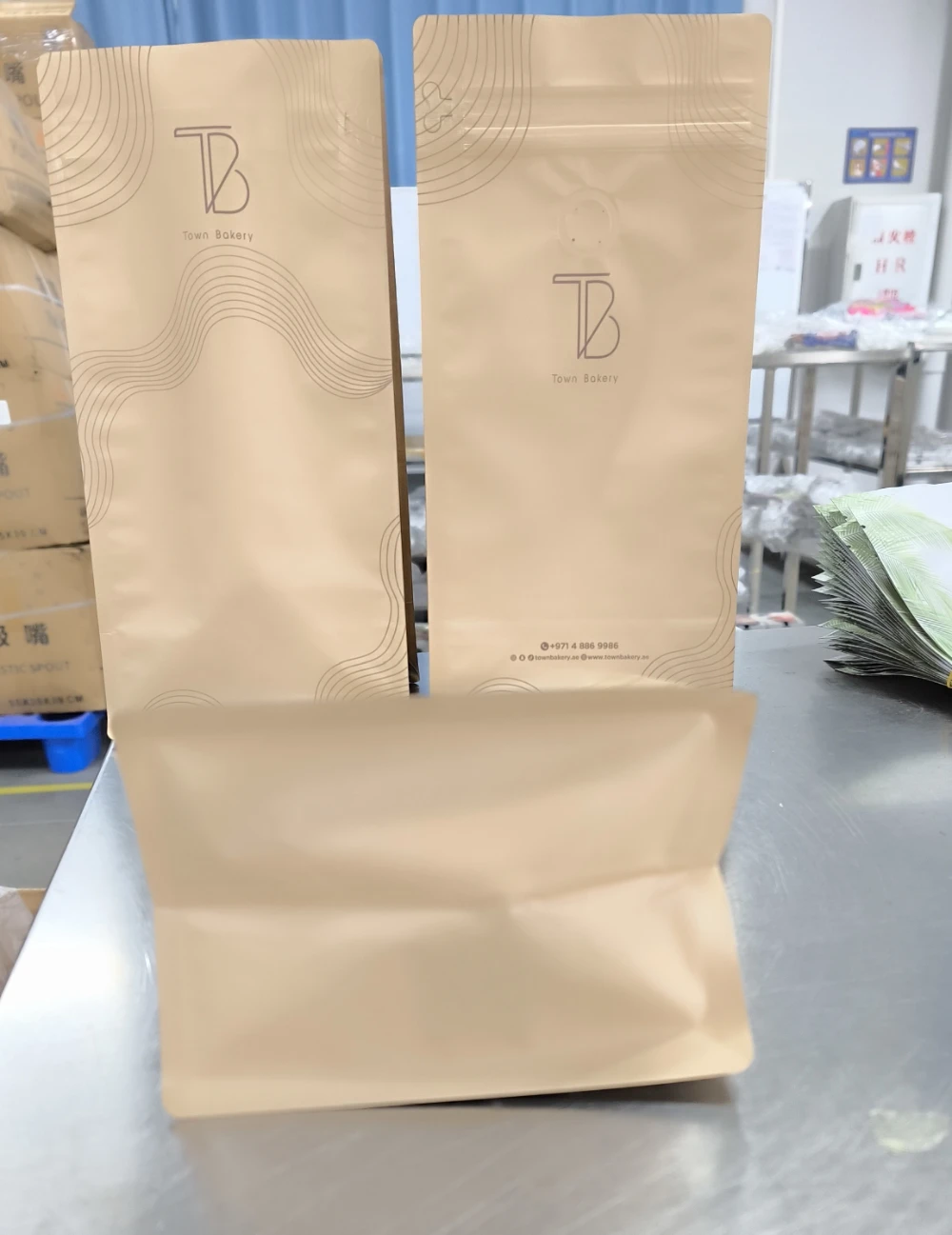
sacos de café com fundo plano personalizados, produzidos na fábrica da JINYI — prontos para a inspeção de qualidade
Estes são sacos de café com fundo plano personalizados, recém-saídos da linha de produção da fábrica da JINYI — cada lote passa pelo nosso processo de controlo de qualidade antes da embalagem e do envio.
What to Evaluate What to Look For Porque é que é importante
Sample quality Request a printed sample with your actual artwork Colour accuracy and print registration reveal production capability
Response time How quickly do they respond to a detailed enquiry? Slow pre-sales communication predicts slow problem resolution later
Certifications ISO, food-contact certification, ink migration test reports Required for compliance in most major markets
Print capability Do they run both gravure and digital printing? You need both options as your brand grows and volume changes
Category experience Have they worked with coffee or tea brands before? Category-specific experience reduces back-and-forth on specs
QC process How do they handle colour deviation or seal defects? You need to know their process before problems happen, not after
Transparency on lead time Do they give you a clear, stage-by-stage timeline? Vague timelines almost always lead to missed launch dates

A useful rule of thumb: if a supplier can’t give you clear answers to your material and certification questions within 24–48 hours, that’s a signal worth taking seriously.

Nota: Don’t select a supplier based on price alone. A slightly higher unit cost from a supplier with strong QC and clear communication almost always works out cheaper in the long run.

Pouch Types for Coffee and Tea Packaging

Before you brief a supplier, you need to know which format you’re ordering. The right choice depends on your product type, your sales channel, and what your brand needs to communicate on shelf.

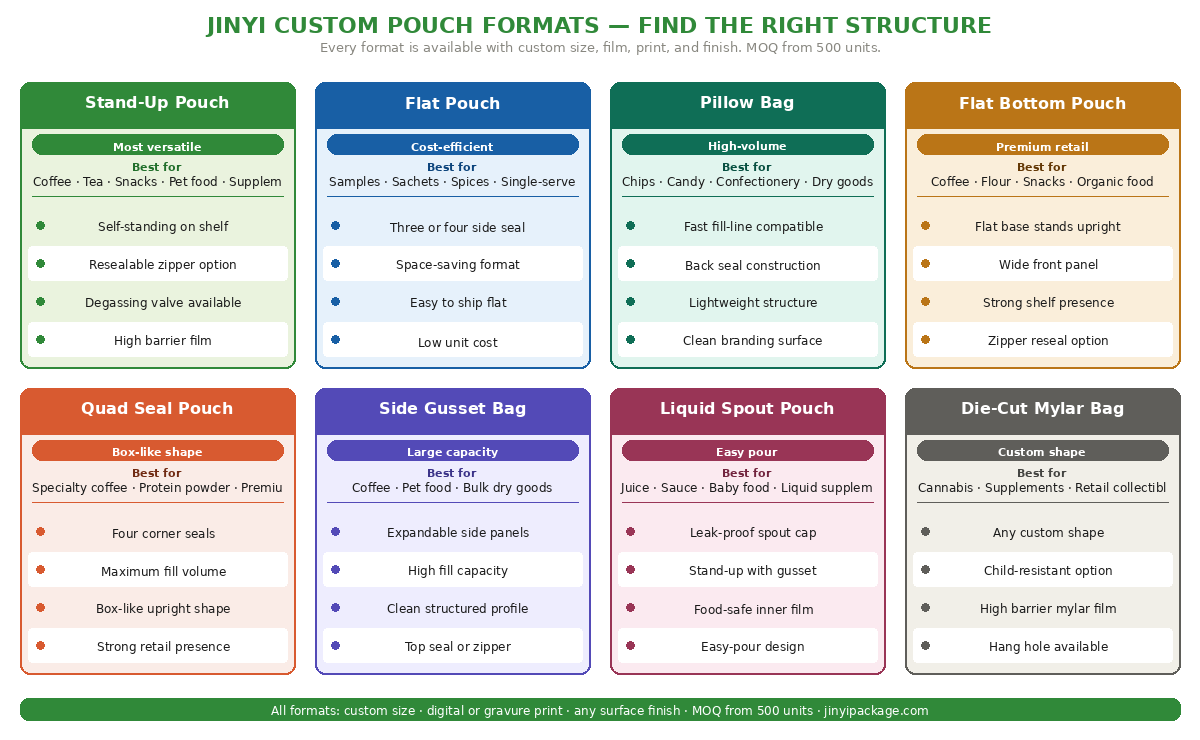
JINYI custom pouch format guide showing stand-up pouch flat pouch pillow bag flat bottom pouch quad seal side gusset liquid spout and die-cut mylar bag with use cases and key features

Formato Melhor para Key Advantage Watch Out For
Bolsa de pé Whole beans, ground coffee, loose leaf tea Versatile, lower MOQ, wide material options Less stable when partially empty
Saco de fundo plano Premium coffee, specialty retail, gift positioning Maximum shelf presence, large branding surface Higher unit cost, higher MOQ
Flat pouch / 3-seal Tea bags, single-serve drip packs, sample packs Compact, cost-efficient for small portions Smaller print area, no self-standing
Saco com reforço lateral Large-format coffee (1kg+), wholesale supply High capacity, strong structure for heavy fills Bulkier, less suited to small SKUs

For most new coffee and tea brands, the bolsa de pé is the most practical starting point. It gives you flexibility on order size, a wide range of materials and finishes, and a format that both retail buyers and online shoppers are comfortable with.

Sugestão: If you’re launching multiple SKUs, keep the same bag structure across the range. Varying artwork is far easier to manage on a first order than mixing formats.

Materials and Barrier Requirements for Coffee Packaging

Coffee is sensitive to oxygen, moisture, light, and its own off-gassing — and the wrong material choice can shorten shelf life, affect flavour, and damage your brand’s reputation with customers.

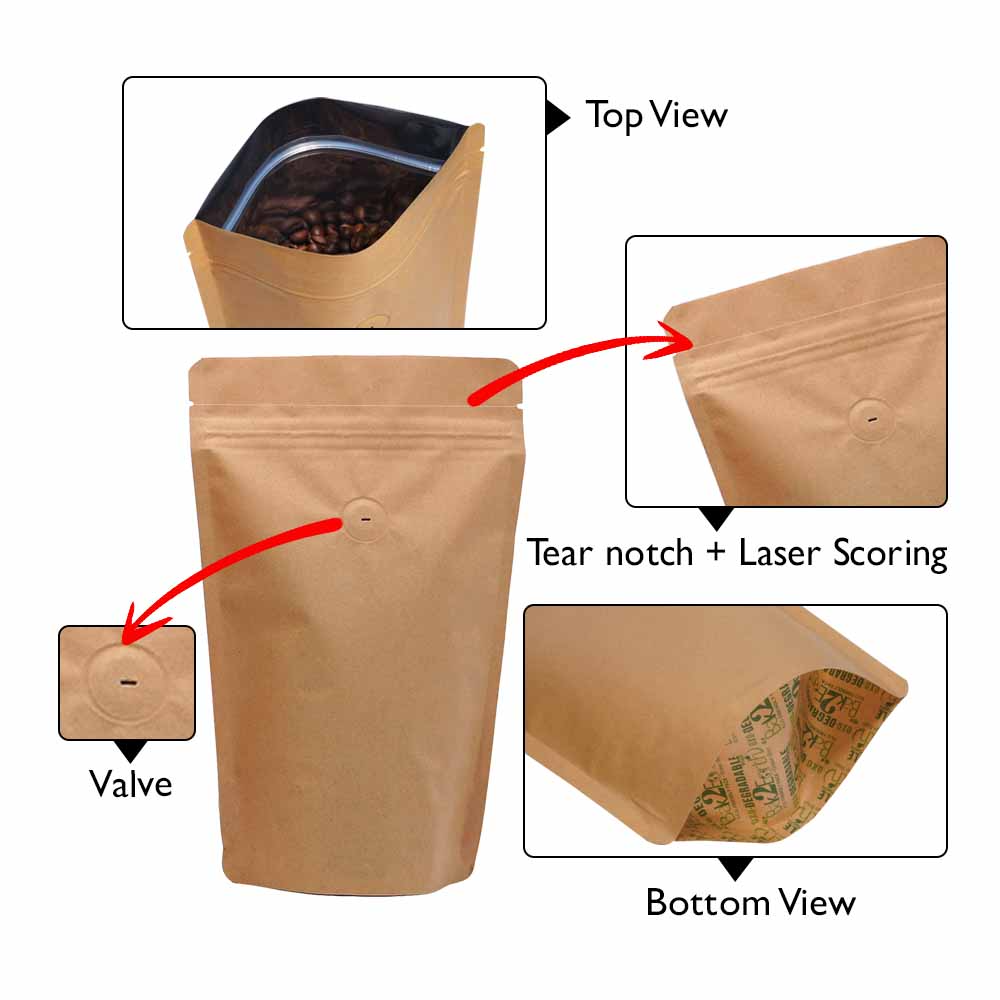
custom kraft stand-up pouch with one-way valve — coffee packaging MOQ guide

Material Nível de barreira Prazo de validade Objetivo Estética da marca
Full Aluminium Foil Highest 12-24 meses Metallic, opaque — strong print contrast
Kraft + Foil Liner Elevado 12-18 meses Natural, earthy — popular with specialty and artisan brands
VMPET (Metalized PET) Médio-Alto 12 meses Shiny metallic finish at lower cost than foil
Matte OPP Médio 6–9 months Soft-touch, clean — suits boutique and lifestyle brands
Kraft + Window Medium (reduced at window) 6-12 meses Natural look with product visibility — popular for loose leaf tea

For most coffee brands, full aluminium foil or kraft + foil liner are the safest starting points. One detail often overlooked: the one-way degassing valve. Freshly roasted coffee releases CO₂, and without a valve, pressure builds up and can compromise the seal over time.

Sugestão: Lock in your material choice before finalising your artwork. The material affects print finish, colour output, and how the bag feels in hand.

MOQ and Pricing: What First-Time Buyers Should Expect

MOQ isn’t a fixed number — it varies by format, print method, material structure, and pouch size. Understanding how MOQ works helps you choose the right supplier for your current stage of growth.

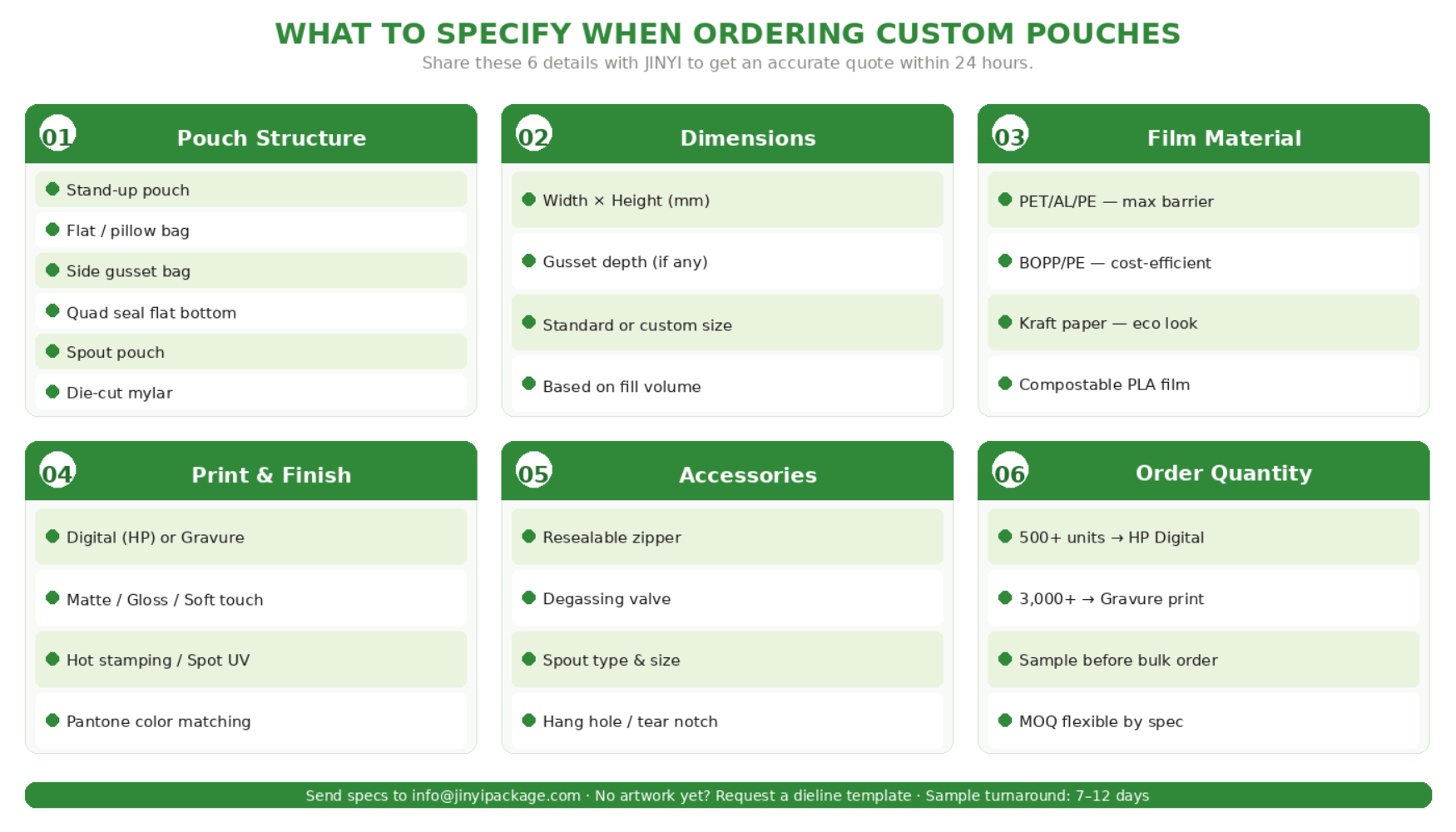
JINYI custom pouch ordering checklist showing 6 specification steps — pouch structure dimensions film material print and finish accessories and order quantity

Formato Método de impressão MOQ típico Melhor para
Bolsa de pé Impressão digital 500 - 1.000 unidades New brands, multiple SKUs, product testing
Bolsa de pé Impressão de gravura 3.000 - 5.000 unidades Marcas estabelecidas com procura confirmada
Saco de fundo plano Digital ou gravura 1.000 - 3.000 unidades Marcas de retalho premium com maior volume
Flat pouch / 3-seal Digital ou gravura 1.000 - 3.000 unidades Single-serve formats, sample packs, tea bags

Digital printing has lower setup costs and no plate fees — right for first orders. Gravure delivers lower per-unit cost at scale once demand is stable. Most brands start with digital and transition to gravure as volume grows.

Sugestão: When comparing quotes, make sure you’re comparing like for like — MOQ, print method, material, plate fees, and whether samples are included all affect total cost.

Lead Times and How to Plan Around Your Launch Date

Underestimating lead time is one of the most common — and most preventable — mistakes on a first packaging order. Here’s a realistic breakdown of every stage:

Estágio Duração típica O que acontece
Confirmação do orçamento e das especificações 2 - 5 dias Share requirements; supplier confirms specs, MOQ, and pricing
Aprovação da linha de base e do trabalho artístico 3 - 7 dias Supplier sends dieline; designer applies artwork; you approve
Sample production 7 - 15 dias Physical sample produced and shipped to you
Sample review and approval 3 - 7 dias Check colour, zipper, valve, seal — approve or revise
Full production 15 – 25 days Mass production run completed and QC checked
Shipping 7 – 35 days Depends on destination and method (air vs sea)

Total: expect 8–12 weeks from first contact to delivery. The biggest time risk isn’t production — it’s artwork revision loops. Every round adds 3–7 days.

Sugestão: Work backwards from your launch date to find the latest artwork approval date — then aim to approve two weeks before that.

Perguntas a fazer antes de se comprometer com um fornecedor

A short but well-targeted list of questions will tell you most of what you need to know. How quickly and clearly they answer is itself part of the evaluation.

Questão What You’re Really Checking
Podem fornecer certificação de contacto com alimentos para a camada interior? Compliance readiness and documentation transparency
Qual é a vossa norma de tolerância de cor para as séries de produção? Print consistency across batches
Como é que trata os defeitos ou desvios de cor após a entrega? Se têm um processo claro de controlo de qualidade e de resolução
Can you confirm the production timeline in writing? Compromisso de cumprimento das datas de entrega
Apoiam a impressão digital e a rotogravura? Long-term scalability as your volume grows
Can I consolidate multiple SKUs to meet MOQ? Flexibility for brands launching with multiple variants
What does your sample process look like? Se as amostras são uma parte normal do seu processo
Nota: Don’t skip the sample step even if your timeline feels tight. Fixing a problem at sample stage costs a fraction of what it costs after 3,000 bags have been printed.

Ready to Find the Right Coffee Packaging Supplier?

The right supplier makes the whole process easier — from spec confirmation to sample approval to on-time delivery. The wrong one costs you time, money, and launch momentum you can’t get back.

If you’re ready to get a quote, request a sample, or just want to talk through your options, our team is here to help you make the right call — clearly and without the guesswork.

Obter um orçamento gratuito →

About JINYI Packaging

JINYI specialises in custom flexible packaging for coffee, tea, food, pet food, and consumer goods brands. With over 15 years of production experience, we support both large-volume runs and small-batch custom orders through our gravure printing lines and HP digital printing system.

From material selection to finished packaging — done right. Learn more at jinyipackage.com.

Elsa - Author
Elsa

Gestor de Desenvolvimento Comercial - Embalagens JINYI

A Elsa lidera o desenvolvimento comercial e a gestão de encomendas de clientes na JINYI. Com 8 anos de experiência em comércio externo em Yiwu e Dongguan, tem um conhecimento profundo da procura do mercado e do que os compradores realmente precisam - transformando a visão real do cliente nas decisões corretas de embalagem.
Necessidades dos clientes
Gestão de encomendas
Desenvolvimento de negócios

FAQ

What should I look for when choosing a coffee packaging supplier?

Look beyond unit price. Evaluate sample quality, response speed, food-contact certifications, print capability, and how clearly they explain their QC process. A supplier who answers quickly and provides documentation without being chased is a strong indicator of reliability during production.

What is the typical MOQ for custom printed coffee pouches?

MOQ depends on your format and print method. Digital print stand-up pouches typically start from 500–1,000 pieces. Gravure print and premium formats like flat bottom bags usually require 3,000 pieces or more. Contact your supplier with your full spec for a confirmed figure.

Which packaging material is best for coffee?

For most coffee brands targeting a 12+ month shelf life, full aluminium foil or kraft + foil liner are the strongest choices. For shorter shelf life products, VMPET is a cost-effective alternative that still delivers solid barrier performance.

How long does it take to produce custom coffee packaging?

From artwork approval, most orders complete production in 15–25 days. Including sample review and shipping, first-time buyers should plan for 8–12 weeks from first contact to delivery.

Do I need a one-way valve on my coffee pouch?

Yes, if you’re packaging freshly roasted coffee. Freshly roasted beans release CO₂, and without a valve, pressure builds up and can compromise the seal. Both stand-up pouches and flat bottom bags support one-way valve fitment.

Is digital printing or gravure printing better for coffee packaging?

Digital printing is better for first orders and multiple SKUs at low volume — lower setup cost, no plate fees. Gravure delivers superior colour consistency and lower per-unit cost at scale. Most brands start with digital and transition to gravure as volume grows.

Can I order samples before committing to full production?

Yes — and we always recommend it. A physical sample lets you verify colour accuracy, material feel, zipper function, and seal integrity before committing to a full run. Sample lead time is typically 7–15 days.