Material de rolo de alto desempenho construído para velocidade, consistência e produção escalável de embalagens.
Saco de Mylar cortado
Presença de grande impacto nas prateleiras com uma forte barreira de proteção para manter os produtos frescos e em conformidade com as normas.
Bolsas planas
Um formato económico e economizador de espaço que proporciona um desempenho de selagem fiável para a venda a retalho e expedição diária.
Bolsas com bico para líquidos
Embalagem resistente a fugas e fácil de verter que aumenta a comodidade do utilizador e reduz a confusão na entrega.
Embalagem de sacos de almofadas
Embalagem tipo saqueta, leve e rápida de embalar, ideal para produtos de grande volume e para uma marca limpa.
Bolsa Quad Seal
Estabilidade semelhante à de uma caixa com um atrativo de prateleira de primeira qualidade - óptima para enchimentos mais pesados e um aspeto mais “vertical”.
Sacos com reforço lateral
Sacos de grande capacidade e eficientes em termos de espaço que maximizam o volume de enchimento, mantendo uma forma limpa e estruturada.
Bolsas de pé
Um dos formatos de crescimento mais rápido, que combina uma forte exposição nas prateleiras, um custo de transporte mais baixo e uma grande proteção da frescura.
Sacos de fundo plano
Caixa de jóias tipo gaveta
Caixas de jóias com gaveta para um desempacotamento de qualidade e uma proteção rígida.
Caixa de jóias com tampa flip-top
Caixas de jóias flip-top com construção rígida e apresentação de luxo.
Estojo rígido retrátil de duas peças
Caixas rígidas de duas peças para uma proteção e apresentação de luxo.
Caixas de correio
Caixas de correio em cartão canelado para um envio seguro e um desempacotamento com marca.
Caixas de exposição
Caixas de exposição personalizadas para vendas ao balcão e grande visibilidade nas prateleiras.
Caixas de oferta
Caixas de oferta personalizadas com estrutura e opções de acabamento premium.
Caixas de embalagem com manga
Caixas de manga com invólucros impressos para uma marca flexível.
Caixa inferior com fecho automático
Caixas de fundo com fecho automático de montagem rápida para retalho e comércio eletrónico.
Caixa de fundo com fechadura
Caixas de fundo com fecho para uma embalagem rápida e um forte suporte de carga.
Caixas de extremidade de dobragem reta
Caixas com extremidades rectas para um fecho perfeito e exposição a retalho.
Saco de papel personalizado
Sacos de oferta de papel personalizados com pegas fortes e impressão nítida da marca.
Copos para frio em PET transparente
Copos frios PET transparentes para bebidas geladas - transparentes, robustos e resistentes a fugas.
Saco de oferta personalizado
Sacos de oferta de papel personalizados com pegas fortes e impressão nítida da marca.
Copo de papel
Copos de papel para bebidas quentes com fixação confortável e impressão limpa e consistente.
Bolsas planas para cannabis
Bolsas planas para cannabis com barreira elevada e espaço livre para rotulagem.
Sacos Mylar para ervas daninhas
Sacos de mylar para ervas daninhas com barreira forte, fechos de correr e opções de controlo de odores.
Caixas de lata personalizadas
Caixas de estanho personalizadas para uma proteção premium, reutilização e impressão a cores.
Etiquetas de manga retrátil
Etiquetas de manga retrátil com cobertura de 360° e impacto na prateleira.
Etiquetas em rolo personalizadas
Rótulos em rolo personalizados para uma aplicação rápida e uma rotulagem consistente da marca.
Autocolante cortado
Autocolantes cortados com arestas limpas e opções de materiais duradouros.
Folhas de autocolantes Kiss Cut
Folhas de autocolantes cortadas à mão para desenhos flexíveis e fáceis de descolar.
A JINYI partilha orientações práticas sobre embalagens para as suas decisões.
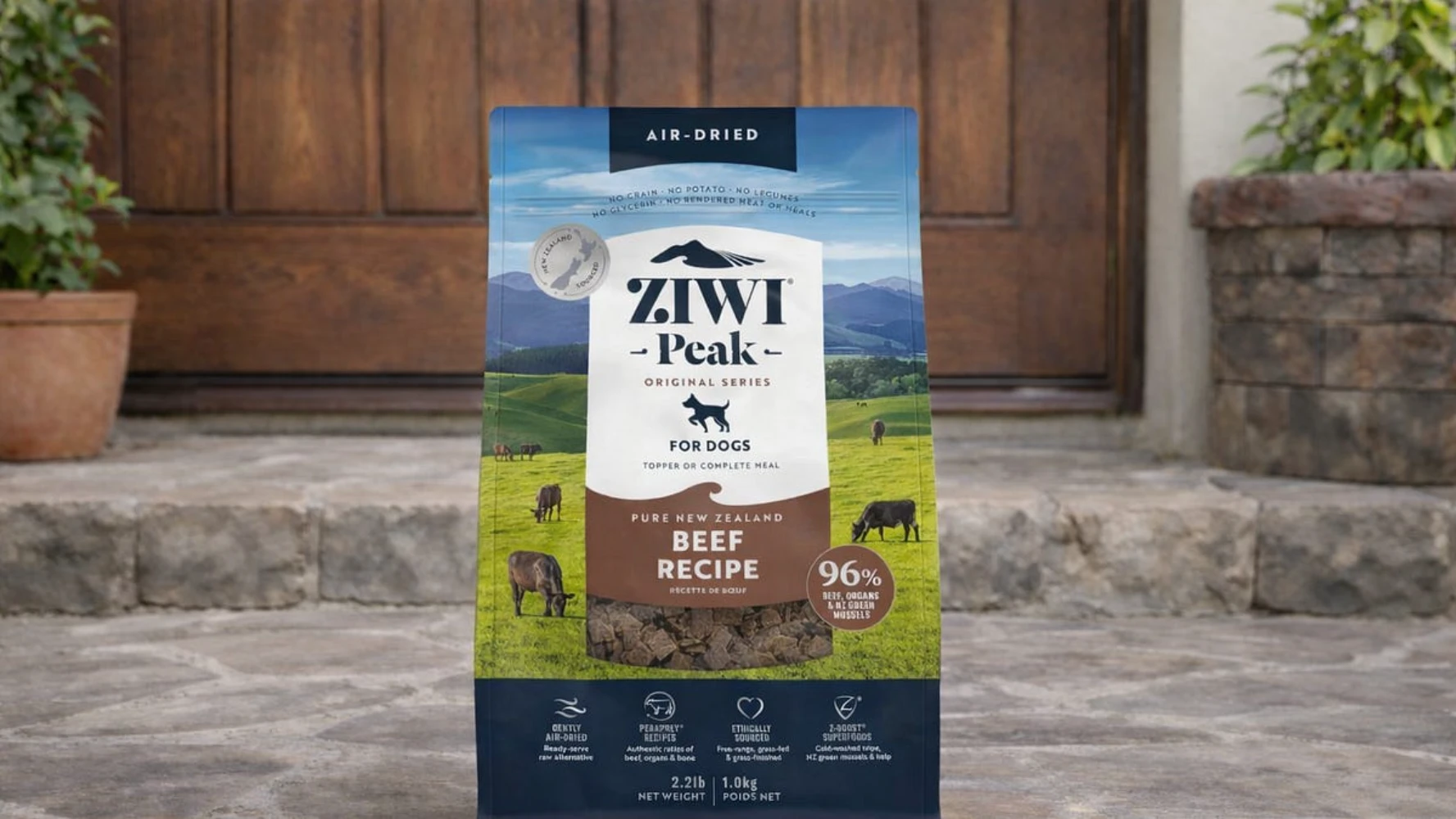
ZIWI Peak is a New Zealand premium pet food brand founded in 2002 by Peter Mitchell, a free-range deer farmer who had been supplying meat to pet food companies and decided to build his own. The brand is built around a single core claim: air-dried food that delivers the nutritional profile of a raw diet without requiring refrigeration or raw food handling. Every ZIWI Peak recipe is formulated with a minimum of 96 percent meat, organs, bone, and seafood — all ethically sourced from New Zealand farms and oceans — and processed through a proprietary twin-stage air-drying method that removes moisture at low temperatures without destroying heat-sensitive nutrients. ZIWI Peak is now sold across more than 25 countries, and in 2021 was acquired by China-based private equity firm FountainVest Partners in a deal reported at approximately NZD 1.5 billion.
That product story creates a specific packaging challenge. Air-dried food sits in a different technical category from conventional dry kibble — it is not extruded and low-moisture in the same way, and its high fat content combined with a 14 percent residual moisture level creates a product that is more sensitive to oxygen and humidity ingress than a standard grain-heavy recipe. The packaging has to hold a 21-month shelf life across a distribution chain spanning multiple continents, climate zones, and retail environments. At the same time, the product’s visual appeal — chunky, meat-textured pieces that look nothing like a standard kibble pellet — is something the brand wants consumers to see before they buy. Those two requirements together drive a packaging specification that is worth understanding in detail.
What ZIWI Peak Is and Why Air-Drying Changes the Packaging Equation
To understand why ZIWI Peak’s packaging is specified the way it is, it helps to understand what air-drying actually does to the product — and how it differs from the other processing methods competing in the premium pet food category.
Conventional dry kibble is extruded: raw ingredients are cooked under high heat and pressure, then shaped into pellets and dried to a very low moisture content — typically 8 to 10 percent. The low moisture and low water activity make the product inherently shelf-stable, and the starch-heavy formulation (which binds the extrusion) results in a relatively low-fat product. The packaging barrier requirements for this format are modest.
Freeze-dried pet food goes to the opposite extreme: raw ingredients are frozen and then moisture is removed by sublimation under vacuum at very low temperatures, producing a product with less than 3 percent moisture. The ultra-low moisture content gives it extreme shelf stability, but the process is energy-intensive and expensive, and the product format — brittle, fragile pieces — requires packaging that protects against physical damage as well as oxygen and moisture ingress.
ZIWI Peak’s twin-stage air-drying sits between these two approaches. The process circulates warm air gently around the raw ingredients over an extended period, reducing moisture to approximately 14 percent — higher than kibble, much higher than freeze-dried. The result is a product that is shelf-stable without refrigeration, retains the textural integrity of the raw meat, and has a calorie density significantly higher than kibble (approximately 4,900 kcal ME/kg for the beef recipe, compared to roughly 3,500–3,800 kcal ME/kg for a typical premium kibble). The minimum 30 percent crude fat content in ZIWI Peak recipes reflects the high animal ingredient ratio and is the primary driver of the packaging barrier specification.
This is the key point that separates air-dried pet food packaging from conventional kibble packaging: the combination of 30 percent minimum fat, 14 percent residual moisture, and a 21-month target shelf life across a global distribution chain demands a barrier film performance level that most standard pet food packaging films cannot reliably sustain. For comparison, ORIJEN’s packaging specification — another high-fat, high-protein format — faces a similar barrier challenge from a different processing angle. In both cases, the product drives the packaging requirement, not the other way around. For brands building pet food packaging from the ground up, the custom pet food packaging guide covers the full decision framework — from format selection through barrier specification — and is a useful reference before entering a factory conversation.
Do ponto de vista da produção: Air-dried pet food at 14 percent moisture is more sensitive to humidity ingress than extruded kibble at 10 percent, because the higher residual moisture creates more headroom for mold development if the barrier is compromised. The packaging specification for this format needs to account for both oxygen transmission (fat oxidation) and moisture vapor transmission (mold risk and texture degradation) across the full 21-month shelf life.
The Format Decision: Flat-Bottom Pouch, Clear Window, and What Each Element Is Doing
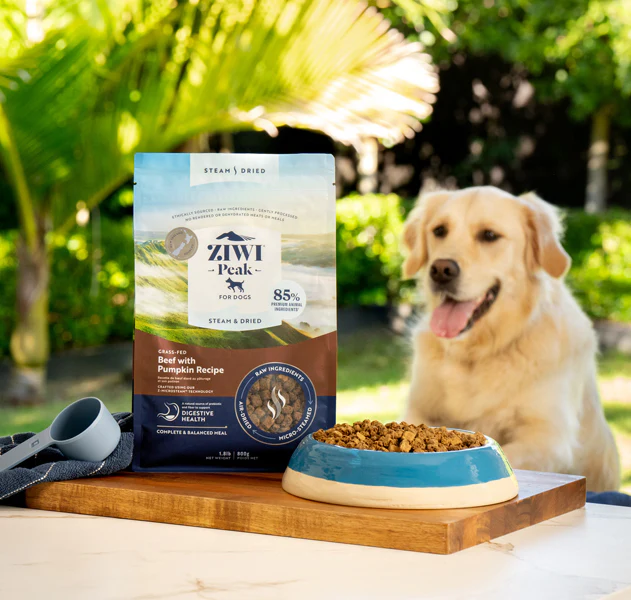
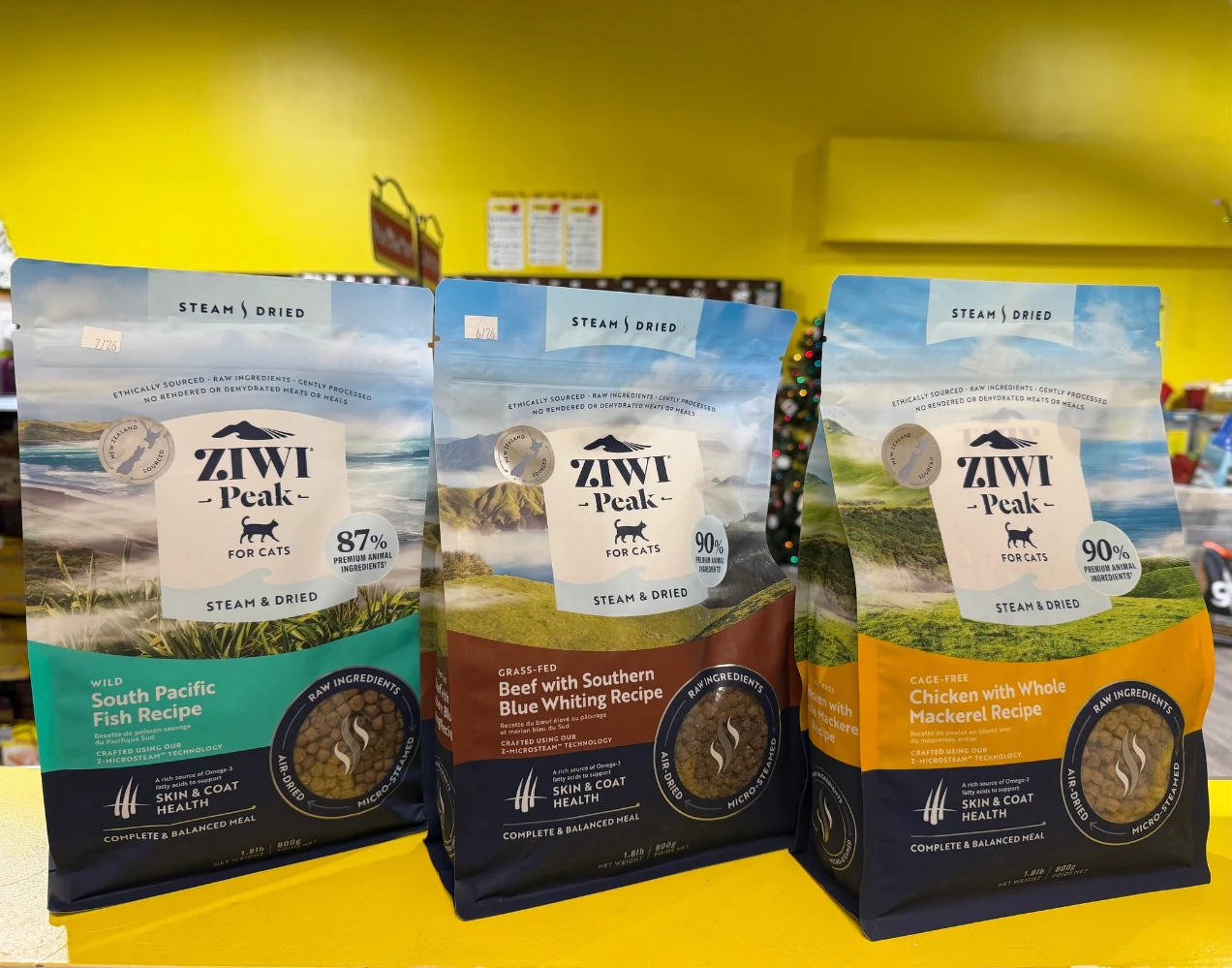
ZIWI Peak’s primary packaging format is a flat-bottom stand-up pouch — a format that sits squarely at the intersection of retail shelf performance and premium brand positioning. The flat bottom allows the bag to stand stably on a shelf without leaning or collapsing, which is a functional advantage in a retail environment where a bag that leans reads as lower quality than one that holds its shape. The flat base also provides a larger printable surface area relative to the bag’s height compared to a standard stand-up pouch with a pinch bottom, which matters when the brand’s visual system relies on full-width landscape photography wrapping around the pack.
The size range spans from a 3.5oz trial bag — a format designed to lower the entry barrier for first-time buyers at a price point that reduces trial risk — through to a 35.2oz large bag for established users with consistent purchase behavior. This range is not arbitrary. The trial size is a deliberate conversion tool: it allows pet owners to test whether their dog or cat accepts the texture and flavor of air-dried food without committing to a large bag. For a product priced at the premium end of the category, reducing the financial risk of first purchase is a meaningful commercial decision expressed in packaging format.
The clear product window is the most distinctive structural feature of ZIWI Peak’s packaging and the one that directly reflects the product’s visual differentiation from conventional kibble. Air-dried pet food looks fundamentally different from an extruded pellet — the pieces are irregular in shape, chunky, and visibly meat-textured in a way that communicates real ingredient quality to a consumer who has been trained to expect uniform brown pellets. Showing that product through a window before purchase is a trust-building mechanism that works in a category where the visual gap between what is on the label and what is in the bag has historically been wide.
The window is deliberately sized to be small relative to the total bag surface. This is a considered decision: a large window reduces the total area of high-barrier laminate film on the bag, which would compromise the overall oxygen and moisture transmission performance of the package. A small window — sufficient to show the product, insufficient to meaningfully degrade the package’s barrier performance — achieves the commercial goal without the technical trade-off. The window material is a transparent film (typically clear PET or CPP) with lower barrier properties than the aluminum foil or metallized laminate used in the main body of the bag. Because the window represents a small fraction of the total bag surface area, its contribution to overall OTR is proportionally small and does not materially affect the package’s shelf life performance.
The resealable press-to-close zipper at the top of the bag serves a specific functional purpose for this product. ZIWI Peak recommends using the food within 8 weeks of opening — a tighter window than most dry kibble, reflecting the higher residual moisture and fat content that makes the product more susceptible to quality degradation once the hermetic seal is broken. A zipper that maintains its closure force reliably through daily opening and closing cycles over an 8-week period is a meaningful product quality variable, not a convenience feature. For brands specifying zipper closures for high-fat air-dried formats, the zipper’s reclose force specification and its resistance to food particle contamination of the closure channel are both worth confirming in the pre-production sample stage.
For brands building a similar format, JINYI’s saco de fundo plano e bolsa de pé lines are both available with clear window inserts in specified positions and dimensions, resealable zipper options, and barrier laminate specifications suited to high-fat air-dried product formats — with physical pre-production samples produced before production is committed.
What Film Structure Does ZIWI Peak’s Bag Most Likely Use?
ZIWI Peak has not published a formal material specification for their packaging film. The following analysis is based on the product’s technical requirements — fat content, moisture content, and shelf life target — cross-referenced with industry-standard laminate structures used for high-fat, moderate-moisture air-dried pet food at a 21-month shelf life specification.
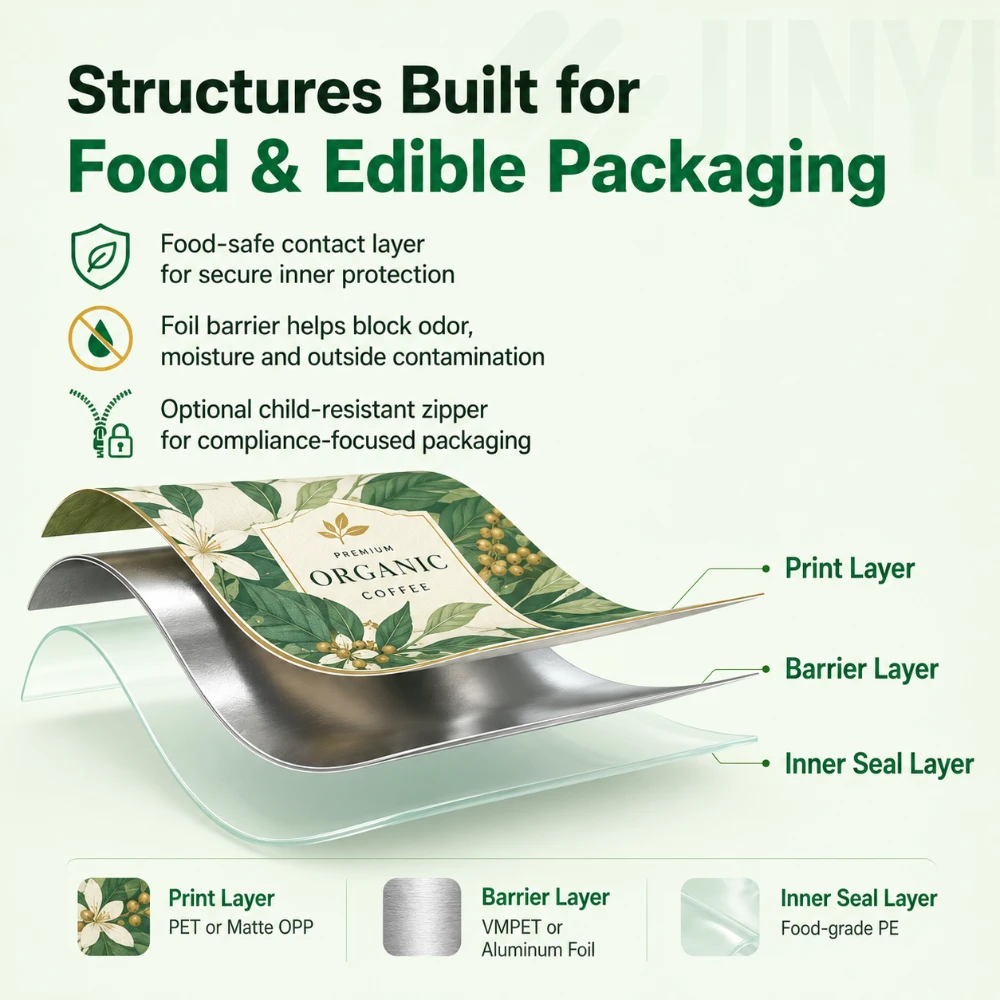
The estimated film structure for the main body of the bag is a standard three-layer laminate:
Camada (Exterior → Interior)
Material estimado
Função
Camada de impressão (exterior)
PET (polyester), 12–15 μm
Reverse-print substrate for high-resolution landscape photography; structural stiffness for flat-bottom bag forming; abrasion and puncture resistance during retail handling
Camada de barreira (meio)
AL (aluminum foil) or VMPET, 7–9 μm
AL: near-zero OTR (est. ≤0.01 cc/m²/day), near-zero MVTR, complete light block — appropriate for 21-month shelf life at 30%+ fat content. VMPET: OTR ~0.5–2.0 cc/m²/day, viable for lower-fat or shorter shelf life variants
Camada de vedação interna (interior)
PE de qualidade alimentar, 60–80 μm
Heat-seal surface for bottom and side seals; food contact compliance; compatible with VFFS flat-bottom bag forming equipment
Note: Film structure is estimated based on product barrier requirements, observable bag properties, and industry-standard specifications for high-fat air-dried pet food. ZIWI Peak has not published official material documentation.
The barrier layer selection requires particular care for air-dried formats. ZIWI Peak’s beef recipe, for example, carries a minimum 30 percent crude fat content — significantly higher than most extruded kibbles. At this fat level, the rate of lipid oxidation — the chemical reaction between unsaturated fatty acids and ambient oxygen that produces rancid off-flavors and reduces nutritional quality — is meaningfully faster than in a lower-fat product. Sustaining product quality to 21 months across a distribution chain that spans tropical, temperate, and cold-climate markets requires a barrier layer that restricts oxygen ingress to levels that keep the oxidation rate below a threshold of perceivable quality change across the full shelf life.
Aluminum foil at 7 to 9 microns provides an OTR of approximately 0.01 cc/m²/day or below — effectively a complete oxygen barrier. VMPET provides meaningful barrier performance at a lower cost per square meter, but its metallized aluminum deposit is susceptible to micro-cracking when the film is flexed repeatedly during bag filling, sealing, and handling — a degradation mode that can raise the OTR of the finished bag above the level measured on the flat film. For a product specification requiring 21-month shelf life at 30 percent minimum fat, the technically conservative choice is aluminum foil. The total laminate thickness across all three layers is estimated at approximately 80 to 110 microns — sufficient structural rigidity for flat-bottom bag forming while maintaining the flexibility required for zipper integration and consumer handling.
The clear window area uses a transparent film — typically clear PET or CPP — bonded into the main laminate structure. The window material has lower barrier properties than the aluminum foil body, but because the window represents a small fraction of the total bag surface area, its contribution to the package’s overall oxygen transmission is proportionally small. Industry practice for window pouches in high-barrier applications is to keep the window-to-total-surface ratio low — which ZIWI Peak’s packaging does — and to ensure the window film is bonded cleanly to the laminate with no edge gaps that could create preferential oxygen ingress pathways.
The Visual Identity: New Zealand Landscape Wrapping Around the Pack
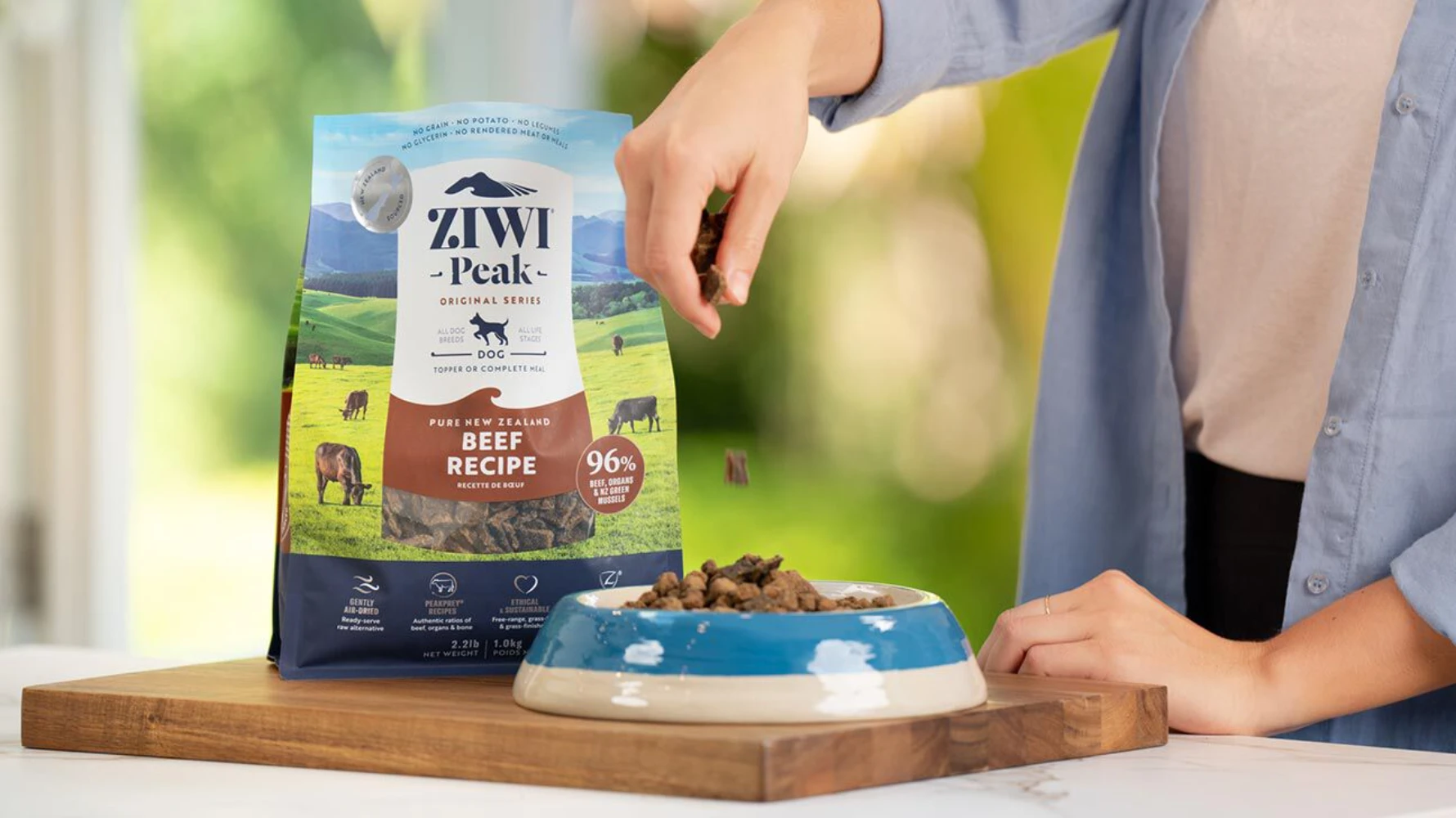
ZIWI Peak’s most recent packaging redesign — launched in 2024 — doubled down on New Zealand provenance as the brand’s primary visual asset. The new packaging features full-width landscape photography of New Zealand scenery wrapping around the entire bag, from front to back, with the landscape image selected to reflect the terrain associated with each recipe’s primary protein source. A lamb recipe bag shows high-country sheep pastures. A venison recipe shows the alpine wilderness of the South Island. The effect is immersive in a way that a flat front-panel photograph cannot achieve — the bag becomes a piece of landscape communication rather than a standard product package.
This is a fundamentally different visual strategy from other premium pet food brands competing at the same price point. ORIJEN uses a dark field with wildlife photography to communicate the ancestral, carnivore-appropriate positioning of the diet — the brand says “this is what your dog evolved to eat.” Blue Buffalo uses warm, family-oriented imagery to communicate the emotional relationship between pet and owner. ZIWI Peak uses New Zealand landscape to communicate something different again: purity of origin, geographic specificity, and a supply chain story that most competitors cannot replicate because their ingredients come from multiple, often undisclosed, sources.
New Zealand’s global brand equity in premium food — built on decades of agricultural exports under strict biosecurity conditions, with no GMOs, no growth hormones, and no endemic livestock diseases — gives ZIWI Peak a provenance story that functions as a quality signal in markets where ingredient sourcing is a primary purchase driver. The packaging makes that story visible before the buyer reads a single word of body copy. In the Asia-Pacific market in particular, where New Zealand-origin food carries strong consumer trust, this visual strategy is well-calibrated to the buying audience.
The multi-SKU color system works within the landscape framework: each recipe uses a distinct accent color applied to the brand name, recipe descriptor, and nutritional callouts — teal for one protein, terracotta for another — providing differentiation at the SKU level without disrupting the cohesive brand system. From a retail navigation standpoint, a pet owner who knows the brand can identify their preferred recipe by accent color from a distance, without needing to read the descriptor text.
From a print production standpoint, wraparound landscape photography creates specific challenges. The front-to-back image must register correctly across the bag’s side gussets and base, which means the print file needs to account for gusset fold geometry in the dieline — if it does not, the image reads as distorted where it wraps around the bag’s corners. For a high-resolution landscape image, even a small registration error at the wrap point is visually obvious. This is a specification detail that is confirmed on the physical pre-production bag sample, where the wraparound registration can be evaluated on a real formed bag rather than on a flat digital proof.
On wraparound print design: A wraparound image that looks correct on the flat dieline will not necessarily look correct on the formed bag. The physical pre-production sample is the only reliable way to evaluate wraparound registration, gusset image continuity, and how the landscape image reads when the bag is filled and standing on a shelf. Approval on screen is not a substitute for approval on the physical bag.
Shelf Life, Storage, and What the Packaging Has to Sustain Across 25 Countries
A 21-month shelf life target means something specific when the distribution chain spans 25 countries across North America, Europe, Asia-Pacific, and beyond. Unopened bags may sit in a New Zealand export warehouse before shipping, spend weeks in ocean freight containers, pass through customs and regional distribution centers, and arrive at retail shelves in climates ranging from the humidity of Southeast Asia to the cold-dry air of Northern Europe. The packaging’s barrier performance needs to be consistent throughout this journey — and that consistency is a function of both the film specification and the seal integrity of every bottom seal, side seal, and zipper closure on every bag in a production run.
ZIWI Peak’s guidance that the food should be used within 8 weeks of opening reflects the difference between the sealed-bag environment and the post-opening environment. Once the hermetic bottom and side seals are intact and the zipper is closed, the barrier film maintains the internal atmosphere of the bag. Once the bag is opened, the product is exposed to ambient air on every feeding — even a well-closed zipper allows some oxygen exchange compared to an unbroken hermetic seal. At 30 percent minimum fat content, the product’s oxidation rate in an opened bag is meaningful over an 8-week period, and the recommendation reflects this honestly rather than overstating the packaging’s ability to preserve quality post-opening.
On the sustainability question, ZIWI Peak’s multi-layer laminate structure — PET, aluminum foil or VMPET, and PE bonded together — is not recyclable in standard municipal or store drop-off streams. This is the same recyclability limitation that applies to most high-barrier flexible pet food packaging, including ORIJEN’s packaging and most comparable premium pet food formats. The mono-material recyclable film technology that is being developed as an alternative does not yet reliably match the OTR performance of aluminum foil laminates for a 21-month, high-fat product specification. For brands at ZIWI Peak’s specification level, the more actionable near-term sustainability lever is optimizing the secondary packaging — shipping cases, pallet wrap, void fill — rather than compromising the primary barrier performance.
What Brands Building Air-Dried or High-Barrier Pet Food Packaging Need from a Factory
ZIWI Peak’s packaging system illustrates what a high-specification air-dried pet food package actually requires — and why those requirements cannot be met by a commodity flexible film supplier working from a standard pet food catalog. The specification starts with the product: fat content, moisture content, and shelf life target. From those numbers, the barrier layer is selected. From the barrier layer, the overall laminate is designed. The format, the window, the zipper, and the print system are all downstream decisions that layer onto the barrier foundation.
For brands in the air-dried, raw-alternative, or high-protein premium pet food category, the factory capabilities that matter at the specification stage are: published OTR and MVTR values for the specific laminate being proposed; food contact compliance documentation for the inner PE layer; clear window insert capability with specified position and dimensions; zipper options with documented reclose force specifications; and physical pre-production bag samples that can be evaluated — filled, sealed, and assessed for print registration, window clarity, zipper function, and seal integrity — before production volume is committed.
The flat-bottom format requires specific tooling and forming capability. Not every flexible packaging factory that produces stand-up pouches produces flat-bottom bags — the base forming process is different, and the dieline geometry needs to be correct for the bag to stand cleanly when filled. JINYI’s flat-bottom bag production covers this format in barrier laminate specifications, with clear window options and zipper configurations that match the functional requirements of high-fat air-dried pet food formats.
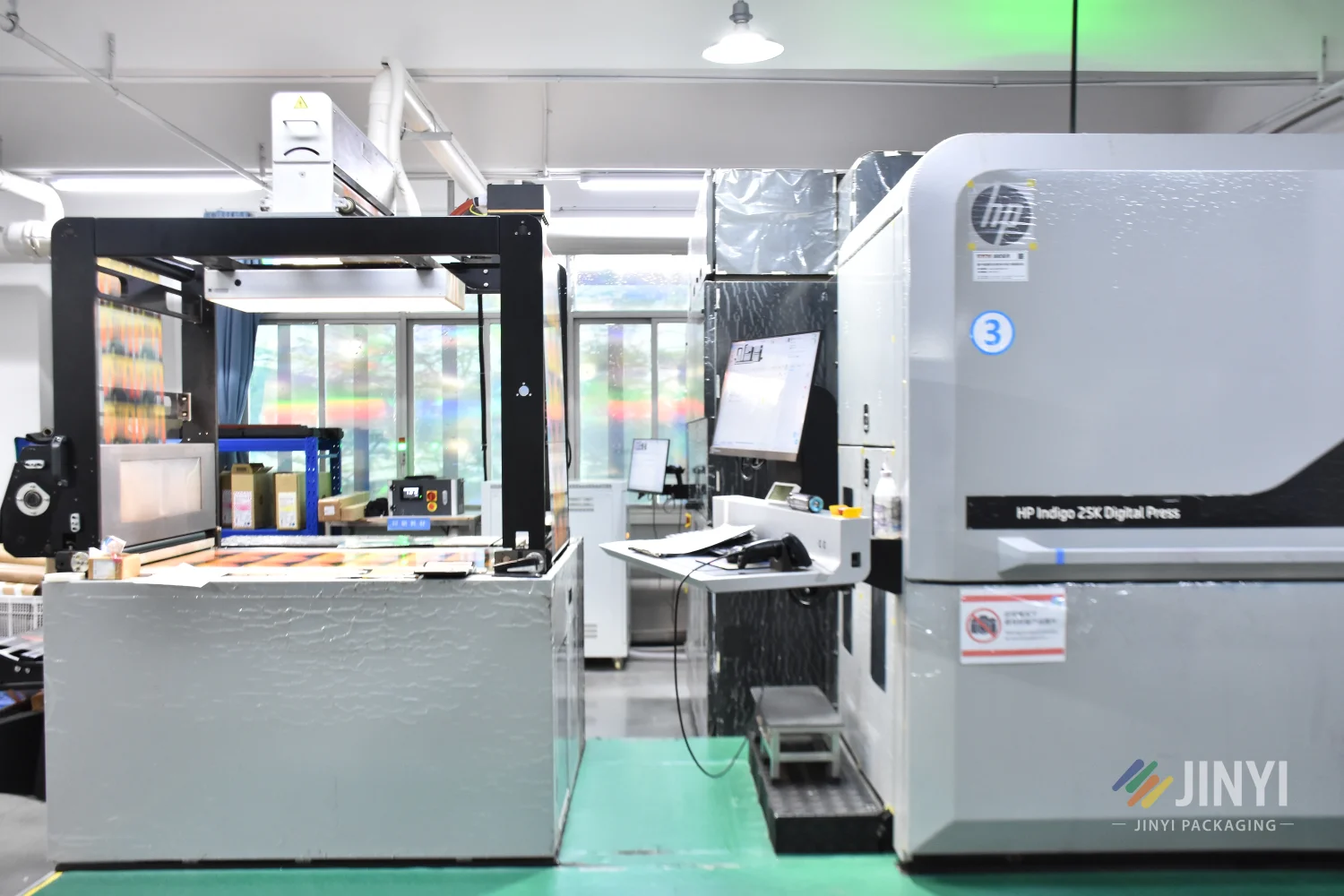
HP Indigo 25K na JINYI — resultados de cor consistentes em todos os sistemas de impressão através do ESKO Automation Engine
For the print specification, wraparound landscape photography — the visual approach ZIWI Peak has committed to in its 2024 rebrand — demands color management that holds consistent output across reorder runs separated by months. The landscape image that identifies a recipe’s regional origin needs to read the same on the third production run as it did on the first. At JINYI, color output across our HP Indigo digital press line is managed through ESKO Automation Engine, applying the same color profile to each job and making run-to-run consistency measurable. For brands building a visual system where geographic landscape imagery is the primary brand asset, this level of color management is a production specification, not a preference.
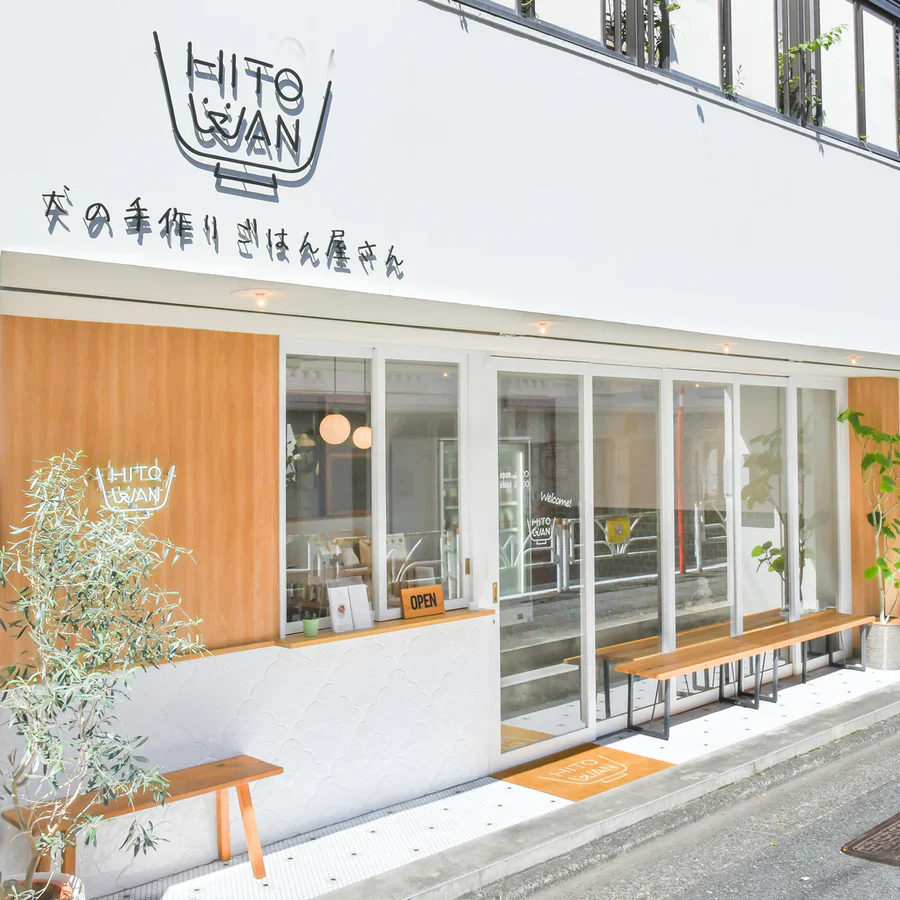
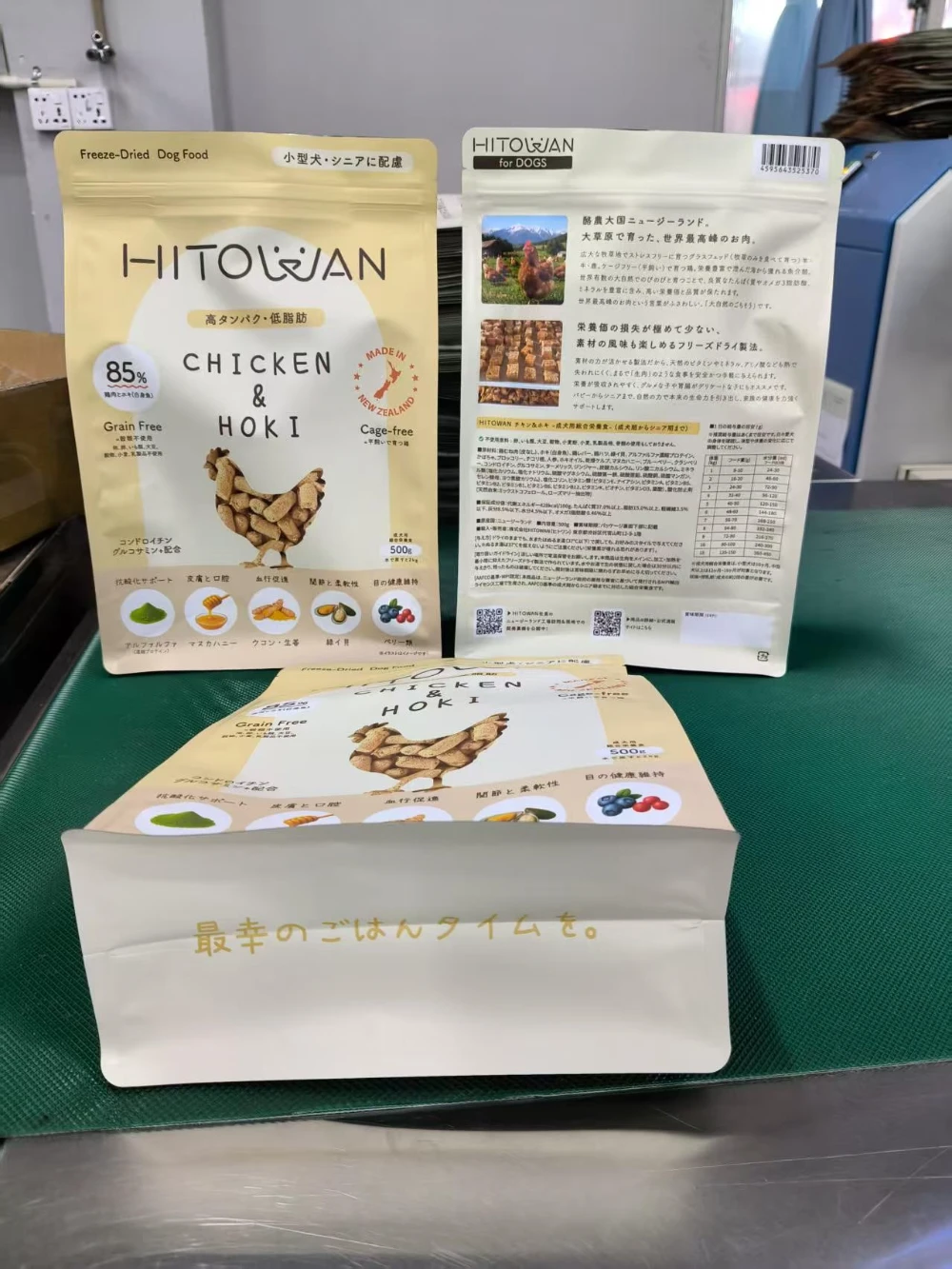
The logic that ZIWI Peak has built its brand around — New Zealand provenance as a primary quality signal — applies equally to other premium pet food brands sourcing from the same origin. HITOWAN, a Tokyo-based premium pet food chain operating seven retail stores across the city, is exactly this kind of brand. A portion of the custom pouches JINYI produces for HITOWAN ship directly to New Zealand, where premium meat ingredients are processed and sealed on-site before making the long journey back to Japan for retail sale. The remaining pouches go to HITOWAN’s central kitchen in Japan, where fresh pet meals are prepared daily and distributed to their stores. Both use the same high-barrier laminate specification — and both include a small clear window panel, allowing customers to see the real-ingredient quality of the product before purchase, the same structural decision ZIWI Peak makes for the same reason. Two supply chains, two use cases, one non-negotiable requirement: every bag performs from the moment it is sealed to the moment it is opened. You can see HITOWAN’s full range at hitowan.jp, and read the full case study in our custom pet food packaging guide.
One of HITOWAN’s seven Tokyo retail locations — a brand built on freshly prepared pet food and the kind of quality standard that demands packaging to match.
Da JINYI soluções de embalagem para alimentos para animais de companhia cover the full specification range for premium air-dried and high-barrier pet food — barrier laminates in PET/AL/PE and PET/VMPET/PE, flat-bottom and stand-up formats, clear window inserts, resealable zipper options, and complete material documentation as standard. For a detailed walkthrough of how the production process works from film specification through finished bag, the guia para a produção de bolsas personalizadas abrange todas as etapas que antecedem a primeira conversa com a fábrica.
HITOWAN Chicken & Boki flavour pouches produced at JINYI — premium Japanese pet food packaging with matte white finish and full-colour illustration print
Building High-Barrier Pet Food Packaging for an Air-Dried or Raw-Alternative Product?
JINYI produces flat-bottom bags and stand-up pouches in PET/AL/PE and PET/VMPET/PE barrier laminates — with clear window options, resealable zipper configurations, complete material documentation, and physical pre-production samples as standard. The conversation starts with your product’s fat content, moisture level, and shelf life target.
A JINYI é uma fábrica de embalagens flexíveis personalizadas com mais de 15 anos de experiência em produção, que fornece marcas dos setores alimentar, de suplementos, de café, de alimentos para animais de estimação e de bens de consumo em mais de 150 países. Produzimos saquetas verticais, sacos de fundo plano, sacos tipo almofada e sacos com reforço lateral em PET/AL/PE, PET/VMPET/PE e outras especificações de barreira — através de impressão digital HP Indigo a partir de 500 unidades e impressão por gravura em grandes quantidades — com documentação completa dos materiais incluída de série em todas as encomendas.
É isso que Do filme ao acabamento - feito corretamente significa na prática.
Elsa
Gestor de Desenvolvimento Comercial - Embalagens JINYI
A Elsa lidera o desenvolvimento comercial e a gestão de encomendas de clientes na JINYI. Com 8 anos de experiência em comércio externo em Yiwu e Dongguan, tem um conhecimento profundo da procura do mercado e do que os compradores realmente precisam - transformando a visão real do cliente nas decisões corretas de embalagem.
Necessidades dos clientes Gestão de encomendas Desenvolvimento de negócios
What packaging format does ZIWI Peak use for its air-dried pet food?
ZIWI Peak uses a flat-bottom stand-up pouch with a clear product window and a resealable press-to-close zipper. The flat-bottom format allows the bag to stand stably on a retail shelf and provides a large printable surface for the brand’s wraparound landscape photography. The clear window shows the air-dried product — which looks visually different from conventional kibble — before purchase. The bag is available in sizes ranging from a 3.5oz trial bag through to a 35.2oz large bag.
What film structure does ZIWI Peak’s packaging most likely use?
ZIWI Peak has not published an official material specification. Based on the product’s technical requirements — minimum 30 percent crude fat, 14 percent residual moisture, and a 21-month shelf life target — the estimated structure is a standard three-layer laminate: a PET print layer on the outside, an aluminum foil or high-barrier VMPET barrier layer in the middle, and a food-grade PE inner seal layer. The clear window area uses a transparent film bonded into the laminate structure, with a small window-to-total-surface ratio that limits its impact on overall package barrier performance.
Why does ZIWI Peak recommend using the food within 8 weeks of opening?
The 8-week post-opening guideline reflects the product’s fat content and residual moisture level. Once the hermetic seals are broken and the bag is opened daily for feeding, the product is exposed to ambient oxygen on each occasion. At 30 percent minimum fat content, lipid oxidation — the chemical reaction that produces rancid off-flavors — proceeds more quickly than in a lower-fat product once the oxygen barrier is no longer intact. The resealable zipper slows but does not eliminate this process. The 8-week guideline is an honest representation of the product’s post-opening shelf life, not a conservative over-caution.
Does the clear window in ZIWI Peak’s bag affect its barrier performance?
Minimally. The window area uses a transparent film with lower barrier properties than the aluminum foil main body of the bag. However, because the window represents a small fraction of the total bag surface, its contribution to overall oxygen and moisture transmission is proportionally small and does not materially affect shelf life performance. ZIWI Peak’s window is deliberately sized to be small — sufficient to show the product, insufficient to significantly compromise the package’s barrier system. This is standard practice for window pouches in high-barrier pet food applications.
What is the difference between air-dried and freeze-dried pet food packaging requirements?
Air-dried pet food retains approximately 14 percent residual moisture — significantly more than freeze-dried, which typically falls below 3 percent. The higher moisture content means air-dried packaging needs to restrict both oxygen transmission (to prevent fat oxidation) and moisture vapor transmission (to prevent mold development and texture degradation). Freeze-dried packaging focuses more on oxygen barrier and physical protection — the ultra-low moisture makes mold development a lesser concern, but the fragile, brittle product texture requires packaging that resists physical impact and compression during distribution.
What is ZIWI Peak’s packaging design strategy and how has it changed recently?
ZIWI Peak relaunched its packaging in 2024 with a wraparound New Zealand landscape photography system — full-width scenery images that wrap from front to back of the bag, with the landscape tied to each recipe’s primary protein source. This replaced an earlier packaging design and represents a deliberate doubling-down on New Zealand provenance as the brand’s primary visual differentiator. The strategy works particularly well in Asia-Pacific markets where New Zealand-origin food carries strong consumer trust as a quality signal.
How does ZIWI Peak’s packaging compare to ORIJEN’s approach?
Both brands use high-barrier laminate film for high-fat, high-protein pet food with extended shelf life requirements — the barrier specification logic is similar. The key differences are in format and visual strategy. ZIWI Peak uses a flat-bottom stand-up pouch with a clear product window and wraparound landscape photography emphasizing New Zealand provenance. ORIJEN uses side gusset bags for larger sizes and a dark-field wildlife photography system that communicates ancestral, carnivore-appropriate nutrition. Both are legitimate premium positioning strategies built on fundamentally different brand stories. For a detailed breakdown of ORIJEN’s packaging decisions, see our ORIJEN packaging analysis. For a broader look at premium pet food packaging formats and specifications across the category, the custom pet food packaging guide covers the full decision framework.