Rouleaux de haute performance conçus pour la vitesse, la cohérence et la production d'emballages évolutifs.
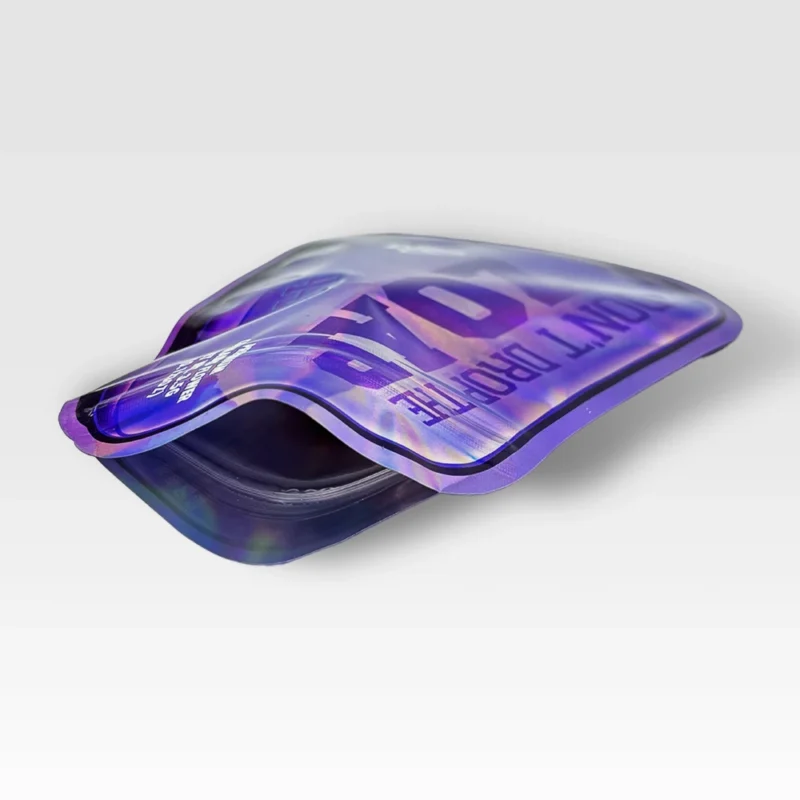
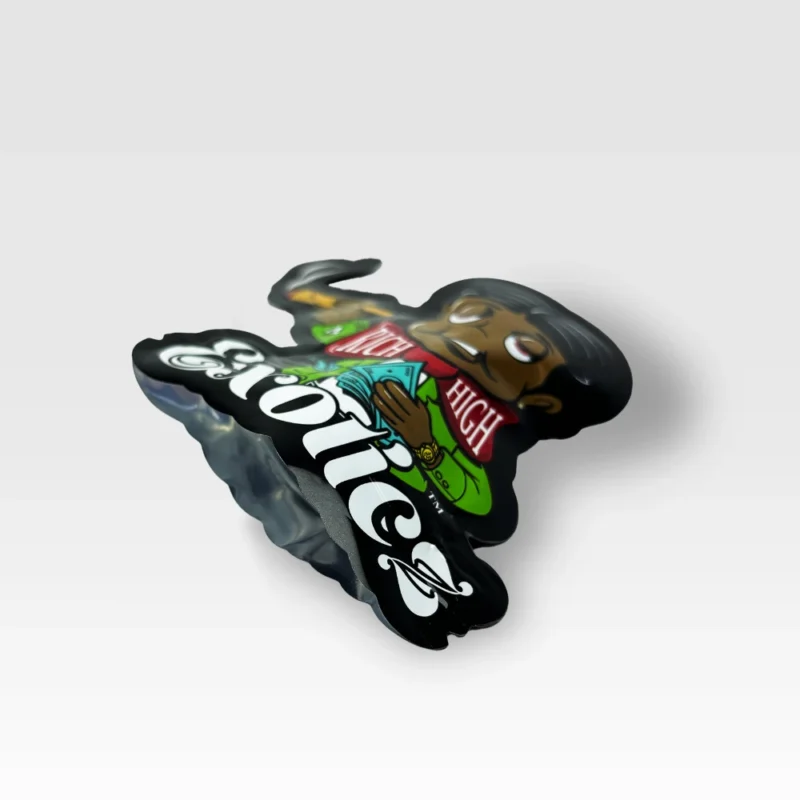
Sac en Mylar découpé à l'emporte-pièce
Présence en rayon à fort impact avec une forte protection de la barrière pour garder les produits frais et prêts pour la conformité.
Pochettes plates
Un format peu encombrant et rentable qui offre des performances de scellage fiables pour la vente au détail et l'expédition au quotidien.
Pochettes à bec liquide
Emballage résistant aux fuites, facile à verser, qui améliore le confort de l'utilisateur et réduit le désordre lors de la livraison.
Emballage des sacs d'oreillers
Emballage léger, rapide à emballer, de type sachet, idéal pour les produits en grande quantité et les marques propres.
Pochette Quad Seal
Stabilité semblable à celle d'une boîte avec un attrait de premier ordre en rayon - idéal pour les remplissages plus lourds et un aspect plus “droit”.
Sacs à soufflets latéraux
Sacs de grande capacité, peu encombrants, qui maximisent le volume de remplissage tout en conservant une forme propre et structurée.
Sacs à dos
L'un des formats à la croissance la plus rapide - combinant une forte présentation en rayon, des frais de transport réduits et une grande protection de la fraîcheur.
Sacs à fond plat
Boîte à bijoux à tiroir
Boîtes à bijoux à tiroir pour un déballage de première qualité et une protection rigide.
Boîte à bijoux à couvercle rabattable
Boîtes à bijoux à couvercle rabattable, de construction rigide et de présentation luxueuse.
Étui rigide rétractable en deux parties
Boîtes rigides en deux parties pour une protection et une présentation de luxe.
Boîtes postales
Boîtes d'expédition en carton ondulé pour une expédition sécurisée et un déballage à l'effigie de la marque.
Boîtes d'exposition
Boîtes de présentation personnalisées pour les ventes au comptoir et une bonne visibilité en rayon.
Boîtes cadeaux
Boîtes-cadeaux personnalisées avec structure et options de finition haut de gamme.
Boîtes d'emballage à manchons
Boîtes à pochettes avec enveloppes imprimées pour un marquage flexible.
Boîte de fond à verrouillage automatique
Boîtes à fermeture automatique à montage rapide pour le commerce de détail et le commerce électronique.
Boîte de fond de serrure
Boîtes à fond verrouillé pour un emballage rapide et un support de charge solide.
Boîtes d'extrémité droites
Boîtes à couvercle droit pour une fermeture nette et une présentation au détail.
Sac en papier personnalisé
Sacs cadeaux en papier personnalisés avec des poignées solides et une impression nette de la marque.
Gobelets à froid en PET transparent
Gobelets en PET transparent pour boissons glacées - transparents, robustes et étanches.
Sac cadeau personnalisé
Sacs cadeaux en papier personnalisés avec des poignées solides et une impression nette de la marque.
Gobelet en papier
Gobelets en papier pour boissons chaudes avec une prise en main confortable et une impression propre et cohérente.
Sachets plats de cannabis
Sachets plats pour le cannabis avec une barrière élevée et un espace d'étiquetage clair.
Sacs Mylar pour le désherbage
Sacs de désherbage en mylar avec une barrière solide, des fermetures éclair et des options de contrôle des odeurs.
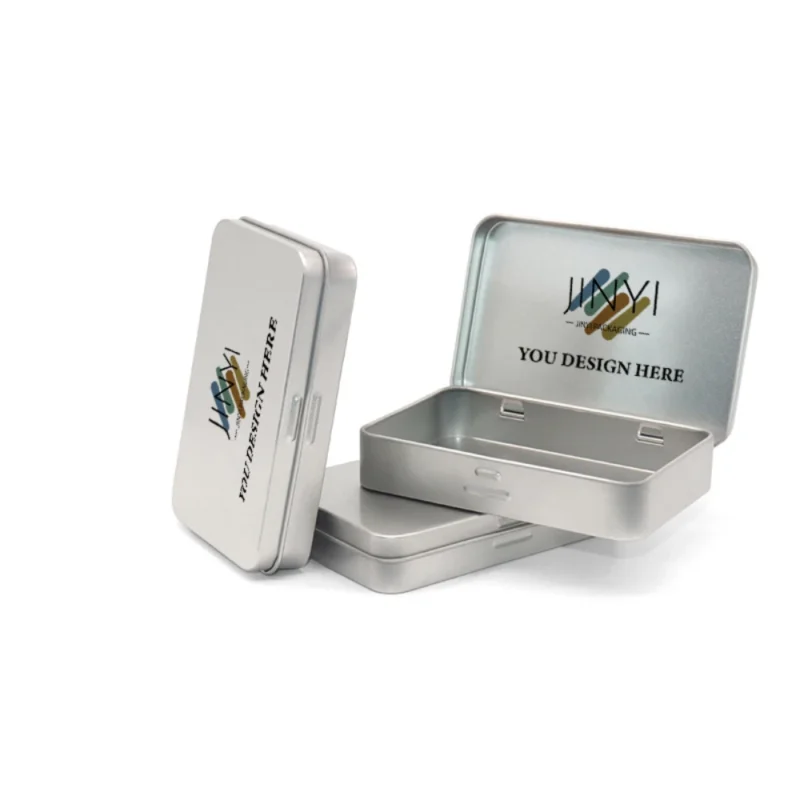
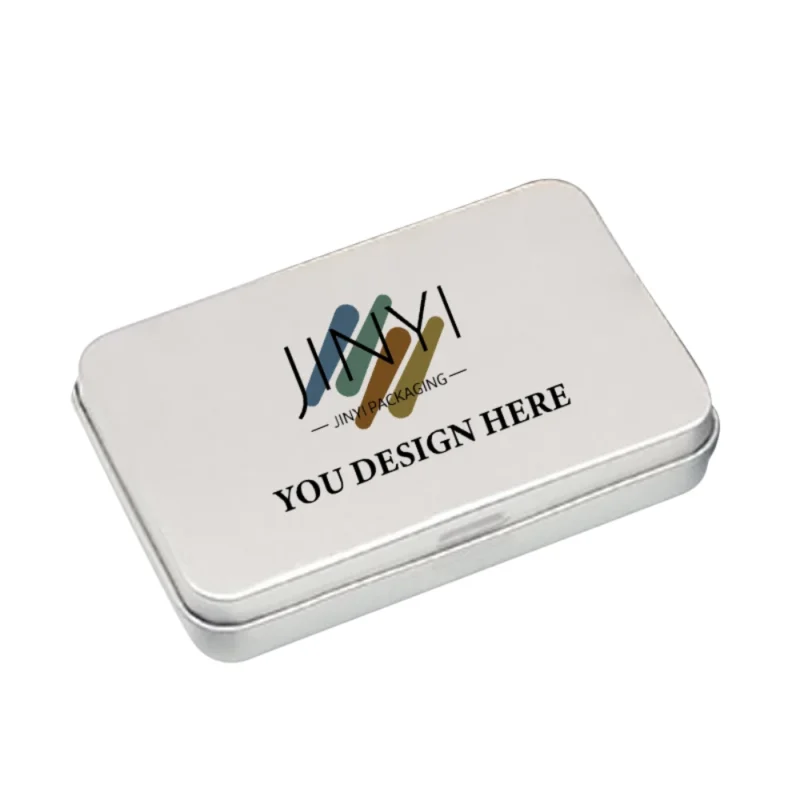
Boîtes en fer blanc personnalisées
Boîtes en fer blanc personnalisées pour une protection optimale, une réutilisation et une impression en quadrichromie.
Étiquettes à manchon thermorétractable
Étiquettes pour manchons thermorétractables avec couverture à 360° et impact en rayon.
Étiquettes en rouleau personnalisées
Étiquettes en rouleau personnalisées pour une application rapide et un étiquetage cohérent de la marque.
Autocollant découpé
Autocollants découpés à l'emporte-pièce avec des bords nets et des options de matériaux durables.
Feuilles d'autocollants Kiss Cut
Feuilles d'autocollants découpées pour un décollage facile et des motifs flexibles.
JINYI donne des conseils pratiques en matière d'emballage pour vous aider à prendre vos décisions.
Orgain was not built in a boardroom. It was built in a kitchen, with a blender, by a physician who could not find a nutritional product he was willing to drink during cancer treatment. Dr. Andrew Abraham was diagnosed with an aggressive form of tissue cancer as a teenager, and the liquid nutrition his doctors prescribed — loaded with high-fructose corn syrup, artificial flavors, and preservatives — struck him as fundamentally at odds with the goal of recovery. He started making his own organic shakes. Years later, after completing medical school and his residency, he turned those kitchen formulas into Orgain, founding the company in 2008. For the first four years, he was the only employee — handling sales, customer service, marketing, and logistics himself. The products went to Costco, then to Whole Foods, then to mainstream grocery. Nestlé Health Science acquired a majority stake in 2019, providing the distribution infrastructure to reach the 30,000 stores Orgain now occupies. Today, Orgain is the number one plant protein powder brand in the United States by market share.
That journey from a single blender to national distribution in 30,000 retail locations compresses a packaging evolution that most brands never have to navigate. A supplement brand producing a few hundred units a month for a niche audience can tolerate packaging decisions made on intuition and adjusted based on returns. A brand selling through Costco, Target, and Amazon simultaneously — at the volume Orgain operates — cannot. Every packaging choice has to work reliably at scale: the film barrier has to maintain product quality through a two-year stated shelf life, the format has to survive the handling demands of mass retail and e-commerce fulfillment, and the materials have to comply with USDA Organic certification requirements that constrain not just the powder inside but the packaging system around it.
This article breaks down the Orgain packaging system from a factory perspective: the formats the brand uses and why each exists, what USDA Organic certification means for the packaging film, why a two-year shelf life puts a different set of demands on the bag than most supplement brands face, how the travel stick pack format has become the fastest-growing flexible format in the range, and what the brand’s Green Initiative means for the packaging’s environmental trajectory.
Orgain’s Packaging Formats: Tub, Pouch, and the Travel Stick Pack
Orgain’s core protein powder range runs across three distinct packaging formats, each serving a different consumption context and retail channel. Understanding which format does what is the starting point for any brand evaluating its own supplement packaging strategy — because the format decision is not just aesthetic, it drives the film specification, the filling line requirements, and the consumer experience downstream.
The primary retail format is the rigid plastic tub — the 1lb, 2lb, and 2.03lb containers that anchor the brand’s presence in Costco, Target, and grocery channels. The tub is the format consumers associate most immediately with protein powder as a category. It offers high shelf presence, easy scooping, and reclosure without a separate zipper system. It is also the format that falls entirely outside flexible packaging — HDPE or PP injection-molded tubs are a rigid plastics category, not a film-based flexible packaging category. This article does not focus on the tub for that reason: it is the dominant format by volume, but it is not the format that flexible packaging manufacturers produce.
The two flexible packaging formats in the Orgain range are where the engineering conversation becomes relevant. The pochette de rangement appears across the protein powder range as an alternative format — lighter, more compact, lower cost per unit than a rigid tub, and better suited to e-commerce fulfillment where dimensional weight pricing makes rigid containers expensive to ship. A pochette de rangement for a 1–2lb protein powder application requires a high-barrier film capable of maintaining the powder’s moisture and oxygen equilibrium across a two-year shelf life, a base gusset wide enough to stand stably under the product’s weight, and a zipper that reseals cleanly after repeated scooping — without allowing fine powder particles to contaminate the closure and degrade its effectiveness over time.
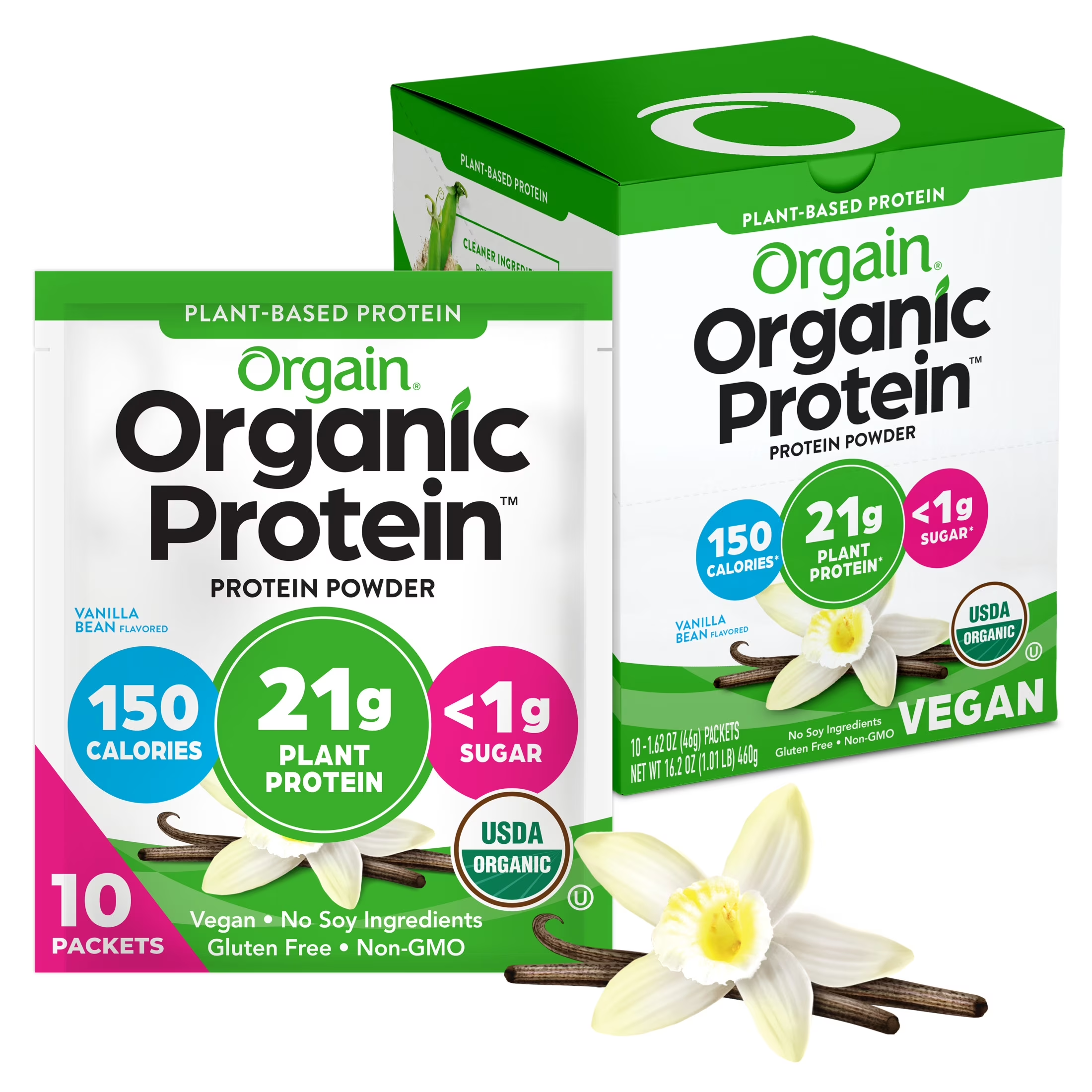
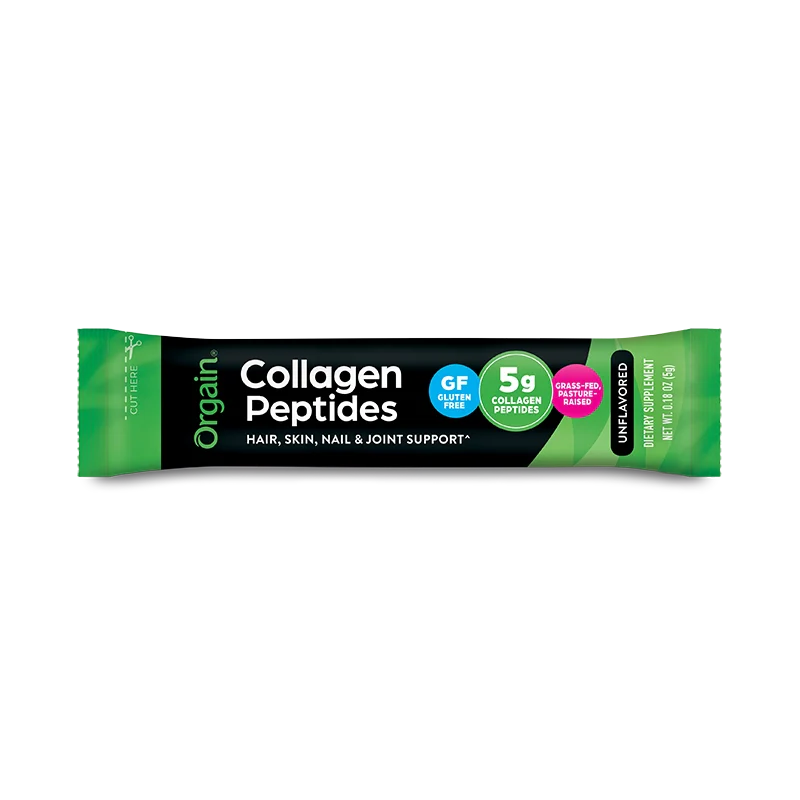
Le travel stick pack is the fastest-growing flexible format in the range. Orgain’s single-serve travel packs — typically sold in 10-count boxes in Vanilla Bean and Chocolate Fudge — are individual fin-sealed packets designed to be torn open and mixed with water or milk in a single serving. The format targets the gym bag, the airport bag, the desk drawer — anywhere a consumer needs portable protein without committing to carrying a full tub. Each packet is independently sealed and shelf-stable; the outer box is a secondary retail unit that holds the individual packets rather than a barrier packaging layer in its own right. The stick pack format is also the most demanding brief for the film: a very small headspace means the film is doing most of the work to maintain the internal atmosphere, with less gas volume to buffer fluctuations in temperature and humidity. More on this in the section below.
For context on how the supplement powder category is packaged more broadly, our supplement powder packaging guide covers the full range of pouch formats and film specifications used across the category.
The Organic Constraint: What USDA Certification Means for the Bag
USDA Organic certification is widely understood as a constraint on ingredients — no synthetic pesticides, no GMOs, no artificial preservatives. What is less widely understood is that the certification also extends to packaging materials, specifically where the packaging comes into direct contact with the organic product. The National Organic Program (NOP) regulations prohibit the use of packaging materials that contain synthetic fungicides, preservatives, or fumigants that could migrate into an organic product and compromise its certification. This is a food contact safety requirement that applies regardless of whether the product is organic, but the organic certification makes it explicit, audited, and subject to decertification risk if violated.
For flexible packaging, the practical implication falls most heavily on the inner sealant layer — the film surface in direct contact with the protein powder. A standard food-grade PE inner film meets the basic food contact requirements under FDA regulations, but an organic brand sourcing packaging from a supplier who cannot provide documentation of the inner film’s compliance with NOP food contact requirements takes on a certification risk. The inner film should be free from specific prohibited substances, and that compliance should be documented in the supplier’s material declarations — not assumed on the basis of general food safety certification alone.
The second area where organic certification touches packaging is adhesives and inks. The laminating adhesive that bonds the layers of a multi-layer flexible pouch must not contain substances prohibited under the NOP, and the printing inks on the outer layer — while not in direct food contact in a reverse-printed laminate — are subject to similar scrutiny in some certification bodies’ interpretations. Solventless lamination adhesives, which eliminate residual solvent from the bonding process, are the standard approach for premium and organic-positioned supplement brands for this reason. Orgain’s public sustainability reporting highlights its reduction in packaging materials; a parallel commitment exists in using packaging production processes consistent with its organic brand positioning.
The practical difference this creates for a sourcing team is that the packaging specification document for an organic supplement brand needs to include material compliance declarations that a conventional supplement brand does not require. The film is not fundamentally different — it is still a barrier laminate of the type used across the supplement category — but the documentation trail is longer and the supplier qualification process is more rigorous.
Film Structure: Why a 2-Year Shelf Life Changes the Brief
Orgain states a two-year shelf life for its protein powder from the date of manufacture — an unusually long target for a supplement category where many brands operate on 12 to 18-month timelines. That two-year figure is not arbitrary; it reflects the demands of a brand distributing through mass retail where stock can sit in warehouses, on shelves, and in consumer pantries for extended periods before consumption. But it also places a more demanding performance requirement on the packaging film than most supplement brands specify.
Protein powder degrades through three primary mechanisms. The first is moisture absorption: protein powder is hygroscopic — it draws moisture from its environment — and absorbed moisture causes the powder to clump, cake, and become difficult to scoop cleanly. More significantly, moisture absorbed into the protein matrix accelerates the Maillard reaction, a chemical process between amino acids and sugars that produces off-flavors and reduces the biological value of the protein over time. The second mechanism is oxidative degradation: the fats and lipids present in plant-based protein sources — pea protein, brown rice protein, sunflower, and others — oxidize in the presence of oxygen, producing rancid off-flavors that make the product unpleasant to consume. The third is aromatic compound loss: the flavoring system that makes a chocolate or vanilla protein powder palatable is volatile; it migrates through insufficiently dense film at a rate that can leave the product tasting flat well before the best-by date.
Together, these three mechanisms mean that a protein powder pouch needs to perform simultaneously on moisture vapor transmission rate (MVTR), oxygen transmission rate (OTR), and aroma barrier — across a two-year period, through handling, shipping, and retail conditions that include temperature fluctuations and potential humidity exposure. This is a more demanding brief than a gummy candy bag, which only needs moisture control. It is comparable to a coffee bag, which also requires both moisture and oxygen control over a similar shelf life. The film structure options that can meet this combined specification are as follows.
Route A — PET / AL / PE (foil structure): Aluminum foil provides the strongest combined moisture and oxygen barrier available in flexible packaging — effectively zero transmission rate for both. For a two-year shelf life across global distribution, this is the most conservative and reliable choice. The trade-off is cost, weight, and the non-recyclable nature of the aluminum-containing laminate.
Route B — PET / VMPET / PE (metallized structure): A metallized PET barrier layer delivers strong moisture and oxygen barrier at lower cost and weight than foil, and without the rigidity that makes foil less suitable for stand-up pouches. For a brand targeting 18 to 24-month shelf life in controlled retail environments, a well-specified metallized structure is often sufficient. The MVTR and OTR values of the metallized layer need to be validated against the specific shelf life target and distribution environment rather than assumed.
Route C — PET / VMPET / EVOH / PE (high-performance hybrid): Adding an EVOH layer to a metallized structure provides exceptional oxygen barrier — in dry conditions, EVOH’s OTR is lower than metallized film alone — while maintaining the moisture barrier of the metallized layer. This is the highest-performance option for a two-year shelf life product with demanding oxygen sensitivity. The cost premium is real, and EVOH’s moisture sensitivity means it needs to be protected by the PE inner layer, but for a premium organic supplement brand at Orgain’s price point, the performance benefit can justify the cost.
Orgain has not published official film specifications for its protein powder pouches. The estimated primary structure for the standard stand-up pouch is shown below. A third-party test report by Guangzhou Quality Supervision and Testing Institute (GQT, report no. QGWT20250075137E, September 2025) on a BOPP/VMPET/PE structure produced in this product category recorded a water vapor transmission rate of 0.8 g/(m²·24h) and an oxygen transmission rate of 0.4 cm³/(m²·24h·0.1MPa) — both significantly better than the regulatory thresholds for food packaging barrier performance, providing a reference point for what a well-specified metallized structure can deliver in practice.
Couche (extérieure → intérieure)
Estimation du matériel
Fonction
Couche d'impression (extérieure)
PET, 12-15 μm
Stiffness for stand-up pouch structure; reverse-printed brand graphics; aroma barrier contribution from dense PET matrix
Couche barrière (milieu)
AL ou VMPET, 7 à 12 μm
Primary moisture and oxygen barrier; foil (AL) for maximum 2-year shelf life assurance; metallized PET (VMPET) at lower cost for controlled-environment distribution
Note: Film structure is estimated based on Orgain’s stated shelf life requirements and industry-standard specifications for high-barrier supplement powder pouches. Orgain has not published official layer-by-layer material documentation. Actual structures may use aluminum foil, metallized film, or EVOH-containing laminates depending on specific SKU shelf life targets and distribution requirements.
Factory Take — Foil vs Metallized for Protein Powder: Orgain’s two-year shelf life claim makes foil the conservative engineering choice — and for a brand distributing through Costco and Amazon across all US climates, that conservatism is justified. Replacing foil with a metallized structure saves cost and weight but introduces a shelf-life risk that only shows up at the tail end of the distribution cycle — exactly where a brand has the least visibility. For a growing supplement brand with tighter distribution, shorter shelf life targets (12–18 months), and more controlled retail environments, a well-specified PET/VMPET/PE structure is sufficient and meaningfully cheaper — the cost saving per unit scales with volume. The decision follows from your real shelf life requirement and your distribution chain, not from copying what a larger brand uses.
The Stick Pack: Orgain’s Most Demanding Flexible Format
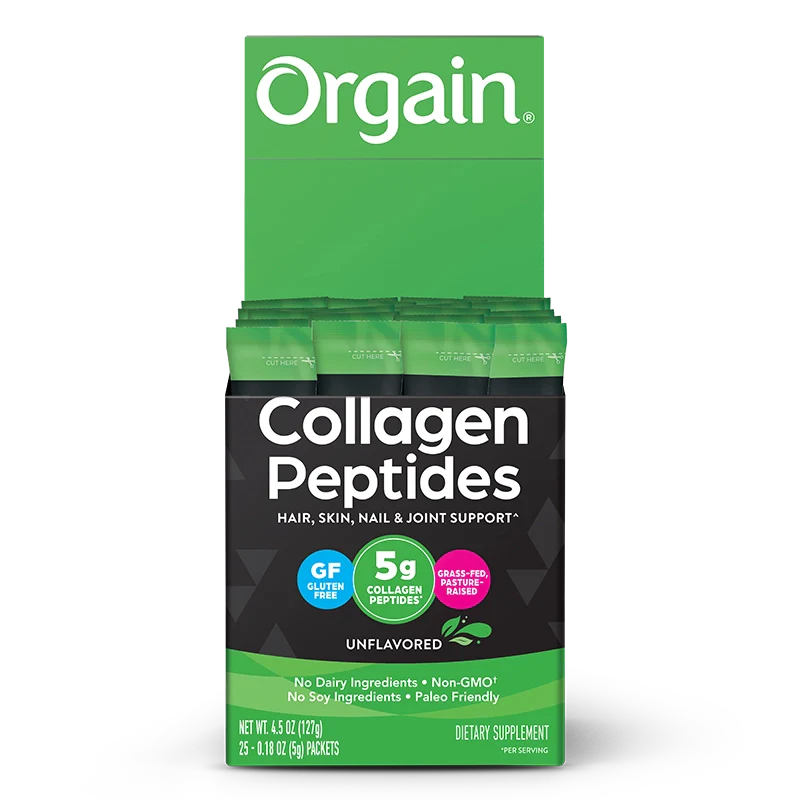
The single-serve travel packet — the fin-sealed stick that each holds one serving of protein powder — is the most engineering-intensive flexible format in the Orgain range. The format’s appeal is straightforward: it eliminates the commitment of carrying a full tub and reduces the per-serving cost of travel-size protein compared to buying a dedicated travel product. For the consumer, it is pure convenience. For the packaging engineer, it is a brief that is harder than the stand-up pouch in almost every dimension.
The primary challenge is headspace. A stand-up pouch for a 1lb protein powder has significant air volume above the powder — that headspace provides a buffer between the powder and the environment, and any oxygen or moisture that permeates through the film is diluted within that volume before it reaches the product. A stick pack contains a single serving — roughly 30 to 40 grams of powder — in a very compact package with almost no headspace. Every molecule of oxygen or moisture that permeates through the film reaches the product immediately. The film is doing almost all of the work, with no gas-volume buffer to compensate for imperfect barrier performance.
The second challenge is seal integrity in the presence of fine powder. Protein powder is extremely fine — particle sizes in the range of tens to hundreds of microns — and migrates freely inside the packet during handling. Fine powder at the seal zones is the leading cause of seal failures in stick pack production: particles between the film faces at the moment of heat sealing create micro-channels through which oxygen and moisture can permeate after sealing, creating a product that fails its shelf life specification not because the film is inadequate but because the seal is contaminated. Managing powder migration through the sealing station — via product-handling geometry, seal temperature profiles, and seal width — is as important as the film specification for stick pack quality. For reference on how the LMNT stick pack handles a comparable electrolyte powder brief, the engineering logic is similar though the powder chemistry differs.
Factory Take — Stick Pack Seal Width for Protein Powder: A brand at Orgain’s volume can optimize seal width down to 3–4mm because its production data across millions of units has validated that contamination rate at that width is acceptable. A brand running its first stick pack production — at 50,000 to 100,000 units — does not have that data. Starting with a 5–6mm seal width reduces the contamination risk meaningfully during the learning curve, at a cost of roughly 3–5% additional film per unit. That cost is real but recoverable once the production process is dialed in. Seal width optimization is worth doing, but not on the first run.
Orgain’s Green Initiative: 40% Less Packaging and the Recyclable Question
In 2020, Orgain launched what it called its Green Initiative — a packaging reduction program that cut the amount of packaging material in its containers by 40%, saving approximately 30,000 pounds of plastic annually, reducing CO₂ emissions by 884,000 kg, and saving 580,000 pounds of corrugated cardboard. The program was primarily achieved through lightweighting: reducing the wall thickness of rigid tubs, reducing secondary packaging, and rationalizing the range of sizes. This is a materials reduction approach rather than a materials substitution approach — the packaging structure did not change to a fundamentally different material, it became less of the same material.
The harder question for Orgain, as for all supplement brands with high barrier requirements, is whether the flexible pouch format can be transitioned to a recyclable mono-material structure. The challenge is specific to the performance requirements: a two-year shelf life for a moisture-sensitive and oxygen-sensitive product rules out the lower-barrier mono-material PE structures that work well for confectionery applications. Haribo’s recyclable doypack — built from a mono-material PE structure — works for gummy candy because gummies are primarily a moisture problem, not an oxygen problem, and the barrier requirement is low enough that a PE structure can meet it. A protein powder pouch with a two-year shelf life and dual moisture-and-oxygen sensitivity cannot make the same trade-off without reformulating the product to reduce its shelf life target or adding compensating measures like desiccants and oxygen absorbers inside the bag.
This is not a permanent barrier to recyclable supplement packaging — it is a timing and specification problem. PE/EVOH/PE mono-material structures with EVOH content below 5% can be classified as PE-recyclable under APR guidelines while delivering significantly better barrier performance than plain PE. The question is whether that barrier level is sufficient for a two-year shelf life across the temperature and humidity range of Orgain’s distribution network — and that is a validation question, not a theoretical one. A brand that can demonstrate, through accelerated aging studies, that its PE/EVOH/PE structure maintains product quality through month 24 in its target distribution conditions has a credible path to a recyclable pouch that does not require sacrificing shelf life.
Factory Take — On Prioritizing Barrier Over Recyclability for Long-Shelf-Life Protein: Orgain’s decision to pursue lightweighting rather than switching to recyclable film structures is the right call for a two-year shelf life product in mass retail distribution. A recyclable structure that compromises product quality at month 18 is not a sustainability win — it is a product failure that generates waste, returns, and brand damage. The barrier comes first. For a supplement brand with a 12-month shelf life target, controlled retail distribution, and a European market presence where PE film recycling infrastructure exists, evaluating PE/EVOH/PE is worth doing. But recommending a recyclable film change without validating it against real shelf life data is the kind of advice that sounds responsible and causes problems later.
Sourcing Custom Protein Powder Packaging: The Specification Questions That Define Quality
The Orgain packaging system — high-barrier film, organic-compliant materials, stand-up pouch for retail, stick pack for on-the-go — is directly applicable to any supplement brand developing its own protein powder packaging. The specification decisions that separate a well-sourced pouch from a generic one are the same regardless of brand scale: shelf life target, distribution environment, format-specific seal integrity requirements, and material compliance for any certification the product carries.
The barrier conversation starts with the shelf life target and works backward to the film structure. A 12-month shelf life in controlled US retail is a different brief from a 24-month shelf life through global distribution including hot-humid climates — the film specification that meets one may not meet the other. Both the MVTR and OTR need to be specified and validated, not assumed. For organic brands, the inner film compliance documentation needs to be in hand before production, not requested after the first run.
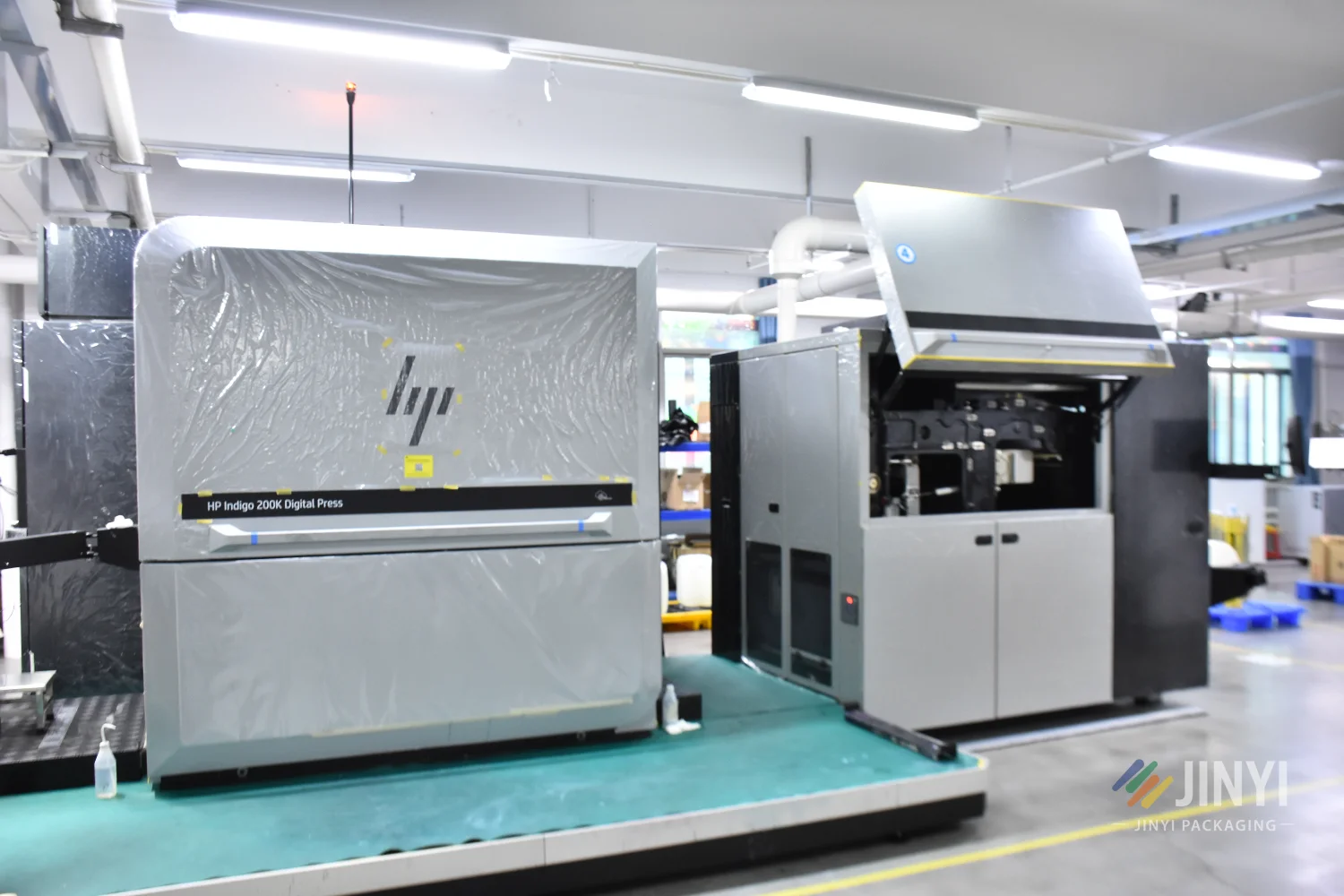
Inside JINYI — a clean, well-organised production floor running HP Indigo digital and gravure printing alongside bag-making and lamination lines
At Jinyi Packaging Co., Ltd. — a 10,443㎡ source factory serving brands across 70+ countries — both stand-up pouches and stick pack rollstock are produced with high-barrier film structures in PET/AL/PE, PET/VMPET/PE, and EVOH-containing configurations. For brands with sustainability commitments or European market exposure, recyclable structures in mono-material PE and PP are also available, with the caveat that shelf life validation against the specific product is essential before committing to a production run. The HP Indigo digital press fleet — including the HP Indigo 25K for high-speed short-run production and the HP Indigo 6K for fast-turnaround samples — handles protein powder pouch graphics from 500 units, allowing a brand to validate design and film specification on a physical sample before committing to a gravure production run. For a brand launching multiple flavors or format sizes, each variant can be run as a separate digital file without plate or cylinder commitment.
Every JINYI order includes three standard services at no additional cost: a free 3D mockup rendering for design confirmation before production, production progress photo and video updates at each manufacturing stage, and free e-commerce photography of the finished bags. For a supplement brand managing a product launch timeline, those three touchpoints reduce the risk of discovering specification or design issues at delivery rather than at the confirmation stage.
HP Indigo 200K - la presse la plus récente de JINYI, mise en service en 2025, augmentant la capacité d'impression numérique et réduisant les délais de livraison
Sourcing custom protein powder or supplement packaging?
JINYI produces stand-up pouches and stick packs in high-barrier foil, metallized, and EVOH-containing structures — with organic-compliant material documentation, digital print from 500 units, and free 3D mockup, production updates, and e-commerce photography with every order.
JINYI est une usine de production d'emballages flexibles sur mesure, avec plus de 15 ans d'expérience dans la production, au service de marques de produits alimentaires, de compléments alimentaires, de café, d'aliments pour animaux de compagnie et de biens de consommation dans plus de 70 pays. Nous produisons des sachets à fond plat, des sachets coussins et des sachets à soufflets latéraux en PET/AL/PE, PET/VMPET/PE et autres spécifications de barrière - via l'impression numérique HP Indigo à partir de 500 unités et l'impression hélio en volume - avec une documentation complète sur les matériaux incluse en standard dans chaque commande.
C'est ce que Du film au produit fini - bien fait dans la pratique.
Elsa
Responsable du développement commercial - JINYI Packaging
Elsa dirige le développement commercial et la gestion des commandes des clients chez JINYI. Avec 8 ans d'expérience dans le commerce extérieur à Yiwu et Dongguan, elle a une connaissance approfondie de la demande du marché et des besoins réels des acheteurs, ce qui lui permet de prendre les bonnes décisions en matière d'emballage sur la base d'une connaissance réelle du client.
Besoins des clients Gestion des commandes Développement des entreprises
Orgain protein powder stand-up pouches are estimated to use a multilayer high-barrier laminate — likely PET outer layer, an aluminum foil or metallized PET barrier layer, and a food-grade PE inner sealant. The inner film is selected to comply with USDA Organic food contact requirements. Orgain has not published official film specifications. The structure is more demanding than a typical snack bag due to the two-year shelf life requirement and the moisture and oxygen sensitivity of protein powder.
Why does Orgain protein powder have a 2-year shelf life?
The two-year shelf life reflects the demands of mass retail distribution through channels like Costco and Amazon, where products can sit in warehouses, on shelves, and in pantries for extended periods. Achieving it requires high-barrier film that controls both moisture vapor and oxygen transmission over the full shelf life — a more demanding specification than most supplement brands require.
Does USDA Organic certification affect the packaging film?
Yes. The National Organic Program (NOP) regulations extend to packaging materials in direct contact with organic products — the inner film must be free from synthetic fungicides, preservatives, and other prohibited substances. The laminating adhesive and printing inks are also subject to scrutiny. Organic brands need material compliance documentation from their packaging suppliers, not just general food safety certification.
What is the difference between Orgain’s tub and pouch packaging?
The rigid plastic tub is the primary retail format — higher shelf presence, easy scooping, familiar to protein powder consumers. The stand-up pouch is lighter, more compact, and lower cost per unit, better suited to e-commerce fulfillment where dimensional weight pricing makes rigid containers expensive to ship. The stick pack is a single-serve travel format for on-the-go consumption. Each format targets a different consumption context and retail channel.
Why is protein powder packaging harder to make recyclable than candy or chip packaging?
Candy packaging needs primarily moisture barrier; chip packaging needs primarily oxygen barrier. Protein powder needs both — plus aroma barrier — across a two-year shelf life. The mono-material PE structures that work for candy recyclability do not deliver sufficient combined barrier for a long-shelf-life protein product without compensating measures. PE/EVOH/PE structures with EVOH below 5% offer a potential path, but require shelf life validation before production commitment.
How is protein powder packaging different from coffee packaging?
Both require high barrier against moisture and oxygen over a long shelf life — the barrier brief is similar. The key differences are: coffee bags typically include a one-way degassing valve to release CO₂ from freshly roasted beans, which protein powder does not need; protein powder packaging must accommodate a zipper system for repeated scooping, while coffee bags may be designed for single-open use; and protein powder has organic certification requirements that coffee packaging may not face.
What film structure should I use for a protein powder pouch?
The right structure depends on your shelf life target and distribution environment. For 12–18 months in controlled retail, a PET/VMPET/PE structure with a well-specified metallized barrier is typically sufficient and costs less than foil. For 24 months across variable global distribution, aluminum foil provides the most conservative barrier assurance. For brands targeting recyclable packaging, PE/EVOH/PE structures with EVOH below 5% are worth evaluating — but require shelf life validation before production commitment.
Can I order custom protein powder pouches at low minimum quantities?
Yes. Through HP Indigo digital printing, custom stand-up pouches and stick pack rollstock with high-barrier film can be produced from 500 units. This allows a brand to validate design, film specification, and organic compliance documentation on a physical sample before committing to a gravure production run. JINYI includes free 3D mockup rendering, production progress updates, and e-commerce photography with every order.