تشارك JINYI إرشادات عملية للتغليف والتعبئة والتغليف من أجل قراراتك.
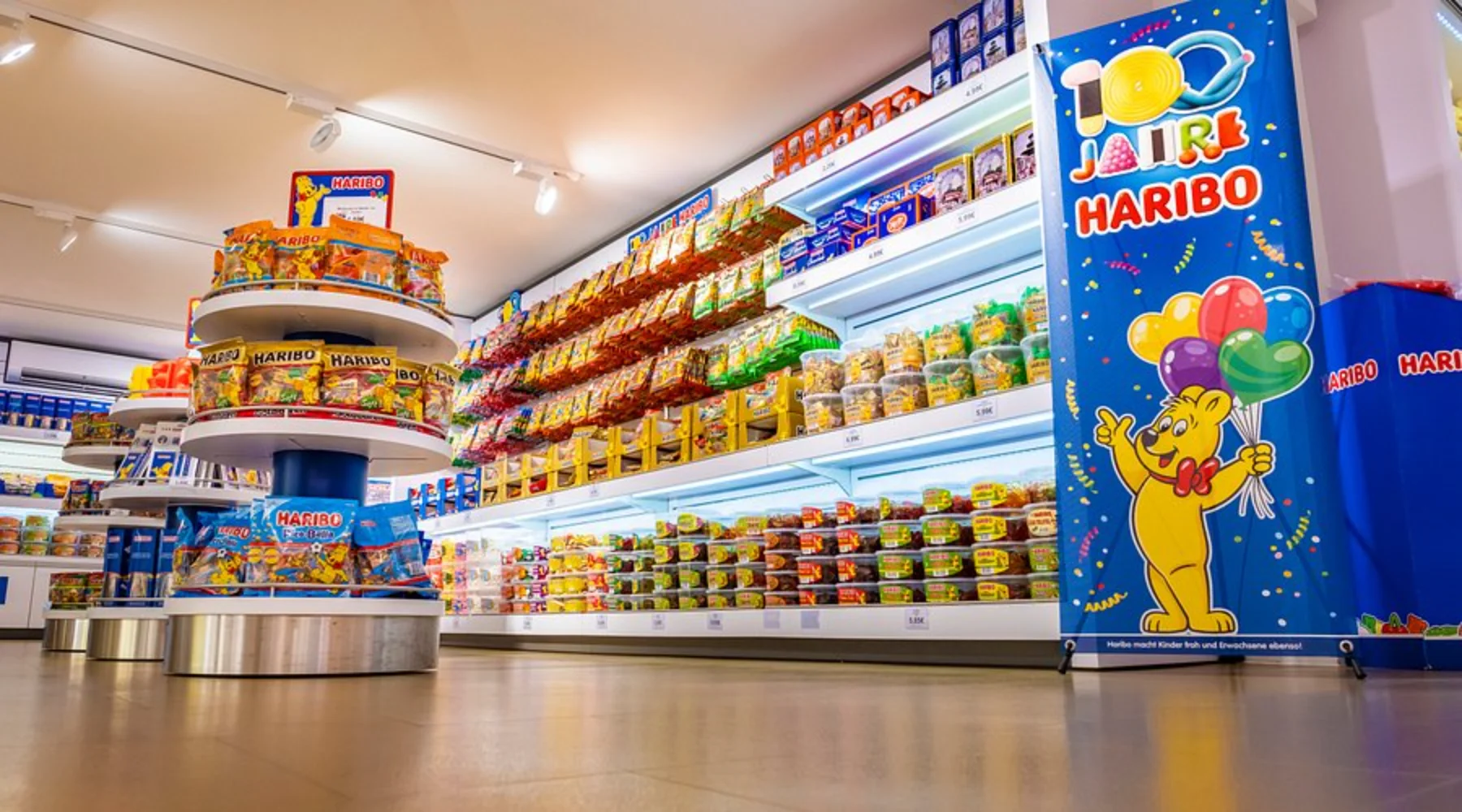
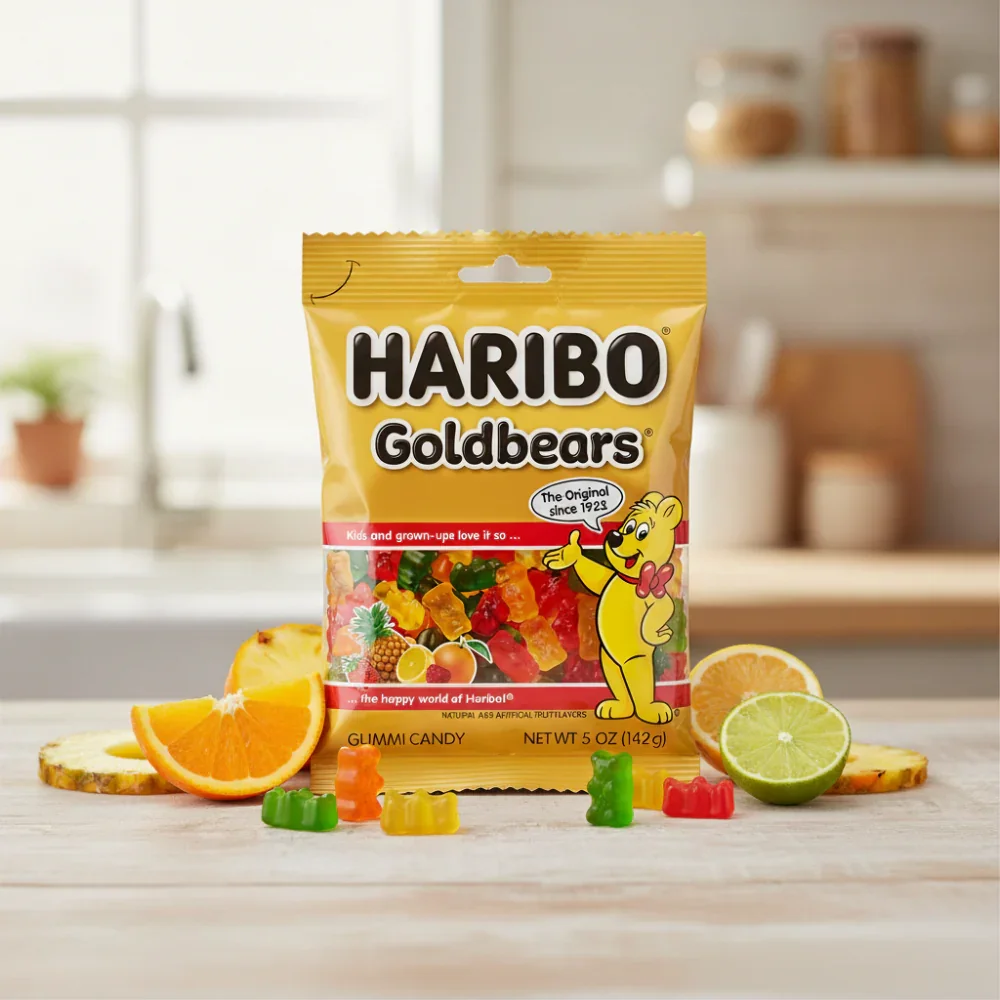
Haribo is the oldest and largest gummy candy brand in the world. The name is a portmanteau of its founder’s name and city — HAns RIegel BOnn — and the company was registered on 13 December 1920 in the basement of Riegel’s Bonn home, with a copper pot, a rolling pin, and a marble slab as his entire production setup. Two years later, in 1922, Riegel invented the Tanzbär — the Dancing Bear — a fruit gum in the shape of a bear inspired by the trained bears he had seen at German street fairs. That bear became the Goldbear, trademarked in 1967, and today more than 160 million Goldbears are produced every single day across Haribo’s 17 global manufacturing facilities. The brand sells in over 100 countries. Its products — Goldbears, Starmix, Tangfastics, Maoam, Chamallows — are so deeply embedded in European and North American childhood that a significant portion of consumers cannot imagine a confectionery aisle without them.
The bag those Goldbears come in looks, at first glance, like any other snack bag. It is printed, flexible, heat-sealed, sold off a shelf. Most people assume it works on the same logic as a chip bag or a nut pouch — some combination of barrier film and gas flushing to keep the contents fresh. That assumption is wrong in almost every detail. Gummy candy has a completely different relationship with its packaging than potato chips or dried nuts do. The enemy is not oxygen. The enemy is moisture. And once you understand that, everything about how a Haribo bag is built — and why it was the first candy brand to successfully develop a recyclable stand-up pouch — follows logically.
This article breaks down the Haribo packaging system from a factory perspective: what formats the brand uses, why gummy packaging is fundamentally a moisture problem rather than an oxygen problem, what the film structure looks like and why it is simultaneously simpler and more nuanced than you would expect, how Haribo’s sour lines create additional inner film requirements, and what the brand’s 2020 recyclable doypack actually achieved and how it was done.
Haribo’s Packaging Formats: Pillow Bags, Stand-Up Pouches, and Everything Else
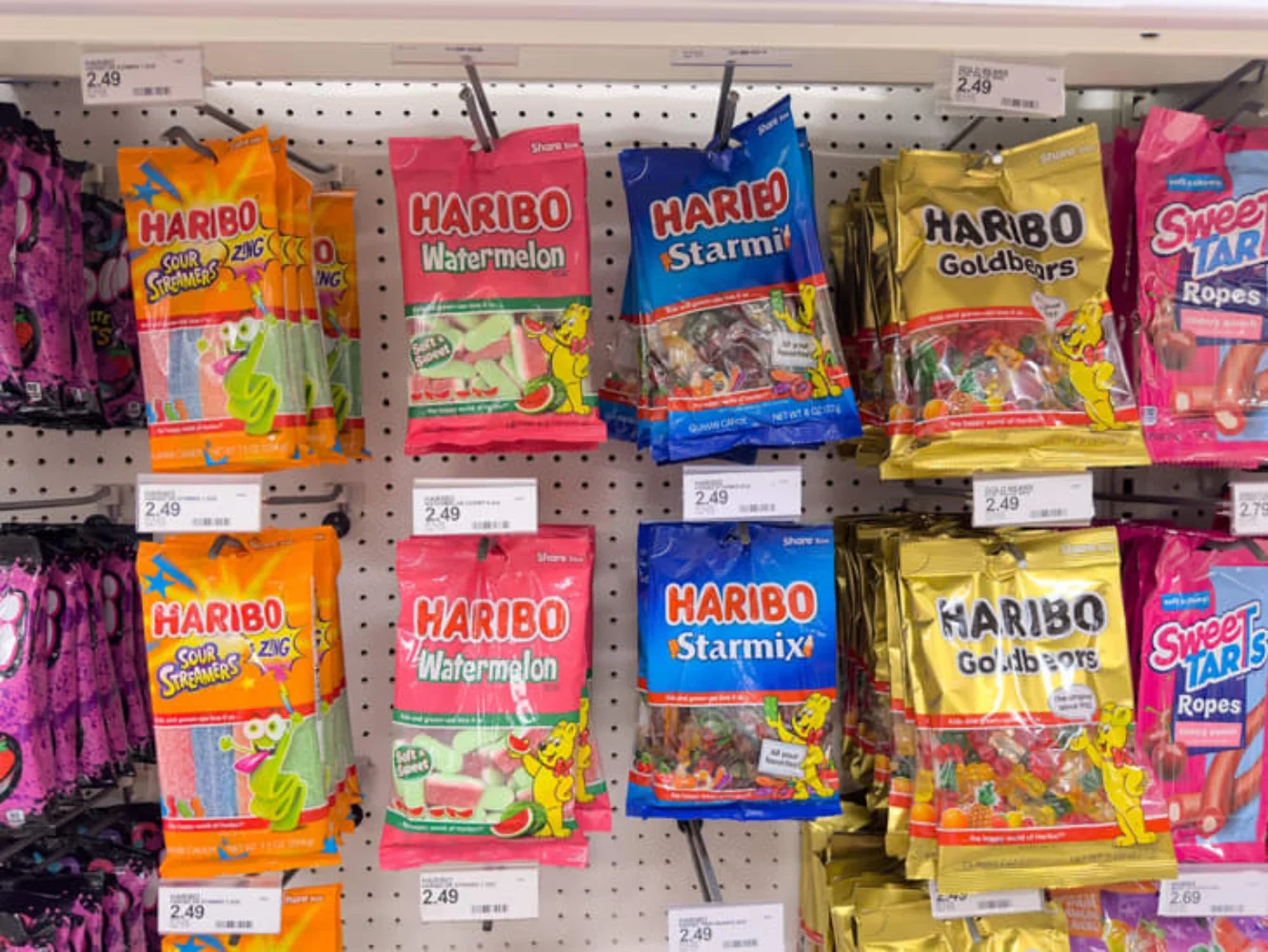
The backbone of the Haribo range is the كيس وسادة — the classic back-sealed, fin-sealed tube format that runs at high speed on a VFFS machine. The standard Goldbears bag in every format from the single-serve 30g through the 100g, 175g, and 250g sizes all use this structure. It is the cheapest format per unit, the fastest to produce, and entirely appropriate for a product that is typically consumed in one sitting. There is no zipper, no window, no gusset — just a printed bag that is opened and finished. At the scale Haribo operates, that simplicity translates into meaningful cost savings per unit across billions of bags.
The larger sharing and family sizes use a stand-up pouch with a resealable zipper — a doypack format that stands on shelf and can be closed after opening. This is where the engineering becomes more interesting, and where Haribo’s recyclable packaging development has been focused. A stand-up pouch requires a stiffer film than a pillow bag to hold its shape, a base gusset to create the standing footprint, and a zipper that survives repeated open-and-close cycles without shedding particles into the candy. All of these requirements become more demanding when the film is a single-material PE structure rather than a conventional PET/PE laminate.
Beyond flexible bags, Haribo also uses rigid plastic tubs and tubes for seasonal and gift formats — the Easter Filled Tube, holiday tins, and promotional buckets. These sit entirely outside flexible packaging and are a small part of the overall volume. The mini bags sold in multipack boxes are individual pillow bags, each sealed independently. For brands sourcing their own gummy or confectionery packaging, the starting point is almost always the pillow bag for single-serve and the stand-up pouch for sharing sizes — the same two formats that anchor the Haribo range.
ملاحظة التنسيق: For candy consumed in a single sitting, a pillow bag without a zipper is the right call — lower cost, simpler structure, no wasted closure mechanism. The zipper becomes worth its cost only when the product will realistically be resealed between servings. For gummies, that threshold is roughly the 200g+ sharing size range.
Gummy Packaging Is a Moisture Problem, Not an Oxygen Problem
Every snack packaging engineer starts from the same question: what will degrade this product first? For potato chips, the answer is oxidative rancidity — the oils in the chip react with oxygen and go stale. The response is nitrogen flushing, a metallized barrier film with a low oxygen transmission rate, and sometimes an oxygen absorber. For beef jerky, the answer combines oxygen sensitivity with a higher water activity, requiring a more complex three-element freshness system. For gummy candy, the answer is almost entirely different: moisture.
Gummy bears are made primarily of sugar, glucose syrup, gelatin, and water, cooked and set into a specific moisture content that gives them their characteristic chew. That moisture content — typically around 15 to 20 percent — is carefully calibrated during production. If the product gains moisture from the environment after packaging, the gummies become sticky, clump together, and lose their individual shape. If they lose moisture to a dry environment, they become hard and leathery. Either outcome is a product failure. The packaging’s job is to maintain the original moisture equilibrium against the ambient humidity of whatever retail, storage, and home environment the bag passes through.
This is why a Haribo bag does not need nitrogen flushing. There are no oils to oxidize, no proteins that degrade in the presence of oxygen, no reason to invest in the gas-flushing infrastructure and oxygen-absorber logistics that a chip or jerky production line requires. The film needs to block water vapor — the MVTR (moisture vapor transmission rate) is the specification that matters — and it needs to hold its barrier properties across a range of temperatures and humidity levels in transit and at retail. The oxygen transmission rate, so critical for chips and nuts, is largely secondary for gummies.
This difference — moisture versus oxygen as the primary threat — is what makes gummy packaging simultaneously simpler and more nuanced than other snack categories. Simpler, because it eliminates the need for the most expensive barrier materials (aluminum foil, high-grade EVOH) and the gas-flushing systems that add cost and complexity to chip and jerky production. More nuanced, because moisture management across the product’s full shelf life in variable environments is a specification that demands precision in film selection, even if the film itself looks unremarkable from the outside.
Film Structure: Simpler Than a Chip Bag, But Not Without Choices
Because gummy packaging is a moisture problem rather than an oxygen problem, the film structure does not need the heavy-duty barrier layer that defines chip, nut, and jerky bags. There is no requirement for aluminum foil or metallized film — both of which exist primarily to block oxygen and light in products where those are the primary degradation drivers. A gummy bag needs a printable outer layer, a sealant inner layer, and enough moisture vapor barrier between them to protect the candy’s moisture equilibrium over its shelf life. That can be achieved with simpler structures than most snack categories require.
The main structural routes used in gummy and confectionery packaging are as follows, and the right choice depends on the target shelf life, the ambient humidity of the distribution environment, and whether a recyclable structure is required.
المسار أ — BOPP / PE (طبقتان): The simplest approach. A printed BOPP outer film laminated directly to a PE sealant layer. Provides basic moisture barrier, low cost, and runs well on high-speed VFFS lines. Suitable for short shelf life products sold in low-to-moderate humidity environments. The moisture barrier is adequate rather than strong — the BOPP itself provides most of the barrier performance.
Route B — PET / PE (two-layer, higher performance): Replacing BOPP with PET as the outer layer improves moisture barrier slightly, significantly improves stiffness and puncture resistance, and raises the ceiling on print quality. The trade-off is cost. For premium confectionery or products requiring longer shelf life and better physical protection, PET/PE is the upgrade from BOPP/PE.
المسار C — BOPP / VMPET / PE (ثلاث طبقات مع حاجز معدني): Adding a metallized PET layer dramatically improves both oxygen and moisture barrier. Overkill for most gummies from an oxygen-blocking standpoint, but the improved moisture barrier is genuinely useful for products with longer shelf lives or distribution through high-humidity environments. This is the same structure used in most chip bags — applied to candy when the barrier requirements justify the cost step-up.
Route D — Mono-material PE (recyclable): A single-material polyethylene structure where all layers — outer, barrier, and sealant — belong to the PE polymer family. This is the route Haribo took for its recyclable Dragibus doypack. The moisture barrier of a mono-PE structure is lower than a metallized laminate, but for a gummy candy with a moderate shelf life target and distribution in temperate European climates, it is sufficient. This is precisely why confectionery was the first snack category to successfully commercialize a recyclable flexible stand-up pouch — the barrier requirements are low enough that the performance gap between a recyclable PE structure and a conventional laminate can be closed without major product reformulation or shelf life reduction.
Haribo has not published official film specifications for its standard range. The estimated structure for the core Goldbears pillow bag is shown below. The full mechanics of how these layers are laminated and converted into a finished bag are covered in detail in our guide on كيف يتم تصنيع الأكياس المخصصة من الفيلم إلى الكيس النهائي.
الطبقة (الخارجية → الداخلية)
المواد المقدرة
الوظيفة
طبقة الطباعة (من الخارج)
BOPP، 18–20 ميكرومتر
Stiffness, surface for reverse-printed full-color graphics; primary moisture barrier contribution from the BOPP film itself
طبقة الختم الداخلية (من الداخل)
بولي إيثيلين البولي إيثيلين من الدرجة الغذائية، 40-60 ميكرومتر
Heat-seal performance; food contact compliance; secondary moisture barrier; contact surface for the candy
Note: Film structure is estimated based on Haribo’s product requirements and industry-standard specifications for gummy confectionery packaging. Haribo has not published official material documentation. Standard pillow bags for moderate shelf life likely use a two-layer BOPP/PE structure; longer shelf life lines or stand-up pouches may use PET/PE or BOPP/VMPET/PE. The recyclable Dragibus doypack uses a confirmed mono-material PE structure. Specifications vary by market, product line, and shelf life target.
Sour Lines and Sugar Coating: When the Inner Film Needs More Attention
The standard moisture-management brief that governs Goldbears packaging gets more demanding when applied to Haribo’s sour lines — Tangfastics and similar acid-coated products. Sour gummies are coated in a mixture of citric acid, tartaric acid, and sugar, applied as a fine crystalline powder that gives the product its initial sharp flavor before the sweetness of the gummy comes through. That acid coating introduces two additional considerations that a plain gummy bag does not face.
The first is acid contact with the inner film. Citric acid in a sealed bag is in prolonged contact with the inner sealant layer — typically PE — for the entire shelf life of the product. A PE sealant that reacts with the acid over months of contact can develop off-flavors that migrate into the candy, and in extreme cases can weaken the seal integrity at the contact zones. For a low-acid product like standard Goldbears, a generic food-grade PE inner film performs adequately. For a high-acid sour product, the inner film specification deserves explicit validation against the specific acid load — the same principle we noted when examining Takis’ citric acid seasoning requirements for their inner film.
The second consideration is sugar powder migration. The crystalline acid-sugar coating sheds fine particles inside the bag during transit and handling. These particles accumulate at the seal zones — particularly the fin seal of a pillow bag — and can contaminate the heat-seal area, creating weak points where the seal is compromised by interposed powder. A stand-up pouch with a wide base seal is somewhat less vulnerable than a narrow fin seal, but powder contamination at the zipper is also a real concern: a zipper track filled with crystalline sugar does not reseal cleanly, defeating the purpose of the closure. These are the engineering details that differentiate a well-specified confectionery bag from a generic one.
The First Recyclable Candy Doypack: What Haribo Actually Did in 2020
In July 2020, Haribo launched the first recyclable stand-up pouch in the global confectionery market — a doypack for its Dragibus range in France. The bag is made from a single material, polyethylene, across all layers. According to Haribo France’s brand manager at the time of launch, the development took two years of research and involved simultaneously meeting three objectives: creating a recyclable flexible package, maintaining the same freshness and quality as the conventional bag, and introducing Dragibus in a sharing-size resealable format that had not previously existed in the range. The carbon footprint of manufacturing the new PE structure was reported as approximately half that of the conventional PET/PE laminate it replaced.
Why did confectionery get there before chips, nuts, or coffee? The answer is precisely the moisture-not-oxygen logic described earlier. The barrier requirement for a gummy candy is low enough — MVTR rather than OTR, and at moderate rather than extreme levels — that a mono-material PE structure can meet it without a major performance gap relative to the conventional laminate. A chip brand trying to do the same thing faces the challenge that a mono-PE structure’s oxygen barrier is significantly lower than a metallized laminate — a gap that requires compensating measures like heavier nitrogen flushing, which adds cost and complexity. For Haribo’s Dragibus, the barrier requirements were within reach of what a well-engineered mono-PE film could deliver. The product did not need to be reformulated, and the shelf life target was achievable. That alignment of low barrier requirements with the capabilities of recyclable film structures is why candy was first.
This is the same logic that underpins the recyclable transitions we have covered for Lavazza’s coffee bags و Lay’s chip bags — in both cases, the transition is harder because the barrier requirements are higher. Haribo had the easier engineering brief, which is why it happened first. The broader goal Haribo set in 2018 — reducing plastic in its packaging by 20 percent by 2025 — is being pursued through multiple steps including bag size reductions that have already saved ten tonnes of plastic, alongside the recyclable structure development.
Why gummy brands should consider recyclable film first: If your product’s primary packaging challenge is moisture rather than oxygen, you are likely a strong candidate for a mono-material PE or PP recyclable structure. The barrier gap between recyclable and conventional film is smallest in low-OTR-requirement applications — which is precisely the confectionery and dry snack category. This is the lowest-cost entry point into recyclable flexible packaging, and it is where the most commercial traction has been gained so far.
Sourcing Custom Gummy or Confectionery Packaging: Start With the Moisture Spec
The Haribo case demonstrates something that applies directly to any brand sourcing its own gummy or confectionery packaging: the barrier specification conversation should start with moisture, not oxygen. Most packaging suppliers default to the same metallized three-layer structure they sell to chip brands — partly because it works, partly because it is familiar, and partly because the margin on a more complex structure is higher. For a gummy product with moderate shelf life requirements, that structure is frequently an over-specification that adds cost without adding meaningful product protection. The right film for your product starts from your specific MVTR requirement, your shelf life target, and your distribution environment — not from what your supplier typically quotes.
For brands with sustainability commitments or European market exposure, the recyclable angle is worth a direct conversation. Gummy and confectionery products are among the easiest categories to transition to mono-material PE or PP recyclable structures, precisely because the barrier requirements are lower than most other food categories. At JINYI, both conventional and recyclable flexible packaging structures are available — traditional BOPP/PE and PET/PE laminates for standard applications, and mono-material PE and PP structures for brands targeting recyclable packaging commitments, particularly in European markets where regulatory and consumer pressure is highest. The right choice depends on the product’s moisture sensitivity, its target shelf life, and the waste infrastructure in its distribution markets.
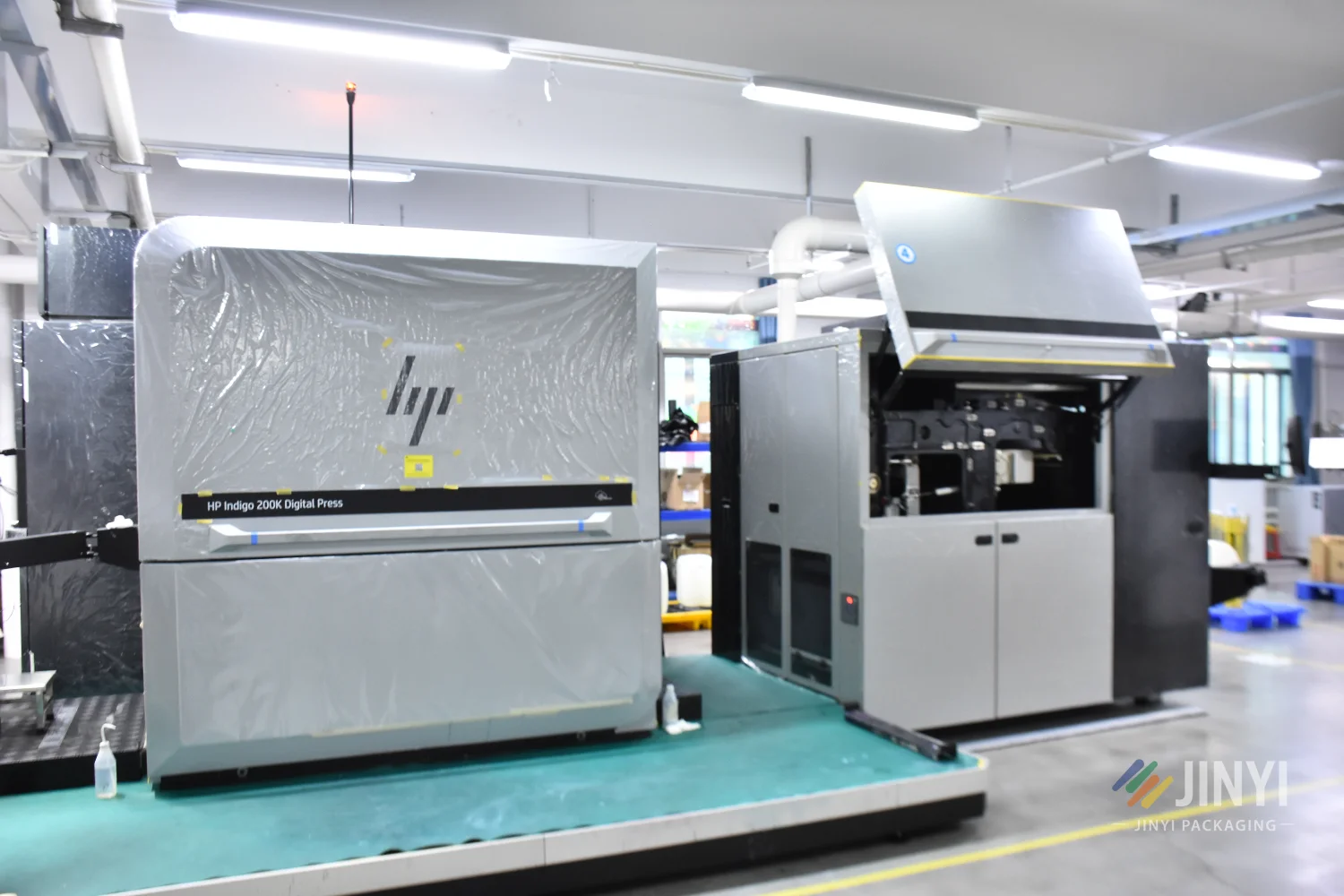
طابعة HP Indigo 200K - أحدث طابعة من إنتاج شركة JINYI، التي تم تشغيلها في عام 2025، لتوسيع سعة الطباعة الرقمية وتقليل فترات الإنتاج
The HP Indigo digital press fleet at JINYI — including the HP Indigo 25K for high-speed short-run production and the HP Indigo 6K for fast-turnaround design samples — handles full-coverage confectionery graphics across pillow bags, stand-up pouches, and flat pouches from 500 units. For a brand launching multiple flavors or seasonal variants, digital print allows each design to run independently without plate or cylinder commitment, at the same print quality as a gravure run. Every JINYI order includes free 3D mockup rendering before production, production progress updates at each manufacturing stage, and free e-commerce photography of the finished bags.
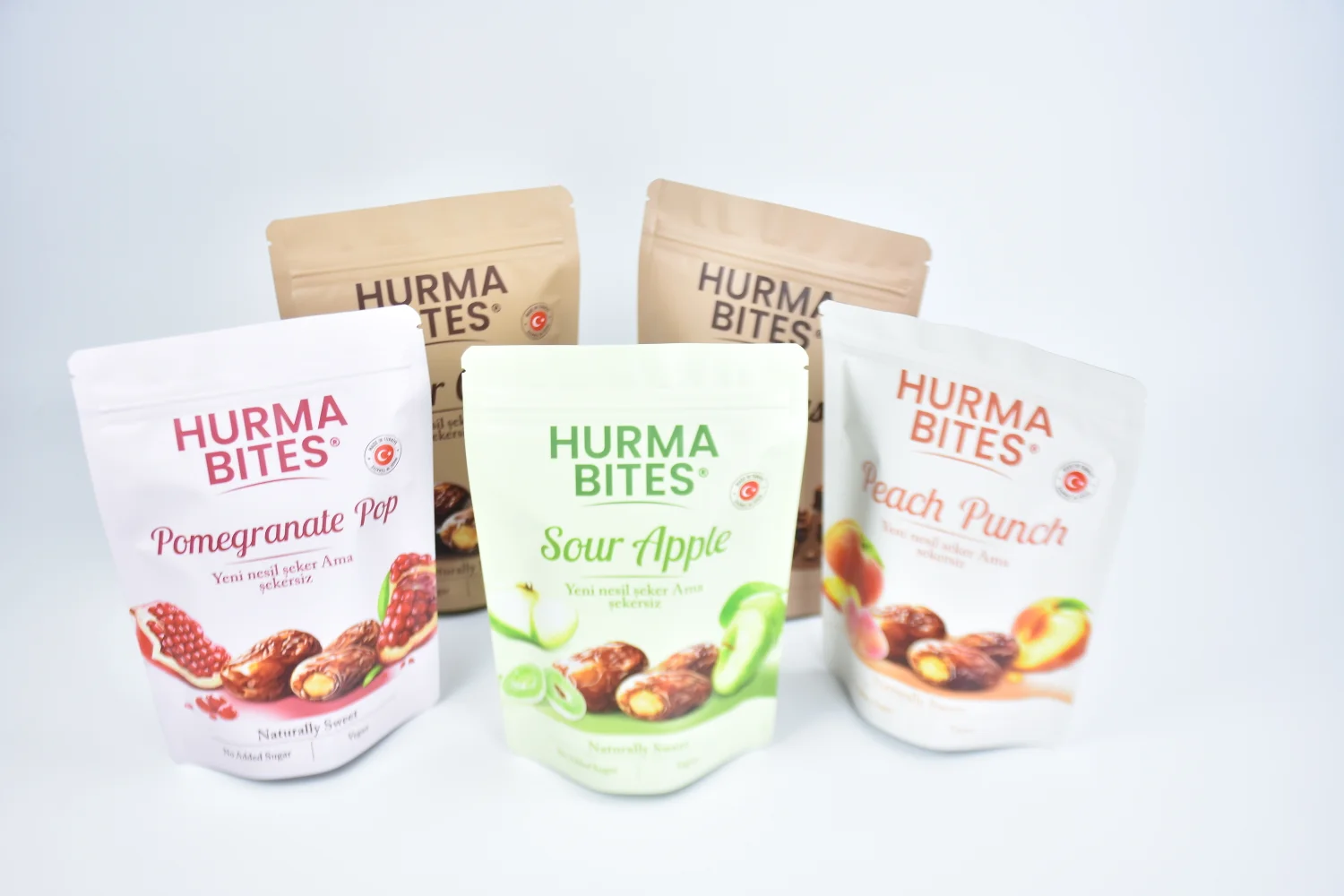
Two recent client projects from JINYI’s confectionery packaging work illustrate how these decisions play out in practice. The first is Hurma Bites, a Turkish brand producing date-based candy in flavored varieties — Pomegranate Pop, Sour Apple, Peach Punch, and others. The brief combined the moisture-management requirements of a natural fruit product with the visual demands of a premium health-snack brand targeting international retail. The result is a clean matte stand-up pouch with a color-coded design system — each flavor carries its own background tone — product photography on the front face, and a resealable zipper. The film specification addresses the date candy’s moisture sensitivity without over-engineering the barrier, while the matte finish and flavor-color system give the range strong shelf cohesion.
Hurma Bites (Turkey) — Custom matte stand-up pouches with flavor-coded color system, resealable zipper, and product photography. Produced by JINYI.
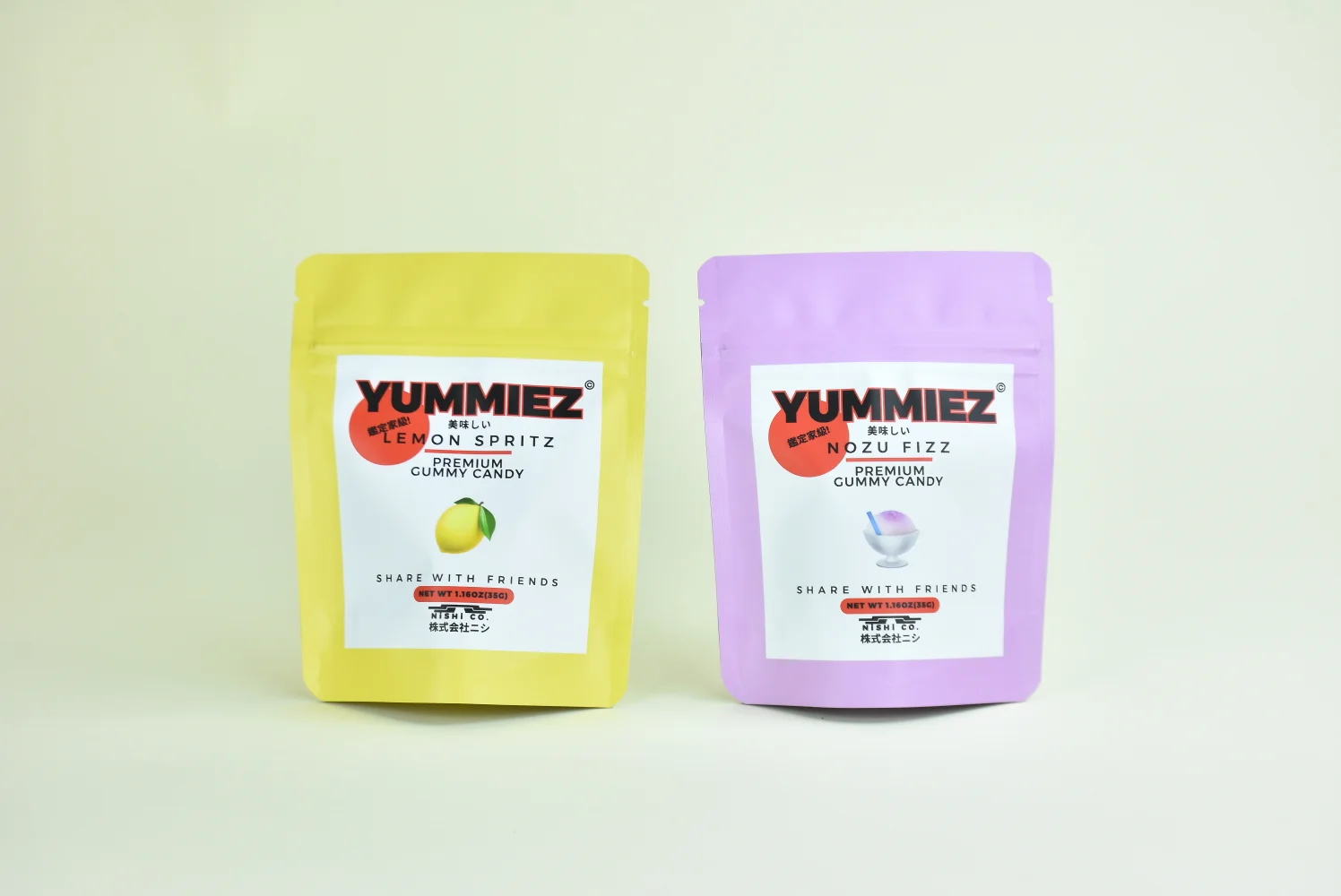
The second is Yummiez, a German premium gummy candy brand distributed through Japanese-inspired retail. The packaging uses solid-color stand-up pouches — lemon yellow and lavender — with a clean white label panel carrying bold typography and a Japanese design aesthetic. The brief here was entirely about shelf presence and brand identity: a gummy candy with no unusual barrier requirements, where the packaging decision was primarily a design and format question. The stand-up pouch format gives the brand strong shelf presence in a category otherwise dominated by flat pillow bags, and the solid-color film surface allows the label panel to carry the full brand story without competing with a busy print background.
Yummiez (Germany) — Solid-color stand-up pouches with Japanese-inspired label design for premium gummy candy. Produced by JINYI.
Sourcing custom gummy or confectionery packaging?
JINYI produces pillow bags and stand-up pouches in conventional and recyclable mono-material structures — with moisture barrier specifications matched to your product, full-color digital or gravure printing, and free 3D mockup, production updates, and e-commerce photography included with every order. From 500 units.
JINYI هي مصنع مصدر للتغليف المرن المخصص مع أكثر من 15 عامًا من الخبرة في الإنتاج، حيث تقدم خدمات الأغذية والمكملات الغذائية والقهوة وأغذية الحيوانات الأليفة والعلامات التجارية للسلع الاستهلاكية في أكثر من 70 دولة. نحن ننتج أكياسًا قائمة وأكياسًا ذات قاع مسطح وأكياس وسائد وأكياس مجمعة جانبية من PET/AL/PE وPET/VMPET/PE وغيرها من مواصفات الحواجز - عبر الطباعة الرقمية من HP Indigo من 500 وحدة وطباعة الحفر بكميات كبيرة - مع تضمين وثائق المواد الكاملة كمعيار قياسي مع كل طلب.
هذا ما من الفيلم إلى النهاية - تم إنجازه بشكل صحيح يعني في الممارسة العملية.
إلسا
مدير تطوير الأعمال - شركة جيني للتغليف والتعبئة والتغليف
تقود إلسا تطوير الأعمال وإدارة طلبات العملاء في شركة جيني. وبفضل عملها لمدة 8 سنوات في التجارة الخارجية في ييوو ودونغقوان، فإنها تتمتع بفهم حاد للطلب في السوق وما يحتاجه المشترون بالفعل - مما يحول رؤية العملاء الحقيقية إلى قرارات التغليف الصحيحة.
Standard Haribo pillow bags are estimated to use a two-layer BOPP/PE structure — a printed polypropylene outer film laminated to a food-grade polyethylene sealant. Larger sharing pouches may use PET/PE for improved stiffness. The recyclable Dragibus doypack uses a confirmed mono-material polyethylene structure. Haribo has not published official film specifications for its standard range.
Why don’t Haribo bags have nitrogen inside like chip bags?
Nitrogen flushing protects against oxidative rancidity — the degradation of oils when exposed to oxygen. Gummy candy contains very little oil and is not susceptible to oxidative rancidity. The primary threat to gummies is moisture: too much and they become sticky and shapeless, too little and they harden. The packaging is engineered to control moisture vapor transmission, not oxygen.
Was Haribo really the first candy brand to use a recyclable stand-up pouch?
Yes, according to Haribo’s announcement in 2020. The Dragibus recyclable doypack, launched in France in July 2020, was the first recyclable stand-up pouch in the global confectionery market. It uses a mono-material polyethylene structure and required two years of development. The carbon footprint of manufacturing the new structure is approximately half that of the conventional PET/PE laminate it replaced.
Why is gummy candy packaging easier to make recyclable than chip packaging?
Chip bags need a very low oxygen transmission rate, which requires metallized film or aluminum foil — both of which make the structure non-recyclable. Gummy bags need moisture barrier, not oxygen barrier, and that requirement can be met by a mono-material PE structure whose performance gap relative to a conventional laminate is manageable. Lower barrier requirements make the recyclable transition technically and commercially feasible at reasonable cost.
Can I order custom gummy or candy bags at low minimum quantities?
Yes. Through HP Indigo digital printing, custom pillow bags and stand-up pouches for confectionery can be produced from 500 units — in both conventional and recyclable mono-material structures. This allows a brand to validate design, film spec, and market response before committing to a large gravure run. JINYI includes free 3D mockup rendering, production progress updates, and e-commerce photography with every order.