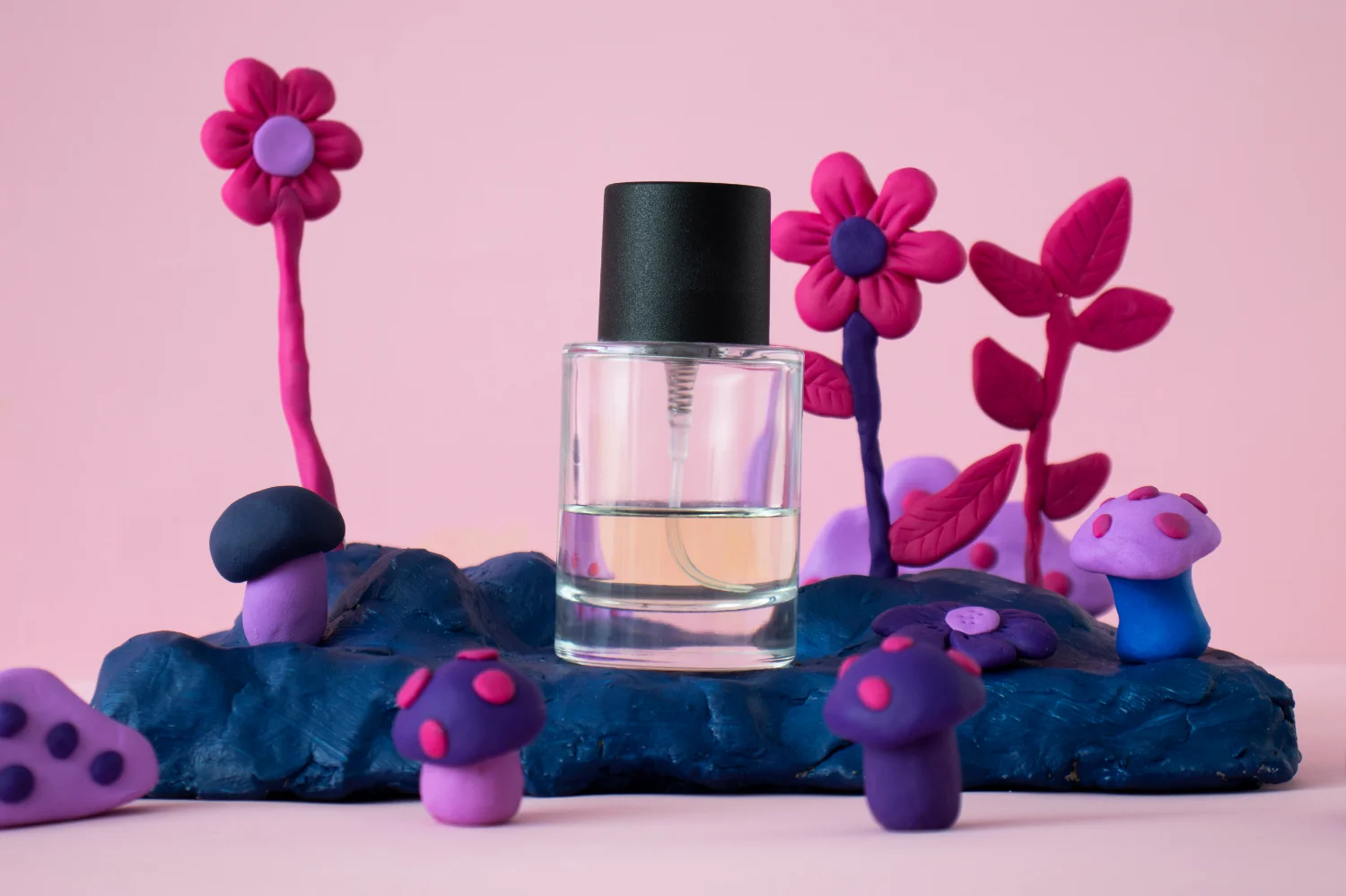
Some fragrances smell bright at launch, then feel flat weeks later. Customers notice missing top notes first. Teams often blame the formula, but packaging can quietly change the aroma balance.
Plastic usually loses top notes faster when the wall absorbs aroma molecules (scalping) or allows permeation over time. Glass rarely acts as an aroma sink, but glass can still lose top notes quickly if the closure leaks or breathes.
Explore cosmetic packaging that protects fragrance and reduces top-note loss across storage and shipping.

Top-note loss is rarely one mechanism. A fragrance can lose volatile molecules through permeation to the outside, or it can lose them into the package wall through absorption. A closure can also become a shortcut variable through micro-leaks or material incompatibility. As a flexible packaging manufacturer, we focus on measurable exposure paths and the sealing details that packaging can control.
What does “top note loss” mean, and how should brands measure it?
Many teams judge top notes by memory. That approach creates arguments, not decisions. A team needs repeatable markers and a shared test temperature.
Top note loss should be measured with a small set of volatile markers, headspace intensity at a fixed temperature, and a sensory triangle test linked to the instrument data.
Use marker retention, headspace strength, and sensory confirmation together
A team should define top notes as a measurable set of highly volatile molecules that drive the first impression. A team can select three to six marker compounds that represent the “bright” character of the fragrance and track them over time by HS-GC-MS. A team should measure headspace intensity at a fixed temperature, because headspace changes often match what users perceive. A team should add a sensory triangle test or a simple intensity score, but the panel results should be tied back to marker retention so the team avoids purely subjective conclusions. A team should also separate “total volatiles” from “ratio drift,” because a fragrance can smell dull even when total volatiles remain high if top-note markers drop faster than base notes. A team can validate scalping by extracting aroma from the plastic wall or by using thermal desorption to confirm that molecules moved into the package material.
| Measurement |
What it shows |
Why it matters for packaging |
| Top-note marker retention (HS-GC-MS) |
specific losses of high-volatility notes |
distinguishes permeation from ratio drift |
| Headspace intensity at fixed temperature |
what the consumer smells first |
captures sink effects and small leaks |
| Sensory triangle / intensity score |
perceptible change threshold |
confirms whether analytical shifts matter |
| Wall uptake check (extract/desorb) |
scalping into plastic |
proves the wall acted as an aroma sink |
Evidence (Source + Year): Reynier et al., “Stabilization of Aroma Compounds through Sorption…” Journal of Agricultural and Food Chemistry (2004). | Franz, permeation and lag-time discussion for aroma compounds through polymer films, Packaging Technology and Science (2014).
Is plastic losing top notes faster because of permeation, or because of scalping into the wall?
Plastic does not fail in one way. Some plastics let aroma escape slowly. Some plastics absorb aroma and hold it. Both paths can weaken top notes.
Permeation is loss to the outside over time. Scalping is loss into the wall, where the polymer becomes an aroma sink. Scalping can remove top notes even when the closure is perfect.
Separate “outside loss” from “inside sink” using a top-note budget model
A top-note budget model helps a team avoid guessing. The model splits losses into three terms. The first term is outside loss through the wall and through the closure. The second term is inside loss into the plastic wall through absorption or sorption. The third term is use-behavior loss when consumers open, spray, and expose headspace repeatedly. A team can separate outside loss from inside sink by measuring wall uptake and by comparing different plastics under the same closure. If wall uptake rises while headspace markers fall, the wall likely acted as a sink. If wall uptake stays low but headspace markers fall and package mass drops, permeation or leakage likely dominated. A team should avoid broad labels like “plastic is bad” because PET, HDPE, and multilayer structures behave differently. A team should also track surface-area-to-volume ratio because small bottles can show faster drift even when the material is the same.
| Loss path |
What changes first |
Best confirmation test |
| Permeation to outside |
marker loss + possible mass loss |
mass tracking + headspace markers |
| Scalping into plastic wall |
marker loss without mass loss |
wall extraction / thermal desorption |
| Closure shortcut (micro-leak) |
fast drift across all materials |
leak screening + closure comparison |
Evidence (Source + Year): Reynier et al., aroma sorption and packaging interactions, Journal of Agricultural and Food Chemistry (2004). | Peyches-Bach et al., ethanol effects on sorption of volatile compounds in polyethylene film, Journal of Agricultural and Food Chemistry (2012).
Why does glass usually win on barrier, yet still fail when closures leak?
Many brands switch to glass and expect stability. Some products still lose top notes fast. Those cases often come from the closure, not the bottle.
Glass rarely absorbs aroma and it offers strong barrier performance, but the closure can become the dominant loss path through micro-leaks, gasket incompatibility, or poor seal compression.
Treat the closure as the primary risk interface, not as a commodity component
Glass usually performs well because the wall does not act as an aroma sink and the barrier is strong. The closure system can still dominate performance because it contains more materials and interfaces. A spray pump or crimp can include elastomers, liners, and valves that can swell, relax, or leak after temperature changes. A threaded closure can lose compression when materials creep or when liners do not recover after heat exposure. If glass performs close to plastic in top-note loss, a team should test closure integrity first. A team can screen for leak risk with mass tracking, pressure decay, or a controlled headspace marker test that isolates the closure. A team should also compare multiple liners or gasket materials under the same bottle. This step prevents false conclusions such as “glass did not help,” when the real issue is a shortcut variable in the closure system.
| Closure risk |
What it causes |
Practical check |
| Micro-leak at threads or crimp |
fast headspace drift |
mass change + repeat headspace test |
| Gasket swelling or relaxation |
seal compression loss |
torque/compression retention check |
| Valve or pump breathing |
oxygen and aroma exchange |
closure A/B comparison under same bottle |
Evidence (Source + Year): ISO 15105-1:2007, gas transmission rate determination for plastic films and sheeting (ISO, 2007). | Franz, permeation and lag-time concepts for aroma compounds in polymer packaging (2014).
If glass still loses top notes, evaluate closure sealing and gasket compatibility before changing the formula.

Which variables dominate: temperature cycles, bottle thickness, or surface-area-to-volume ratio?
Some SKUs fail only in summer shipments. Some fail only in small bottles. Those patterns point to stress dose, not random chemistry.
Temperature and time increase diffusion and can raise loss rates. Thin walls and high surface-area-to-volume ratios amplify both permeation and scalping. Heat cycling can also increase closure leak probability.
Rank risk using simple geometry and route stress, then validate with a controlled profile
A team should not treat storage as a single temperature. A team should treat storage and shipping as a stress sequence with peaks and cycles. Temperature typically increases diffusion rates and can change how aroma molecules partition into plastics, which can accelerate scalping. Bottle thickness affects the path length for diffusion, and a thin wall can increase flux for a given material. Surface-area-to-volume ratio matters because a small bottle exposes more wall area per unit fragrance, which increases both wall uptake capacity and permeation opportunity. Heat cycling can also change closure stress and raise micro-leak risk. A team can rank risk by combining route temperature exposure, bottle geometry, and expected shelf time. A team should then validate the ranking with a controlled thermal profile and a fixed measurement temperature for headspace tests. This approach makes the decision about plastic versus glass more predictable across sizes and channels.
| Variable |
Why it matters |
What to watch |
| Temperature and cycling |
raises diffusion and can destabilize seals |
marker loss slope increases after hot cycles |
| Wall thickness |
controls diffusion path length |
thin-wall packs drift faster at equal material |
| Surface-area-to-volume ratio |
amplifies sink and flux per unit product |
small bottles show earlier top-note dulling |
Evidence (Source + Year): Cava et al., limonene diffusion through polymer materials, Polymer Testing (2005). | Franz, polymer permeation and lag-time discussion (2014).
How does ethanol change aroma sorption and diffusion in polymers?
Many fine fragrances contain ethanol. Ethanol changes how aroma molecules behave near polymers. The packaging that works for one base can fail for another.
Ethanol can change how volatile compounds partition into polymers and can increase sorption for some molecules in polyethylene-type films. This shift can change which top notes disappear first.
Assume ethanol changes partitioning, then test for aroma drift by marker families
Ethanol is not a passive solvent in packaging contact. Ethanol can change the polarity of the fragrance matrix and can shift how volatile compounds partition between liquid, headspace, and packaging wall. A team should expect that some compounds will show higher affinity for some polymers under ethanol conditions. That effect can amplify scalping for certain top-note families such as citrus-like terpenes, depending on the polymer and the closure materials. A team should also treat closures as part of the contact system because gaskets and liners can interact with ethanol and aroma components. A team can test the effect by comparing ethanol-containing fragrance to an oil-based fragrance in identical packaging, while tracking the same marker set. A team that sees different marker loss patterns should treat the result as a packaging compatibility signal, not as random variability.
| System feature |
Risk it increases |
How to verify quickly |
| Ethanol-based fragrance |
changed partitioning and sorption behavior |
marker drift pattern under fixed temperature |
| Polyethylene-type components |
higher sorption for some volatiles |
wall uptake check after storage |
| Elastomer liners and gaskets |
swelling and seal changes |
closure A/B test with mass tracking |
Evidence (Source + Year): Peyches-Bach et al., ethanol effect on sorption of volatile compounds in polyethylene film, Journal of Agricultural and Food Chemistry (2012). | Reynier et al., aroma sorption considerations in packaging interactions (2004).
What is the minimum proof pack to choose between plastic and glass without guessing?
Many packaging decisions compare one bottle to one bottle. That test cannot separate wall effects from closure effects. The result usually misleads the team.
A minimum proof pack uses a 2×2×2 matrix across container type, closure quality, and thermal condition. This matrix reveals whether the dominant loss path is permeation, scalping, or closure shortcut.
Run a small matrix that isolates wall sink effects from closure shortcut failures
A team can make the decision data-driven with a small but high-information matrix. A team can compare glass versus plastic, but the plastic set should include at least two categories such as PET and HDPE to avoid overgeneralization. A team should keep the fragrance batch identical. A team should compare a standard closure set against a higher-integrity closure set that uses more resistant sealing materials and better compression retention. A team should include constant temperature control and a thermal cycling condition that matches the expected channel stress. Every cell should track top-note marker retention by HS-GC-MS and headspace intensity at a fixed test temperature. Every cell should also include a wall uptake check for the plastic samples to confirm scalping. A team should include a simple leak screen or mass tracking to detect closure shortcuts. This matrix turns “plastic versus glass” into a clear decision about the dominant loss path.
| Factor |
Level A |
Level B |
Main question |
| Container wall |
glass |
plastic (PET vs HDPE) |
is the wall a sink or a barrier risk? |
| Closure system |
standard |
reinforced sealing |
is closure a shortcut variable? |
| Condition |
constant temperature |
thermal cycling |
does route stress accelerate loss? |
Evidence (Source + Year): Grand View Research, Fragrances Market Size & Outlook (Grand View Research, 2024). | ISO 15105-1:2007 (ISO, 2007).

Conclusion
Plastic often loses top notes faster because walls can absorb aromas and allow permeation. Glass usually wins on the wall, but closures can erase that advantage. Contact us to validate the fastest proof pack.
Review fragrance packaging for top-note protection
About Us
Brand: Jinyi
Slogan: From Film to Finished—Done Right.
Website: https://jinyipackage.com/
Our Mission:
JINYI is a source manufacturer focused on custom flexible packaging. We aim to deliver reliable, practical packaging solutions so brands can reduce communication cost, receive stable quality, keep lead times clear, and match packaging structure and print results to real use conditions.
Who We Are:
JINYI is a source manufacturer specializing in custom flexible packaging solutions, with over 15 years of production experience serving food, snack, pet food, and daily consumer brands.
We operate a standardized manufacturing facility equipped with multiple gravure printing lines as well as advanced HP digital printing systems, allowing us to support both stable large-volume orders and flexible short runs with consistent quality.
From material selection to finished pouches, we focus on process control, repeatability, and real-world performance. Our goal is to help brands reduce communication costs, achieve predictable quality, and ensure packaging performs reliably on shelf, in transit, and at end use.
FAQ
- Does plastic always lose top notes faster than glass?
Plastic often loses top notes faster when scalping or permeation dominates. A high-integrity closure and a low-sink plastic can narrow the gap in some cases.
- Why can a glass bottle still smell weaker over time?
A closure can leak or breathe through valves, liners, or thread interfaces. A closure shortcut can dominate even when the glass wall is strong.
- What is “scalping” in fragrance packaging?
Scalping occurs when aroma molecules absorb into the plastic wall and reduce the top-note fraction in the liquid, even without a visible leak.
- Which test is the fastest way to compare packaging options?
A small 2×2×2 matrix across container type, closure quality, and thermal condition, combined with HS-GC-MS marker tracking, provides clear answers.
- Do travel-size bottles lose top notes faster?
Small bottles often have higher surface-area-to-volume ratios, which can amplify wall uptake and permeation effects and accelerate perceived top-note loss.