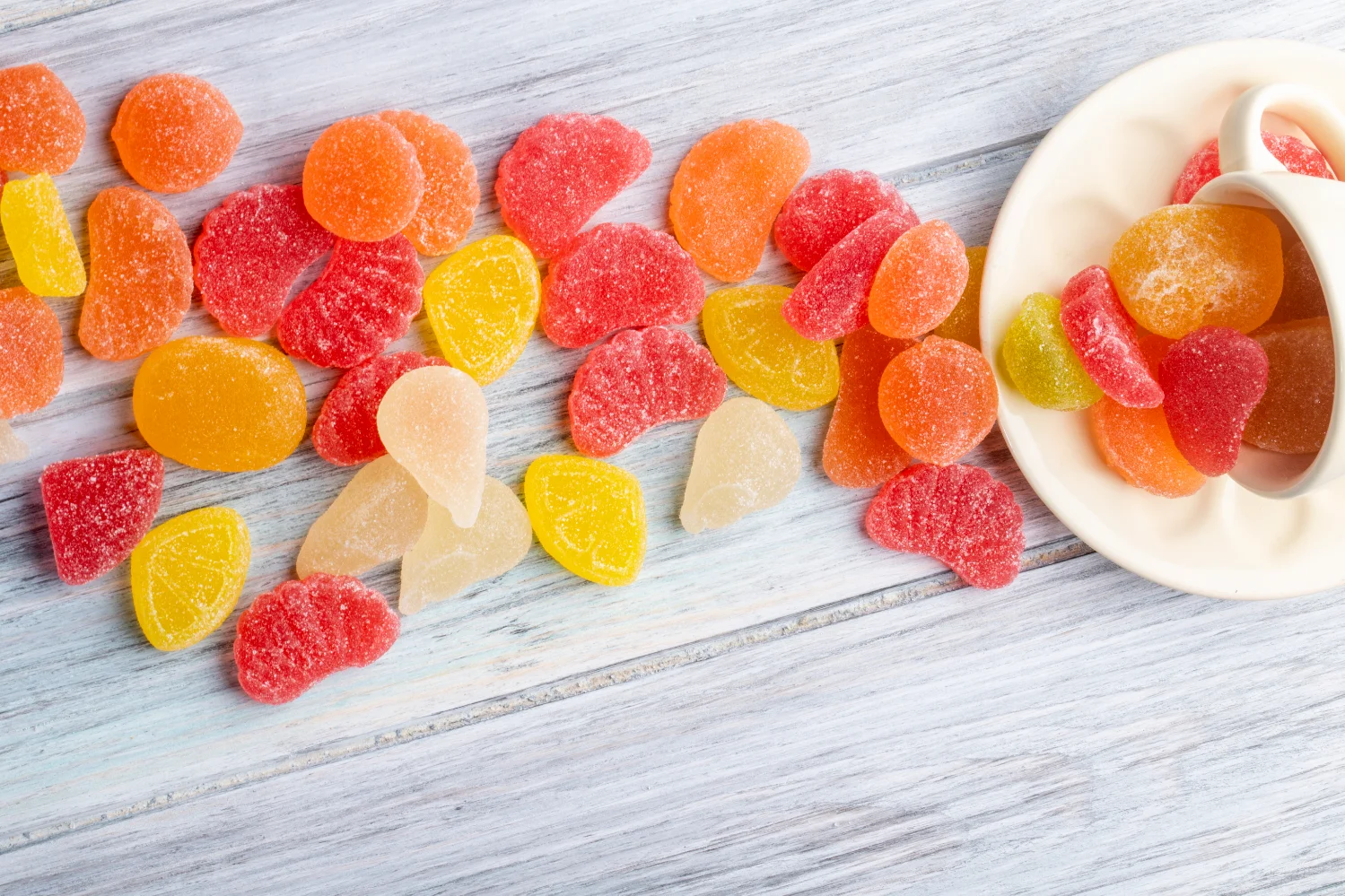
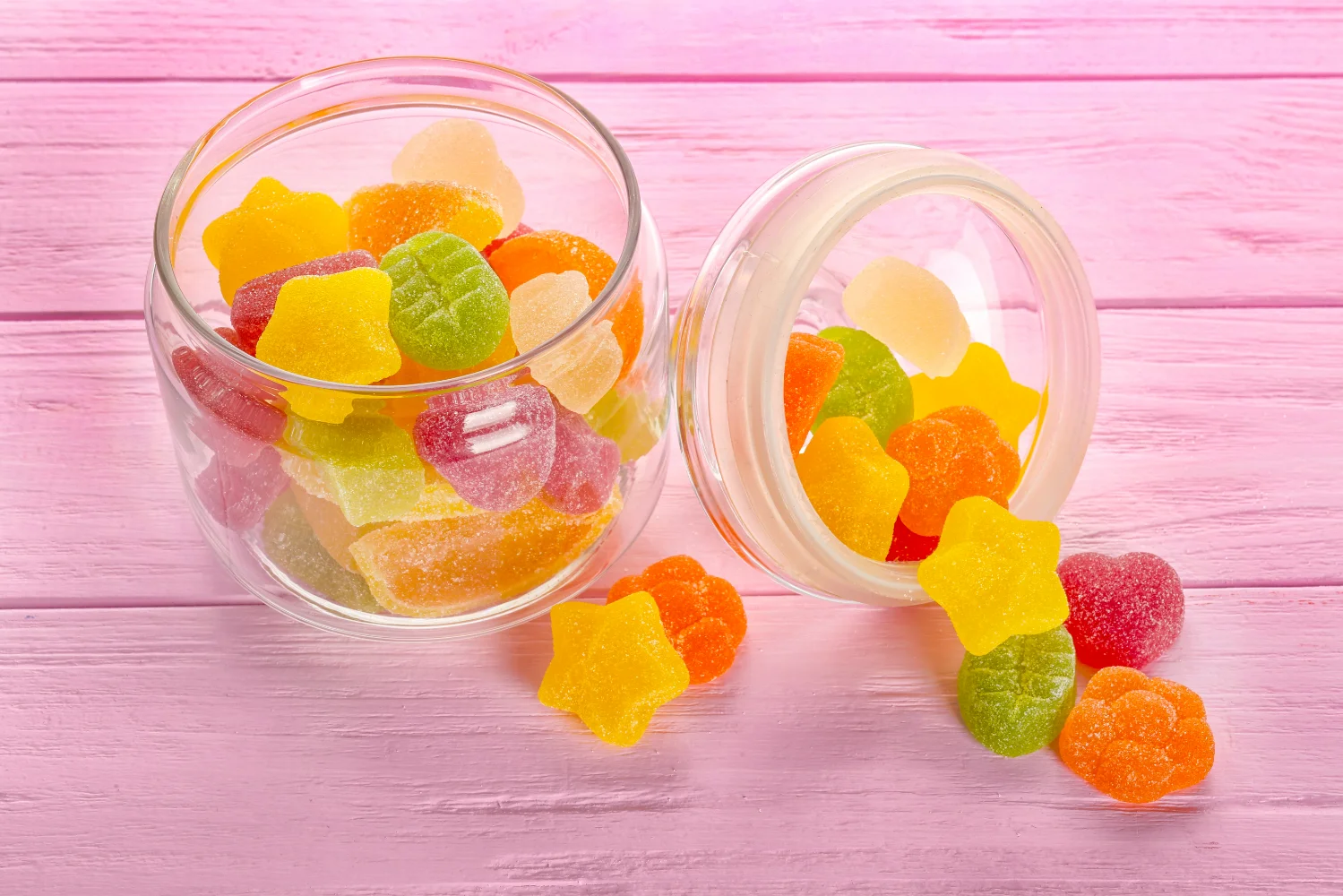
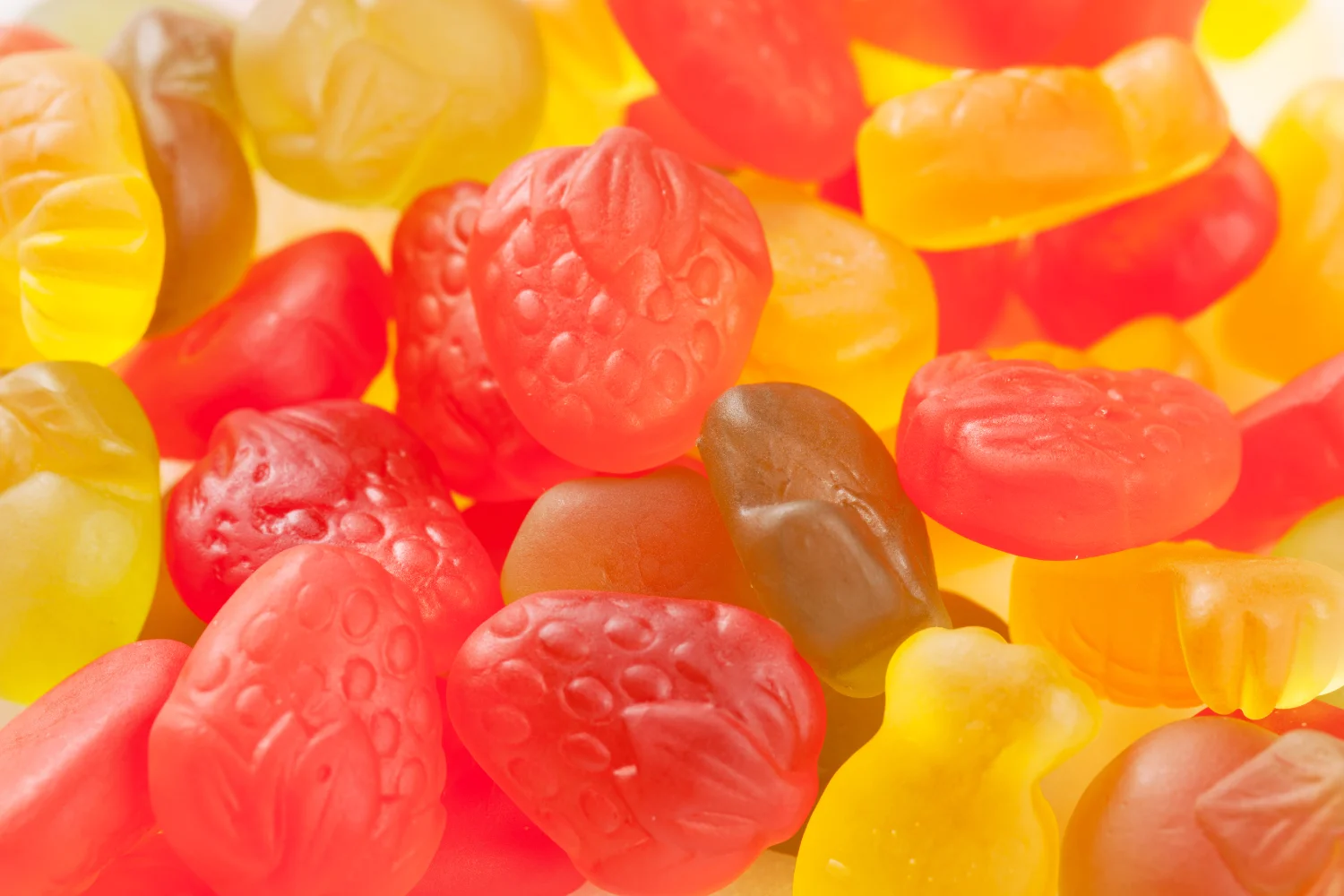
Gummies can leave the factory perfect and still fail on shelf. Customers call it “stale,” “too sticky,” or “wet,” and refunds follow.
Texture drift is usually a state change driven by water activity, moisture migration, glass transition (Tg), sugar phase behavior, and gel network shifts. If those drivers move, gummies turn hard, sticky, or wet even when the formula looks “unchanged.”
Stop gummy complaints by controlling moisture exchange with the right barrier pouch

Most texture complaints map to measurable variables. When brands translate “hard/sticky/wet” into aw, moisture, Tg, crystallization, and syneresis signals, they can fix the root cause instead of guessing.
Why do gummies drift in texture even when the formula is “the same”?
Customers assume time ruins gummies. In reality, the product state shifts when moisture and temperature push it across stability boundaries.
“Same recipe” can still drift if water activity equilibrates with the environment, Tg drops or rises, or the sugar/gel system reorganizes during storage. The drift can be measured and predicted.
Use four measurements to translate complaints into physics
Brands can reduce noise by using four anchors: water activity (aw), moisture content, glass transition temperature (Tg), and texture profile analysis (TPA). aw describes the energetic “availability” of water and strongly relates to both safety and quality. Moisture content explains why two gummies with similar aw can still feel different, because water can be bound differently in the matrix. Tg is the switch point between glassy (hard, brittle, dry-feeling) and rubbery (soft, tacky) behavior in amorphous sugar systems, and it moves with moisture. TPA turns complaints into numbers like hardness and adhesiveness. Together, these metrics create a repeatable language that production, QA, and packaging teams can share.
| Consumer complaint |
What to measure |
Most common driver |
| Hard / tough |
aw, moisture, Tg, TPA hardness |
Water loss + glassy shift |
| Sticky / tacky |
aw at surface, Tg vs storage temp, TPA adhesiveness |
Moisture pickup + rubbery surface |
| Wet / weeping |
Syneresis %, moisture gradients |
Gel network contraction |
Evidence (Source + Year):
Hartel, “Phase/State Transitions of Confectionery Sweeteners” (Comprehensive Reviews in Food Science and Food Safety) (2010).
Talcott Lab (Texas A&M), “Moisture and Shelf Life in Sugar Confections” (2010).
Hard over time: Is it water loss, glass transition, or network tightening?
Hard gummies feel like “stale candy,” but hardness usually has a physical trigger. The trigger is often moisture leaving the matrix or Tg moving above storage temperature.
Gummies harden when water desorbs, aw drops, and the amorphous sugar/gel system shifts toward a glassy state. Gel networks can also tighten during storage, increasing firmness.
Hardening is often a moisture + Tg problem, not an “age” problem
In sugar confections, moisture migration is a core shelf-life driver because it changes both structure and mobility. When moisture decreases, Tg typically increases and the product behaves more glassy at the same storage temperature. That glassy shift increases perceived hardness and can reduce bite recovery. In high-sugar gel systems, the gel structure also evolves during storage, and the balance between sugar solids and gelatin (or other gelling agents) affects gelling behavior and mechanical properties. This is why the same gummy can feel fine at one humidity and turn hard in a drier warehouse. A practical control strategy is to set an aw target range and a hardness target at the end of shelf life, then validate across different RH conditions.
| Hardening signal |
Likely root cause |
Fast check |
| Hardness rises, aw drops |
Moisture loss to environment |
Equilibrium RH vs pack barrier |
| Hardness rises, moisture stable |
Network tightening / phase change |
Tg vs storage temperature |
| Hard edges, softer core |
Moisture gradient from drying/pack |
Cross-section moisture mapping |
Evidence (Source + Year):
Talcott Lab (Texas A&M), “Moisture and Shelf Life in Sugar Confections” (2010).
Burey et al., “Confectionery Gels: A Review…” (International Journal of Food Properties) (2009).
Sticky or tacky: What does moisture pickup do to the surface state?
Sticky gummies are not always “too much syrup.” Stickiness often starts at the surface when moisture enters and Tg drops below storage temperature.
When gummies absorb moisture, the surface can shift into a rubbery state and feel tacky. Moisture can also trigger sugar migration and later crystallization, creating sticky-then-grainy complaints.

Stickiness is often a surface Tg crossing event
Moisture sorption can rapidly change the surface condition before the core changes, especially when packs are opened, seals leak, or the moisture barrier is weak. In confectionery sweetener systems, Tg is strongly dependent on moisture content, so even small moisture gains can lower Tg and shift the surface into a rubbery, tacky state at room temperature. Once tackiness starts, pieces can block together, coatings can smear, and consumers perceive “melting” even without heat. A second failure mode happens after moisture pickup: the system can partially crystallize or phase separate, which creates a sticky feel plus a rough or sandy surface. Brands should treat stickiness as a humidity-control and packaging-integrity problem first, then fine-tune formula only after barrier and sealing are stable.
| Sticky symptom |
Most likely trigger |
Most useful fix direction |
| Tacky surface, pieces block |
Moisture pickup lowers surface Tg |
Improve moisture barrier + seal quality |
| Sticky then grainy |
Moisture pickup then crystallization |
Control RH + sugar system stability |
| Sticky only after opening |
Ambient humidity exposure |
Reseal design + consumer instructions |
Evidence (Source + Year):
Hartel, “Phase/State Transitions of Confectionery Sweeteners” (2010).
Talcott Lab (Texas A&M), “Moisture and Shelf Life in Sugar Confections” (2010).
If gummies turn sticky after transit, treat it as moisture pickup + seal leakage first, not “recipe failure”
Wet or weeping: When is syneresis the real root cause?
“Wet gummies” are easy to blame on packaging. Sometimes packaging contributes, but syneresis can be the real engine that pushes water out from inside.
Syneresis is gel network contraction that expels liquid. It can be driven by gelling agent choice, solids level, acidity, and storage conditions, and it can appear as surface wetness or pooled liquid.
Syneresis is a gel-structure problem that packaging can only slow
Gel systems can release water when the network rearranges and tightens, especially when formulation changes shift the balance between gelling agent interactions and the surrounding sugar matrix. Reviews on gummy and gel confectionery development discuss how alternative gelling agents and formulation choices can change stability behaviors, including water handling. Recent research on jelly-type confections also notes that some gelling choices can be more prone to syneresis during storage. For brands, the key is to separate “internal water release” from “external moisture exchange.” If water is being expelled from the gel, a better moisture barrier will not remove the root cause, although it can reduce additional moisture swings that worsen the symptom. A practical approach is to measure syneresis percentage over time at multiple temperatures and to confirm that the gel system stays stable inside the target aw range.
| Wet symptom |
Most likely cause |
What to test |
| Pooled liquid inside pack |
Syneresis / gel contraction |
Syneresis % vs time and temperature |
| Wet surface + sticky |
Syneresis + moisture pickup |
aw mapping + seal integrity |
| Wet only in cold-to-warm route |
Condensation + formulation sensitivity |
Thermal cycle simulation |
Evidence (Source + Year):
Tarahi et al., “Current Innovations in the Development of Functional Gummy Candies” (review) (2023).
Gorjanović et al., “Enhancing composition and functionality of jelly candies…” (npj Science of Food) (2024).
How do brands lock repeat purchase: aw targets, drying control, and barrier packaging?
Repeat purchase fails when the second bag feels different from the first. Texture drift is a consistency problem, and consistency needs locked targets and a moisture boundary.
Brands can stabilize texture by defining aw and texture targets, controlling drying/conditioning to reduce gradients, and using barrier packaging that slows moisture exchange and prevents seal leak shortcuts.
Packaging sets the boundary condition for moisture migration
Moisture migration is faster when the difference between product aw and storage RH is large, and the effective rate depends on resistance to water diffusion. Barrier packaging can protect confections by slowing aw drift from ambient air, while sealing quality prevents micro-leak paths that bypass the film’s barrier. This is where “hard vs sticky” often becomes a packaging decision: if the film WVTR is too high for the route, gummies can lose moisture and harden; if the pack allows humidity ingress, gummies can absorb moisture and become tacky. In practice, brands should set an aw target range at pack-out, run accelerated RH tests, and validate end-of-life texture with TPA. If the product is recloseable, the closure design and consumer use pattern must be treated as part of shelf life.
| Complaint |
Most likely packaging signal |
Control focus |
| Hardening |
Moisture loss to dry air |
Lower WVTR film + strong seals |
| Stickiness |
Humidity ingress / seal leakage |
Moisture barrier + contamination control at sealing |
| Wet/weeping |
Internal syneresis + route swings |
Formulation stability + thermal/RH route tests |
Evidence (Source + Year):
Talcott Lab (Texas A&M), “Moisture and Shelf Life in Sugar Confections” (2010).
Tireki et al., “Correlation between physical and sensorial properties of gummy confections during storage” (2021).

Conclusion
Hard, sticky, and wet gummies are usually moisture, Tg, phase, or gel-network outcomes. Define targets, validate drift, and use barrier packaging to slow aw change. Contact us to protect repeat purchase.
Get a barrier pouch spec to reduce gummy hardening, stickiness, and weeping
About Me
Brand: Jinyi
Slogan: From Film to Finished—Done Right.
Website: https://jinyipackage.com/
Our Mission:
JINYI is a source manufacturer specializing in custom flexible packaging solutions. We aim to deliver packaging that is reliable, usable, and ready for real production and real shipping. Our goal is to help brands reduce communication costs, achieve predictable quality, and ensure packaging performs reliably on shelf, in transit, and at end use.
About Us:
JINYI is a source manufacturer specializing in custom flexible packaging solutions, with over 15 years of production experience serving food, snack, pet food, and daily consumer brands.
We operate a standardized manufacturing facility equipped with multiple gravure printing lines as well as advanced HP digital printing systems, allowing us to support both stable large-volume orders and flexible short runs with consistent quality.
From material selection to finished pouches, we focus on process control, repeatability, and real-world performance. Our goal is to help brands reduce communication costs, achieve predictable quality, and ensure packaging performs reliably on shelf, in transit, and at end use.
FAQ
- Is a hard gummy always a safety issue?
Hardness is often a moisture and Tg shift. Safety still depends on aw targets and your microbial control plan.
- Why do gummies get sticky only after the bag is opened?
Ambient humidity can raise surface moisture and drop surface Tg, which increases tackiness quickly.
- Can packaging alone fix gummy “weeping”?
Packaging can reduce humidity swings, but syneresis is usually a formulation and gel-structure issue that must be stabilized.
- Which tests should brands run to predict texture drift?
Measure aw, moisture, Tg (or a proxy), and TPA hardness/adhesiveness across RH and temperature conditions.
- What packaging feature most reduces hardening and stickiness risk?
A moisture barrier matched to the route plus consistent sealing quality, because micro-leaks can defeat film barrier performance.