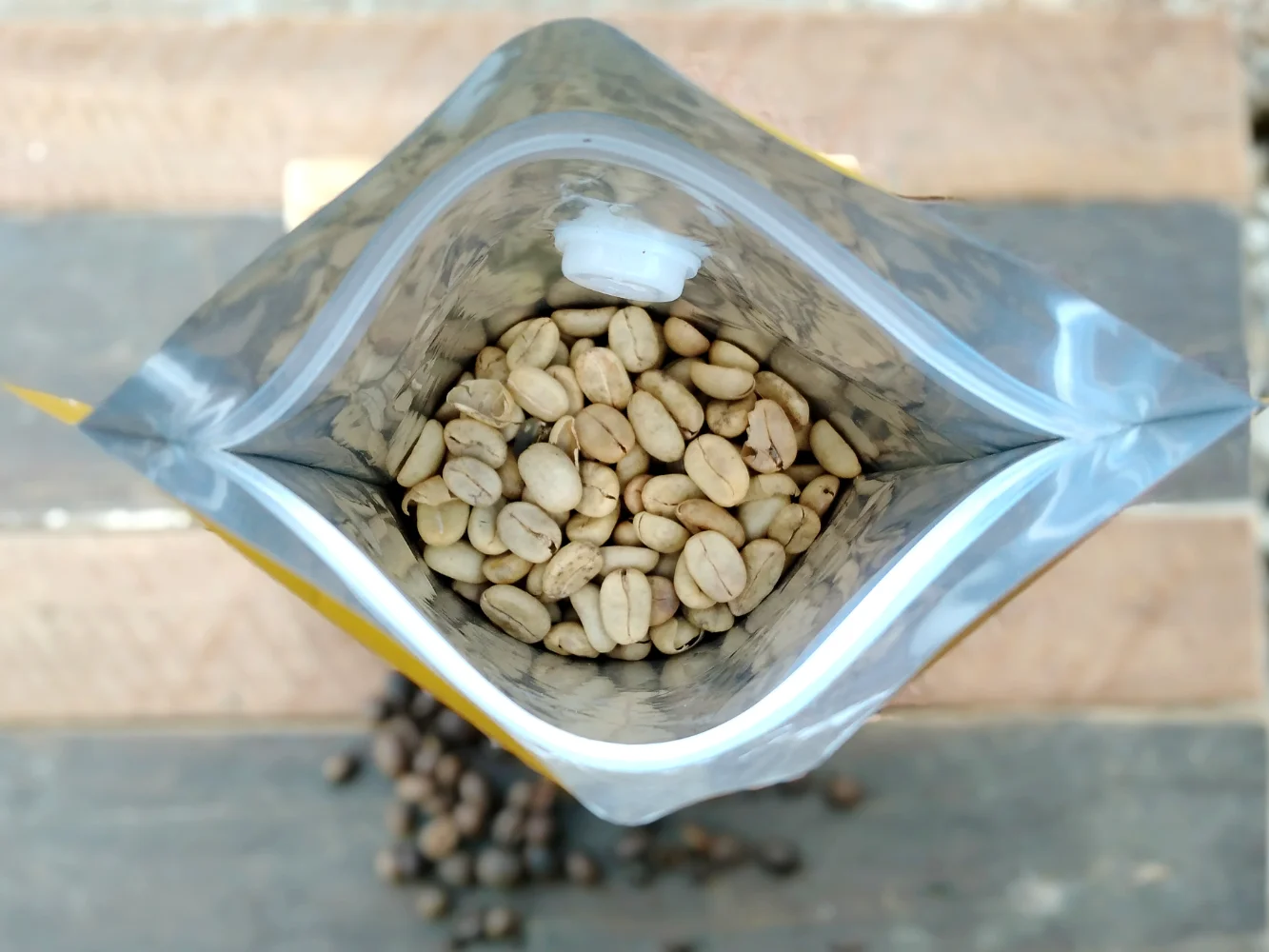
Customers blame the valve when bags go puffy, or blame the coffee when it tastes flat. Most failures come from choosing the wrong “freshness lever” for the real risk.
A one-way valve helps only when CO₂ pressure is the main risk. If oxygen ingress and aroma loss are the main risks, a valve can become an extra failure point unless the valve, laminate, and seals are designed as one system.
Build a coffee packaging spec that matches your roast level and route.

Roast level changes how fast CO₂ leaves the bean. Packaging then decides whether pressure issues show up first, or whether oxygen quietly wins and aroma drops before anyone sees a defect.
What does “fresher” mean here: aroma freshness or pack stability?
Many teams argue “valve vs no valve” without defining what “fresh” means. That is why the same pack can look perfect but taste stale.
“Fresher” needs two endpoints: sensory freshness (aroma clarity, staling notes) and physical freshness (swelling, seal stress, deformation). Each endpoint has a different failure engine.
Freshness endpoints decide what you should optimize
| Freshness endpoint |
What fails first |
What to measure |
What the pack must control |
| Sensory freshness |
Aroma fade, flat taste, oxidation notes |
Sensory scoring, headspace O₂ trend |
Low OTR structure + strong seals, low residual O₂ |
| Pack stability |
Puffy bag, panel distortion, seal creep |
Pack volume change, seal strength/creep, burst risk |
CO₂ venting strategy or pack-out timing + seal window |
Evidence (Source + Year): Robertson, G.L., Food Packaging: Principles and Practice (3rd ed., 2013).
How does roast level change the CO₂ timeline and the “pressure window”?
Some coffees create pressure complaints because CO₂ is still leaving the beans after packing. Other coffees create “stale” complaints because oxygen gets in long before pressure ever becomes a problem.
Roast conditions change gas formation and desorption behavior, so the pressure window is not fixed. The correct choice depends on how soon you pack after roast and how long the route is.
Roast/timeline logic (what changes, and what it looks like)
| Situation |
What CO₂ tends to do |
Common visible symptom |
Primary packaging risk |
| Packed very soon after roast |
More CO₂ remains to release inside the bag |
Puffy bag, seal stress over time |
Pressure cycling finds weak seals |
| Packed after a rest window |
Lower pressure load during storage |
Bag looks normal |
Oxygen ingress becomes the silent driver |
| Hot-to-cold route (temperature swings) |
Gas expansion/contraction amplifies stress |
Intermittent swelling, seal creep |
Seal window margin becomes critical |
Evidence (Source + Year): University of Guelph thesis emphasizing CO₂ formation/desorption and the importance of degassing conditions during/after roasting (2012).
When does a one-way valve truly help—and what must be true for it to work?
A valve is not a freshness feature by default. A valve is a pressure-management tool, and it only adds value when pressure is the first failure engine.
A valve helps most when early CO₂ release would otherwise distort the pack or stress the seals. But the valve does not remove the need for oxygen control, because aroma loss can still happen in a “perfect-looking” bag.
Valve wins only when the system controls oxygen and bonding quality
| What you are trying to prevent |
Why the valve helps |
What can still fail |
What to validate |
| Swelling and seal stress |
CO₂ vents instead of loading seals and panels |
Valve bond micro-channels, slow leaks |
Valve bond strength + leak screening |
| Pressure spikes on warm routes |
Venting reduces peak internal pressure |
Seal creep if seal window is weak |
Burst/creep testing at route temperatures |
| Customer “puffy bag” complaints |
Pack shape stays stable |
Aroma still fades if OTR/seals are weak |
Headspace O₂ tracking over time |
If your valve bags still taste flat, the barrier + seal system is the first place to audit.
Evidence (Source + Year): Robertson, G.L., Food Packaging: Principles and Practice (3rd ed., 2013).
When does “no valve” stay fresher—and why fewer interfaces can reduce risk?
A no-valve pack can preserve aroma better when oxygen control is tighter and the coffee is packed after the high-pressure window. Fewer interfaces can mean fewer leak paths.
No valve is not “old-school.” It can be the better choice when sensory freshness is the first failure engine and when CO₂ load is managed by pack-out timing and structure strength.
No-valve packs win when oxygen is the limiter and CO₂ is already managed
| Scenario |
Why no-valve can win |
What must be controlled |
Most common “stop-working” moment |
| Packed after a rest window |
No valve interface reduces leak risk |
Residual O₂ at pack-out, seal integrity |
High headspace O₂ or weak seals |
| Long shelf life targets |
Oxygen barrier becomes the main lever |
Low OTR laminate + consistent sealing |
Slow oxygen ingress flattens aroma |
| Ground coffee sensitivity |
More surface area makes oxygen damage faster |
Oxygen control + moisture control |
Moisture + oxygen exposure accelerates staling |
Evidence (Source + Year): Food Research International study on how oxygen and moisture exposure accelerate quality loss in ground coffee under controlled storage (2025).
What is the simplest validation plan to choose valve vs no valve by roast and timeline?
Teams often choose valves by habit, then argue later using customer complaints. A faster method is to prove which engine fails first with a small validation loop.
A useful plan tracks CO₂/pressure risk and oxygen/aroma risk in parallel. Then the decision becomes repeatable across roast levels and routes.

Validation plan (minimum data to avoid guessing)
| What you test |
Why it matters |
Pass/Fail signal |
Decision impact |
| Pack deformation over time |
Shows pressure load severity |
Swelling or panel distortion increases |
Valve may be needed or pack-out timing must change |
| Headspace O₂ trend |
Predicts aroma flattening risk |
O₂ rises faster than target shelf-life allows |
Barrier/seals must improve; valve interface must be validated |
| Seal integrity (creep/burst/leak) |
Most real failures start at seals |
Leak rate increases after heat cycling |
Fix seal window before changing valve choice |
| Valve bond + leak screen (if used) |
Valve can become a micro-leak point |
Bond defects or leak variability appears |
Valve design/process must be upgraded or removed |
Evidence (Source + Year): Robertson, G.L., Food Packaging: Principles and Practice (3rd ed., 2013).
Conclusion
A valve wins when CO₂ pressure is the first failure engine. No valve can win when oxygen control is the first engine. If you want a repeatable answer, validate both risks on your route.
Talk to us about your roast level, pack-out timing, and barrier targets
About Us
Brand: Jinyi
Slogan: From Film to Finished—Done Right.
Website: https://jinyipackage.com/
Our Mission: JINYI is a source manufacturer specializing in flexible packaging. We aim to deliver packaging solutions that are reliable, usable, and practical, so brands can get stable quality, clear lead times, and structures that match product performance and print goals with less back-and-forth.
Who We Are: JINYI is a source manufacturer specializing in custom flexible packaging solutions, with over 15 years of production experience serving food, snack, pet food, and daily consumer brands.
We operate a standardized manufacturing facility equipped with multiple gravure printing lines as well as advanced HP digital printing systems, allowing us to support both stable large-volume orders and flexible short runs with consistent quality.
From material selection to finished pouches, we focus on process control, repeatability, and real-world performance. Our goal is to help brands reduce communication costs, achieve predictable quality, and ensure packaging performs reliably on shelf, in transit, and at end use.
FAQ
- Does a one-way valve improve flavor by itself?
A valve mainly manages CO₂ pressure. Flavor retention still depends on oxygen control, barrier, and seals.
- Is a valve always required for dark roast coffee?
Not always. If pack-out timing reduces pressure risk and the structure tolerates modest pressure, no-valve can work.
- Why can a valve bag look fine but taste stale?
Aroma can fade from oxygen ingress or volatile loss without any visible swelling or deformation.
- What is the most common failure point in coffee bags?
Many failures begin at seals or interfaces (including valve bonding) rather than the film itself.
- What should I measure first to choose valve vs no valve?
Track pack deformation (pressure risk) and headspace oxygen trend (sensory risk) on your real route conditions.