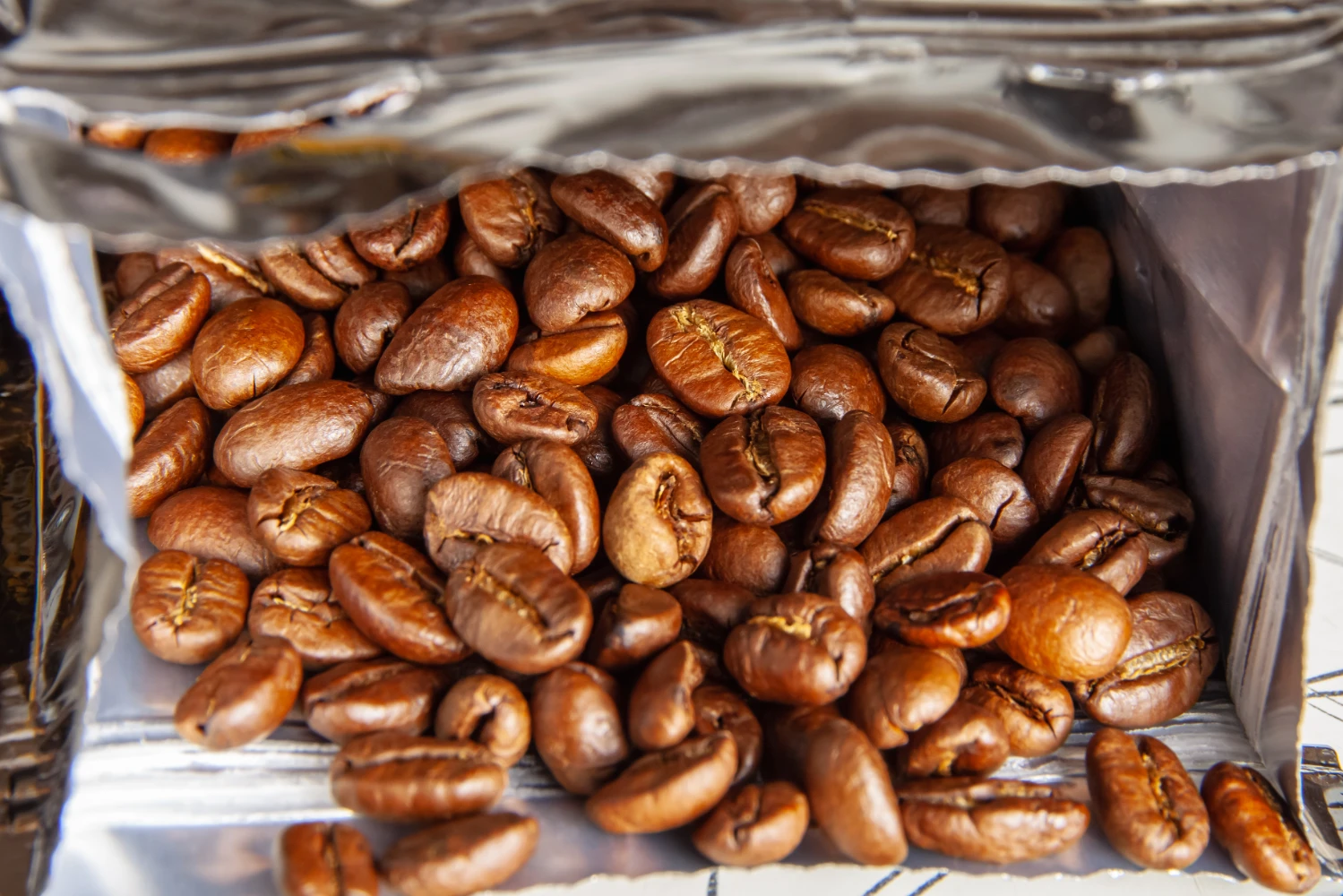
If your coffee bag has a valve but still balloons, leaks, or stales fast, the problem is rarely “the valve itself.” It is the system.
The outcome is decided by three linked controls: oxygen/moisture barrier, the real seal window on your line, and whether the valve zone adds a hidden leak path.
Explore how coffee packaging systems reduce pressure and oxygen risk across real shipping and shelf timelines.

Buyers often treat a coffee valve as an add-on. In reality, a valve changes how pressure behaves, while film structure and sealing decide how oxygen gets in. If these parts do not match, complaints feel random, but the failure mechanism is repeatable.
Why do some valve bags still swell, even with the same spec?
The bag looks fine at pack-out, then turns into a pillow later. That gap is usually CO₂ load plus temperature swings, not “bad luck.”
CO₂ release follows a time curve, so “packed day-1” and “packed day-7” can create very different internal pressure peaks.
CO₂ pressure is a timeline problem, not a yes/no problem
Fresh-roasted coffee releases CO₂ after roasting. The release rate declines over time, and it shifts with roast conditions and storage temperature. This is why pressure complaints can cluster by season, roast profile, or warehouse dwell time. A one-way valve can vent CO₂, but it still needs a realistic load to vent against. If the valve vents too slowly, ballooning appears. If the bag film and seals cannot tolerate cyclic pressure, micro-leaks can “grow” under stress. Buyers can make this predictable by mapping a channel timeline: roast date → pack date → transit → shelf. Then they can ask one simple question: when does pressure peak inside the bag, and what part of the structure carries that stress? A practical approach is to track bag thickness/volume change as a pressure proxy during thermal cycling, then correlate it to complaint timing.
| What buyers see |
Most likely driver |
Fastest verification |
| Ballooning during shipping |
High early CO₂ load + slow venting |
Thermal cycling + volume trend log |
| Ballooning only on some batches |
Roast/pack timing shifts the degassing curve |
Overlay roast-to-pack timeline vs complaints |
| Ballooning plus sporadic staling |
Pressure stress amplifies tiny seal defects |
Leak screening focused on stress zones |
Evidence (Source + Year): Wang & Lim (2014) reported that roasting conditions measurably change CO₂ degassing behavior in coffee.
Does a valve protect freshness, or only prevent ballooning?
Many buyers assume “valve = freshness.” That assumption breaks when oxygen and moisture control are weak.
A valve mainly manages CO₂ pressure. Freshness is still dominated by oxygen and moisture exposure through film, seals, and handling.
Barrier sets the staling rate, not the valve
A valve reduces internal pressure by letting CO₂ out. It does not stop oxygen from entering. Coffee staling is strongly driven by oxidative reactions, and oxygen availability is a key variable in how fast aroma and flavor drift. That means the film’s oxygen transmission rate (OTR) and the integrity of the sealing system often matter more than the presence of a valve for shelf-life. In practice, barrier choices create trade-offs. Higher barrier structures can narrow the sealing process window, especially if the sealant layer is less forgiving under temperature and dwell-time drift. So the buyer decision is not “foil vs no foil.” It is “what OTR/WVTR targets support the shelf-life goal in this channel, and can the factory repeatedly hit the seal window with margin?” When the barrier is mismatched, buyers see the classic complaint: “It stales even though it has a valve.” That is usually an oxygen story, not a venting story.
| Goal |
Dominant risk |
What must be controlled |
| Prevent ballooning |
CO₂ pressure |
Valve venting behavior + pressure stress tolerance |
| Extend shelf life |
Oxygen + moisture exposure |
OTR/WVTR targets + seal integrity + handling |
| Reduce “random” complaints |
Variance across channel |
Process window + valve-zone integrity |
Evidence (Source + Year): Cardelli & Labuza (2001) discussed oxygen exposure as a central driver in quality loss during coffee storage, highlighting packaging oxygen control as a key variable.
Why do “sealed” bags still develop micro-leaks under real production drift?
Most micro-leaks are not dramatic failures. They are small channels that become meaningful only after days of stress.
Heat sealing is a range of conditions, and coffee fines + pressure cycles can turn a small defect into a real oxygen pathway.
Seal window and hot tack decide whether you stay sealed under stress
Heat sealing is not a single setting. It is a window across temperature, pressure, and dwell time where the sealant layer bonds reliably. In real lines, that window is challenged by coffee fines, light oil residue, heater wear, and day-to-day parameter drift. Hot tack matters because seals often experience tension before they fully cool, especially when bags are handled quickly or stacked while warm. For valve bags, internal CO₂ pressure adds continuous load, which can amplify borderline seals into micro-leaks. These leaks are hard to see, but they show up as “stale fast” or “inconsistent lots.” A buyer-friendly approach is to request a seal-window map rather than a single seal strength number. The map shows which parameter combinations still pass, and where the process margin is thin. This turns “quality control” from a slogan into a measurable buffer against production variance.
| Seal risk |
Common cause |
What to measure |
| Micro-leak channels |
Fines/oil contamination or low pressure |
Leak screening + seal strength trend |
| Early seal damage |
Weak hot tack before cooling |
Hot tack performance + handling review |
| Batch-to-batch drift |
Narrow seal window |
Seal window map across parameters |
Evidence (Source + Year): ASTM F2029 (heat sealability by hot tack and seal strength) and ASTM F88/F88M (seal strength) are widely used methods to quantify sealing performance and process windows.
Why is the valve area a “critical zone” that must be tested separately?
A bag can pass seal tests at the top seal and still fail around the valve patch or valve hole.
The valve zone adds new interfaces: film surface + adhesive + valve body. That is where hidden leak paths often start.
Valve integration is where oxygen leaks hide
Buyers usually choose between an integrated valve and a valve sticker (degassing valve with adhesive patch). Regardless of format, performance depends on valve-zone integrity. The valve hole and patch perimeter can introduce channel leaks that are invisible in casual inspection. Surface finishes can reduce adhesive wet-out, and thermal cycling can accelerate edge lift. Meanwhile, pressure cycles from CO₂ degassing create stress concentration near the valve zone, which can worsen small defects over time. This is why testing must be zone-specific. A general leak test that does not focus on the valve area can miss the real failure. A practical approach is to run leak screening with the bag submerged and apply pressure while watching the valve perimeter, then repeat after thermal cycling. If a sticker valve is used, peel and shear aging data should be requested, because edge lift often begins as a slow adhesive creep problem before it becomes visible.
| Valve-zone failure |
What buyers see |
Best screening focus |
| Perimeter channel leak |
Stales “randomly” |
Leak test targeted at valve edge |
| Patch edge lift |
Visible lifting + faster staling |
Peel/shear aging after thermal cycling |
| Valve blocked / vents poorly |
Ballooning persists |
Pressure/volume trend + inspection |
Evidence (Source + Year): ASTM F2096/F2096M (bubble emission leak testing) provides a practical method for gross leak screening, and it can be applied with emphasis on valve-zone observation.

What is the minimum validation plan buyers should request?
Buyers often get one certificate and assume the system is proven. That is rarely enough for valves plus barrier films.
A “minimum proof set” should connect pressure, sealing robustness, and oxygen risk into repeatable results.
A buyer-ready verification set links pressure, leaks, and oxygen exposure
Validation should be small but complete. First, confirm that production has margin by mapping the seal window, not just passing one parameter point. Second, test for leaks with special focus on the valve zone, because that is where hidden oxygen pathways often appear. Third, connect packaging behavior to shelf-life risk by trending headspace oxygen where possible, or by using consistent proxies tied to the brand’s internal QA approach. This is also where packaging content helps your SEO position: the article can be framed around “how packaging and labeling prevent avoidable complaints” instead of “how to buy coffee.” As a flexible packaging manufacturer, we focus on repeatable sealing windows and valve-zone integrity so brands can reduce oxygen-driven staling and pressure-driven failures. A strong supplier can show that the valve and film structure are validated as a system, not as separate parts.
| Validation output |
What it proves |
Typical method references |
| Seal window map + seal strength trend |
Process margin under drift |
ASTM F2029, ASTM F88/F88M |
| Leak screening focused on valve zone |
Valve integration does not add leak paths |
ASTM F2096/F2096M |
| After-opening reseal check (if zipper) |
Consumer use does not collapse protection |
Open–close cycling + leak screening |
Evidence (Source + Year): ISO/TR 18811:2018 provides a stability-testing framework mindset that aligns with “stress + time” validation, and ASTM methods above define repeatable packaging performance measurements.
Failure map: the four most common system breakpoints
Most failures repeat in patterns. When buyers label them correctly, the fix becomes faster and cheaper.
This table turns “complaints” into tests and decisions, so valve + film structure stops being guesswork.
Complaint-to-cause mapping makes the system controllable
When a coffee package valve and film structure are mismatched, the market feedback looks emotional: “puffy,” “stale,” “leaks,” “inconsistent.” But each complaint usually points to a specific breakpoint. Ballooning points to CO₂ load and venting behavior, and it can also signal that pressure is stressing the seal. Staling often points to oxygen exposure through barrier limits, micro-leaks, or post-opening reseal variance. Patch lift points to adhesive compatibility and aging under thermal cycling. Valve-zone micro-leaks point to integration quality and stress concentration. The fastest teams treat each complaint as a measurable hypothesis and run the smallest test that separates causes. This reduces time wasted on over-specification, because the goal becomes “prove the dominant risk,” not “add features.”
| Failure |
Likely cause |
Fastest test |
Fix direction |
| Bag still balloons |
Valve vents too slowly or is blocked |
Thermal cycling + volume trend |
Match venting behavior to degassing load |
| Stales “even with valve” |
Oxygen exposure via barrier or micro-leaks |
Valve-zone leak screening + O₂ trend |
Upgrade barrier and improve seal robustness |
| Patch edge lift |
Adhesive mismatch or poor wet-out |
Peel/shear aging + thermal cycling |
Change adhesive/film surface pairing |
| Inconsistent lots |
Narrow seal window or variable valve-zone QC |
Seal window map + focused leak testing |
Increase process margin and zone QC |
Evidence (Source + Year): Wang & Lim (2014) support why degassing load can vary by roast conditions, and ASTM F2096/F88/F2029 define repeatable test approaches that translate complaints into measurable packaging performance.
Conclusion
A valve manages CO₂ pressure, but shelf life is decided by barrier, seal window margin, and valve-zone integrity. If you want fewer complaints, validate the system, not the accessory.
Talk to Jinyi about a coffee valve + barrier structure that holds up in real distribution
FAQ
| Question |
Answer |
| Does a coffee valve keep oxygen out? |
A valve mainly vents CO₂. Oxygen control depends on film barrier, seal integrity, and how the bag is handled after packing. |
| Why do valve bags sometimes stale faster after opening? |
After opening, reseal variance becomes the main oxygen pathway. A zipper reseal is not equivalent to a factory heat seal. |
| What is the most common hidden leak path in valve bags? |
The valve zone, especially patch perimeter channels or early edge lift, can create oxygen ingress without obvious visual defects. |
| What tests should buyers request at minimum? |
Seal window mapping and seal strength trend, leak screening focused on the valve zone, and an oxygen-risk check such as headspace O₂ trending where possible. |
| Can high-barrier films create new problems? |
Yes. Higher barrier structures can narrow the sealing process window. Buyers should balance barrier targets with repeatable sealing margin. |
About Jinyi
Brand: Jinyi
Slogan: From Film to Finished—Done Right.
Website: https://jinyipackage.com/
Mission: JINYI is a source manufacturer specializing in custom flexible packaging solutions. The team focuses on process control, repeatability, and real-world performance so brands can reduce communication costs and achieve predictable quality.
JINYI operates a standardized manufacturing facility equipped with multiple gravure printing lines and advanced HP digital printing systems, supporting both stable large-volume orders and flexible short runs with consistent quality.