Pet owners do not complain because they are picky. They complain when a “same bag” starts smelling wrong, clumping, or losing appeal, and they cannot explain why.
Freshness breaks first under moisture gain, fat oxidation, and time-at-temperature. These forces change aroma, texture, and acceptance long before “best by” dates, which is why complaints cluster around smell, softness, and refusal.

If brands treat complaints as data, they can map each keyword to a likely physical or chemical shift. Then freshness becomes measurable, not mysterious.
What do shoppers actually complain about, and what can those words mean?
When a pet refuses food, owners often assume “my pet got bored.” The complaint words say something else, and they repeat across brands.
Most complaint keywords point to a few measurable changes: moisture pickup, oxidation off-odors, texture drift, or storage stress after opening. Turning words into metrics is the first step to control.
In practice, complaints can be grouped by mechanism, not emotion. That makes troubleshooting faster and more objective.
A simple “complaint-to-cause” map
| Complaint keyword |
Likely mechanism |
Typical checks |
| “Stale,” “no smell,” “not interested” |
Aroma loss, oxidation byproducts rising |
Headspace odor, PV/TBARS trend, key volatiles (e.g., hexanal) |
| “Rancid,” “fishy,” “oily smell” |
Fat oxidation → off-odor/off-flavor |
PV, TBARS, p-anisidine (if used), odor panel |
| “Soft,” “chewy,” “clumping” |
Moisture pickup → water activity rises → texture collapses |
Water activity (aw), moisture %, hardness/texture |
| “Dusty,” “crumbly” |
Mechanical breakdown + dryness drift |
Durability/fines %, handling simulation |
| “Moldy” |
High aw + warm/humid storage window |
aw, visual inspection, storage condition review |
Evidence (Source + Year): Water activity is widely used as a better predictor of microbial growth potential than moisture alone, and dry kibble typically targets low aw to limit growth (BSM Partners, 2025). Many “freshness” outcomes also sit outside simple “expired/not expired” thinking (Petfood Processing, 2020).
Why does moisture break palatability before “expiration” does?
“Moisture” is not one number. A bag can test “in spec” on moisture %, yet behave differently after it absorbs humidity at home.
Water activity (aw) is often the better signal because it relates to available water for reactions, texture drift, and microbial risk windows. That is why clumping and softening can arrive early.
Moisture damage is common after opening. The stressors are simple: repeated open-close cycles, warm kitchens, high humidity seasons, and pouring kibble into bins without preserving the original inner liner. Then the sequence is predictable. The product absorbs moisture. aw rises. Texture softens and clumps. Aroma release changes. Pets lose interest, and owners assume the formula changed.
Moisture stress points that trigger complaints
| Where moisture enters |
What changes first |
What owners say |
| Open-close cycles in humid rooms |
Surface tackiness, early clumps |
“It feels soft” |
| Storage bin without a tight seal |
aw drift, texture instability |
“It clumps” |
| Heat + humidity together |
Faster staling and odor drift |
“It smells off” |
Evidence (Source + Year): Industry guidance explains why managing moisture and water activity matters for shelf life and quality outcomes, including palatability-linked issues (Petfood Processing, 2020). Consumer-facing handling guidance also emphasizes cool, dry storage and keeping food in the original bag inside a clean, lidded container (AAFCO, Product Handling Safety, 2023).
Why does fat oxidation get “smelled” before it gets noticed on a nutrition panel?
Owners do not measure peroxide value. They smell the bag and watch the bowl. Oxidation announces itself through odor first.
In low-moisture foods, lipids can still oxidize. Oxygen exposure, light, heat, metals, and fatty acid profile all shape the rate. Off-odor becomes a refusal driver.
Oxidation is an economic problem because it turns a brand promise into a rejection event. The product can still be “safe,” but it stops being acceptable. That produces refunds, negative reviews, and “my dog won’t eat it anymore.” A useful approach is to treat odor drift like a tracked KPI. Brands can run a minimal testing set. They can combine PV (peroxide value) and TBARS with a small odor panel. Then they can compare sealed storage versus “opened and reclosed” conditions. This isolates whether the failure is mainly formulation stability, post-opening oxygen exposure, or temperature stress.
Minimal oxidation checks for decision-making
| Check |
What it signals |
When it helps most |
| PV |
Early oxidation stage |
Tracking onset during storage |
| TBARS |
Secondary oxidation byproducts |
Explaining “rancid” reports |
| Odor panel (small, trained) |
Human-detectable off-odor threshold |
Linking lab data to complaints |
Evidence (Source + Year): A major review summarizes mechanisms and risk factors for lipid oxidation in low-moisture foods (Barden & Decker, 2016). Industry materials also note oxidation can reduce palatability and create detectable odor changes at low concentrations (Kemin, 2025).
Why is storage time “chemical time,” not a calendar countdown?
Quality rarely fails on one dramatic day. It drifts until someone notices. That is why owners say “week one was fine, then it changed.”
Time interacts with temperature and oxygen exposure, especially after opening. The curve is what matters, not the date.
In dry pet food, low aw can limit microbial growth, but it does not freeze chemistry. Oxidation can advance. Aroma can thin. Texture can drift under humidity. Heat makes the curve steeper. That matters in real life because the storage chain includes warehouses, last-mile delivery, and kitchens. A practical method is to separate “purchase time” from “open time.” Many complaints start after opening because oxygen and humidity exposure changes overnight. Brands can also use accelerated shelf-life tests to compare scenarios. A high-temperature model can predict trends faster, but it must be interpreted carefully because some reactions do not scale linearly.
Two time axes to track
| Time axis |
What it represents |
Most common risk |
| Sealed storage time |
Factory-to-home exposure |
Slow oxidation drift under heat |
| Post-opening time |
Home handling reality |
Fast odor/texture change from O2 + humidity |
Evidence (Source + Year): A peer-reviewed storage study measured quality changes over 120 days at 25°C and 35°C, showing that quality attributes can shift over time even when microbial growth is limited in dry food (Park et al., 2025, PMC). Practical shelf-life guidance also highlights water activity thresholds that constrain microbial growth, while quality can still drift (BSM Partners, 2025).
Where does palatability break down most often, and how can teams diagnose it fast?
Brands often chase the wrong cause. They look for a single “defect,” but the failure is usually a chain of stressors.
The fastest diagnosis is a table: trigger, measurable signal, and complaint phrase. Then teams can test the right hypothesis first.
Most breakdowns sit in four repeatable buckets. Moisture pickup reshapes texture and aroma release. Fat oxidation creates off-odor that drives refusal. Home storage creates within-bag inconsistency that feels like a formula change. Then information gaps make it worse because owners assume the brand “changed something.” A practical diagnostic flow starts with the complaint keyword group, then asks one question: is this mainly moisture, oxidation, mechanical breakdown, or misunderstanding? That question determines which measurements are worth running. It also determines which storage simulation is most relevant: humidity cycling, oxygen exposure after reclosing, or handling abrasion.
Breakdown table: from trigger to complaint
| Breakdown point |
Trigger condition |
Measurable signals |
What owners say |
| Moisture-driven texture drift |
High humidity + repeated opening |
aw, moisture %, hardness, clump rate |
“Soft,” “clumpy,” “stale” |
| Oxidation-driven off-odor |
Heat + oxygen exposure after opening |
PV, TBARS, odor score |
“Rancid,” “oily smell” |
| Within-bag inconsistency |
Reclosing weak + long open period |
Week 1 vs week 4 comparison set |
“First week ok, then refused” |
| Information-driven misattribution |
Storage guidance unclear |
Label clarity check |
“Not consistent,” “not trustworthy” |
Evidence (Source + Year): Consumer handling guidance recommends cool, dry storage and keeping food in the original bag inside a clean, lidded container, which directly targets common post-opening failure modes (AAFCO, Product Handling Safety, 2023). Water activity is also described as a predictor of spoilage potential while dry kibble targets low aw (BSM Partners, 2025).
How can packaging act as a “freshness delivery system” without becoming marketing noise?
Packaging cannot “fix” formulation choices. Packaging can reduce exposure to the stressors that cause freshness drift after opening and during storage.
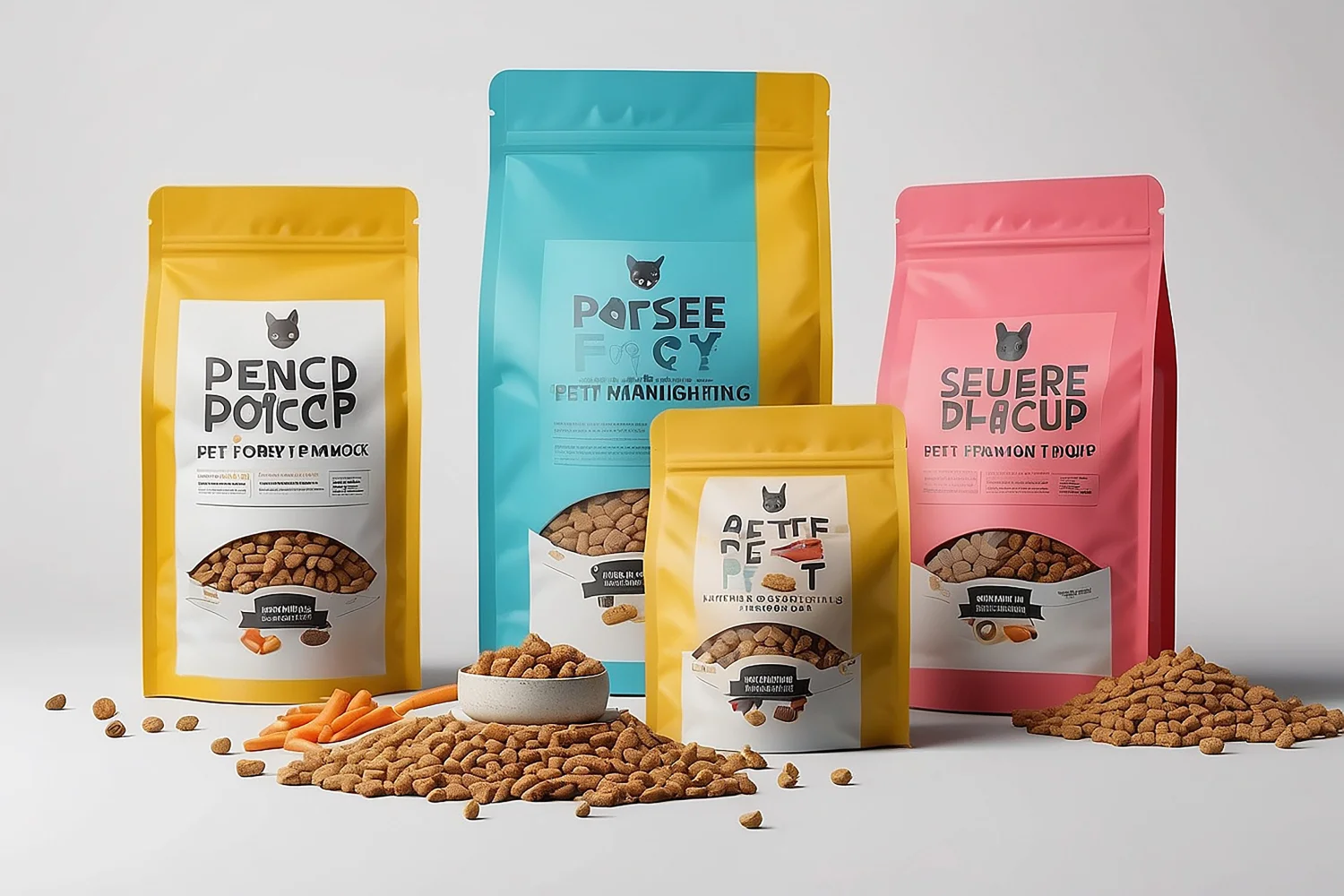
As a flexible packaging manufacturer, we focus on two jobs: controlling moisture and oxygen exposure, and making storage guidance easier to follow so owners do not misread quality drift as “formula change.”
Moisture control is about barrier and reseal behavior in real kitchens. Oxidation control is about limiting oxygen ingress and reducing light exposure when relevant. The goal is not to overbuild. The goal is to reduce the probability that logistics and home handling reshape aroma and texture. Packaging is also an information interface. It can present “store cool and dry,” a simple post-opening best-use window, and batch/date cues in a way that is easy to notice. That reduces misattribution. It also reduces complaint escalation because owners have a clear checklist before they conclude the brand is inconsistent.
A practical “Freshness Stress Test” concept
| Stress |
Why it matters |
What to re-check |
| Humidity + temperature cycling |
Drives aw drift and texture change |
aw, hardness, clump rate |
| Open/reclose simulation |
Models home oxygen and moisture exposure |
PV/TBARS trend, odor panel |
| Handling abrasion |
Creates fines and “dusty” complaints |
Durability %, fines %, appearance |
Evidence (Source + Year): Active packaging research discusses oxygen-absorbing and antioxidant-releasing approaches as broader industry directions, while also noting commercialization challenges (Monção et al., 2022). Basic handling guidance still emphasizes cool, dry storage and proper containment as frontline controls in real homes (AAFCO, 2023).
Conclusion
Freshness complaints usually come from moisture gain, fat oxidation, and time-at-temperature. If brands track these drivers, palatability becomes controllable, not subjective.
Talk to us about pet food packaging that protects freshness
FAQ
Is water activity more important than moisture percentage for kibble texture?
Water activity often predicts texture drift and stability better because it reflects “available water” that drives clumping and reaction rates.
Why does a bag smell rancid even if the “best by” date is far away?
Fat oxidation can progress under heat and oxygen exposure, especially after opening, and odor changes can appear before safety limits are reached.
What are the most common home storage mistakes that cause complaints?
Frequent opening in humid rooms, weak resealing, and transferring food to bins without keeping the original liner are common triggers for moisture and odor drift.
What is a simple test set to connect complaints to root causes?
A practical set includes aw, moisture %, a basic texture check, and PV/TBARS plus a small odor panel under sealed vs opened-and-reclosed storage.
How can packaging reduce “formula changed” accusations?
Packaging can help by slowing moisture and oxygen exposure and by presenting clear storage guidance and batch/date cues that reduce misattribution.
About Jinyi
Brand: Jinyi
Tagline: From Film to Finished—Done Right.
Website: https://jinyipackage.com/
Our mission: JINYI is a source manufacturer focused on flexible packaging. We aim to deliver reliable, practical packaging solutions with predictable quality, clear lead times, and consistent performance across shelf, transit, and end use.
We operate a standardized manufacturing facility with multiple gravure printing lines and advanced HP digital printing systems. We support both stable large-volume orders and flexible short runs with consistent quality. From material selection to finished pouches, we focus on process control, repeatability, and real-world performance.