تشارك JINYI إرشادات عملية للتغليف والتعبئة والتغليف من أجل قراراتك.
A laminated roll can look ready on the outside while the bond inside is still weak. Move it too soon, and the problem follows the roll into slitting and pouch making.
Laminated pouches need curing time because the polyurethane adhesive keeps reacting after the films leave the laminator. The wait allows the bond to build enough strength and resistance for the next machine and the packed product.
In our factory, I do not release a roll just because a set number of hours has passed. I check the adhesive, film structure, curing record, next process, and final use. The schedule tells me when to check the roll. The roll condition tells me whether it can move forward.
If you already know your film structure and filling conditions, send them to our production team before fixing the pouch-making date.
A dry surface does not mean the adhesive between the films has finished curing.
There is no single curing time for every laminate; the adhesive, films, temperature, ink, and end use all matter.
For standard non-retort laminates, JINYI commonly plans 24–72 hours in controlled curing at around 40–50°C, then checks the job before release.
Slitting, pouch making, filling, and food-contact use are different release points and may need different checks.
Extra time cannot repair the wrong mix ratio, dirty film, weak surface treatment, uneven coating, or an incompatible ink-and-adhesive combination.
If lead time is tight, the safer time to discuss a faster adhesive and validation plan is before production starts.
Why Isn’t a Dry-Looking Laminate Ready for Pouch Making?
The surface may feel dry while the adhesive between the films is still developing the properties needed to make the laminate behave as one structure.
Drying describes the removal of a carrier such as solvent or water. Curing describes the continuing reaction and performance development of the adhesive. The two can overlap, but they are not the same release condition.
I Do Not Treat Surface Dryness as Completed Curing
When two films leave the lamination nip, they may already stay together well enough for winding. That early handling strength is useful because the roll must remain aligned and stable. It does not prove that the laminate is ready for the tension of slitting, repeated bending in a bottom gusset, zipper installation, or heat and pressure during pouch making.
Early bond strength can be misleading. The layers may resist a hand pull, then behave differently when the next machine adds heat, tension, and repeated folding. I am not only checking whether the films stay together today. I am checking whether they will stay stable through the next operation and during use.
What a Buyer May See
What May Still Be Developing
The surface feels dry
The adhesive reaction between the films
The roll looks smooth
Final bond strength and stress resistance
The layers stay together by hand
Resistance to heat, chemicals, folding, and filling
No obvious bubbles are visible
Uniform performance across ink, barrier, and sealant interfaces
This is why I do not approve same-day pouch making simply because a newly laminated roll looks clean. The buyer should treat curing as an active production stage, not as unused time between lamination and converting.
What Do I Check Before I Set the Curing Window?
A curing window starts with the adhesive and laminate structure, then changes with temperature, ink, coating, downstream stress, and the product that will be packed.
I never begin with one universal number. I begin with the approved adhesive instructions and the actual job specification, then decide when the first inspection and each later release gate should occur.
I Set the Curing Window from the Structure, Not the Clock
My first check is the adhesive system. Solvent-based, solventless, water-based, standard, high-performance, and retort adhesives do not cure on one shared timetable. Even two products in the same category can reach pouch-making readiness at different times.
Next I check what the adhesive must bond. PET/PE is not the same production decision as a printed PET/metallized barrier/sealant structure. Foil, metallized films, nylon, coatings, heavy ink coverage, transparent barrier films, and chemically resistant sealants can change interface behavior. A structure that looks similar from the outside may require a different hold and verification plan.
I also separate the buyer’s end use from the film description. A dry powder pouch stored at room temperature, a pouch filled with an oily product, a hot-fill application, and a retort pack expose the laminate to different stresses. The same roll may have enough handling strength for slitting before it has enough developed performance for the final use.
تحقق
Why It Changes My Decision
Adhesive system and supplier instructions
Defines the intended mixing, coating, curing, and compliance conditions
Film and coating interfaces
Changes how the adhesive wets, reacts, and transfers stress
Ink coverage and ink compatibility
Can affect the ink-to-adhesive interface and local bond behavior
Curing-room temperature
Changes reaction speed and must be considered with the adhesive guidance
Next converting step
Slitting, gusset folding, zipper or fitment work impose different stresses
Packed product and use conditions
Heat, oil, acid, aroma compounds, and transport can expose hidden weakness
Our factory guide to كيف تُصنع الأكياس الواقية المخصصة shows where lamination sits in the full process. Curing is the control point between joining the films and asking that structure to survive later converting.
What Is Actually Changing Inside the Adhesive During Curing?
The adhesive is moving from an early bond that lets us wind the roll to a stronger bond that can carry real production and use stress.
Many flexible packaging laminates use a two-part polyurethane adhesive. The two parts keep reacting inside the wound roll after lamination. As that reaction develops, the bond usually becomes better able to handle heat, product contact, bending, and machine tension. The actual pace depends on the adhesive, mixing, coat weight, films, temperature, and end use.
I Judge Curing as Performance Development
The practical point is simple: we are not waiting just to fill space in the schedule. We are waiting for the bond to reach the level needed by the next process. A roll may be strong enough to wind and move but still not be ready for pouch making or final food-contact release.
ASTM F904-22 describes techniques for separating plies so bond strength or ply adhesion can be measured. Its significance section explicitly distinguishes a green, uncured bond from a cured bond when the bonding agent is reactive. That distinction matches what we see in production: the laminate can be handled before the adhesive has reached full performance.
Evidence · ASTM F904-22
ASTM distinguishes green bond from cured bond for reactive laminate bonding agents and describes ply-separation techniques used to support bond-strength evaluation. View ASTM F904-22 →
Bond development is also not uniform if the inputs are wrong. Waiting longer cannot correct an inaccurate mixing ratio, contaminated film, inadequate surface treatment, severe residual solvent, uneven coating, or an incompatible ink and adhesive combination. Time supports the intended reaction. It does not repair an incorrect lamination process.
Which Production Variables Change the Real Curing Time?
The adhesive supplier may provide a starting cure recommendation, but the actual release decision still depends on how the laminate was produced and what it must do next.
I reconsider the curing window whenever the adhesive, material interface, temperature, ink coverage, coat weight, roll condition, or end-use requirement changes.
I Reconsider the Window When the Production Conditions Change
Temperature is one of the clearest variables. A controlled curing room can help the reaction move faster than a cold, uncontrolled area. But turning up the heat is not a shortcut around the adhesive technical data sheet. Too much heat can also create problems for films, inks, coatings, or tightly wound rolls.
Coat weight and mixing affect the chemistry available at the interface. Film treatment and cleanliness affect wetting and adhesion. Ink coverage can introduce another interface between the adhesive and the outer film. Roll width, winding tension, and the time needed for the core and outer layers to experience a stable environment can also affect how confidently I interpret a calendar value.
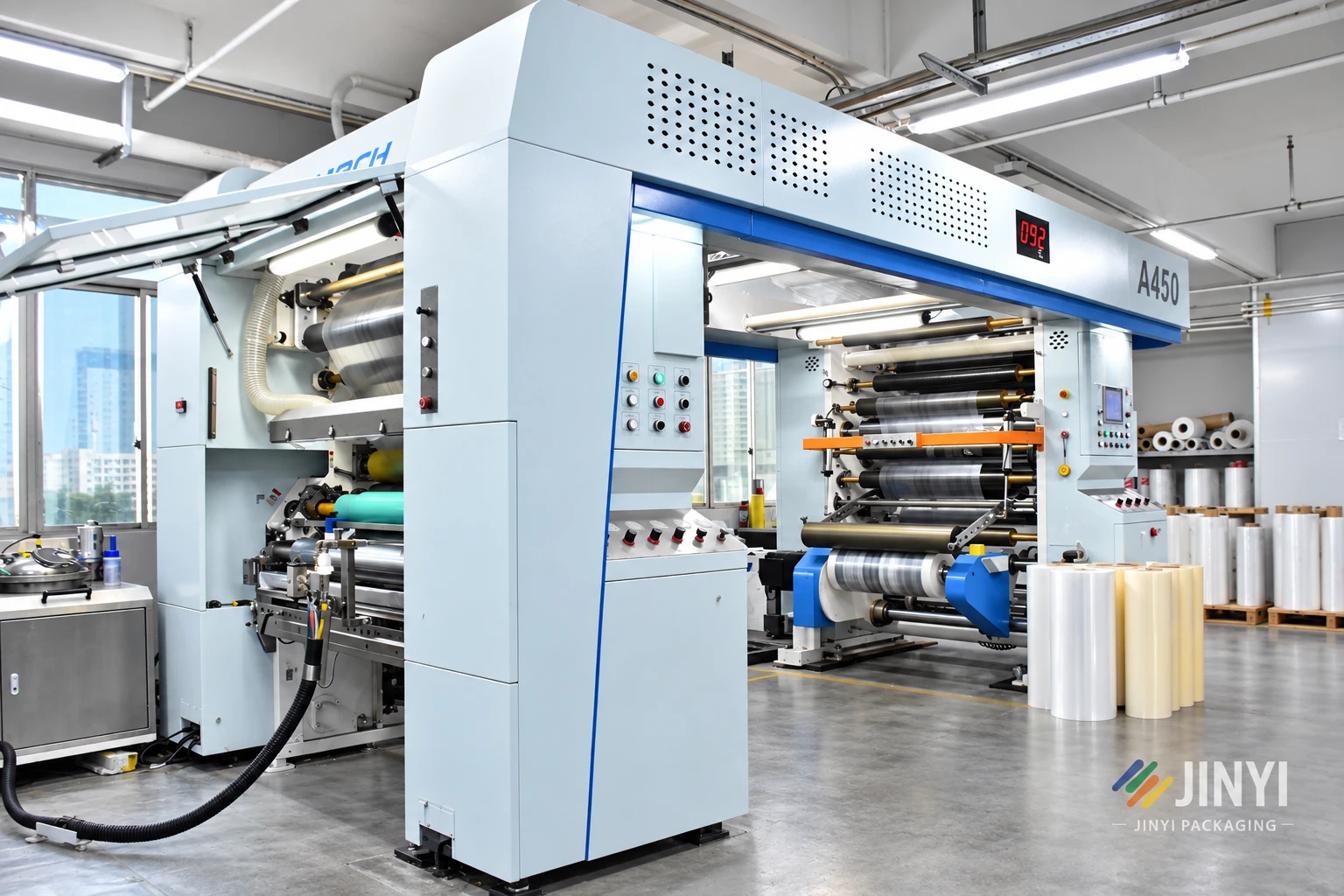
jinyi laminated film curing machine
Material thickness is another common distraction. A thicker finished pouch does not automatically require a longer cure, and a thinner pouch is not automatically ready sooner. Thickness alone does not identify the adhesive, the bonded interfaces, or the final stress. This is the same reason buyers should not judge a packaging specification by total thickness alone, as explained in our article on how thick a pouch should really be.
Production Variable
How It Can Change the Curing Decision
Adhesive grade
Changes reaction profile, processability, resistance, and compliance timing
Curing temperature
Can accelerate or slow reaction within the validated operating window
Coat weight and mixing
Affects adhesive distribution and the intended two-part reaction
Ink and surface condition
Changes the strength and consistency of the bonded interface
Metallized, foil, nylon, or coated films
May require structure-specific validation rather than a standard schedule
Final packed product
Oil, acid, heat, or aggressive ingredients may require more developed resistance
Retort or hot-fill exposure
Raises the release requirement beyond ordinary room-temperature use
Engineering Data · JINYI Production Planning
For standard non-retort flexible laminates, our current production planning commonly reserves a 24–72 hour controlled curing window before pouch-making release, with curing-room conditions often managed around 40–50°C. This is a starting production range, not a universal specification. The adhesive guidance, laminate structure, recorded conditions, and inspection results determine the actual release.
That range is deliberately broad. A fast-curing adhesive may support earlier converting when its supplier conditions and our checks are satisfied. A demanding high-barrier, chemically resistant, or heat-resistant structure may need a longer hold. Buyers should not copy the range into a purchasing specification without identifying the adhesive system and application.
The sealant layer also affects what happens after curing because it controls the heat-seal interface and contact with the packed product. Our guide to why sealant layer choice matters explains why the last layer cannot be separated from the final process decision.
What Can Fail If We Slit or Make Pouches Too Early?
Early conversion adds tension, bending, heat, pressure, and local stress before the adhesive has developed the performance expected from the finished laminate.
The first signs may be weak layer bonding, tunnels, bubbles, local delamination, distortion, or trouble around folds and seals. The harder problem is a pouch that looks acceptable on the line and becomes unstable later.
I Do Not Let an Early Schedule Move Risk Downstream
Slitting rewinds the laminate under tension and creates new cut edges. Pouch making repeatedly guides, folds, stops, heats, presses, and cools the material. A stand-up pouch adds bottom-gusset folds and multi-layer intersections. Zippers, fitments, and complex seal paths add more local stress. If the adhesive is still developing, these operations can expose a weak area that was not obvious on the original roll.
A finished pouch can also pass a quick visual check and still fail under storage or route stress. Heat, vibration, repeated flexing, oily contents, acidic products, and filled-pouch pressure can turn a marginal interface into visible delamination or seal-adjacent weakness. This is why our article on snack pouches that look sealed but fail in week four separates initial appearance from performance over time.
Production Case · High-Barrier Stand-Up Pouch for Thailand
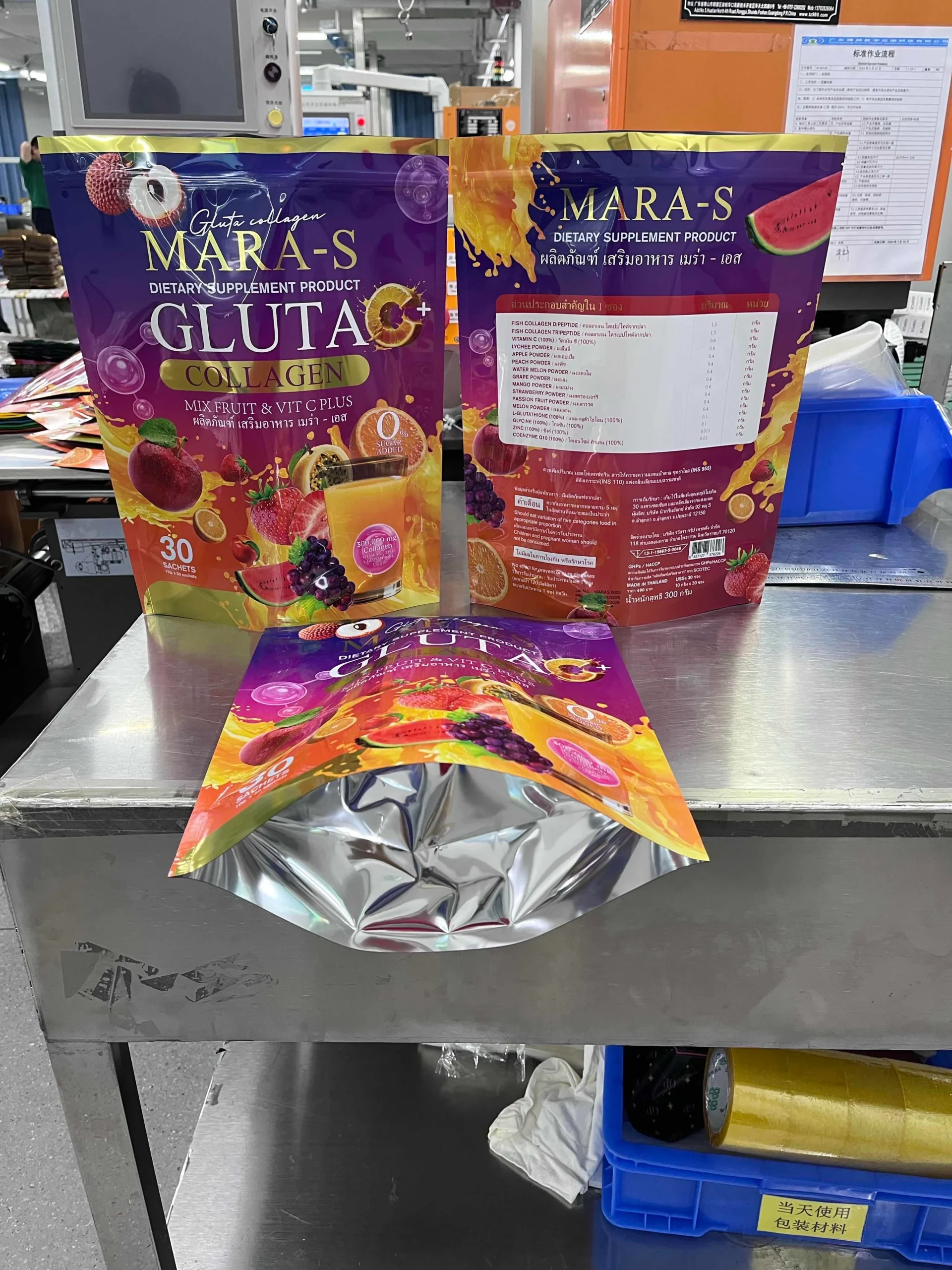
One of our Thailand projects involved a large printed stand-up pouch for a food and dietary supplement processor. The finished pouch held 30 individual collagen drink-powder sachets. The bright reverse-printed exterior, metalized barrier appearance, large format, and bottom gusset made it a useful example of why I do not treat curing as a passive gap in the schedule.
After lamination, the roll looked clean and could be handled. That was not our pouch-making release point. The structure still had to pass through slitting, bottom-gusset forming, side sealing, and repeated web tension. I kept the laminated roll in the planned controlled curing stage, then checked the ply behavior at representative locations before authorizing the next process.
The first pouch-making check focused on the areas where converting stress accumulates: the bottom fold, side seals, multi-layer intersections, and cut edges. We also checked whether the laminate remained stable after heat sealing instead of judging only the unsealed film. Once the laminate and trial pouches showed stable behavior for the intended process, the order moved into the full converting run.
The important lesson is not that every supplement pouch needs the same number of hours. It is that a real production schedule must include the structure-specific hold and verification stage. Removing that stage would not make the pouch faster in a meaningful way. It would transfer uncertainty to the finished product and to the customer’s filling operation.
For a pouch with metallized film, heavy ink coverage, a large gusset, or demanding filling conditions, review our custom stand-up pouch options and send us the intended structure before you lock the lead time.
How Do I Decide the Laminate Is Ready for Slitting, Pouch Making, or Filling?
I use separate release gates because the laminate does not face the same requirement during slitting, pouch making, filling, and final food-contact use.
Elapsed time is only one input. I also use the curing record, adhesive instructions, visual condition, layer behavior, trial converting, seal response, and any food-contact documents required for the job.
I Use Different Release Gates for Different Processes
A handling release means the roll can be moved without damage. A slitting release means the laminate can tolerate web tension and rewinding. A pouch-making release means it can tolerate folding, sealing, cooling, and repeated machine handling. A filling or end-use release may require compatibility, heat resistance, migration, or other application-specific evidence.
Release Gate
What I Need to Confirm
التعامل
Stable winding, alignment, and no obvious laminate damage
Slitting
Acceptable ply behavior under cut-edge inspection, tension, and rewinding
Pouch making
Stable folds, gussets, seals, edges, appearance, and trial-pouch behavior
Filling and use
Compatibility with product, temperature, pressure, storage, and transport
Food-contact release
Applicable adhesive documentation and any required migration or PAA assessment
The check depends on the structure. We may inspect the roll, separate sample layers, compare bond behavior across the web, make trial pouches, inspect sealed areas, and recheck samples after conditioning. If the customer specification calls for a formal test, we record the test conditions and pass criteria instead of relying on a quick hand pull.
Mechanical Bond Is Not the Same as Food-Contact Clearance
This matters especially for food packaging. A laminate may feel mechanically strong before every food-contact question has been cleared. Some polyurethane adhesive systems can leave reactive aromatic isocyanates; contact with moisture can form primary aromatic amines, or PAAs. What must be checked depends on the adhesive, structure, curing, food, contact conditions, and destination market.
A peer-reviewed study indexed by PubMed used liquid chromatography-mass spectrometry to investigate PAA migration and followed its evolution during industrial curing of multilayer plastic laminates before release to a food-industry user. That research supports a simple production rule: mechanical appearance alone is not enough evidence for food-contact release.
Evidence · Lambertini et al., 2014
The researchers monitored potential primary aromatic amine migration during industrial curing of multilayer plastic laminates, showing why curing and food-contact release must be evaluated as more than a visual bond check. View the PubMed record →
Odor is also not a reliable cure test by itself. An odor can come from ink, residual solvent, film, adhesive components, or the surrounding environment. The absence of odor does not prove complete curing, and the presence of odor does not identify the root cause. I use documented inputs and appropriate checks instead of turning one sensory observation into a release rule.
What Should Buyers Confirm Before Asking Us to Shorten Lead Time?
A shorter curing hold is only responsible when the selected adhesive, laminate, controlled conditions, downstream process, and verification plan support it.
Buyers should confirm the packed product, filling temperature, film structure, pouch format, seal process, storage, transport, regulatory market, and required launch date before asking the factory to remove time from curing.
I Only Shorten the Hold When the Evidence Supports It
Fast-curing adhesives are real, but their claims are product-specific. H.B. Fuller states that its Flextra Fast SF8400/XR1700 solventless adhesive can support pouch and zipper or fitment installation in one day and can meet PAA guidelines for most structures in as soon as one day. That is useful evidence that faster converting can be engineered. It is not evidence that every adhesive, every structure, or every factory process can be released in one day.
Evidence · H.B. Fuller Flextra Fast
H.B. Fuller reports one-day pouch or fitment processability and rapid PAA compliance for most structures using one named adhesive system. The claim belongs to that product and its stated conditions, not to laminated pouches in general. View the H.B. Fuller source →
If lead time is critical, I prefer to discuss it before the adhesive and material structure are locked. We can then evaluate whether an appropriate faster adhesive system is compatible with the films, ink, product, heat-seal process, and compliance requirements. Trying to recover time after lamination by skipping the validated hold is a different decision and carries a different risk.
Confirm the actual packed product, including oil, acid, aroma, alcohol, or other aggressive components.
Confirm the filling temperature, sealing method, and any pasteurization, hot-fill, boil, or retort exposure.
Confirm the laminate structure and whether metallized film, foil, coatings, nylon, or special sealants are involved.
Confirm whether the next deadline is for slitting, pouch making, filling, shipping, or food-contact release.
Confirm the destination market and any customer-specific migration, declaration, or test requirements.
Allow time for a representative converting check instead of treating the cure-room exit as automatic approval.
JINYI can evaluate these conditions through our custom packaging solutions. The most useful inquiry is not simply, ‘Can you cure it faster?’ It is, ‘What structure, adhesive, controlled conditions, and verification would support my required date without moving risk into the finished pouch?’
How We Keep Curing Connected to the Next Process at JINYI
At JINYI, printing, lamination, curing, slitting, and pouch making are managed as one connected production flow. A roll does not move forward only because the calendar says it should. The lamination record and curing conditions stay with the job, and the next team checks how the material behaves before the full order continues.
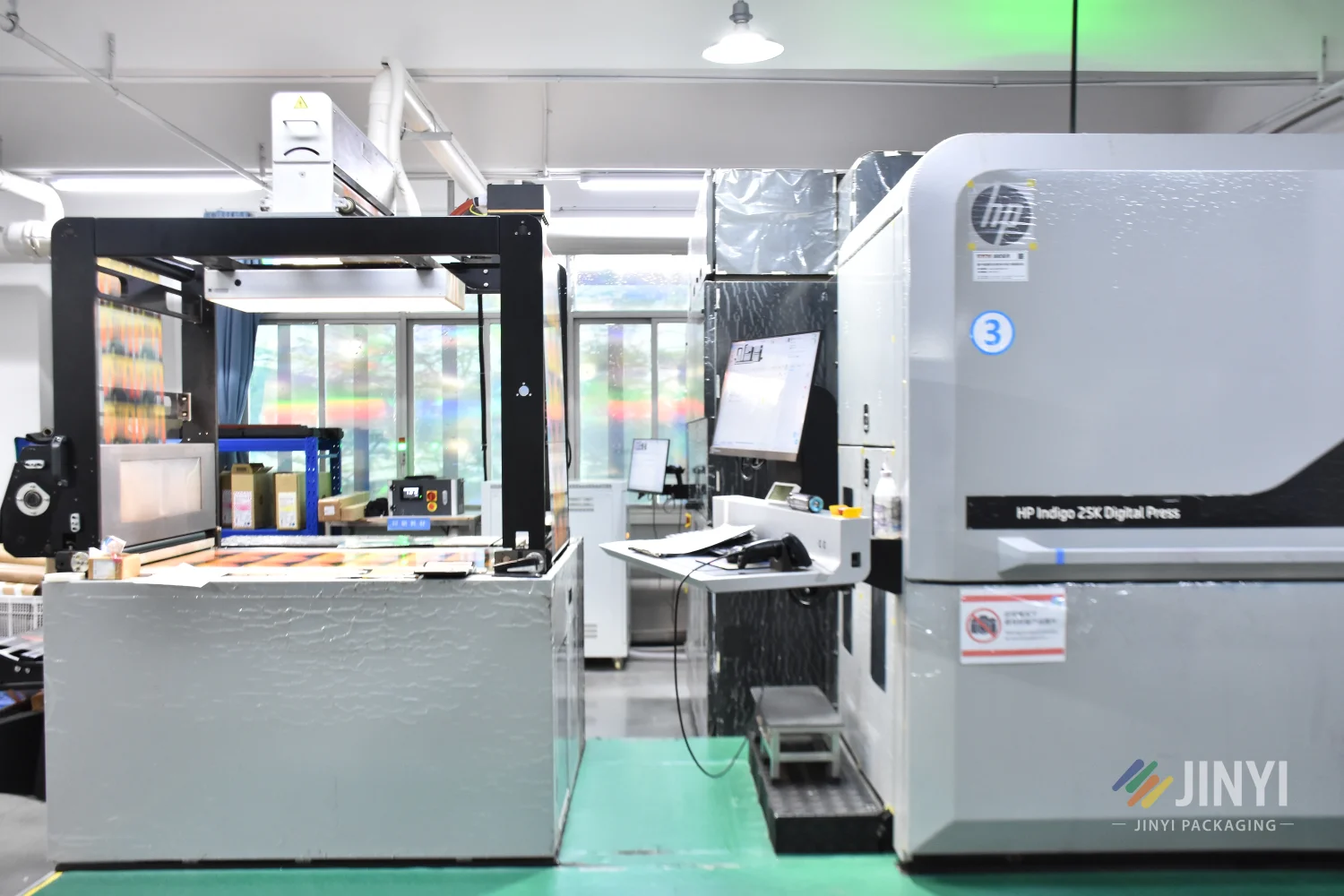
HP Indigo 25K في JINYI - إخراج ألوان متناسق عبر جميع أنظمة الطباعة عبر محرك التشغيل الآلي ESKO
That connection matters when a structure is large, heavily printed, metallized, or expected to face demanding filling and storage conditions. Our equipment gives us the ability to run the next converting check in the same factory, while our material documents and quality records give the buyer a clearer basis for approval. This is the quiet value of factory control: problems can be stopped before they become finished pouches.
الخاتمة
Laminated pouches need curing time to build a dependable bond. I release the roll only when its structure, curing record, next process, and end use support it.
If you want us to review the curing risk before production, send the packed product, filling conditions, pouch format, material structure, destination market, and required date.
JINYI هي مصنع مصدر للتغليف المرن المخصص مع أكثر من 15 عامًا من الخبرة في الإنتاج، حيث تقدم خدمات الأغذية والمكملات الغذائية والقهوة وأغذية الحيوانات الأليفة والعلامات التجارية للسلع الاستهلاكية في أكثر من 70 دولة. نحن ننتج أكياسًا قائمة وأكياسًا ذات قاع مسطح وأكياس وسائد وأكياس مجمعة جانبية من PET/AL/PE وPET/VMPET/PE وغيرها من مواصفات الحواجز - عبر الطباعة الرقمية من HP Indigo من 500 وحدة وطباعة الحفر بكميات كبيرة - مع تضمين وثائق المواد الكاملة كمعيار قياسي مع كل طلب.
هذا ما من الفيلم إلى النهاية - تم إنجازه بشكل صحيح يعني في الممارسة العملية.
مارك
رئيس إدارة الإنتاج · شركة جيني للتغليف
يتولى مارك قيادة عمليات جدولة الإنتاج وتنسيق الطلبات في شركة «جينيي». وبفضل خلفيته في إدارة الأعمال وخبرته العملية في مجال التصنيع، يركز مارك على الحفاظ على استقرار الجودة ومدة التنفيذ والتسليم في جميع طلبات التغليف المخصصة.
تخطيط الإنتاجالتسليم في الموعد المحددالتنسيق بين الفرق
How long do laminated pouches normally need to cure?
There is no universal curing time. For standard non-retort structures, our production planning commonly starts with a controlled 24–72 hour window, but the adhesive, structure, temperature, end use, and release checks determine the actual time.
Can laminated film be slit before it is fully cured?
Sometimes a laminate reaches a slitting release before it reaches its final-use release. We only do this when the adhesive guidance, recorded conditions, and laminate checks support the tension and rewinding involved.
Can pouch making start immediately after lamination?
Normally, no. Pouch making adds folding, heat, pressure, web tension, and stress at gussets and edges. A dry-looking roll is not enough evidence that the laminate is ready.
Does higher curing temperature always make the process safer?
No. Temperature can accelerate reaction within a validated process, but it must remain compatible with the adhesive, films, inks, coatings, winding condition, and supplier guidance.
Can extra curing time fix poor lamination?
No. More time cannot reliably correct the wrong mixing ratio, contamination, poor surface treatment, incompatible ink, uneven coating, or another process defect. The cause must be identified and corrected.
Is strong bond strength enough for food-contact release?
Not by itself. Mechanical bond, adhesive documentation, migration considerations, PAAs, intended food, contact conditions, and market requirements may require separate review.
Can a fast-curing adhesive reduce pouch lead time?
Yes, when a specific fast-curing adhesive is compatible with the laminate and its stated process and compliance conditions are met. A supplier’s fast-cure claim cannot be transferred automatically to another adhesive or structure.