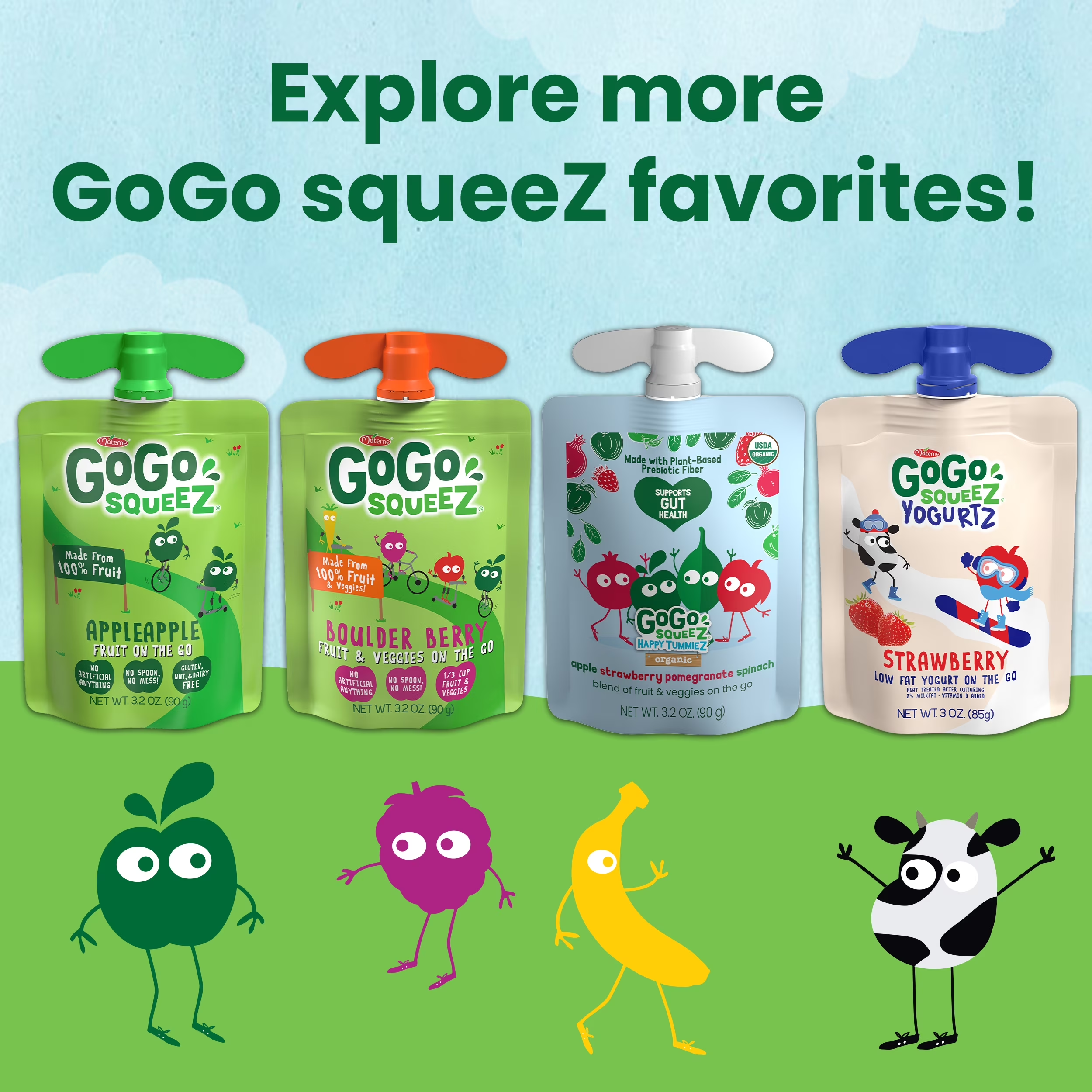
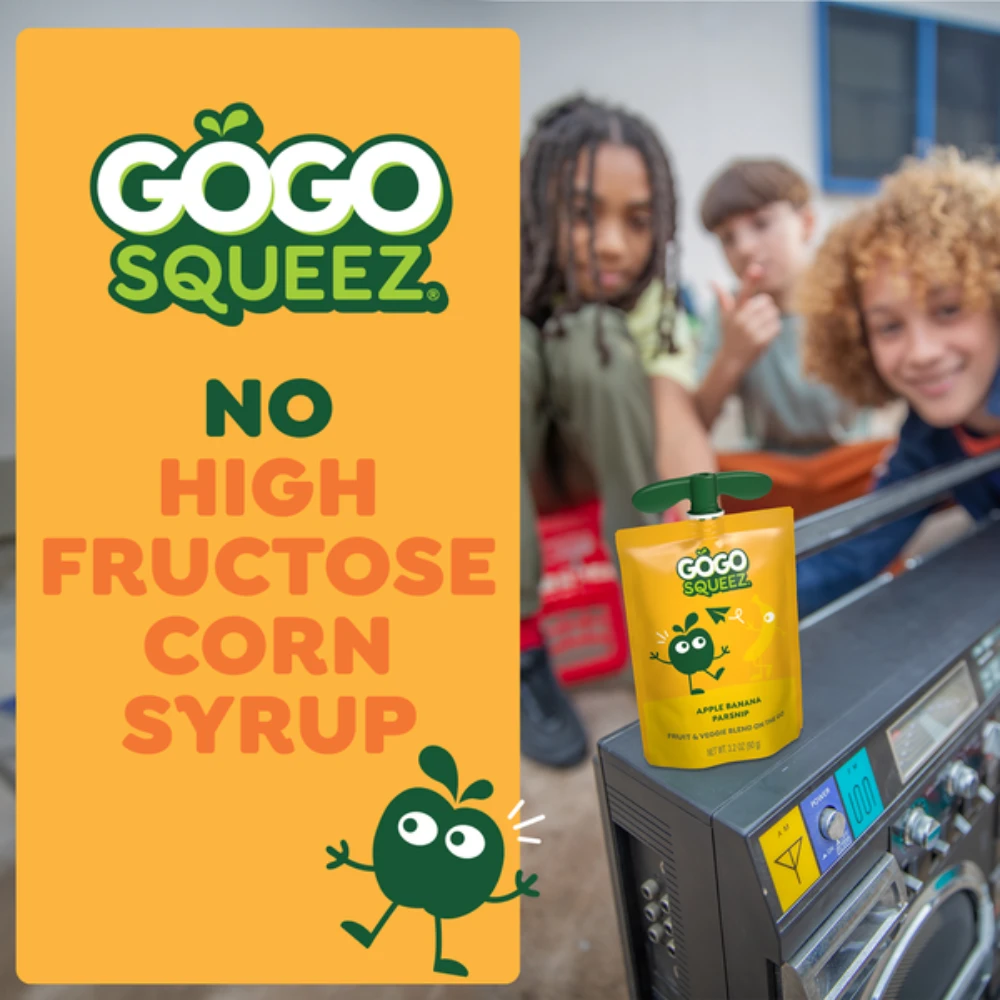
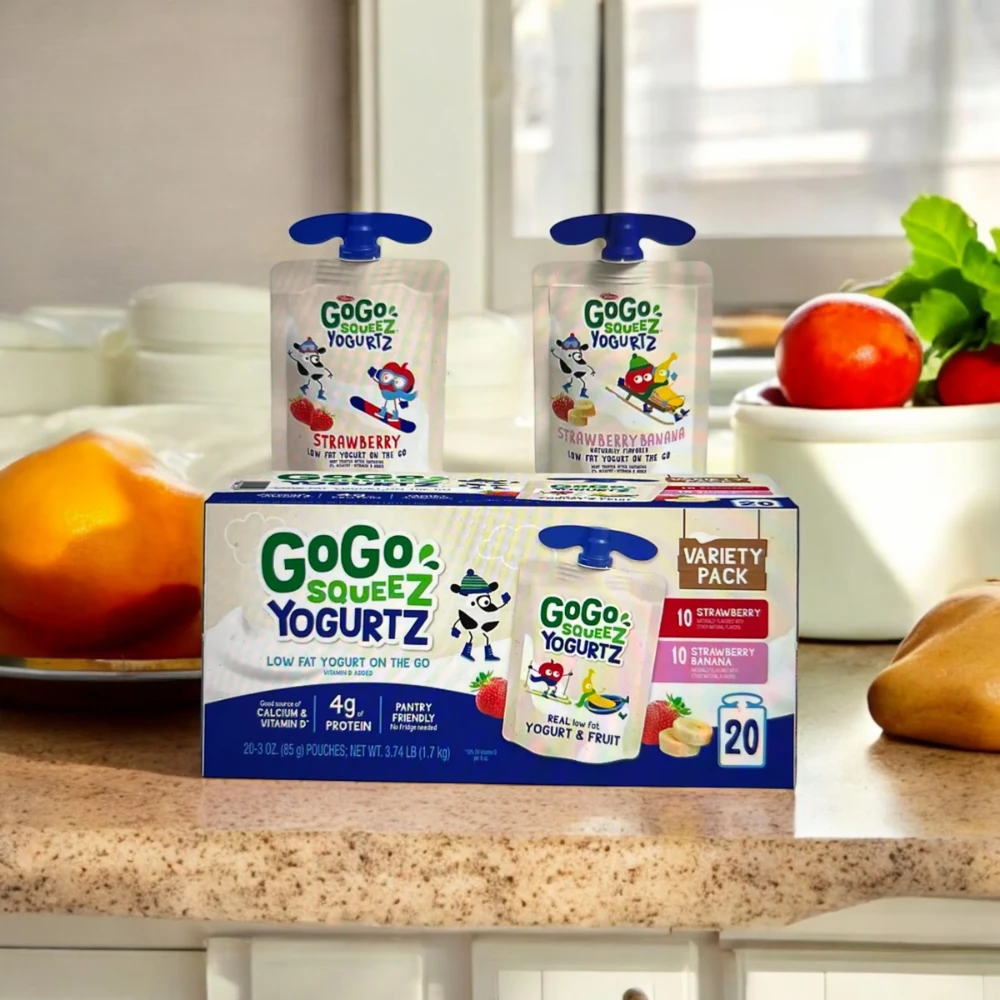
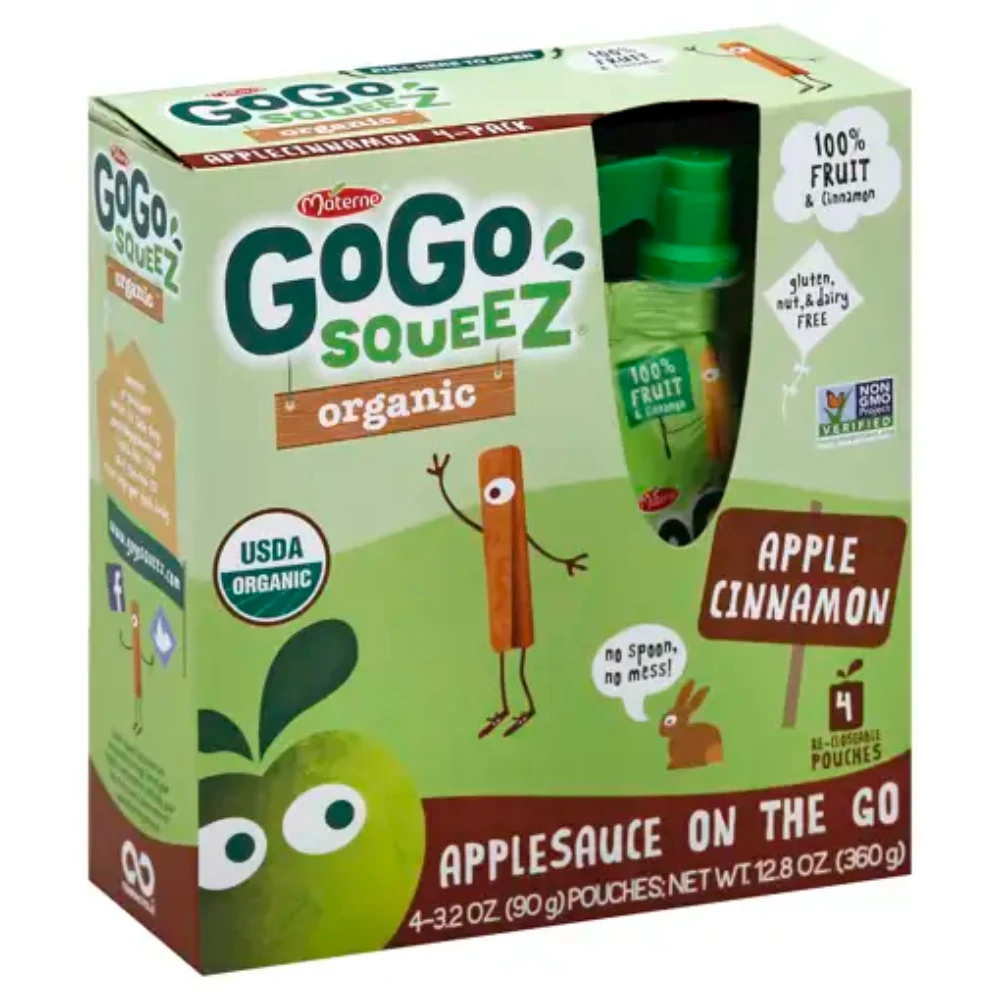
The squeeze pouch as a snack format did not begin in America. It began in 1881 in Boué, a small town in northern France, where a fruit processing factory was established that would eventually become Materne — a company with more than a century of experience making apple purées and compotes for the French market. In 1998, Materne introduced Pom’Potes: the world’s first fruit purée in a flexible squeeze pouch, sold in French supermarkets as a portable alternative to the glass jar of applesauce that had been the standard format for generations. The product was a success in France. Michel Larroche, a ten-year Heinz Europe veteran who had taken leadership of MOM Group — Materne’s parent company — saw something in the format that the American snack market did not yet have. He reportedly smuggled Pom’Potes pouches across the Atlantic in suitcases to share with family in New York. In 2008, MOM Group launched the American version under the name GoGo squeeZ. By November of that year, one million pouches had been sold. The product went first to Costco, then Whole Foods, then Target. Today, GoGo squeeZ sells approximately 1.5 billion pouches annually and commands roughly two-thirds of the United States market for squeezable fruit and dairy snack pouches.
That scale — 1.5 billion units per year, shelf-stable for up to twelve months, no refrigeration required, no artificial preservatives — is not primarily a product achievement. It is a packaging achievement. The fruit purée inside a GoGo squeeZ pouch is a high-moisture food product with a water activity approaching 1.0, which places it in the same biological risk category as fresh fruit. Keeping that product safe and palatable for a year in a pantry, a lunch bag, or a hot car, without chemicals that suppress microbial growth, requires the packaging to perform a more demanding barrier function than virtually any chip bag, candy bag, or protein powder pouch has to deliver. Add to that the structural demands of a squeeze format — a pouch that has to dispense its contents through a small opening under manual pressure, reclose cleanly, and survive the handling of children — and the GoGo squeeZ pouch becomes one of the most technically sophisticated pieces of flexible packaging in a grocery store, dressed up as a product for four-year-olds.
This article breaks down the GoGo squeeZ packaging system from a factory perspective: what the spout pouch format is and why it is fundamentally different from a conventional flexible pouch, why high-moisture food without preservatives demands more from the film than anything else in the snack aisle, how GoGo squeeZ transitioned from an aluminium-containing multilayer structure to an all-polyethylene film over five years and why that transition was harder than it looks, and why the weld between the spout and the pouch body is the most critical engineering point in the entire system.

The Spout Pouch Format: Why It Is Not Just a Stand-Up Pouch With a Lid
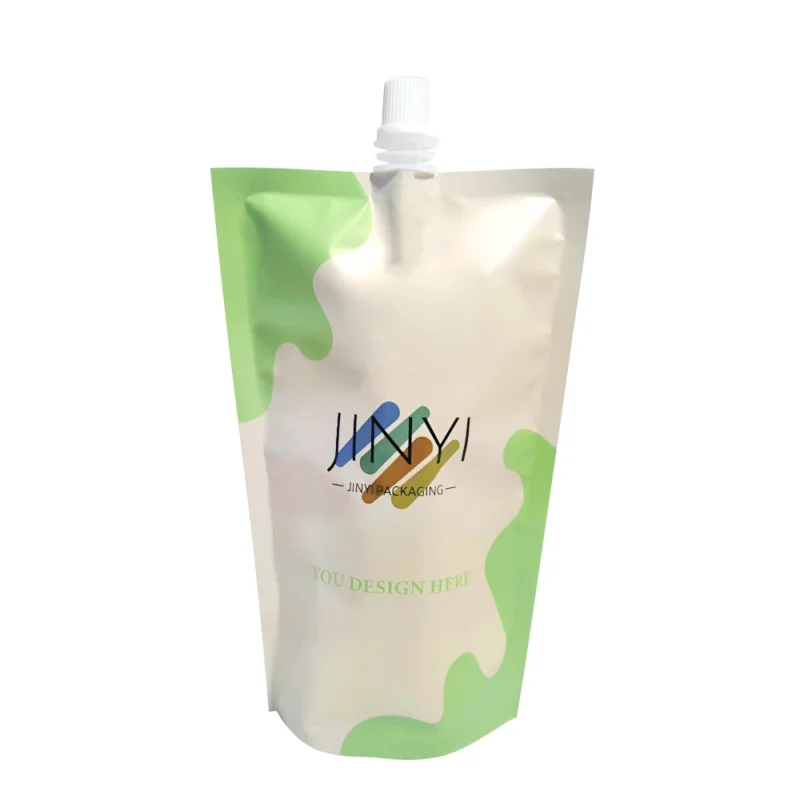
A spout pouch and a conventional pochette de rangement share a silhouette, but their engineering logic is different in almost every dimension that matters. A conventional stand-up pouch is designed to be opened once — torn across the top, or unzipped — and either consumed entirely or resealed with a zipper. The opening is wide, the contents are dry or semi-dry, and the act of opening does not require controlled directional force. A spout pouch is designed to dispense a liquid or semi-liquid product through a small, fixed aperture under squeeze pressure, repeatedly, with a closure that the end user — often a child — can operate independently. The pouch body provides the reservoir; the spout provides the controlled exit; the cap provides the reseal. Each of those three components has to function as part of a system, and the interfaces between them are where most of the engineering challenges concentrate.
The GoGo squeeZ pouch uses a standard 3.2oz (90ml) format for its core range, sold in four-packs, twelve-packs, and bulk club-store packs of 20 and 32. The pouch body is a sealed flexible film bag with a base gusset that allows it to stand. The spout — the rigid fitment through which the fruit purée is dispensed — is made from polypropylene, a material chosen for its combination of rigidity (it needs to hold the cap threads and resist deformation under squeeze pressure), food contact compliance, and heat resistance (it has to survive the thermal processing the filled pouch undergoes). The cap that screws onto the spout is a proprietary design that has evolved over the brand’s history: the current version is a propeller-shaped polyethylene cap that uses 40% less plastic than the original helicopter cap design, while maintaining the ease-of-opening performance that makes GoGo squeeZ accessible to young children. A secondary yogurt line uses a different cap — a blue helicopter cap — that requires adult supervision for children under three, reflecting the different viscosity and dispensing behavior of the dairy product versus the fruit purée.

The format’s commercial success is built on a specific consumer insight: a fruit purée that a child can eat independently, without a spoon, without making a mess, and without requiring refrigeration, is a fundamentally different product from the same purée in a glass jar or a plastic tub. The packaging format is the product differentiation. Removing the spout — putting the same fruit purée in a conventional stand-up pouch with a zipper top — does not produce the same product. It produces a product that requires a spoon, cannot be consumed on the move, and cannot be operated by a four-year-old without adult help. The format and the product proposition are inseparable.
Factory Take — On Choosing Spout Pouches vs Conventional Pouches: GoGo squeeZ uses a spout pouch because the format is the product — squeeze-and-sip dispensing for children is the entire commercial proposition. For a brand evaluating whether to specify a spout pouch, the question is whether the dispensing format creates value that justifies the cost premium. Spout pouches cost roughly 20–30% more per unit than a comparable stand-up pouch, require more complex filling equipment, and introduce the spout-to-body weld as an additional failure point. For liquid and semi-liquid products where controlled dispensing is a genuine user requirement — baby food, energy gels, condiment sachets, pet treats — that premium is commercially justified. For products where the spout is cosmetic rather than functional, a conventional stand-up pouch with a zipper delivers the same barrier performance at lower cost and simpler production.
No Preservatives, No Fridge, 12 Months: Why the Packaging Has to Work Harder Than Any Chip Bag
Every snack packaging brief starts from the same question: what will degrade this product first, and how fast? For potato chips, the answer is oxidative rancidity — fats meeting oxygen. For gummy candy, it is moisture absorption softening the texture. For beef jerky, it is a combination of both, plus microbial risk from the elevated water activity of dried meat. For GoGo squeeZ fruit purée — a product with a water activity approaching 1.0, no artificial preservatives, and a twelve-month ambient shelf life target — the answer is simultaneously more demanding than any of those categories and different in kind from all of them.
A water activity of 1.0 means the product has essentially the same free moisture availability as liquid water. At that level, virtually every pathogen and spoilage organism that threatens food safety can grow if given the opportunity. The reason a GoGo squeeZ pouch is safe to eat after twelve months in a pantry is not that the product is inherently resistant to microbial growth — it is not. It is that the production process applies thermal treatment (pasteurization or retort sterilization, depending on the specific product line) that destroys the microbial load before sealing, and the packaging then prevents any new microbial contamination, oxygen ingress, or moisture exchange from occurring for the duration of the shelf life. The film is not just maintaining quality the way a chip bag maintains crunch — it is maintaining safety the way a canning process maintains safety. The consequences of packaging failure are correspondingly more serious: a GoGo squeeZ pouch that allows oxygen permeation or microbial ingress does not just produce a stale product, it potentially produces an unsafe one.
The thermal processing requirement adds a constraint that chip and candy packaging does not face: the film and the spout fitment have to survive the temperatures of the pasteurization or retort process applied after filling and sealing. Pasteurization typically operates at 85–95°C for several minutes; retort sterilization operates at 121°C or above. A film that loses structural integrity, delaminated, or develops pinholes under that thermal load fails immediately and visibly. A film that survives the thermal process but develops micro-defects that are not immediately apparent can produce a product that passes initial quality inspection but fails during distribution. The thermal resistance of the film — particularly at the seal zones and the spout weld — is a specification that has no equivalent in dry snack packaging, and it is one of the most important parameters to validate before committing a spout pouch to production.
This is why the GoGo squeeZ packaging brief is categorically harder than the Jack Link’s jerky three-element freshness system, which manages a similar high-water-activity product through gas flushing, oxygen absorbers, and a high-barrier film — but does so at ambient temperature, without the added thermal processing constraint. The jerky is dried to reduce water activity before packaging; the fruit purée is not. Thermal processing is the intervention that makes ambient shelf stability possible without drying, and the packaging has to accommodate it.
Film Structure: From Aluminium Foil to All-PE — and Why It Took Five Years
For most of its existence, the GoGo squeeZ pouch was built around an aluminium-containing multilayer film structure — the highest-barrier option available in flexible packaging. The original structure combined an inner aluminium layer for oxygen and moisture barrier, a BPA-free plastic contact layer in direct contact with the fruit purée, an outer paper layer providing the recyclable-facing surface, and additional oxygen barrier layers. This structure delivered the combined moisture and oxygen barrier that a high-water-activity, unpresented fruit product requires across a twelve-month shelf life, and it did so reliably at the 1.5 billion-unit-per-year scale that GoGo squeeZ operates.
The structural routes available for a high-moisture food spout pouch application are as follows, each representing a different balance between barrier performance, cost, and recyclability.
Route A — Aluminium foil structure (PET / AL / PE or similar): The original GoGo squeeZ approach. Aluminium foil delivers near-absolute barrier to oxygen, moisture, and light — the strongest available. For a twelve-month unpasteurized or pasteurized fruit product in global distribution, this is the most conservative and reliable choice. The trade-off: the aluminium layer makes the structure non-recyclable in conventional recycling streams and adds to the product’s carbon footprint per unit.
Route B — EVOH-containing multilayer (PE / EVOH / PE or similar): EVOH provides exceptional oxygen barrier — in dry conditions, comparable to or better than thin aluminium foil — while maintaining the possibility of a recyclable structure if EVOH content stays below 5% of the total film weight. The challenge for a high-moisture food application: EVOH’s barrier properties degrade when the polymer absorbs moisture. In a pouch containing fruit purée at near-1.0 water activity, the inner film surface is in prolonged contact with a high-humidity environment. EVOH protection via outer moisture-barrier layers is essential, and the structure becomes more complex as a result.
Route C — All-PE mono-material structure: The route GoGo squeeZ transitioned to by 2022. A single-polymer-family structure where every layer — outer print film, barrier contribution, inner food contact layer — belongs to the polyethylene family. The environmental benefit is significant: eliminating aluminium cuts the CO₂ impact of manufacturing the film by approximately 50%, according to MOM Group’s reporting, and the mono-material structure is compatible with PE film recycling streams. The engineering challenge is that PE’s intrinsic barrier performance is lower than aluminium foil or EVOH — delivering a twelve-month shelf life for a high-moisture product in an all-PE structure required five years of development and validation to achieve at GoGo squeeZ’s scale. GoGo squeeZ’s competitor Gerber took a different route for the same transition, choosing polypropylene as the mono-material basis rather than polyethylene — a choice that reflects the same barrier-recyclability trade-off from a different angle.
For context on barrier performance in practice: a third-party test report commissioned by Jinyi Packaging Co., Ltd. and issued by Guangzhou Quality Supervision and Testing Institute (GQT, report no. QGWT20250075137E, September 2025) on a BOPP/VMPET/PE structure produced at JINYI’s facility recorded a water vapor transmission rate of 0.8 g/(m²·24h) and an oxygen transmission rate of 0.4 cm³/(m²·24h·0.1MPa) — both well within food safety thresholds, and a direct reference point for the barrier performance JINYI’s film structures deliver in production. The GoGo squeeZ all-PE structure targets comparable or better performance for its specific application, achieved through a more demanding engineering process given the absence of a metallized barrier layer. The complete process of how film layers are laminated and converted into finished pouches is covered in our guide on comment les sachets sur mesure sont fabriqués, du film au sac fini.
| Structure Route |
Barrier Performance |
Recyclabilité |
Suitable Shelf Life |
| PET / AL / PE (foil) |
★★★★★ Maximum |
❌ Not recyclable |
12–24 months, global distribution |
| PE / EVOH / PE |
★★★★☆ High (dry conditions) |
⚠️ PE-recyclable if EVOH <5% |
6–18 months, needs moisture protection for EVOH |
| All-PE mono-material (estimated, current GoGo squeeZ) |
★★★☆☆ Moderate-high |
✅ PE film recycling stream |
Up to 12 months, validated for specific product and climate |
Note: GoGo squeeZ’s current film structure is estimated as all-PE mono-material based on MOM Group’s public sustainability reporting. Specific layer compositions and performance specifications have not been published officially. The foil and EVOH routes represent industry-standard alternatives for high-moisture spout pouch applications.
Factory Take — On All-PE vs Foil for High-Moisture Spout Pouches: GoGo squeeZ’s five-year transition to all-PE is the right long-term direction for a brand selling 1.5 billion units annually — the scale makes the environmental impact of the film structure material, and the investment in developing a validated all-PE solution pays back across billions of units. For a smaller brand developing a fruit purée, baby food, or similar high-moisture spout pouch product: if your shelf life target is 6 months or less and your distribution is in low-to-moderate humidity climates, an all-PE structure is worth evaluating now — the barrier gap relative to foil is manageable at shorter shelf lives. If you are targeting 12 months or more, especially across warm or humid distribution environments, start with a foil structure and a validated shelf life result before attempting a recyclable transition. A recall from a product that failed its shelf life in an all-PE pouch is a significantly worse outcome than a delayed recyclability commitment.
The Spout-to-Body Weld: The Engineering Detail That Determines Whether the Pouch Is Safe
The film of a spout pouch can be perfectly specified — correct barrier, correct thermal resistance, correct food contact compliance — and the pouch can still fail if the weld between the spout fitment and the pouch body is inadequate. The spout-to-body interface is the most mechanically and thermally stressed point in the entire package, and it is the point where the two primary materials of the spout pouch system — the rigid PP spout and the flexible PE film body — meet in a heat-bonded joint that has to remain intact through pasteurization, distribution, handling, and repeated squeeze cycles by a child’s hands.
The fundamental challenge is material compatibility. Polypropylene and polyethylene belong to the same polyolefin family, which makes them more compatible than, say, PET and PE — but they do not weld as cleanly as like-to-like materials. The heat sealing parameters — temperature, pressure, dwell time — that produce a reliable weld between a PP spout and a PE film are narrower than those for a PE-to-PE seal, and deviation from the validated parameters produces either under-welded joints that fail under squeeze pressure or over-welded joints that damage the film adjacent to the spout. Either failure mode can compromise the hermetic seal that keeps the product sterile and safe.
The consequence of a failed spout weld is not a stale product — it is a product safety event. A GoGo squeeZ pouch with a micro-leak at the spout interface admits oxygen and potential microbial contamination into a food product that contains no preservatives and has a water activity that supports rapid microbial growth. The product will not look or smell spoiled immediately; the deterioration happens below the detection threshold. This is why spout pouch production requires leak testing on a sampling basis — pressure decay testing, vacuum testing, or visual inspection of weld integrity — as a standard quality control step, not an optional one. For a brand producing spout pouches for the first time, the weld validation process is the single most important quality step before committing to a production run.
Factory Take — On PP Spout With PE Body: GoGo squeeZ uses a polypropylene spout with a polyethylene film body — and this combination is the right choice for this application. PP’s rigidity is what allows the screw cap to function correctly over repeated cycles; PE’s flexibility and heat-seal performance are what make the pouch body manufacturable at high speed with reliable seals. The PP/PE combination at the spout interface introduces a welding complexity that a fully homogeneous structure would not have, but it is the established industry solution for good reason: the performance of each material in its respective role is superior to any single-material alternative currently available at commercial scale. A fully PP spout pouch — spout and body both PP — would simplify recyclability but require a stiffer, less flexible body film that changes the squeeze experience. The PP spout plus PE body is the correct answer for this product category.
TerraCycle, All-PE, and the Recyclability Problem Spout Pouches Have Not Solved
GoGo squeeZ has operated a voluntary recycling program in partnership with TerraCycle since the brand’s early years. Consumers collect used pouches and ship them to TerraCycle, earning points redeemable for charitable donations. TerraCycle processes the pouches through its proprietary separation and upcycling system, converting the material into recycled plastic products. The program is genuine and well-intentioned, and it has diverted a real volume of pouches from landfill. It is also, by design, a supplementary program rather than a mainstream recycling solution — it requires consumer action beyond placing an item in a recycling bin, and it reaches a fraction of the total pouches sold.
The transition to an all-PE film body addresses one part of the recyclability problem: the film itself is now compatible with PE film recycling streams, in markets where those streams exist and are accessible. This is the same direction that Haribo took with its recyclable candy doypack — and a significantly harder engineering achievement, because a fruit purée pouch has higher barrier requirements than a gummy candy bag. The difference is that Haribo’s doypack is a fully mono-material PE structure with no rigid fitment; GoGo squeeZ’s pouch still has a PP spout. Even with an all-PE film body, the assembled GoGo squeeZ pouch is a multi-material product — the PP spout and PE film body are not separated before disposal by most consumers, and most recycling facilities do not separate them either. The all-PE film transition reduces the carbon impact of manufacturing, but it does not make the finished pouch recyclable in the way that a standalone PE film bag is recyclable.
This is the structural tension at the heart of spout pouch sustainability: the spout — the feature that makes the format commercially valuable — is also the feature that makes true recyclability difficult to achieve. Eliminating the spout removes the commercial proposition. Keeping the spout means the package will, for the foreseeable future, require specialized recycling infrastructure or voluntary take-back programs to avoid landfill. The brands that have invested most heavily in spout pouch sustainability are banking on recycling infrastructure improvements — particularly the expansion of flexible film recycling to include multi-component packages — that are currently more advanced in Europe than in North America.
Sourcing Custom Spout Pouches: The Specification Questions That Actually Matter
The GoGo squeeZ engineering brief — high-barrier film for a high-moisture product, thermal process resistance, spout-to-body weld integrity, and a squeeze-and-reseal format for independent use by children — is directly applicable to any brand developing a spout pouch product. The format serves a wide range of applications beyond fruit purée: baby food, pet treats and supplements, condiment sachets, energy gels for sports applications, and adult nutritional pouches. Each application has its own specific barrier requirements, thermal processing constraints, and user interface demands — but the core engineering questions are the same.
The specification conversation for a spout pouch should cover five things that are often inadequately addressed in a first sourcing inquiry. First, the thermal processing method and temperature — pasteurization or retort, and at what temperature — because this drives the film and spout material selection. Second, the target water activity and microbial specification of the filled product, because this determines how much barrier work the film has to do over the stated shelf life. Third, the shelf life target and distribution environment, because a six-month ambient shelf life in a temperate market and a twelve-month shelf life through hot-climate global distribution require fundamentally different barrier specifications. Fourth, the spout fitment material and weld validation protocol — because this is where quality failures are most likely to occur and most dangerous in their consequences. Fifth, the sustainability requirements of the target market, because the recyclability of the assembled pouch is increasingly a procurement criterion in European markets and a growing consideration in North America.

At Jinyi Packaging Co., Ltd. — a 10,443㎡ source factory serving brands across 70+ countries — spout pouches are produced with film structures from foil-based laminates for maximum shelf life to all-PE mono-material structures for brands pursuing recyclability commitments. Spout fitment welding is validated through pressure testing on each production run, not assumed from equipment settings alone. For brands at the development stage — testing a new fruit purée, a baby food line, a pet supplement pouch — the HP Indigo digital press fleet enables pouch design validation on physical samples from 500 units, before committing to the tooling and film investment of a full production run. Every JINYI order includes free 3D mockup rendering before production, production progress updates at each manufacturing stage, and free e-commerce photography of the finished pouches.

Sourcing custom spout pouches for food, baby food, or pet products?
JINYI produces spout pouches with foil, EVOH, and all-PE film structures — thermal process validated, spout weld tested, and available in digital print from 500 units. Free 3D mockup, production updates, and e-commerce photography included with every order.
Obtenir un devis pour l'emballage →
À propos de JINYI
JINYI est une usine de production d'emballages flexibles sur mesure, avec plus de 15 ans d'expérience dans la production, au service de marques de produits alimentaires, de compléments alimentaires, de café, d'aliments pour animaux de compagnie et de biens de consommation dans plus de 70 pays. Nous produisons des sachets à fond plat, des sachets coussins et des sachets à soufflets latéraux en PET/AL/PE, PET/VMPET/PE et autres spécifications de barrière - via l'impression numérique HP Indigo à partir de 500 unités et l'impression hélio en volume - avec une documentation complète sur les matériaux incluse en standard dans chaque commande.
C'est ce que Du film au produit fini - bien fait dans la pratique.

Elsa
Responsable du développement commercial - JINYI Packaging
Elsa dirige le développement commercial et la gestion des commandes des clients chez JINYI. Avec 8 ans d'expérience dans le commerce extérieur à Yiwu et Dongguan, elle a une connaissance approfondie de la demande du marché et des besoins réels des acheteurs, ce qui lui permet de prendre les bonnes décisions en matière d'emballage sur la base d'une connaissance réelle du client.
Besoins des clients
Gestion des commandes
Développement des entreprises
Questions fréquemment posées
What are GoGo squeeZ pouches made of?
GoGo squeeZ pouches are estimated to use an all-polyethylene (all-PE) mono-material film body, following MOM Group’s transition away from aluminium-containing multilayer structures completed by 2022. The spout fitment is polypropylene. The original structure used aluminium foil as the primary barrier layer. MOM Group has not published official layer-by-layer film specifications.
How does GoGo squeeZ stay shelf-stable for 12 months without refrigeration or preservatives?
GoGo squeeZ achieves ambient shelf stability through a combination of thermal processing — pasteurization or retort sterilization applied after filling and sealing — and high-barrier packaging that prevents oxygen and moisture exchange after the product is sealed. The thermal process destroys microbial contamination present at the time of filling; the film barrier prevents new contamination from entering. There are no artificial preservatives; the packaging does the work that preservatives would otherwise do.
What is a spout pouch and how is it different from a stand-up pouch?
A spout pouch adds a rigid fitment — the spout — welded into the top of a flexible film body, through which liquid or semi-liquid contents are dispensed under squeeze pressure. A stand-up pouch has no fitment; it is opened by tearing or unzipping the top. Spout pouches cost roughly 20–30% more per unit, require more complex filling and assembly equipment, and introduce the spout-to-body weld as an additional quality control point. They are justified when controlled dispensing through a small opening is a genuine user requirement.
Are GoGo squeeZ pouches recyclable?
GoGo squeeZ has transitioned its film body to an all-PE structure compatible with PE film recycling streams where those exist. However, the assembled pouch includes a PP spout that is not separated from the PE film body by most consumers or recycling facilities, making the complete package difficult to recycle in conventional systems. GoGo squeeZ operates a TerraCycle take-back program for used pouches. The all-PE film transition reduces the manufacturing carbon footprint by approximately 50% but does not make the assembled pouch fully recyclable through mainstream infrastructure.
Why does spout pouch production require special quality testing?
The weld between the PP spout fitment and the PE film body is the highest-stress point in the package and the most likely location for seal failure. A failed spout weld in a high-moisture, preservative-free food product admits oxygen and potential microbial contamination that can compromise food safety without immediately visible signs. Pressure decay testing or vacuum testing of the spout weld is a standard quality control requirement for food-grade spout pouch production, not an optional step.
What products can be packaged in spout pouches?
Spout pouches are suitable for any liquid or semi-liquid product where controlled dispensing through a small aperture adds consumer value: fruit purées, baby food, pet food and supplement pastes, condiments and sauces, energy gels for sports applications, and adult nutritional supplements. The film specification, thermal processing requirements, and spout design vary by product — a baby food pouch has different food safety and regulatory requirements than a pet treat pouch, even if the physical format is similar.
Can I order custom spout pouches at low minimum quantities?
Yes. Through HP Indigo digital printing, custom spout pouches in foil, EVOH, or all-PE film structures can be produced from 500 units — allowing a brand to validate design, film specification, and spout weld integrity on a physical sample before committing to a full production run. JINYI includes free 3D mockup rendering, production progress updates, and e-commerce photography with every order.