JINYI shares practical packaging guidance for your decisions.
Choosing the wrong packaging for your matcha brand doesn’t just affect the way the product looks — it can compromise freshness within weeks, fail retail compliance, and leave you with a bag that undermines the premium positioning you’ve worked to build. Matcha is one of the most packaging-sensitive products in the food and wellness category, and the decisions you make before placing your first order carry more weight than most buyers realise.
This guide covers the decisions that matter most: which pouch format fits your brand and channel, what barrier specs your matcha actually needs, what MOQ to expect on a first order, and what to ask a supplier before you commit. For a deeper look at how established matcha brands like Jade Leaf and Golde have made their packaging decisions, see our matcha packaging teardown.
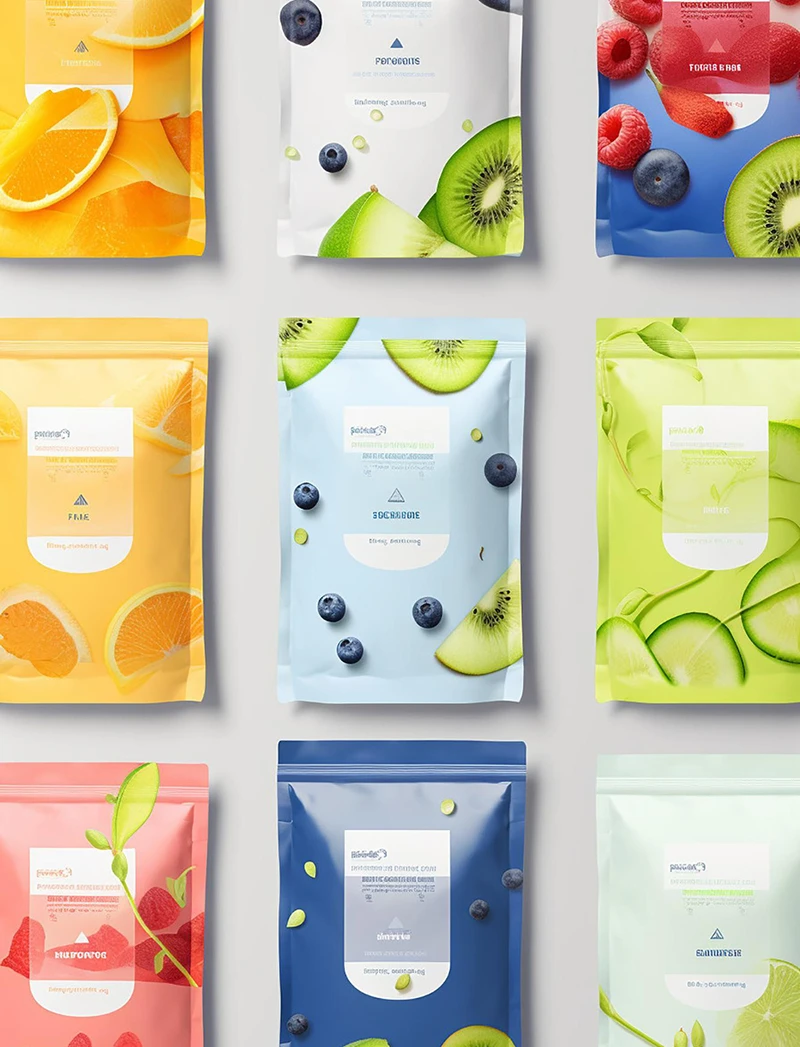
Jinyi’s Bagged Matcha Product Photography Services for Clients
Use a PET/AL/PE high-barrier laminate for matcha — no other flexible film structure provides adequate protection for ceremonial-grade powder.
Keep the bag fully opaque — any window creates a light pathway that degrades chlorophyll and turns your matcha yellow-brown.
Pick your format before briefing a supplier — stand-up pouches suit most new brands; flat-bottom bags suit premium retail and DTC photography.
Plan for MOQ starting from 500 units via digital print — no plate fee, and the right starting point before you have confirmed volume.
JINYI dispatches within 7–15 days from artwork approval (no sample) — significantly faster than the industry average of 4–6 weeks production alone.
Always request a physical sample before committing to full production — colour accuracy, zipper function, and seal integrity are all easier to fix at sample stage.
Ask your supplier for material documentation as standard — OTR, MVTR, and food-contact certifications are required for most retail and organic compliance.
Why Matcha Packaging Requires Higher Barrier Than Most Powders
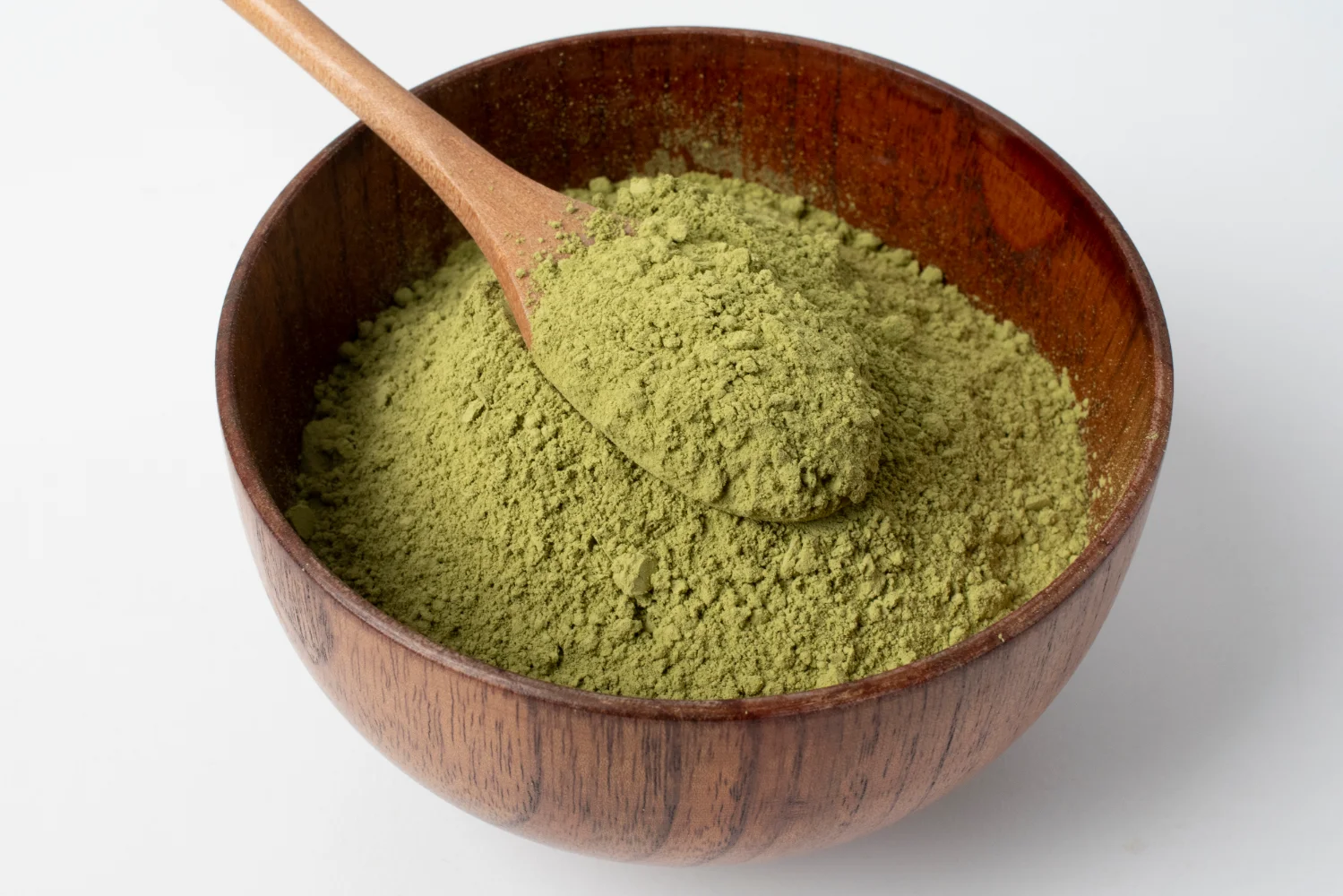
Matcha is stone-milled to an extremely fine particle size — often 1,000-mesh or finer. That means its total surface area per gram is hundreds of times greater than ground coffee or protein powder. Every square millimetre of that surface is directly exposed to whatever oxygen, moisture, or light the packaging allows in — and the damage is fast and irreversible.
Two chemical processes begin immediately upon oxygen or light exposure. Chlorophyll breaks down — the powder shifts from vibrant emerald green to dull yellow-brown. L-theanine, the amino acid responsible for matcha’s smooth umami flavour, degrades simultaneously. Neither process can be reversed once started. A brand can get away with a moderate-barrier bag for protein powder or culinary spices and still have a commercially viable product. For matcha — especially ceremonial grade — the packaging spec is not a branding decision. It is a quality assurance decision.
Degradation Factor
Effect on Matcha
What Your Packaging Must Do
Oxygen
Oxidises chlorophyll and L-theanine — colour and flavour loss
Aluminium foil barrier layer + oxygen absorber or nitrogen flush
Note: Unlike coffee, matcha does not release CO₂ after processing — so there is no need for a degassing valve. The primary freshness mechanism for matcha is oxygen exclusion, not gas release. This is why matcha bags use oxygen absorbers or nitrogen flushing at the point of sealing, rather than the one-way valves common in coffee packaging.
Pouch Formats for Matcha: Which One Fits Your Brand?
The format you choose determines your shelf presence, your logistics footprint, and how your brand reads in retail and DTC photography. For matcha powder, three flexible formats and one rigid option dominate the market — and each serves a different business model.
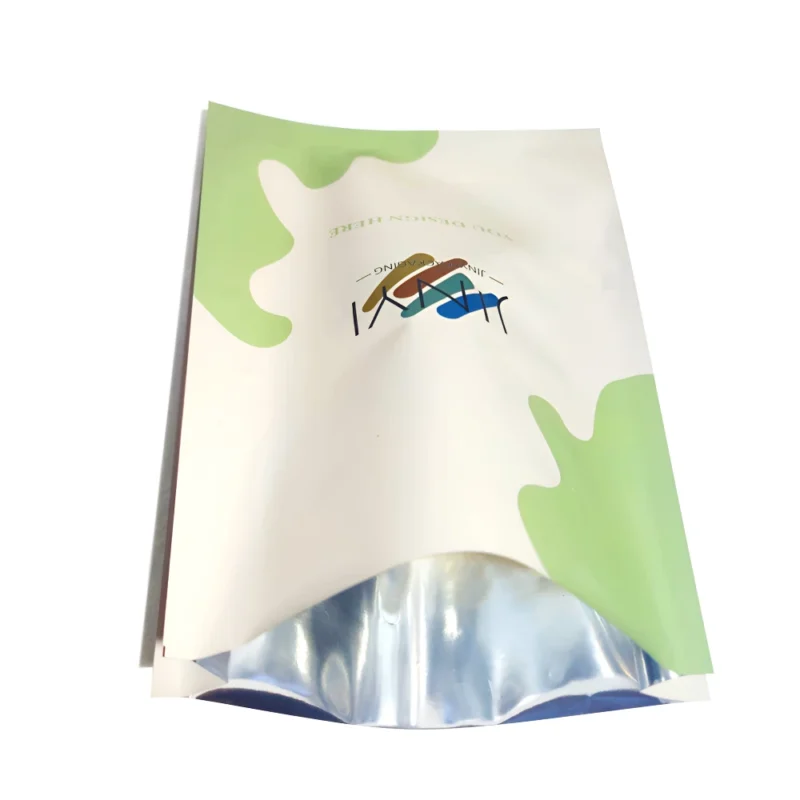
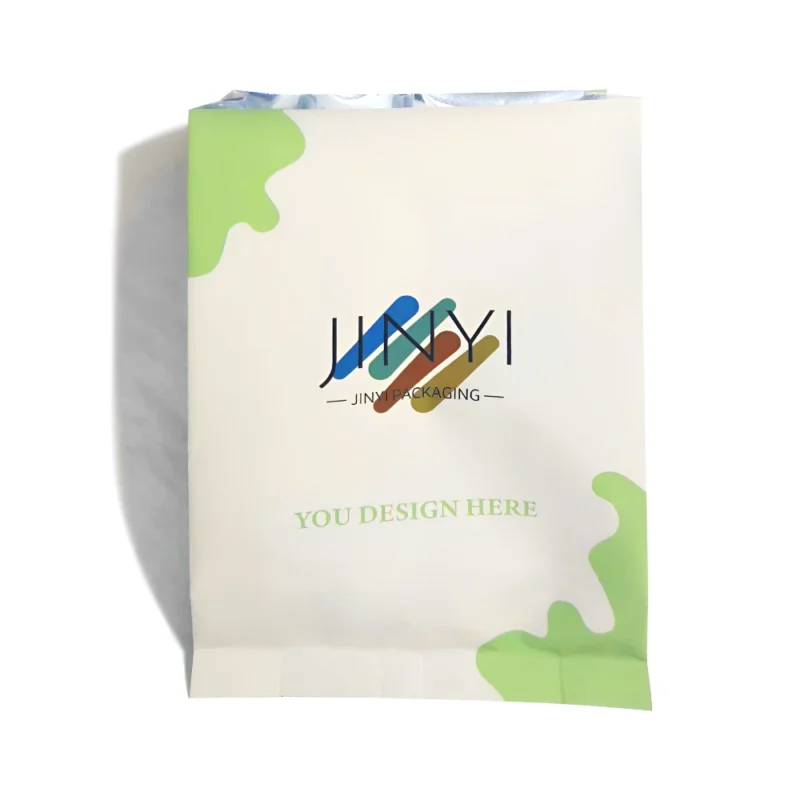
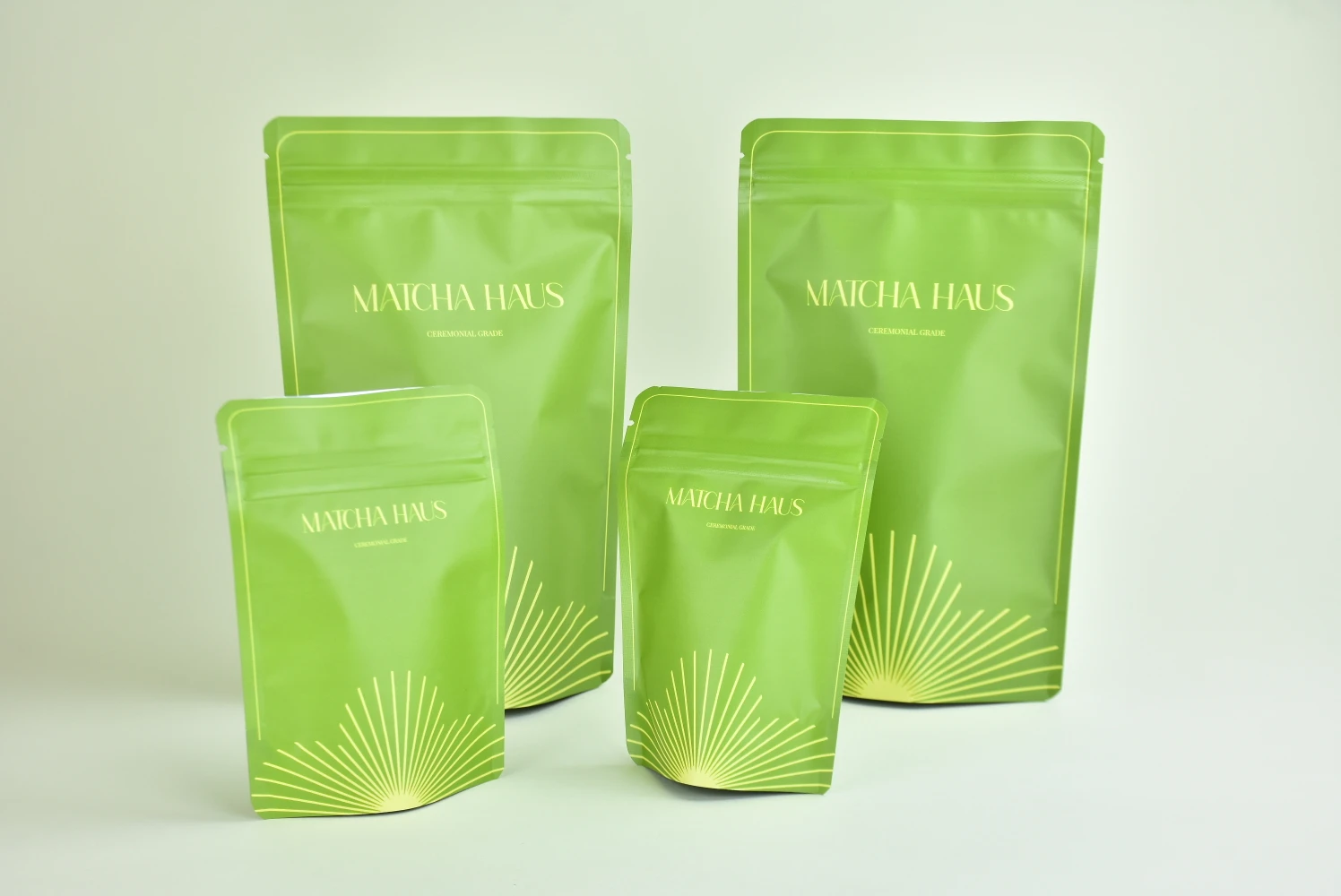
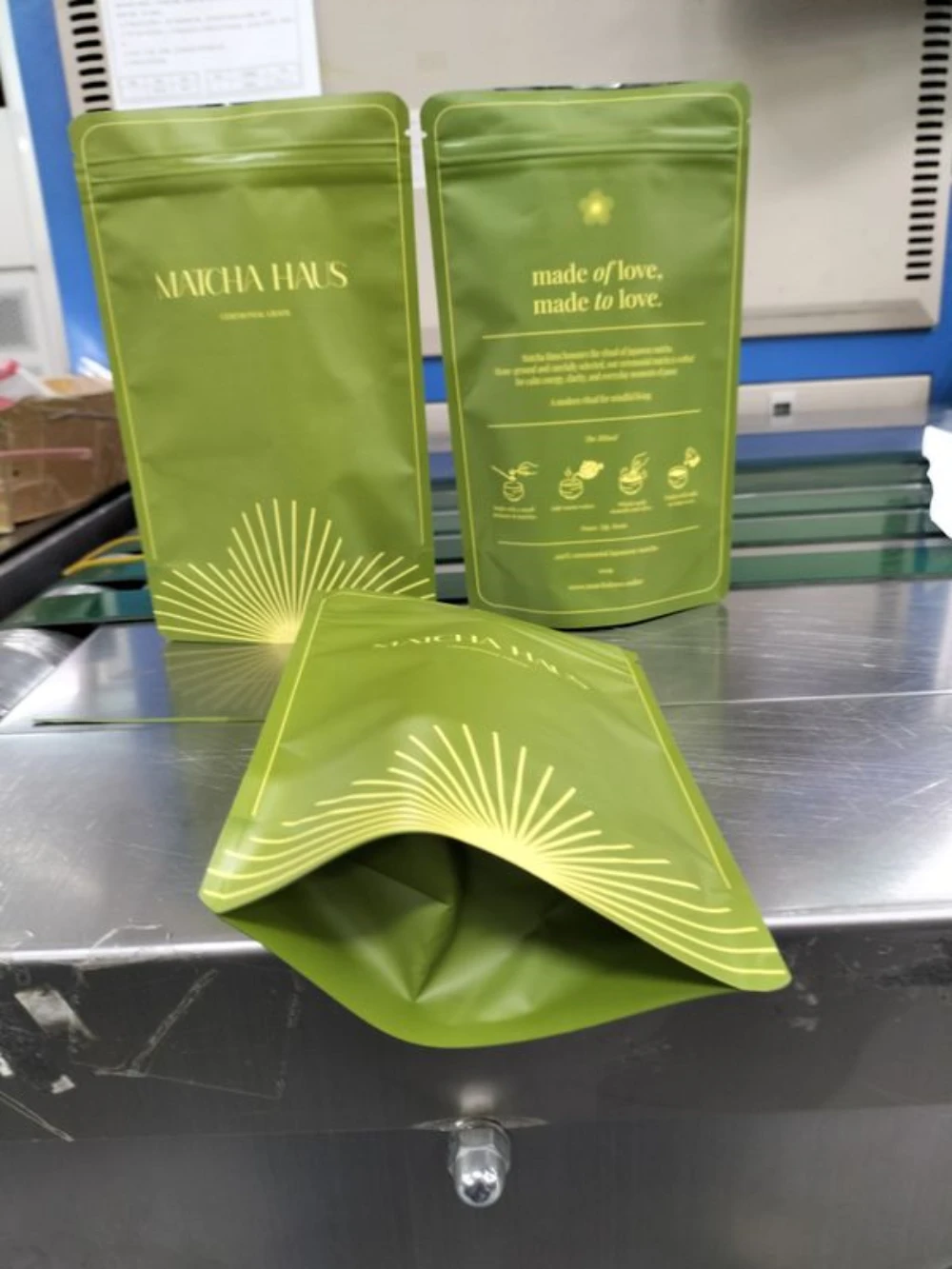
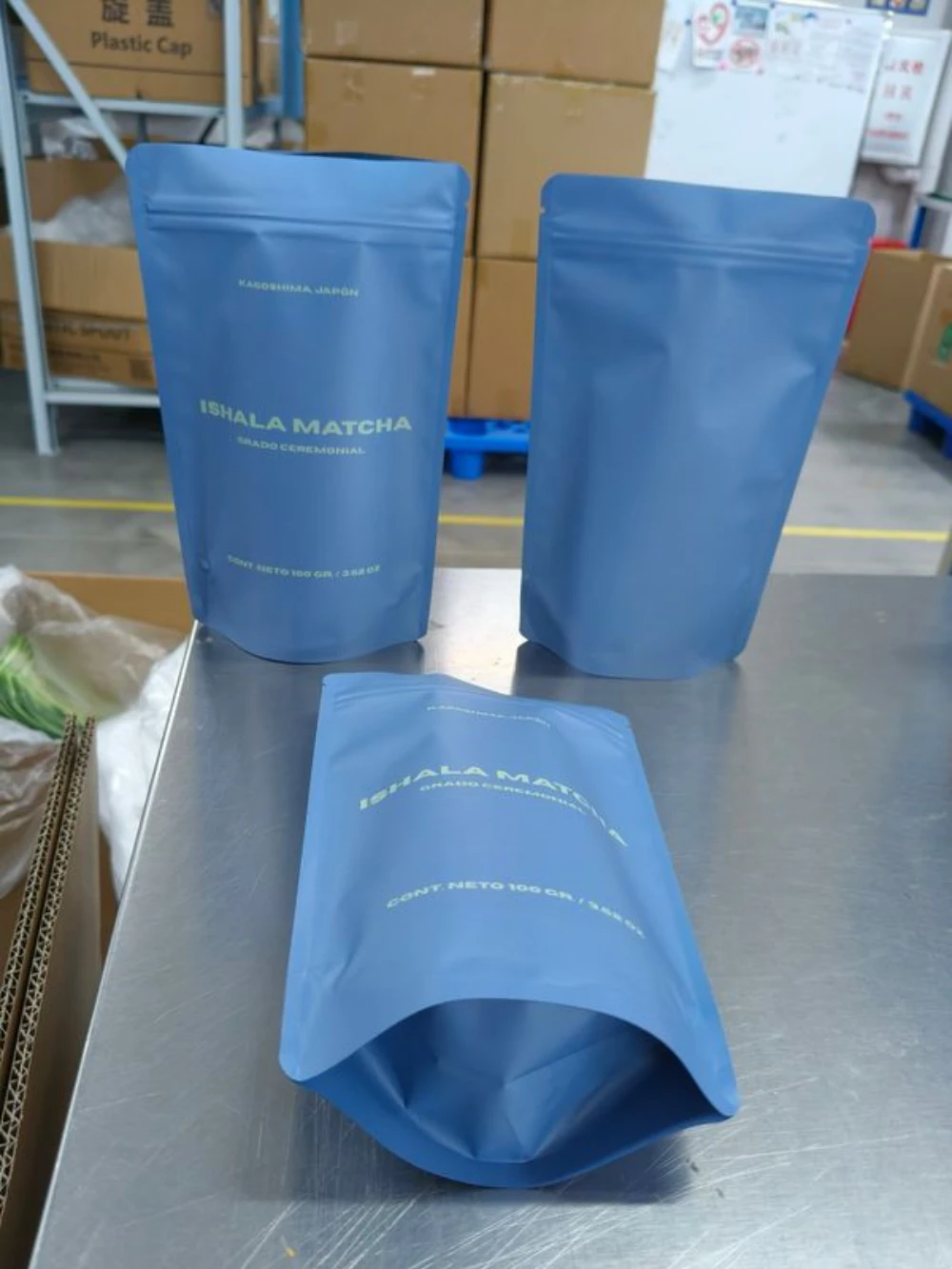
Green matcha packaging pouches freshly produced at the Jinyi factory.
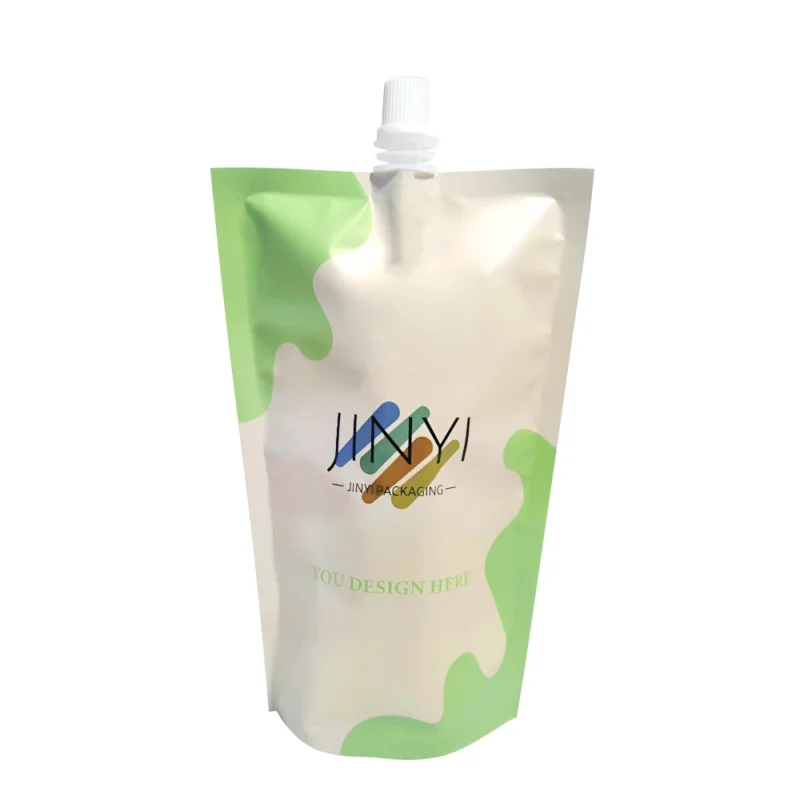
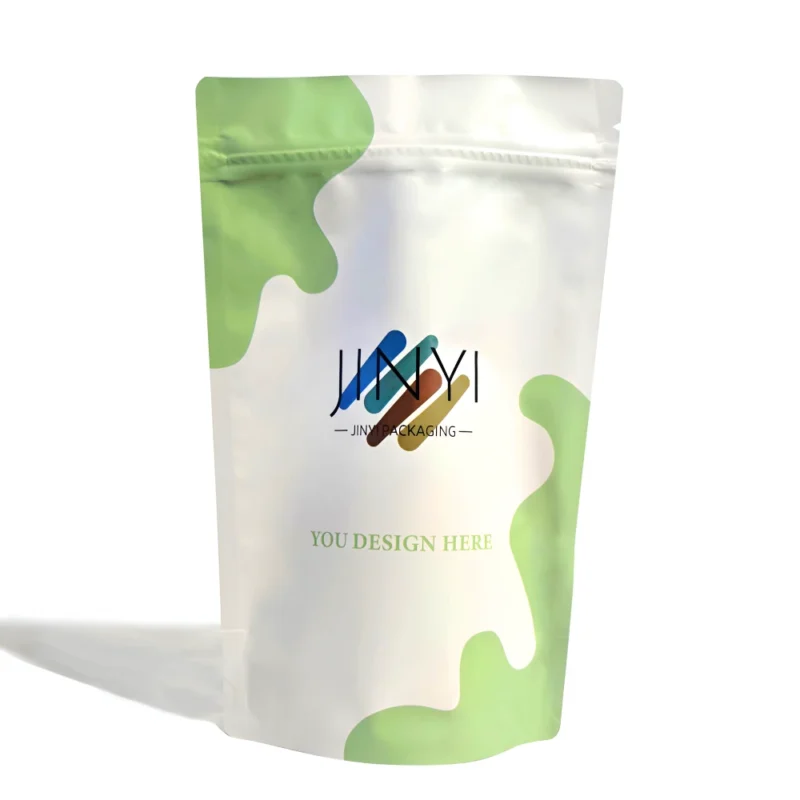
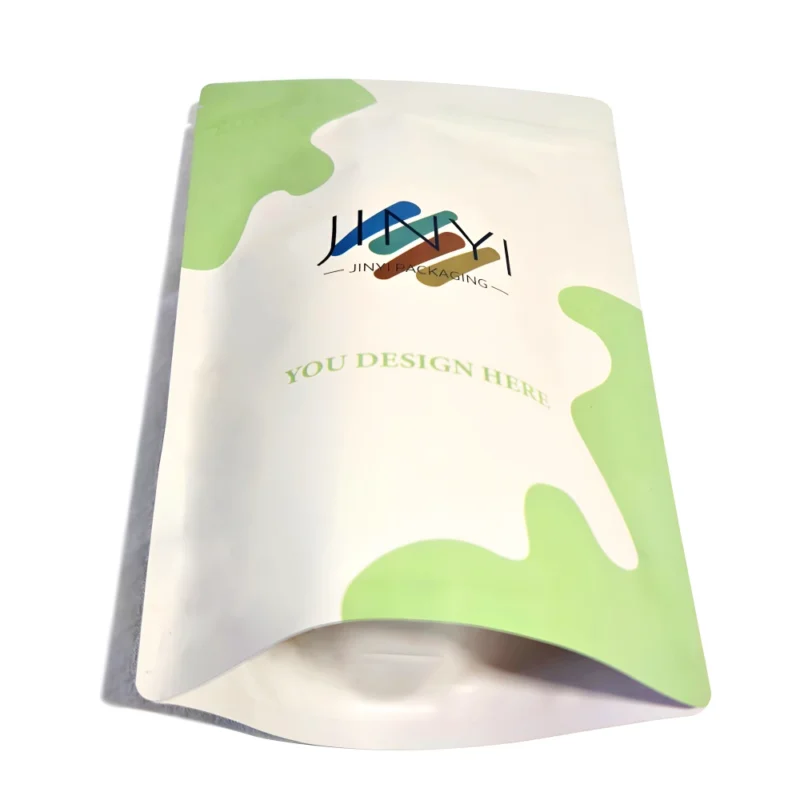
The stand-up pouch is the dominant format for retail and DTC matcha brands. It stands upright on shelf without support, ships flat when empty, provides a large front panel for brand artwork, and is available across the widest range of sizes — typically 30g to 500g. It is the most cost-efficient starting format and carries the lowest MOQ of any flexible option. For most brands launching their first matcha SKU, the stand-up pouch is the right choice: it validates your market at lower unit cost before you commit to a premium format.
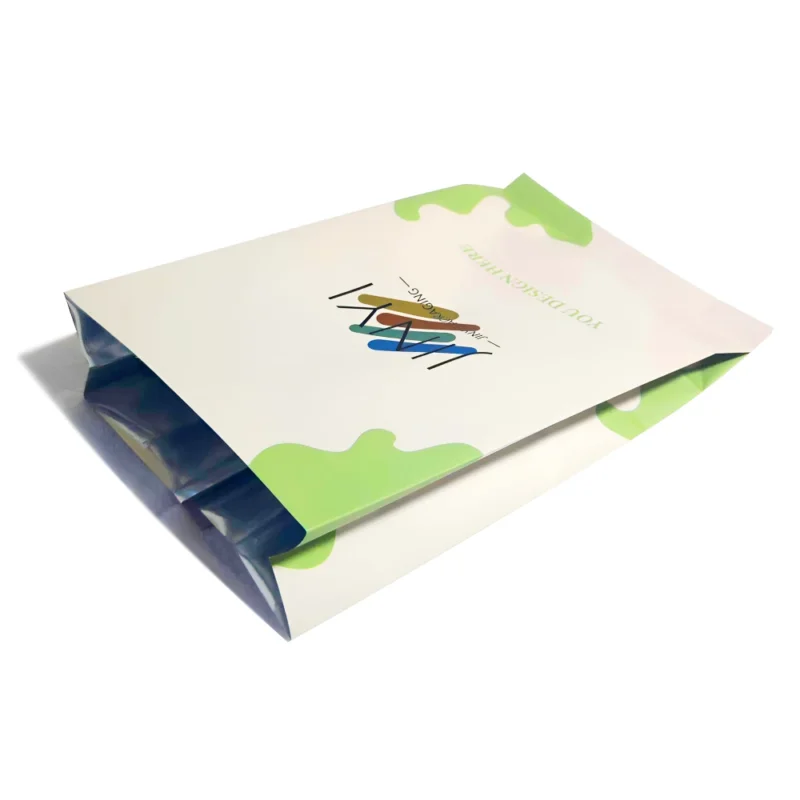
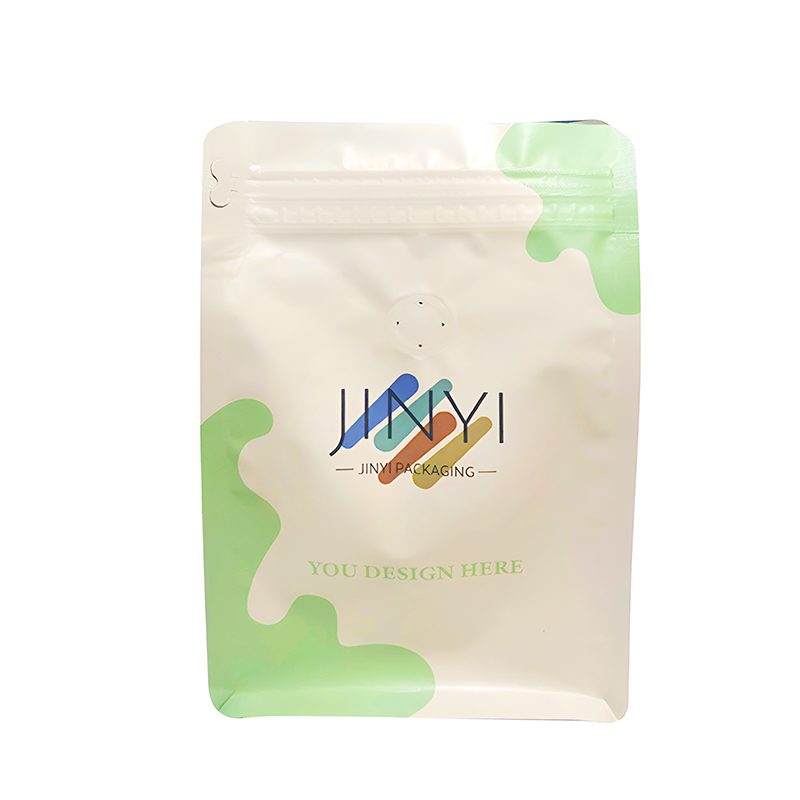
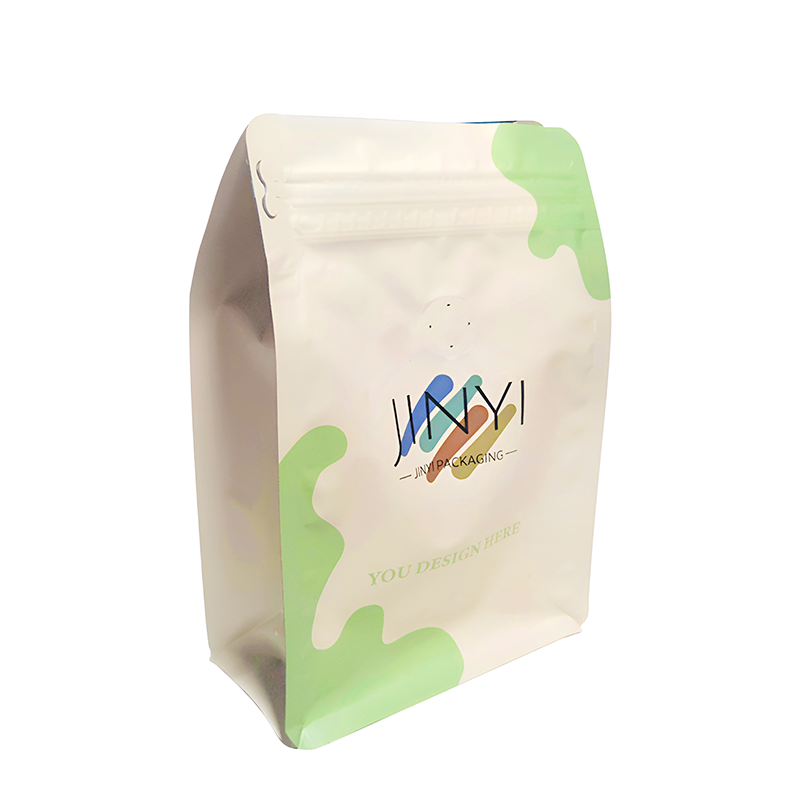
The flat-bottom bag — also called a box bottom bag or quad-seal bag — offers a more architectural standing profile. The base folds out flat, giving the bag a rigid, box-like presence on shelf that reads more premium than a standard stand-up pouch. It photographs better in tabletop and lifestyle settings, and holds its shape more consistently under retail handling. Several premium matcha brands use flat-bottom bags for boutique retail SKUs precisely for this reason. The trade-off is a slightly higher unit cost and typically a higher MOQ.
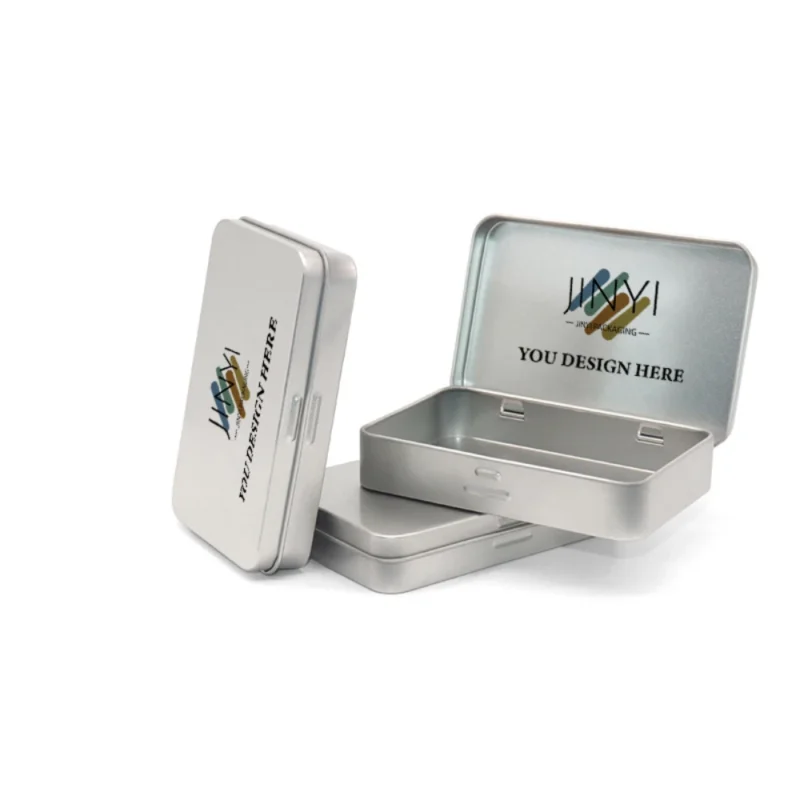
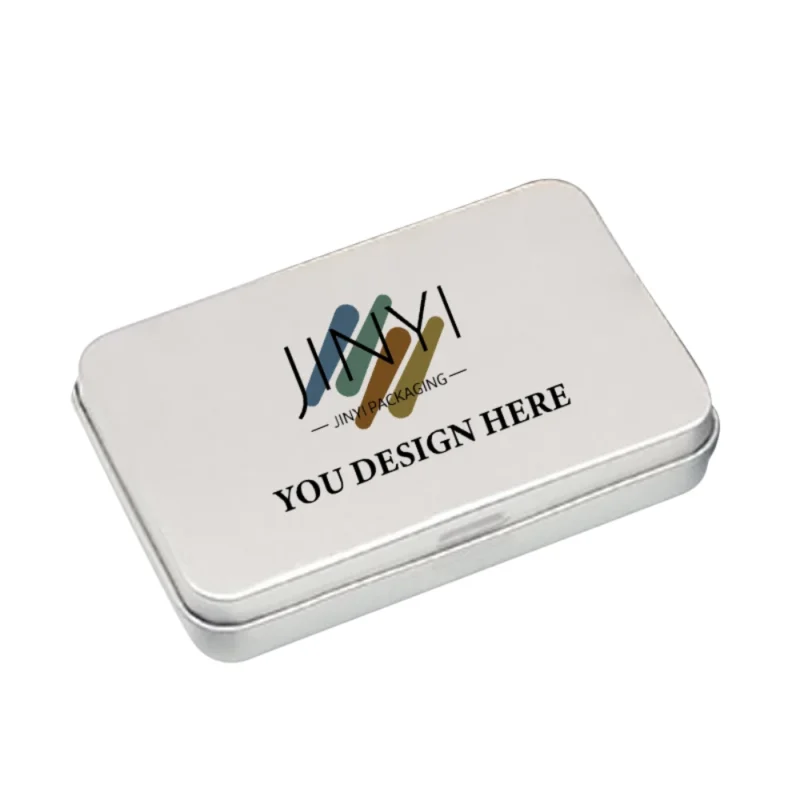
The single-serve stick pack works for brands in the convenience, subscription, and hospitality channel — small 2g to 5g portions that are easy to carry and portion. The per-gram packaging cost is significantly higher than a standard pouch, but the format drives strong repeat purchase behaviour in DTC subscription models. The metal tin provides absolute freshness protection at zero OTR, but carries higher per-unit cost, heavier logistics weight, and is typically reserved for gifting or boutique sampling SKUs — not a brand’s primary high-volume format.
Format
Best For
Typical Size Range
Key Trade-Off
Stand-up pouch
Retail / DTC / Amazon — volume SKUs
30g – 500g
Most cost-efficient — slightly softer shelf profile
Flat-bottom bag
Premium retail / boutique / DTC photography
50g – 250g
Better shelf presence — slightly higher unit cost
Metal tin
Gifting / sampling / boutique retail
30g – 100g
Maximum protection — high cost, heavy logistics
Single-serve stick pack
Subscription / convenience / hospitality
2g – 5g per stick
Highest per-gram cost — strong for subscription DTC
Tip: If you are deciding between a stand-up pouch and a flat-bottom bag for your first order, start with the stand-up pouch to validate your market at lower unit cost. Both formats use the same PET/AL/PE film structure and barrier spec — so your material choice doesn’t change between the two, and upgrading your format later doesn’t mean starting from scratch with your supplier.
Materials and Barrier Specs You Need to Know
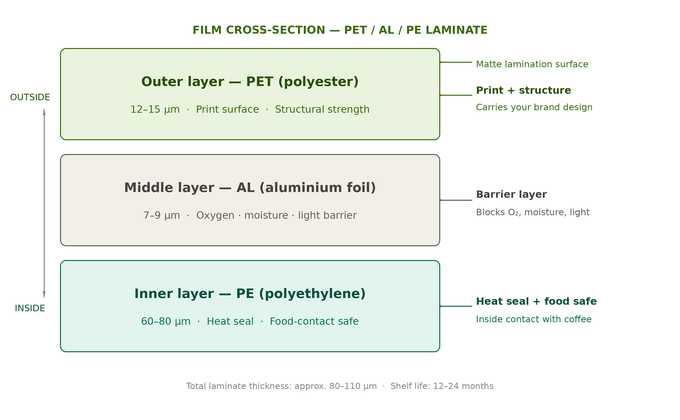
The film structure is what makes your packaging perform. For matcha specifically, the industry standard is a three-layer laminate with an aluminium foil core: PET / AL / PE. The PET outer layer is the print substrate — where your matte lamination and artwork sit. The aluminium foil middle layer delivers the barrier performance: an OTR of approximately 0.01 cc/m²/day and an MVTR of approximately 0.01 g/m²/day. These near-zero figures mean oxygen and moisture ingress through the film is effectively eliminated over the product’s shelf life. The PE inner layer provides the heat seal and food-contact surface.
This structure supports a shelf life of 12 to 24 months for matcha powder under standard storage conditions — which is what most retail and DTC distribution models require. Any film structure without an aluminium foil core compromises your barrier performance significantly, and for ceremonial-grade matcha the consequences show up fast: colour degradation, flavour loss, and customer complaints that are difficult to trace back to packaging without proper spec documentation.
Film Structure
OTR
Shelf Life (Matcha)
Suitable for Ceremonial Grade?
PET / AL / PE
~0.01 cc/m²/day
12–24 months
Yes — maximum protection
PET / VMPET / PE
0.5–1.5 cc/m²/day
6–12 months
Conditional — culinary grade with fast turnover only
Kraft / PLA (compostable)
5–15 cc/m²/day
Under 3 months
Not recommended — colour degradation within weeks
Metal tin (aluminium)
Zero
24+ months
Yes — absolute protection, higher cost and logistics weight
On surface finish: matte lamination is the standard for premium matcha brands because it photographs cleanly, feels premium in hand, and doesn’t reflect light in a way that washes out shelf presence. Gloss finish is available and costs less, but is less common in the matcha and wellness category. Spot UV over matte — used for logo areas or design details — adds a tactile premium element that works well for boutique retail positioning.
Note: If your brand carries an organic certification or clean-label claim, confirm that your supplier’s food-contact inks and adhesives carry the relevant certifications — ECO PASSPORT by OEKO-TEX or equivalent. This documentation is required for compliance in the EU and North American organic retail channels, and a reputable supplier will have it available without you needing to chase it.
MOQ and Pricing: What to Expect on Your First Order
MOQ isn’t a fixed number — it varies by format, print method, film structure, and pouch size. Understanding how those variables interact helps you choose the right supplier for your current stage of growth, rather than committing to volumes your sales can’t yet support.
Format
Print Method
Typical MOQ
Best For
Stand-up pouch
Digital print
500 – 1,000 pcs
New brands, multiple SKUs, market testing
Stand-up pouch
Gravure print
3,000 – 5,000 pcs
Established brands with confirmed demand
Flat-bottom bag
Digital or gravure
1,000 – 3,000 pcs
Premium retail brands with higher volume
Single-serve stick pack
Digital or gravure
2,000 – 5,000 pcs
DTC subscription, hospitality, sampling
The biggest pricing variable is print method. Digital printing has no plate fees and lower setup costs — the right choice for first orders and multiple SKUs at low volume. The per-unit cost is higher than gravure, but your total upfront commitment stays manageable. Gravure printing requires a significant plate-making investment upfront, but the per-unit cost drops sharply at scale. Most matcha brands start with digital print and transition to gravure once demand is confirmed and volume justifies the format upgrade.
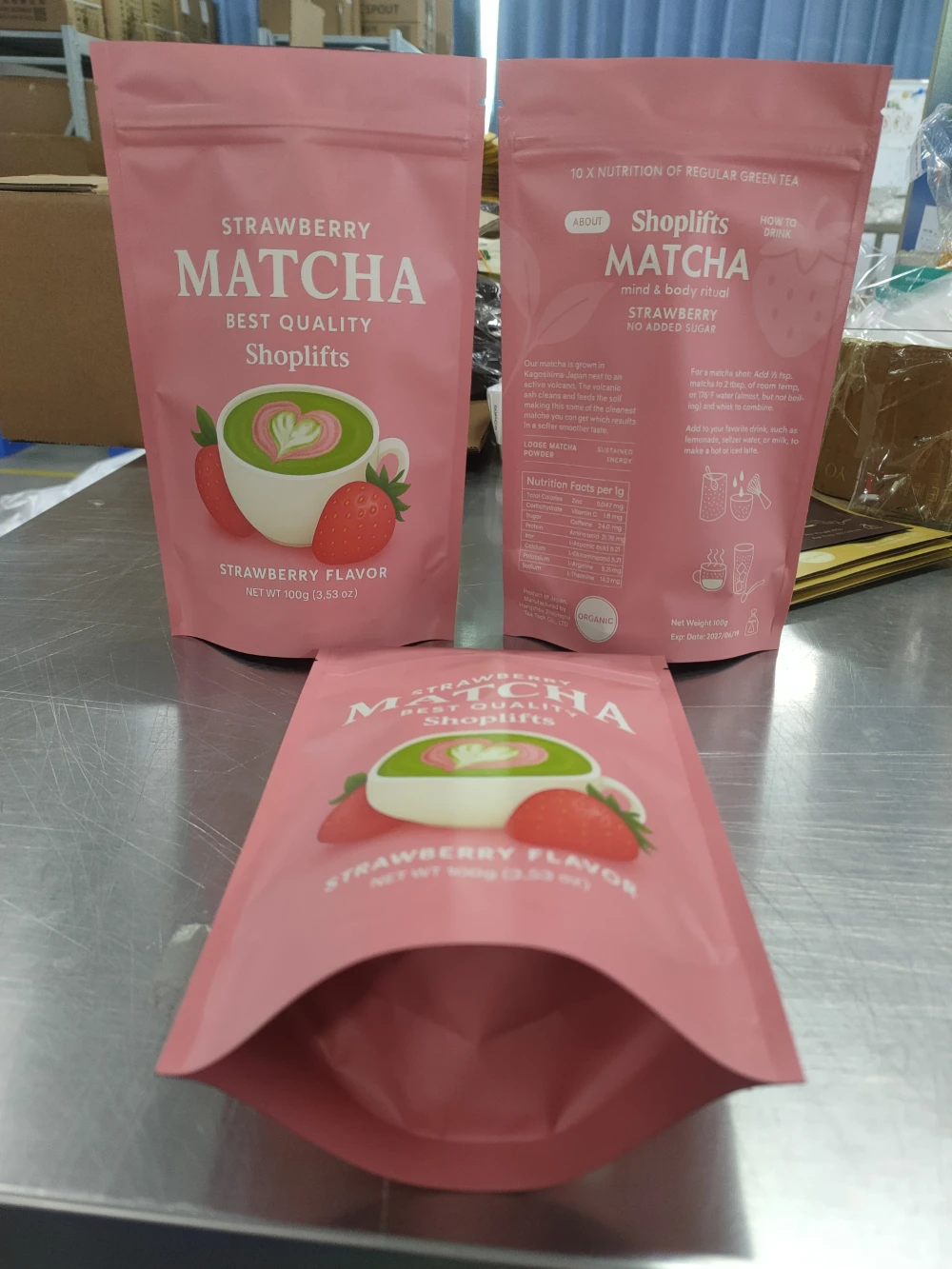
Custom matcha stand-up pouches freshly completed on the JINYI production line.
If you are launching multiple SKUs — different grades, sizes, or flavour variants — with the same bag structure, ask your supplier whether they can consolidate your order across SKUs to meet MOQ rather than requiring each variant to hit it individually. This can significantly reduce your minimum commitment on a first order.
Tip: When comparing quotes from multiple suppliers, make sure you’re comparing like for like. MOQ, print method, film structure, plate fees, sample costs, and material documentation are all part of the total cost. A quote that looks cheaper on unit price can be significantly more expensive once everything is factored in.
Lead Times and How to Plan Your Launch
Underestimating lead time is one of the most common — and most avoidable — mistakes on a first packaging order. Production takes longer than most buyers expect, and the timeline doesn’t include shipping, customs clearance, or the time needed to fill and label the pouches after they arrive.
Stage
Typical Duration
What Happens
Quote and spec confirmation
2 – 5 days
You share requirements; supplier confirms specs, MOQ, and pricing
Dieline and artwork approval
3 – 7 days
Supplier provides dieline; designer applies artwork; you approve the print-ready file
Not required
7 – 10 days (if requested)
Production and dispatch
7 – 15 days
7 – 15 days
Total to dispatch
10 – 23 days
17 – 33 days
Fresh off the line at JINYI’s factory — custom matcha stand-up pouches awaiting final QC before dispatch.
Most custom packaging suppliers quote 4–6 weeks for production alone. At JINYI, orders without a sample requirement are dispatched within 7–15 days from artwork approval — shipping time not included. That timeline applies to both stand-up pouches and flat-bottom bags in the PET/AL/PE structure, across digital and gravure print runs. The most common source of delay at any supplier is artwork revision loops — every round of changes adds 2–5 days, so finalising your brand direction before engaging us is the single most effective way to hit your launch date.
Tip: If your launch date is fixed and time is tight, skip the sample and go straight to production — JINYI dispatches within 7–15 days from artwork approval. If you have more flexibility, a sample adds 7–10 days and is worth it for colour accuracy and zipper confirmation on a first run.
Questions to Ask Before You Commit to a Supplier
A short, well-targeted list of questions will tell you most of what you need to know about a supplier before you place an order. How quickly and clearly they answer is itself part of the evaluation — responsiveness before the order is one of the most reliable predictors of reliability during production.
Question
What You Are Really Checking
Can you confirm the film structure is PET/AL/PE and provide the OTR and MVTR specs?
Whether they know their own specs and can document them
Can you provide food-contact certification for the inner layer?
Compliance readiness — required for retail and organic claims
What is your colour tolerance standard for production runs?
Print consistency across batches — critical for brand identity
How do you handle defects or colour deviations after delivery?
Whether they have a clear QC and resolution process
Can you confirm the production timeline in writing before I place the order?
Commitment to accountability on delivery dates
Do you support both digital and gravure printing?
Long-term scalability as your order volume grows
What does your sample process look like, and what is included in the sample cost?
Whether samples are a standard part of their process
Note: Don’t skip the sample step even if your timeline feels tight. A physical sample is your last checkpoint before full production — and the cost of identifying a problem at sample stage is a fraction of what it costs after 1,000 bags have been printed with the wrong colour or a faulty zipper.
Source Your Custom Matcha Packaging Factory-Direct
Tell us your format, target fill weight, surface finish, and volume. We will come back with a full spec recommendation, material documentation, and a factory-direct quote — within 24 hours.
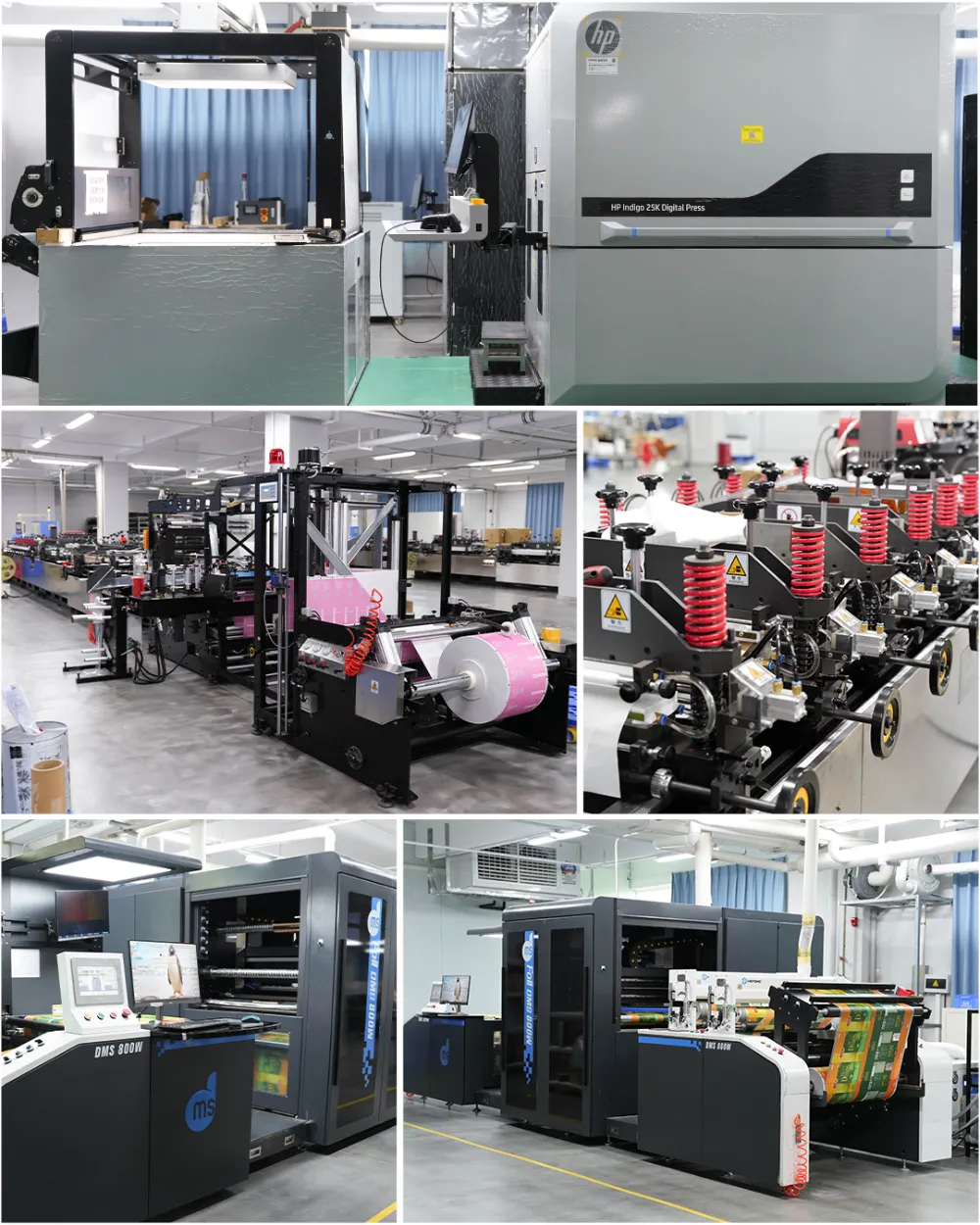
JINYI is a source factory for custom flexible packaging with 15+ years of production experience, serving food, supplement, matcha, and consumer goods brands across 150+ countries. Our facility runs HP digital print systems alongside multiple gravure printing lines — giving brands a clear path from small launch orders to full-scale production without changing suppliers.
Every client receives full material specification documentation with their order as standard — film structure, barrier data, and food-contact certifications included. That is what From Film to Finished — Done Right means in practice.
Elsa
Business Development Manager · JINYI Packaging
Elsa leads business development and customer order management at JINYI. With 8 years in foreign trade across Yiwu and Dongguan, she has a sharp understanding of market demand and what buyers actually need — turning real customer insight into the right packaging decisions.
Customer needs Order management Business development
What is the best packaging material for matcha powder?
PET/AL/PE — a three-layer laminate with an aluminium foil core — is the industry standard for matcha powder packaging. It delivers near-zero oxygen and moisture transmission, supporting a shelf life of 12 to 24 months. Any film structure without an aluminium foil barrier layer will compromise freshness, particularly for ceremonial-grade matcha where colour and flavour degradation are rapid and visible.
What MOQ should I expect for custom matcha pouches?
For digital print stand-up pouches, MOQ typically starts from 500 units with no plate fee — the most accessible starting point for new brands. Gravure print and premium formats like flat-bottom bags usually require 1,000 to 3,000 units or more. Contact your supplier with your full spec — format, size, film structure, and finish — for a confirmed minimum order quantity.
Should I use a stand-up pouch or a flat-bottom bag for my matcha brand?
Both formats use the same high-barrier film structure and provide equivalent freshness protection. The difference is in shelf presence and cost. Stand-up pouches are more cost-efficient and carry lower MOQ — the right starting point for most new brands. Flat-bottom bags offer a more premium, architectural profile that works better in boutique retail and DTC photography. Start with a stand-up pouch to validate your market, then upgrade to flat-bottom once your volume supports it.
Can matcha pouches have a transparent window?
Not recommended. Any window cut into the film creates a light pathway directly to the powder, accelerating the chlorophyll degradation that turns ceremonial-grade matcha from vibrant green to dull yellow-brown. The bag must be fully opaque — this is a non-negotiable spec choice for matcha, not a branding preference. Both stand-up pouches and flat-bottom bags are available in fully opaque constructions.
How long does custom matcha packaging take to produce?
At JINYI, orders without a sample requirement are dispatched within 7–15 days from artwork approval. If you include a sample round, add 7–10 days to the front of the timeline. Total time from first contact to dispatch is typically 10–33 days depending on whether samples are requested — significantly faster than the industry average. Shipping time to your location is additional and depends on your destination and method (air vs sea).
Do I need a degassing valve on my matcha pouch?
No. Unlike freshly roasted coffee, matcha does not release CO₂ after processing — so a degassing valve is not required. The primary freshness mechanism for matcha is oxygen exclusion, not gas release. Instead, matcha brands typically use an oxygen absorber inside the sealed bag, or nitrogen flushing at the point of sealing, to eliminate residual oxygen and protect colour and flavour through the full shelf life window.