A complete inside look at how JINYI manufactures custom flexible packaging — from raw film to finished pouch.
Every custom flexible packaging bag — every stand-up pouch, every flat-bottom bag, every side gusset coffee bag — passes through a precise sequence of production stages before it reaches your hands. Most buyers never see inside that process. They see the finished product, the price, and the lead time. What happens between raw film and finished pouch determines everything else: barrier performance, print accuracy, seal strength, shelf life, and whether the bag actually delivers on what it promised on paper.
This guide walks through every stage of the flexible packaging manufacturing process as it happens at JINYI — from the first client conversation through material selection, printing, lamination, bag making, quality control, and final shipment. We have been producing custom flexible packaging for 15+ years, serving brands across 150+ countries in food, coffee, matcha, supplements, pet food, cannabis, and beyond. This is what the process actually looks like from inside the factory.
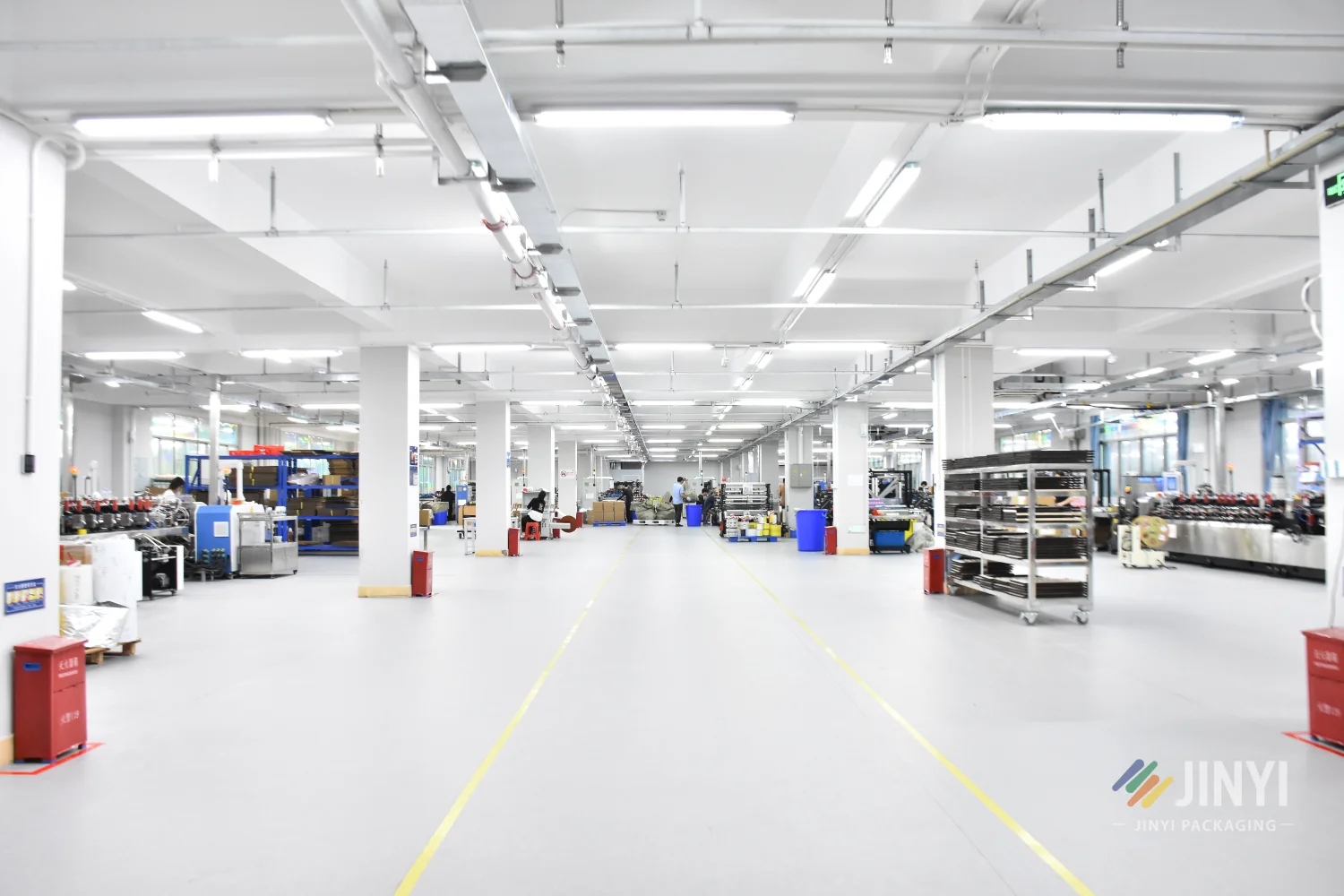
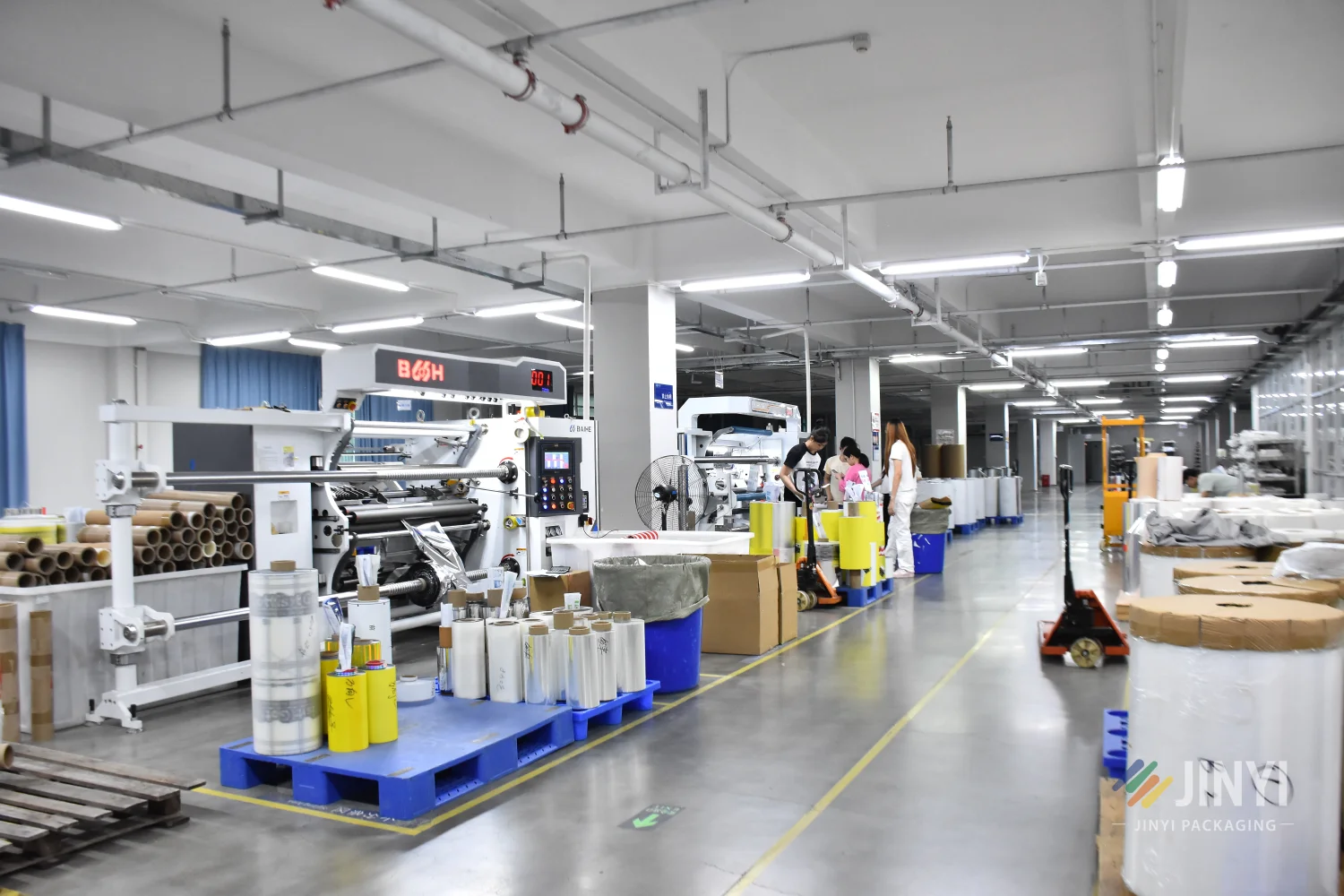
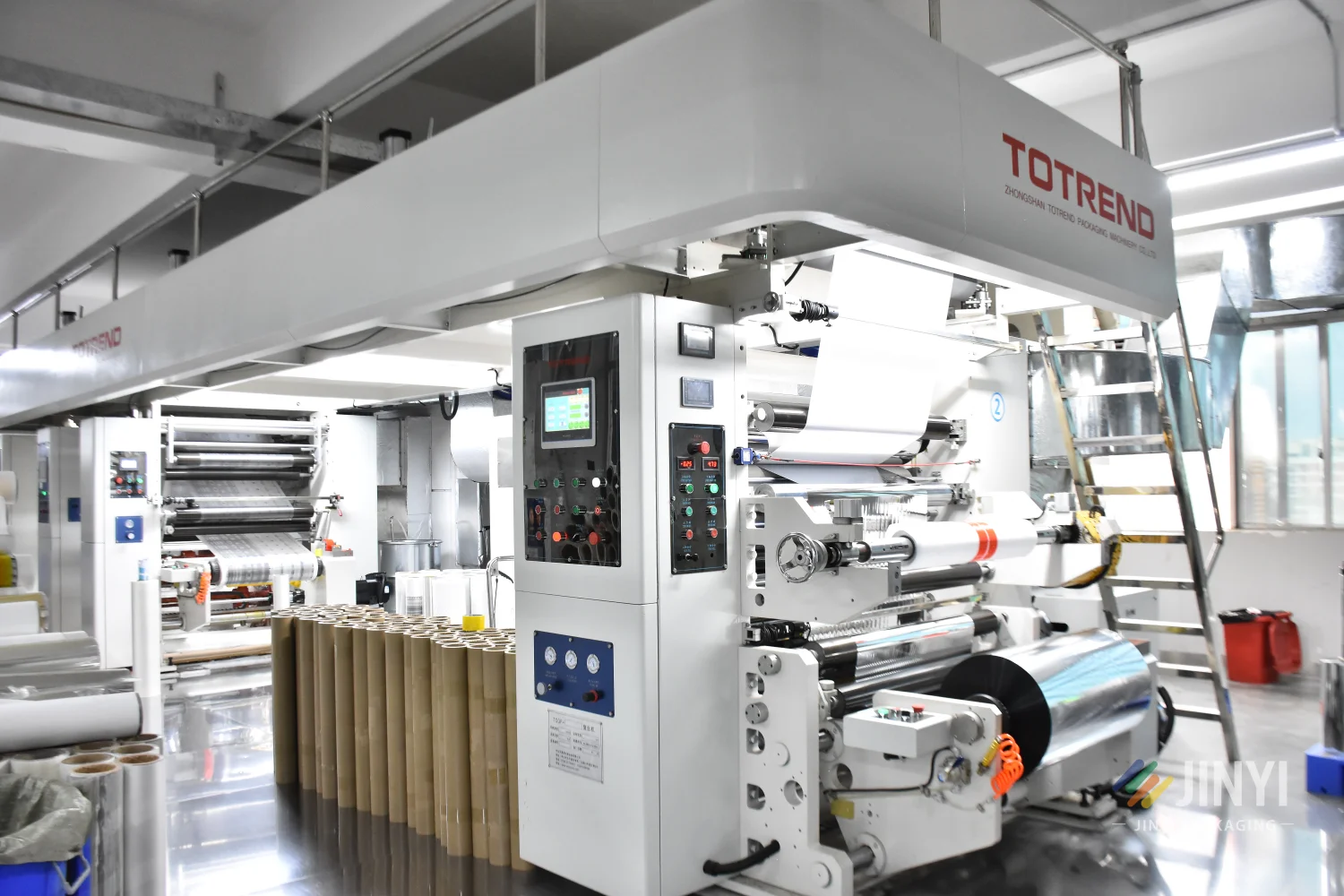
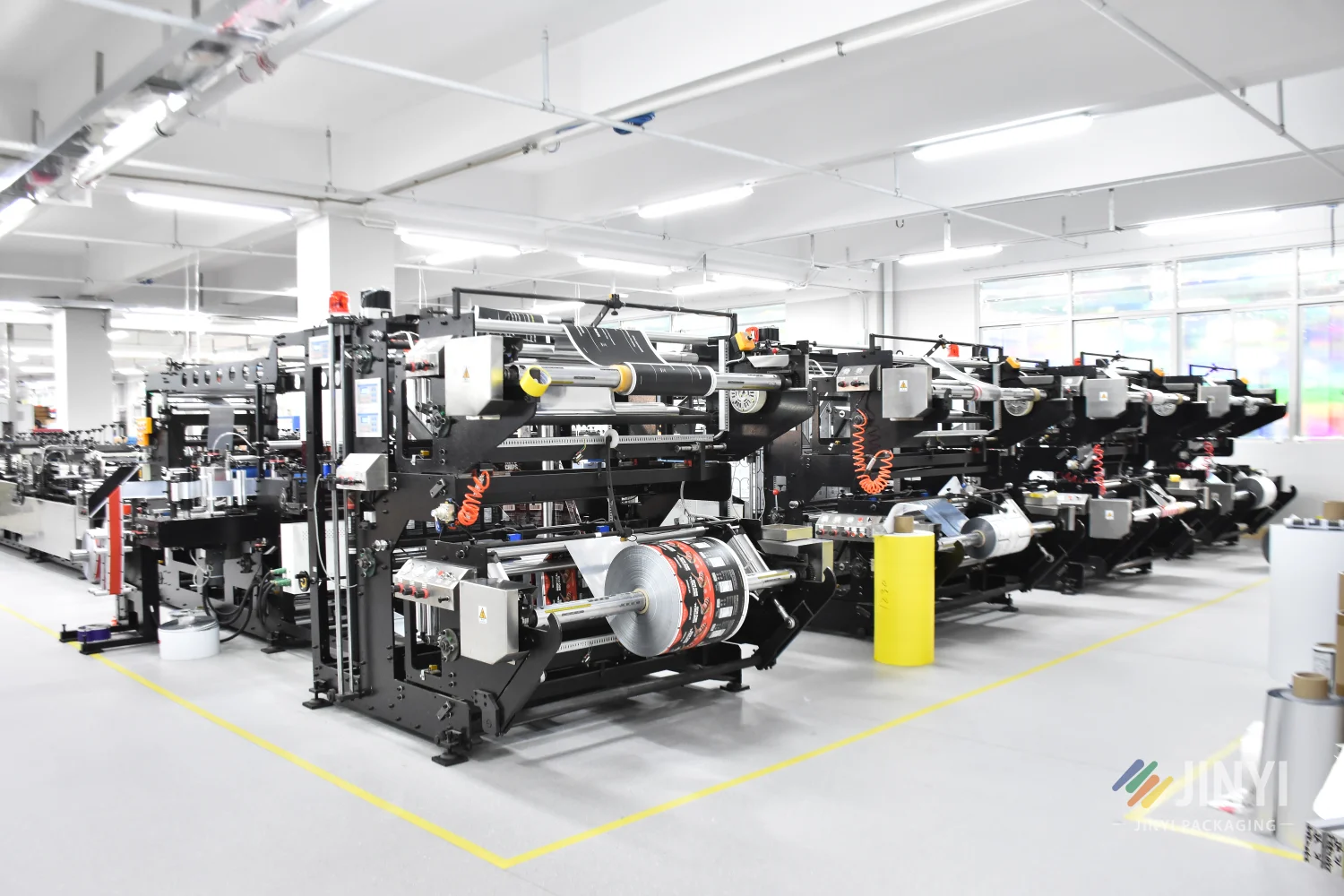
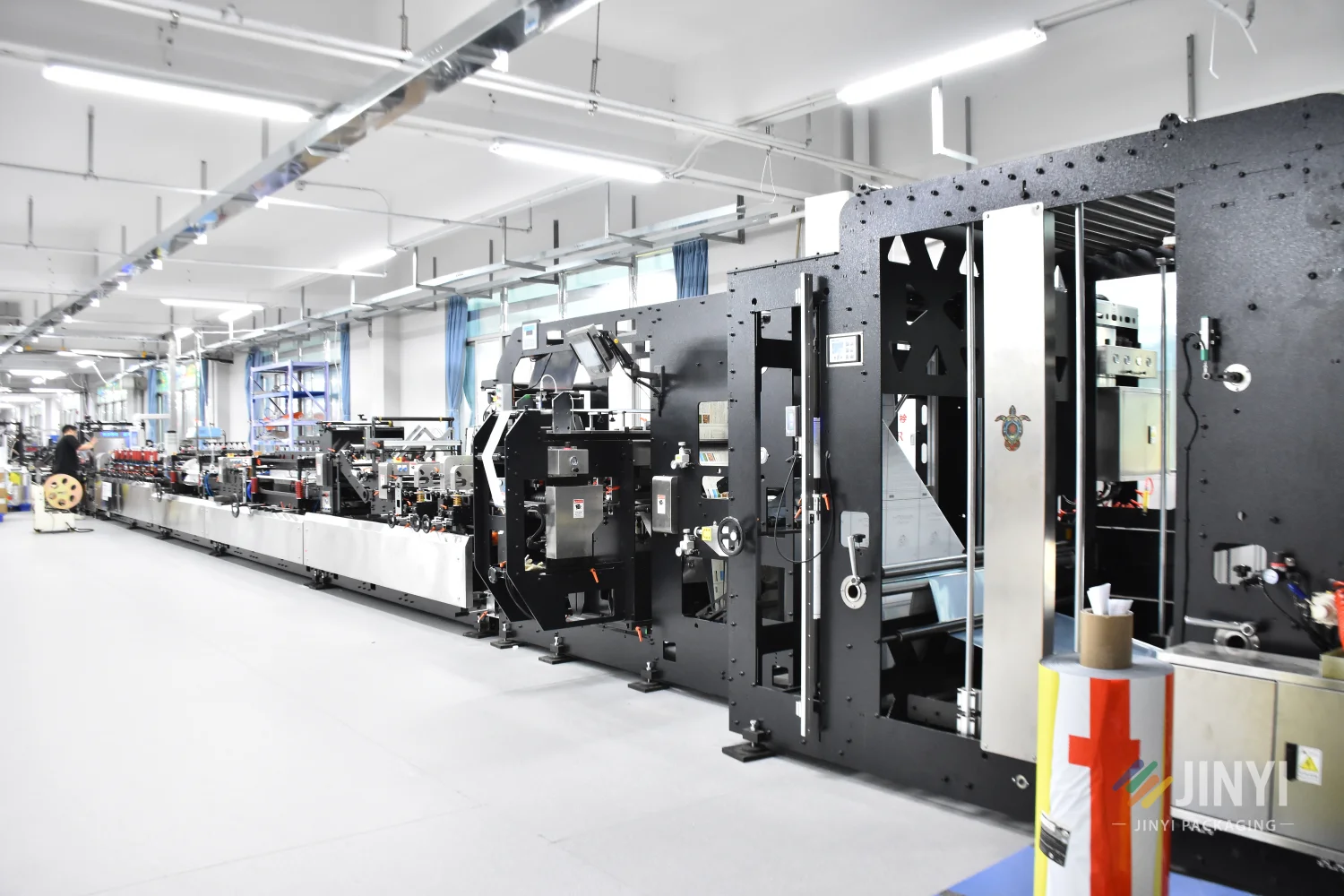
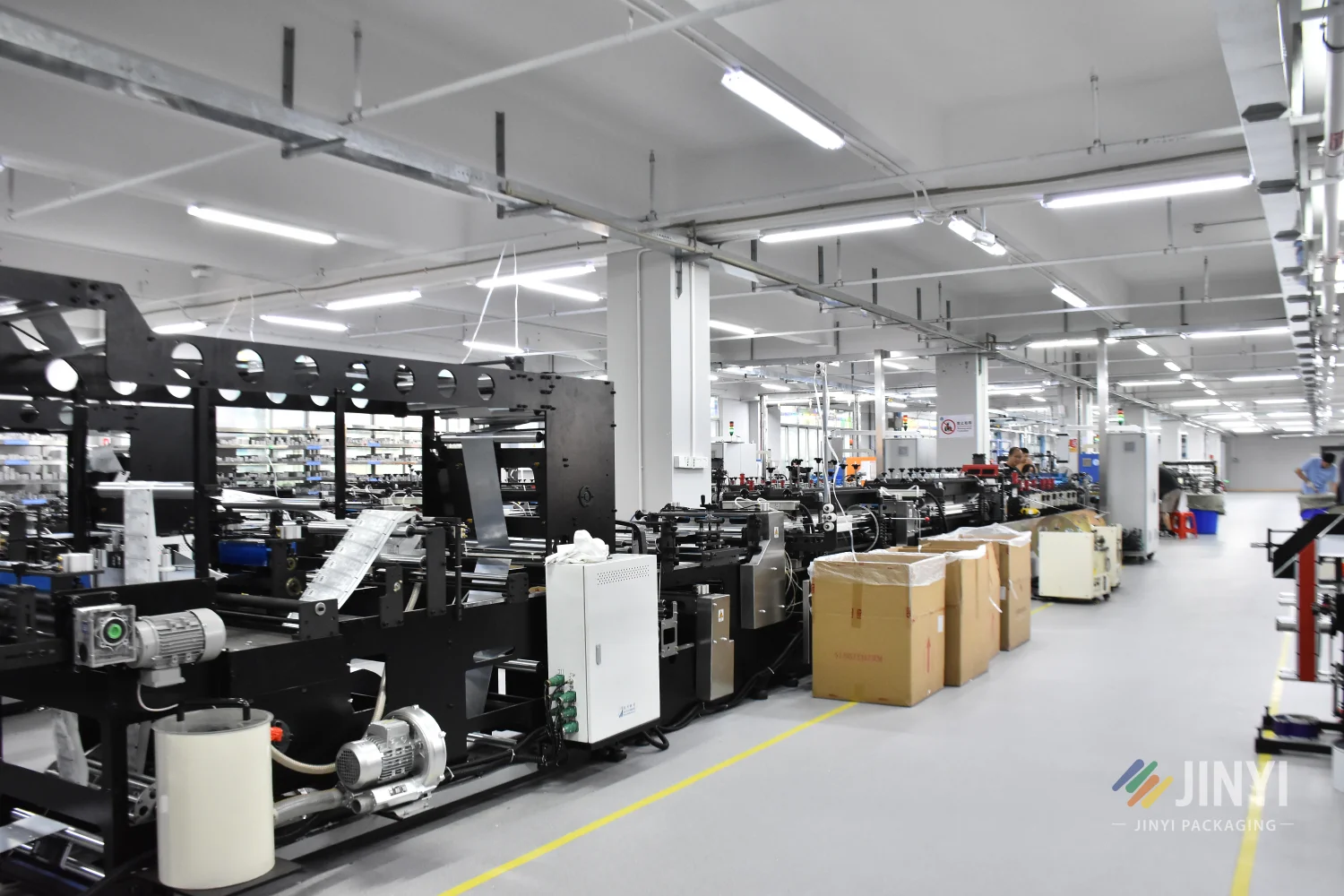
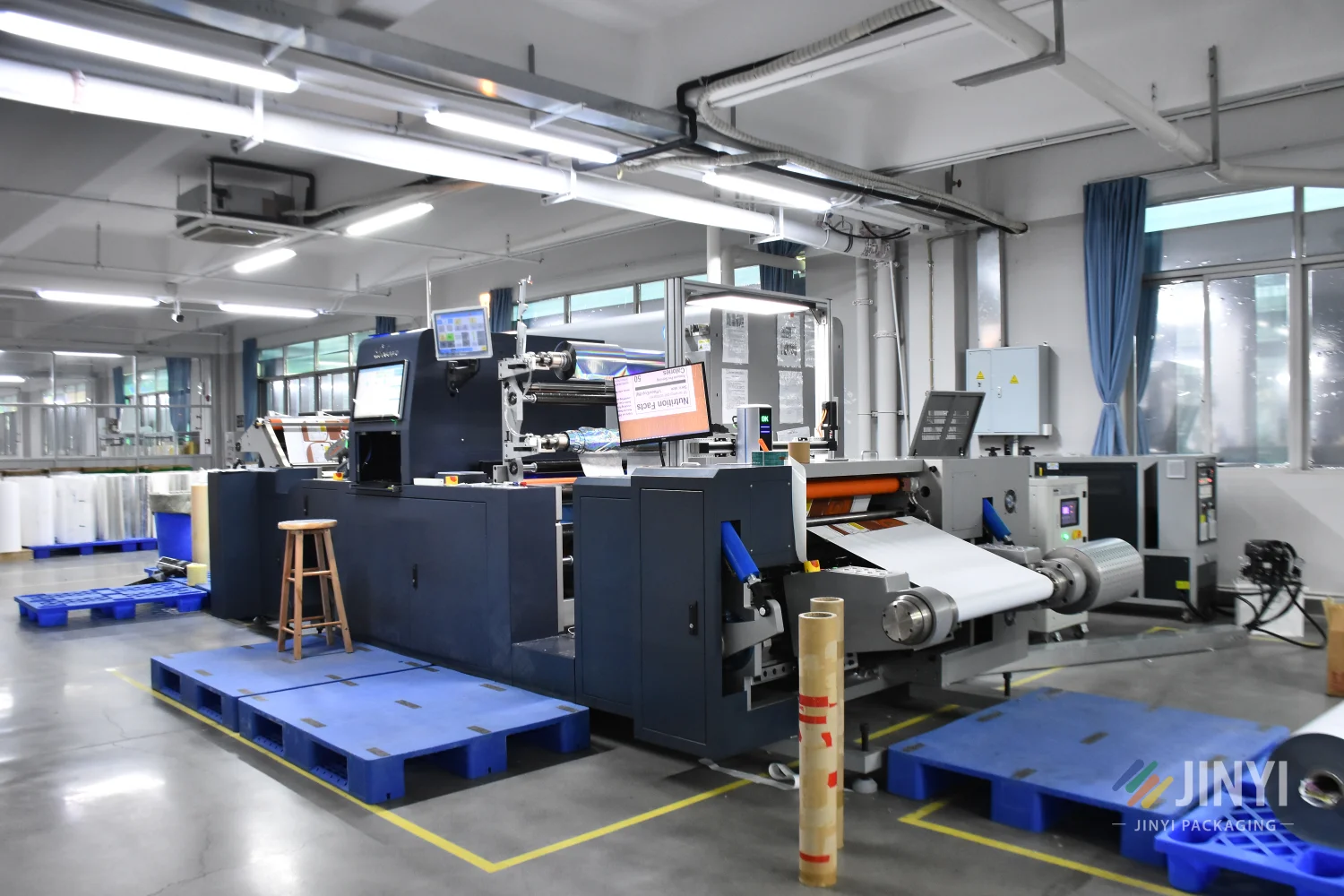
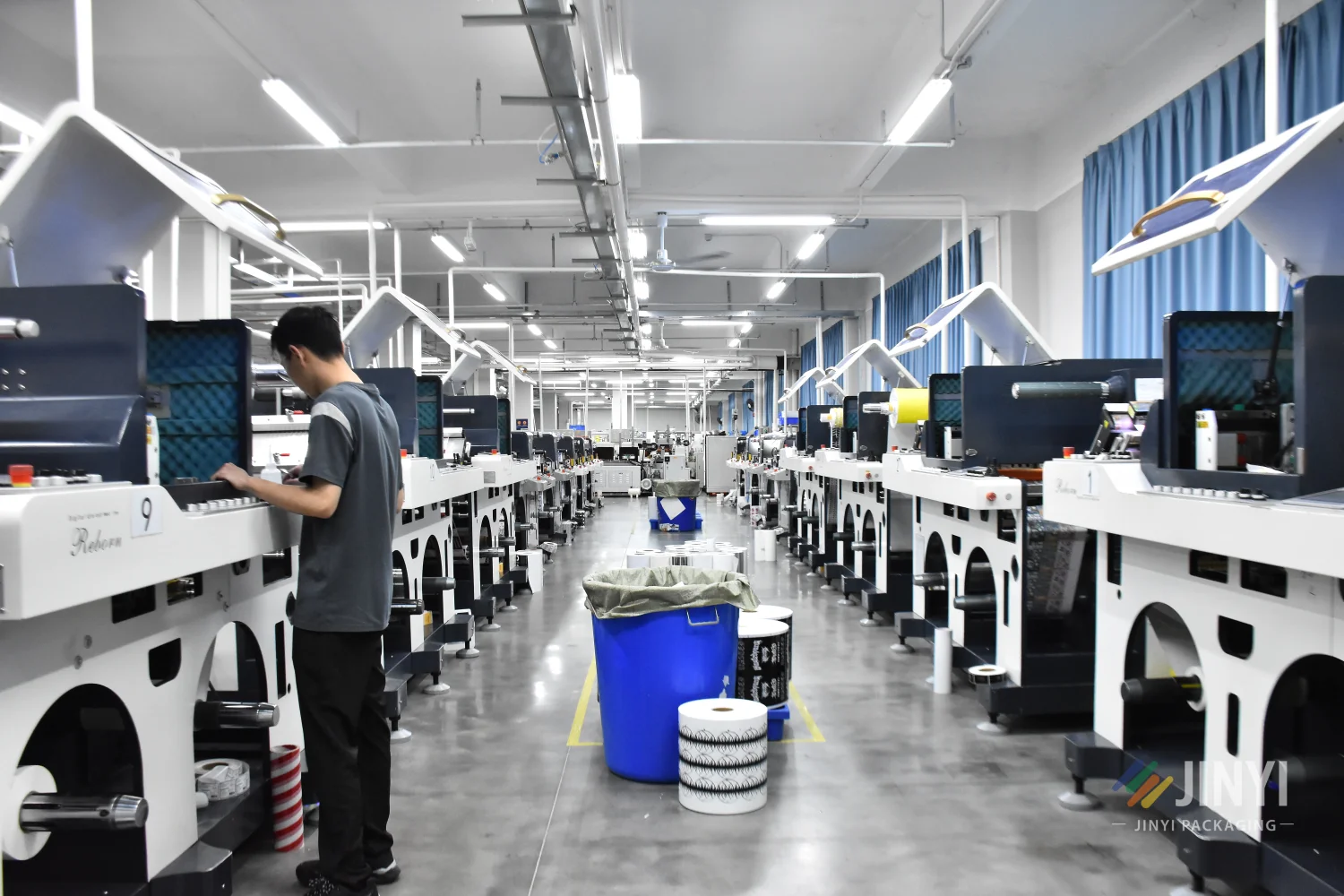
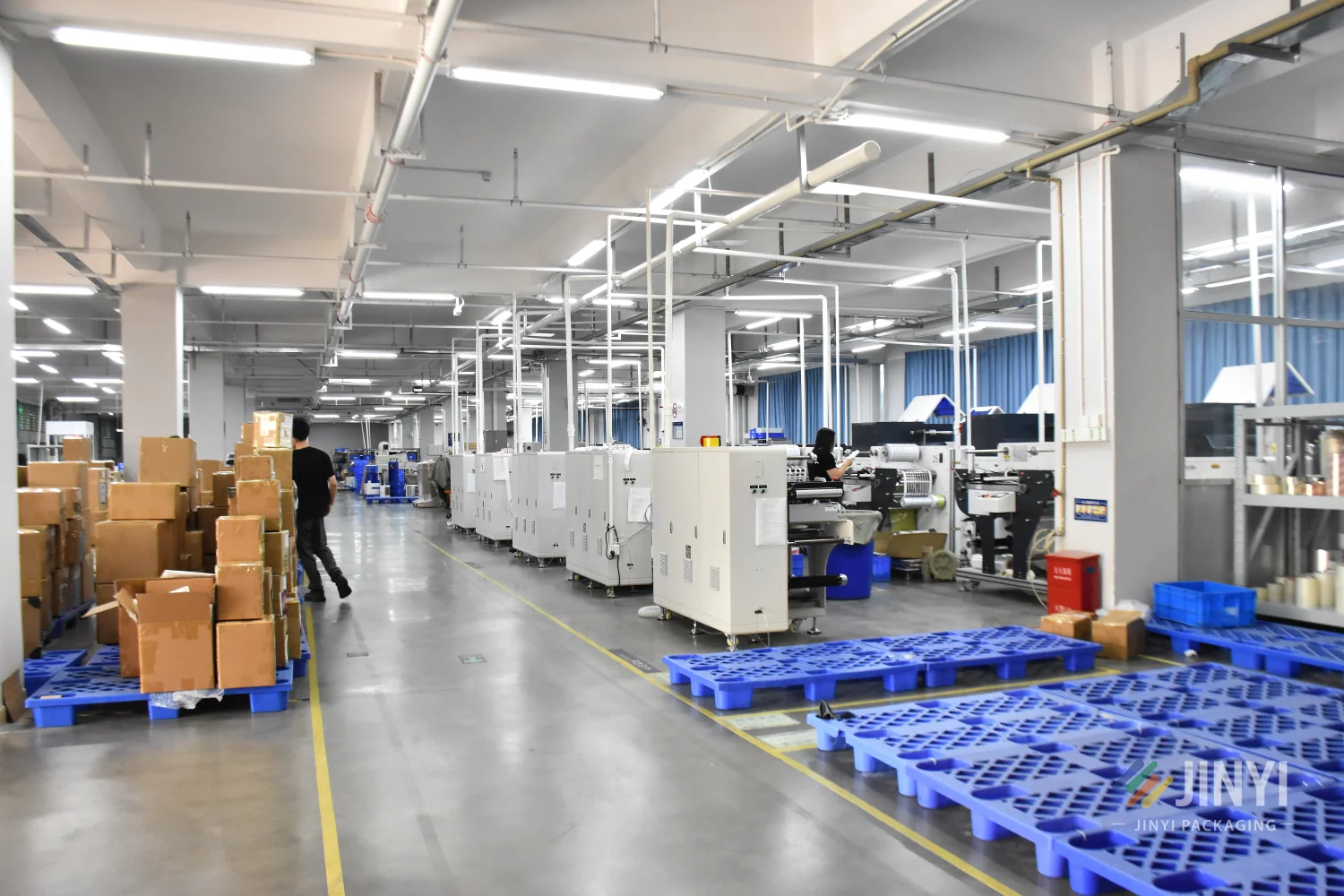
Inside JINYI — a clean, well-organised production floor running HP Indigo digital and gravure printing alongside bag-making and lamination lines
What Is Flexible Packaging — And Why the Manufacturing Process Matters
Flexible packaging refers to any packaging format made from pliable materials — films, foils, and laminates — that can be formed, filled, and sealed into bags, pouches, or wraps. Unlike rigid packaging (glass jars, metal cans, plastic bottles), flexible packaging ships flat, stores compactly, and offers significant cost and logistics advantages at every stage of the supply chain. A pallet of flat-packed stand-up pouches occupies roughly one-twentieth the volume of the same quantity of empty tin cans — a difference that compounds across warehousing, freight, and last-mile delivery costs.
The flexible packaging market has grown consistently over the past decade and continues to expand, driven by the shift from rigid containers to lightweight, high-barrier alternatives across food, beverage, pharmaceutical, and consumer goods categories. For D2C brands in particular, flexible packaging has become the default format — it photographs well, ships without breakage risk, and gives brands a large printable surface area for storytelling and brand communication that rigid containers cannot match.
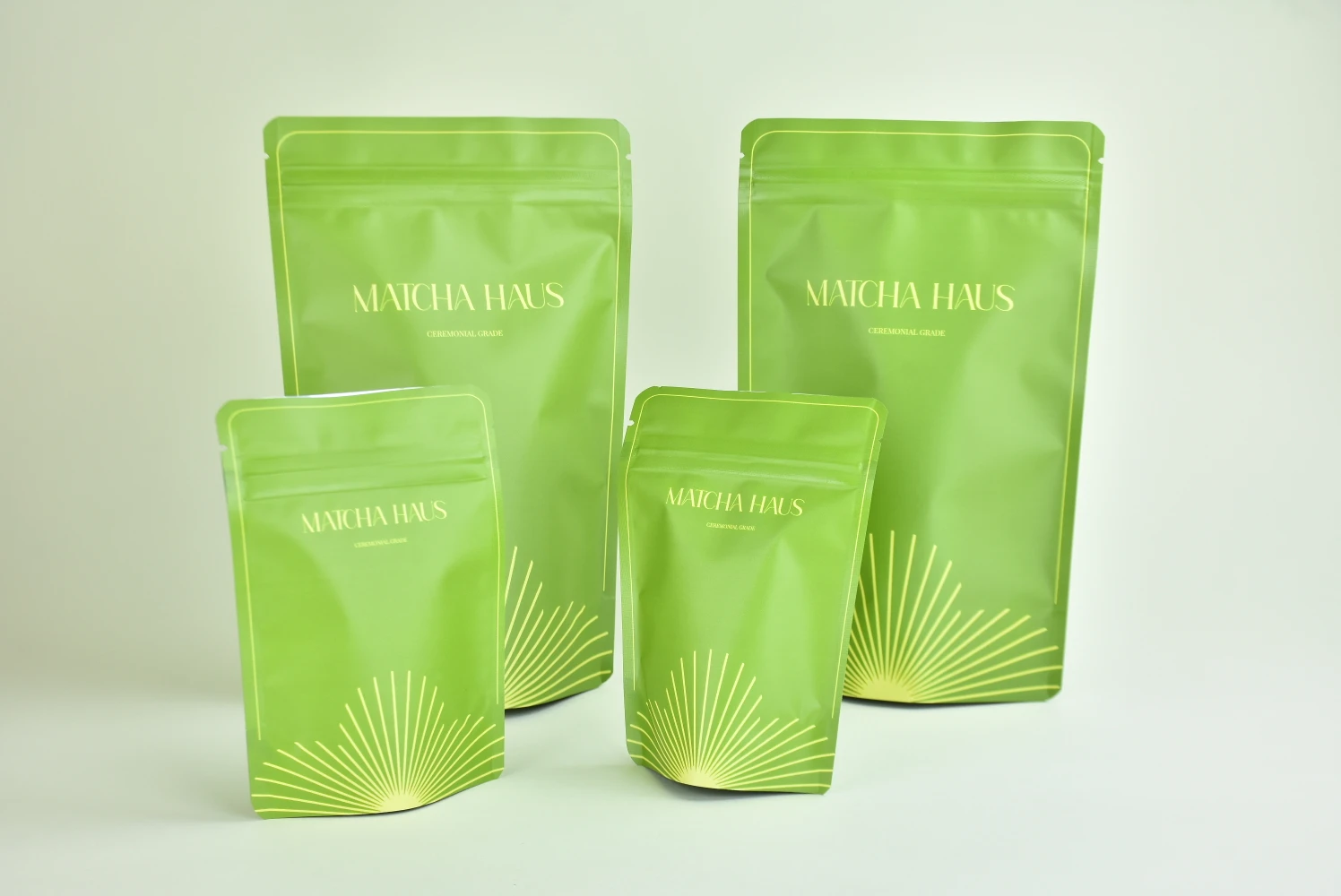
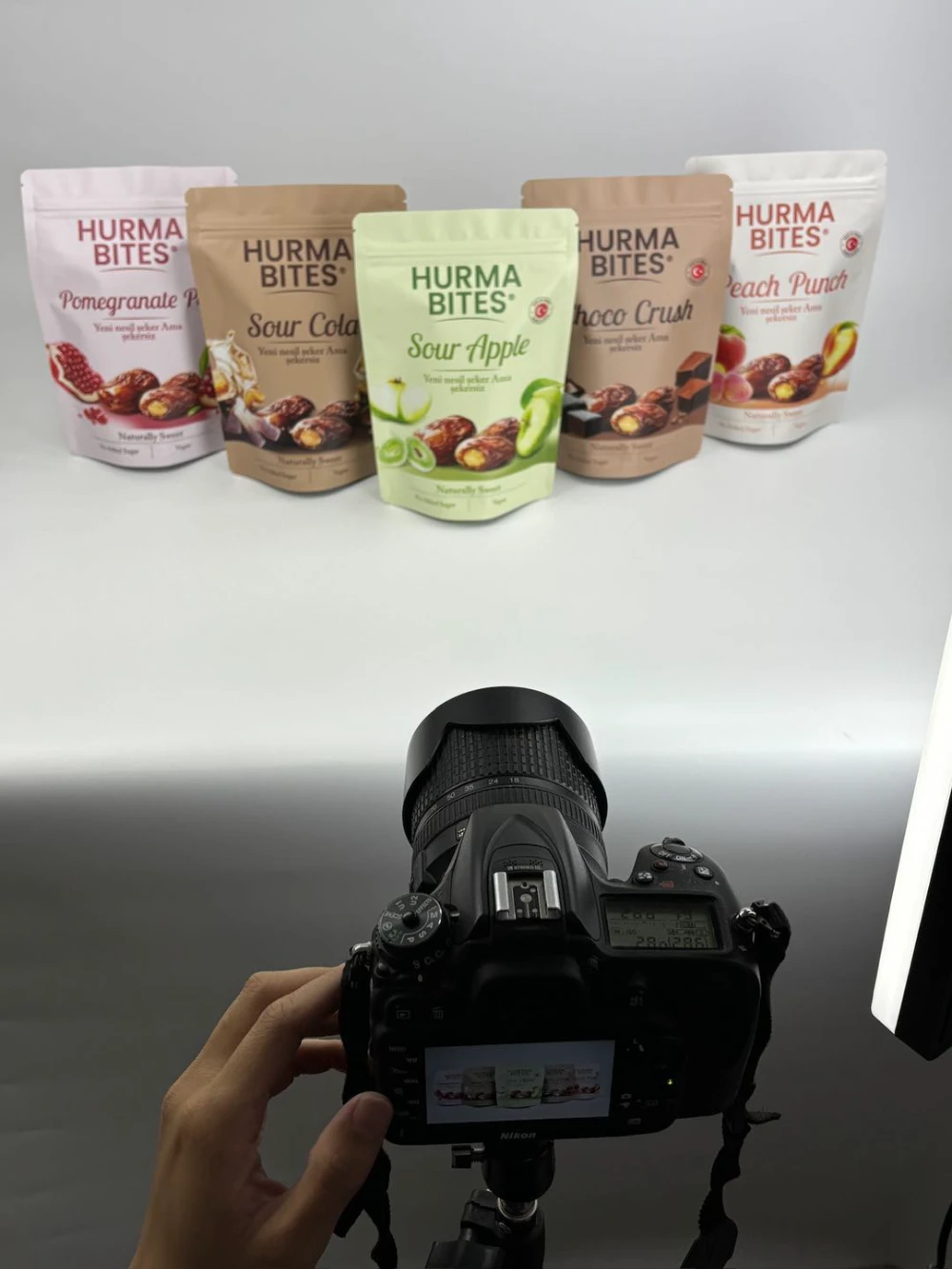
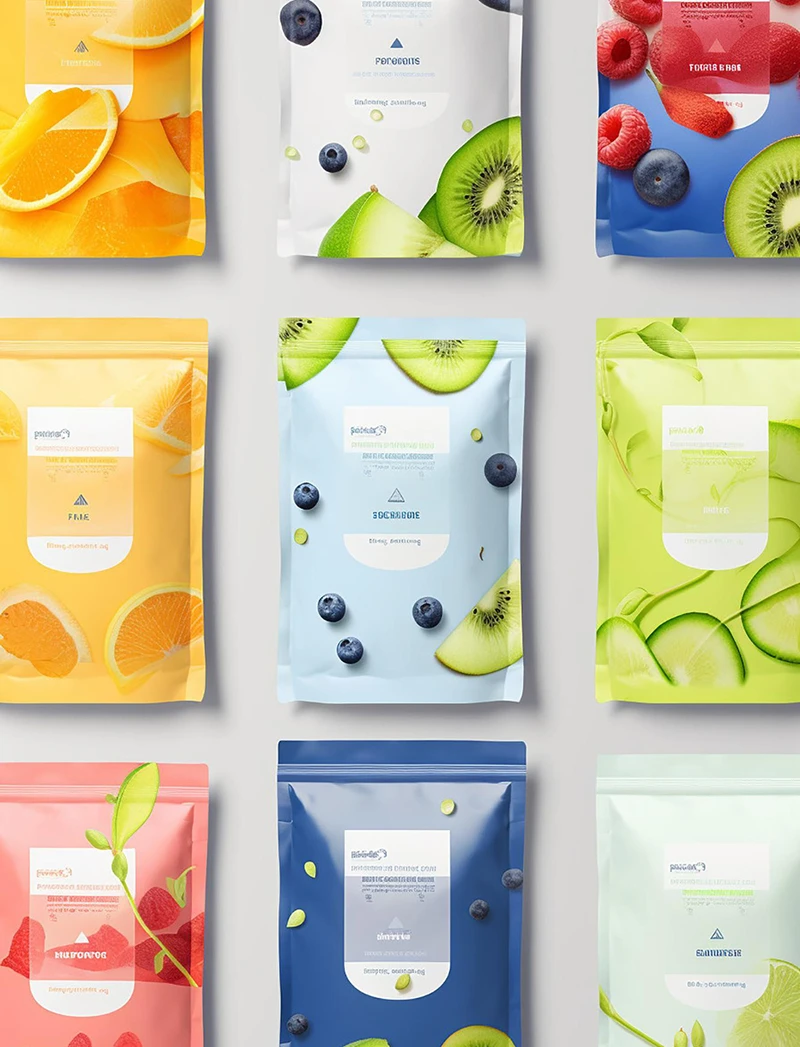
Jinyi’s Bagged Matcha Product Photography Services for Clients
The primary formats in flexible packaging include stand-up pouches (Doypacks), flat-bottom bags, side gusset bags, three-side seal pouches, back seal pouches, and lay-flat pouches. Each format has a different structural geometry, a different set of use cases, and different production requirements. The choice of format is one of the first decisions made in the manufacturing process — and it affects every stage that follows, from the lamination width to the bag-making machine tooling to the shelf footprint at the point of sale.
Why does the manufacturing process matter to a buyer? Because two bags that look identical on the surface can have completely different barrier performance, seal strength, and shelf life — depending on the materials used, the lamination method, the printing process, and the quality controls applied at each stage. A bag printed with substandard colour management looks slightly wrong in every product photograph. A bag laminated with insufficient adhesive delaminates on shelf. A bag sealed at incorrect temperature parameters fails at the bottom seal when the product is filled. None of these failures are visible from a product photo or a supplier’s website. Understanding the process gives you the ability to ask the right questions, evaluate suppliers accurately, and make sourcing decisions that protect your product and your brand before problems appear in the field.
The flexible packaging manufacturing process consists of six core production stages — material selection, printing, lamination, slitting, bag making, and functional component installation — followed by quality control, photography, and logistics. Each stage has its own technical parameters, its own failure modes, and its own quality verification checkpoints. This guide covers all of them, in the sequence they occur at JINYI, with the specific equipment, standards, and service commitments that apply at each step.
Format
Structure
Primary Applications
Stand-up pouch
Bottom gusset, stands upright
Coffee, matcha, snacks, supplements, pet food
Flat-bottom bag
Structured flat base, wide shelf footprint
Premium retail coffee, matcha, dry goods
Side gusset bag
Gussets on both sides, high fill volume
Bulk coffee, flour, rice, commercial supply
Three-side seal pouch
Flat, sealed on three sides
Sachets, single-serve, sample packs
Back seal pouch
Fin seal or lap seal on reverse
Snacks, confectionery, flow-wrap products
Step 1: Understanding What You Actually Need — Before Production Starts
At JINYI, production does not start with a machine — it starts with a conversation. Every custom packaging order begins with a structured requirements briefing that covers the product being packaged, the target market and distribution channel, the shelf life requirement, the quantity, and any regulatory or certification requirements the buyer needs to meet.
This stage matters more than most buyers realise. The wrong film structure for a product’s moisture sensitivity, the wrong bag format for a retailer’s shelf requirements, the wrong zipper type for the end consumer’s usage pattern — these are mistakes that cannot be corrected after production. They result in wasted product, failed retailer audits, or customer complaints about bags that won’t reseal properly. Getting the brief right upfront is what prevents those outcomes.
Our business development team reviews every new inquiry against a standard specification checklist: product category and weight, required barrier properties (OTR/MVTR targets), format preference, print complexity, quantity and timeline, certifications needed (FDA, food-contact, organic-compatible ink), and any sustainability requirements. Where a buyer is not sure about a specification — film structure, for example — we recommend based on product category and shelf life target. That recommendation comes from 15 years of producing packaging across coffee, matcha, supplements, pet food, cannabis, and dozens of other categories.
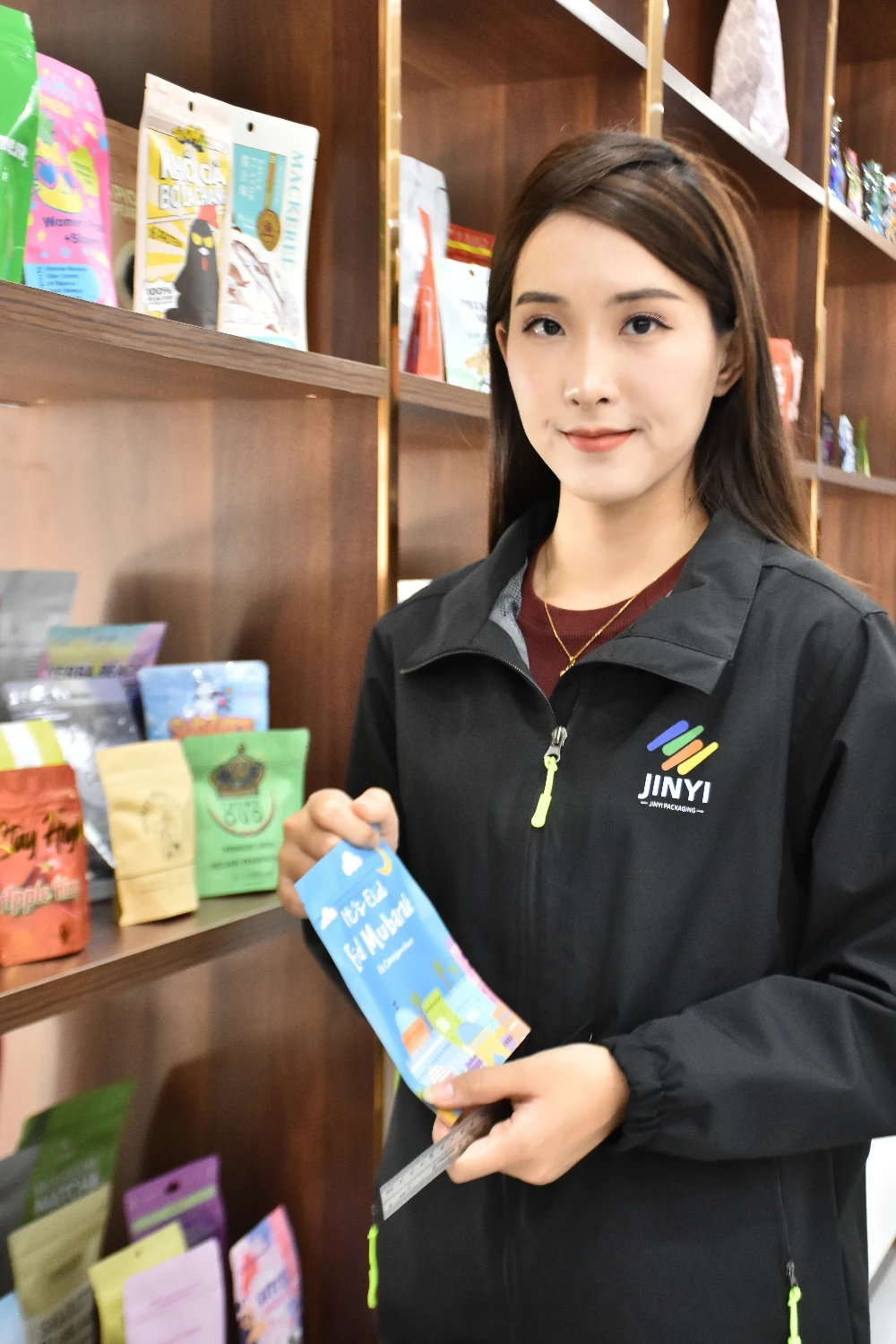
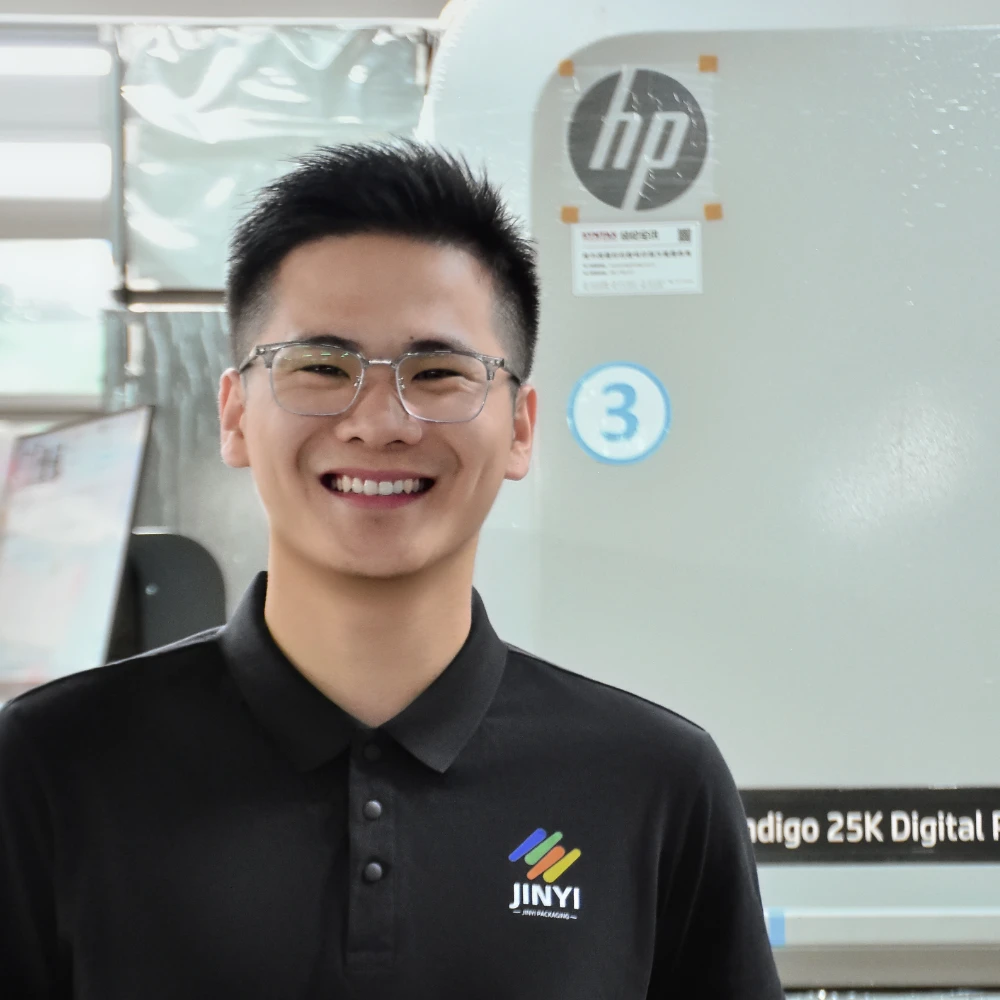
Elsa, JINYI’s Business Development Manager — reviewing custom packaging specifications and matching client requirements to the right production solution
Specification
Why It Matters
Determined At
Bag format
Determines structural geometry and production tooling
Brief stage
Film structure
Defines barrier performance and shelf life
Brief / material selection stage
Print method
Determines MOQ, lead time, and per-unit cost
Brief stage
Functional components
Zipper, valve, spout, handle — affects tooling and lead time
Brief stage
Certifications
FDA, food-contact, organic ink — must be specified before material sourcing
Brief stage
Tip: If you are not sure about your film structure or barrier requirements, tell your packaging supplier your product category, fill weight, target shelf life, and distribution channel. A factory with experience in your category can reverse-engineer the correct spec from those four inputs. You do not need to know the OTR target — you need to know how long the product needs to stay fresh and where it is going.
Step 2: Raw Material Selection — Film Structure and Barrier Properties
Once the specification is confirmed, JINYI sources the raw film materials. Flexible packaging films are multi-layer laminates — typically two to four layers bonded together, each serving a specific function. The outer layer provides the print surface and structural rigidity. The middle layer (where present) provides the barrier performance. The inner layer provides the heat-seal capability and food-contact safety.
The choice of film structure is the single most important technical decision in the entire process. It determines the oxygen transmission rate (OTR), the moisture vapour transmission rate (MVTR), the UV-blocking capability, and the overall shelf life of the product inside the bag. Getting this wrong cannot be corrected after lamination — the structure is fixed once the layers are bonded.
Film Structure
OTR
UV Block
Typical Applications
PET / AL / PE
~0.01 cc/m²/day
100%
Coffee, matcha, supplements, long shelf life products
Beyond the core three-layer structure, many applications require additional layers or specialised materials. A four-layer structure — PET/AL/NY/PE — adds a nylon layer between the aluminium and the inner PE layer, significantly increasing puncture resistance and flexibility. This structure is standard for liquid-filled pouches with spouts, heavy products prone to abrasion during transit, and any application where the bag will be subjected to sustained pressure or flexing. The nylon layer also improves cold-chain performance — maintaining flexibility at low temperatures where standard PE inner layers can become brittle.
For brands with sustainability commitments, JINYI also sources and processes recyclable mono-material films — typically all-PE or all-PP structures — that can be processed through standard flexible film recycling streams. These structures sacrifice some barrier performance compared to aluminium foil laminates, but represent a significant improvement from a recyclability standpoint. The trade-off between barrier performance and recyclability must be evaluated against the product’s actual shelf life requirement and distribution environment — a product turning over in 60 days through a DTC channel has different needs than one sitting in a grocery distribution warehouse for four months before reaching a shelf.
Incoming raw film materials at JINYI — every roll passes inbound quality inspection before entering the production line
All incoming film materials at JINYI go through an inbound quality check (IQC) before entering production. This includes verification of film thickness (measured in microns, using calibrated micrometers at multiple points across the roll width), surface tension (measured in dynes — critical for ink adhesion during printing, minimum 38 dynes for reliable ink bond), transparency or opacity against specification, and initial barrier property sampling. Film that does not pass IQC is returned to the material supplier — it does not enter the production line. Accepting out-of-specification material to maintain a production timeline is a short-term decision that produces long-term quality failures; JINYI does not make that trade-off.
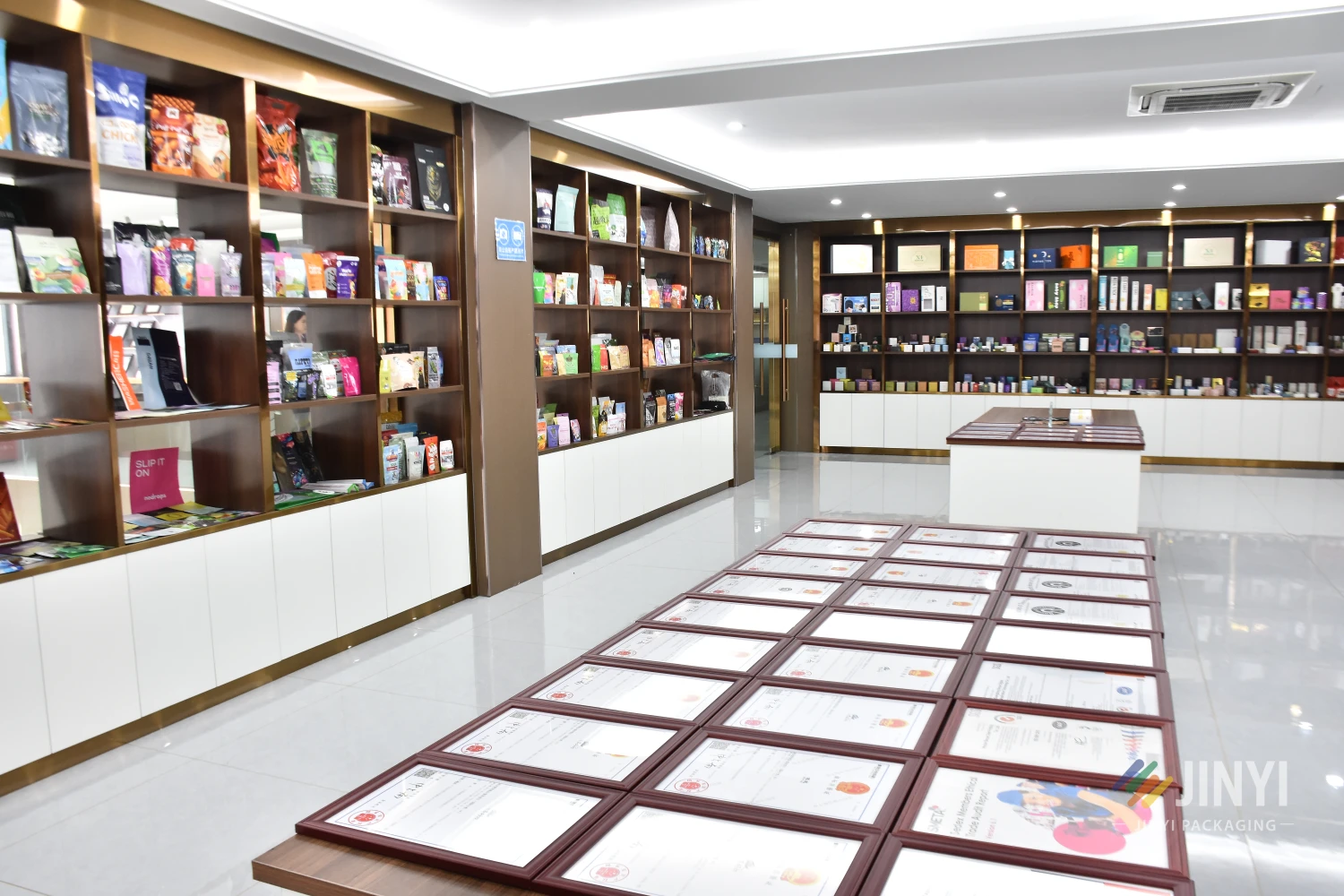
Every film material used in a JINYI production run is food-contact certified — meeting FDA (US), EC 1935/2004 (EU), and ISO 22000 requirements as applicable. The certification documentation for each material is retained on file and provided to clients as part of the material specification package that accompanies every completed order. For clients entering markets with specific regulatory requirements — the EU’s increasingly strict food-contact material regulations, or the FDA’s requirements for food-contact polymers — JINYI can provide the full material compliance chain on request.
Note: OTR and MVTR values are not marketing claims — they are measurable physical properties of the film laminate. Any factory that cannot provide these values for the structure they are selling you either does not know what they are manufacturing or is sourcing from an unverified supplier. At JINYI, every material specification document includes confirmed OTR and MVTR data.
Step 3: Printing — Inside JINYI’s HP Indigo Digital Print Operation
Printing is the stage where the brand comes to life on the film. At JINYI, we run two printing technologies — HP Indigo digital printing and gravure (rotogravure) printing — on the same production floor. This dual capability is relatively rare among flexible packaging manufacturers and gives our clients a clear path from small-batch launch orders to full-scale production without changing suppliers or renegotiating their material spec.
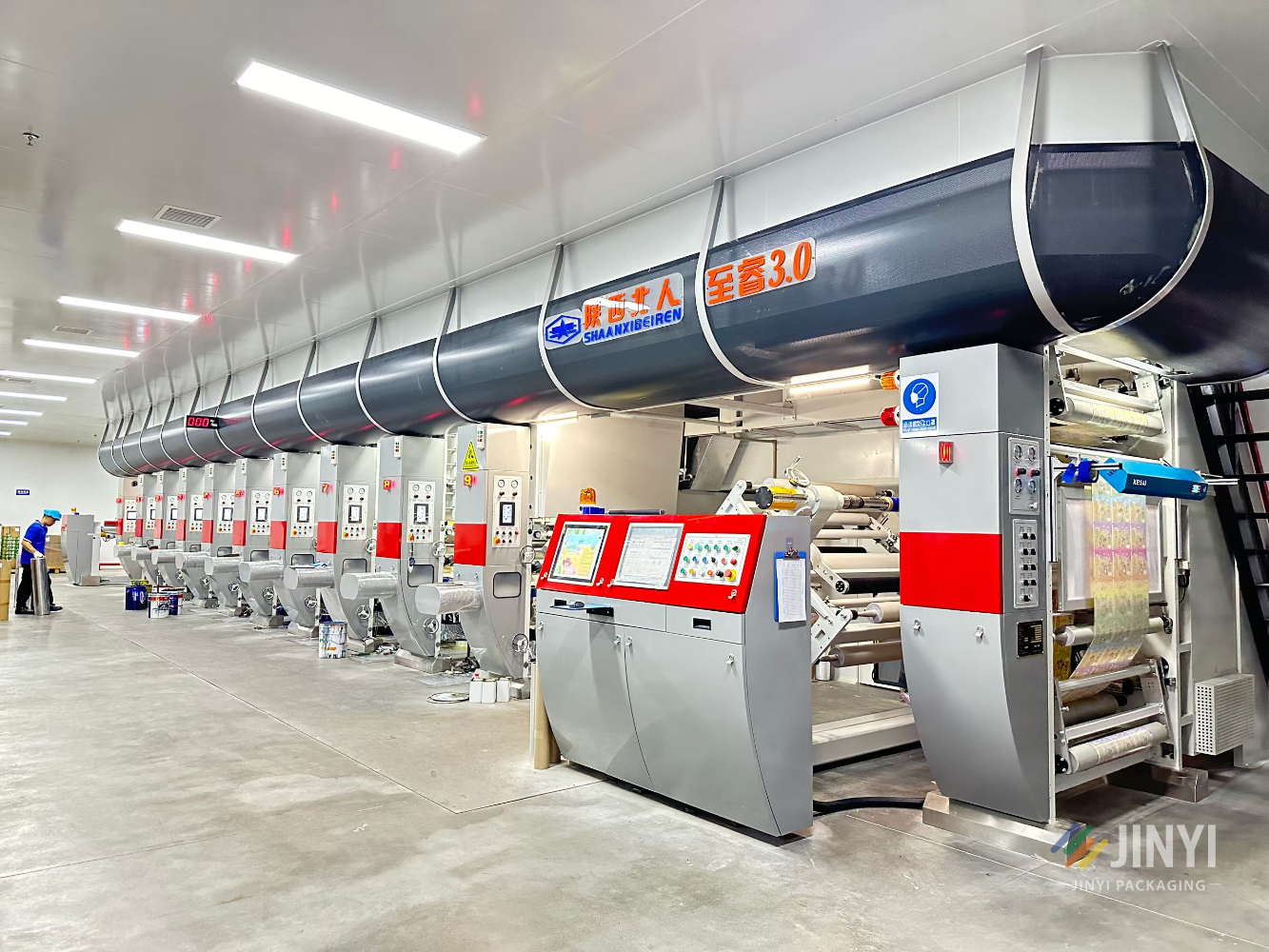
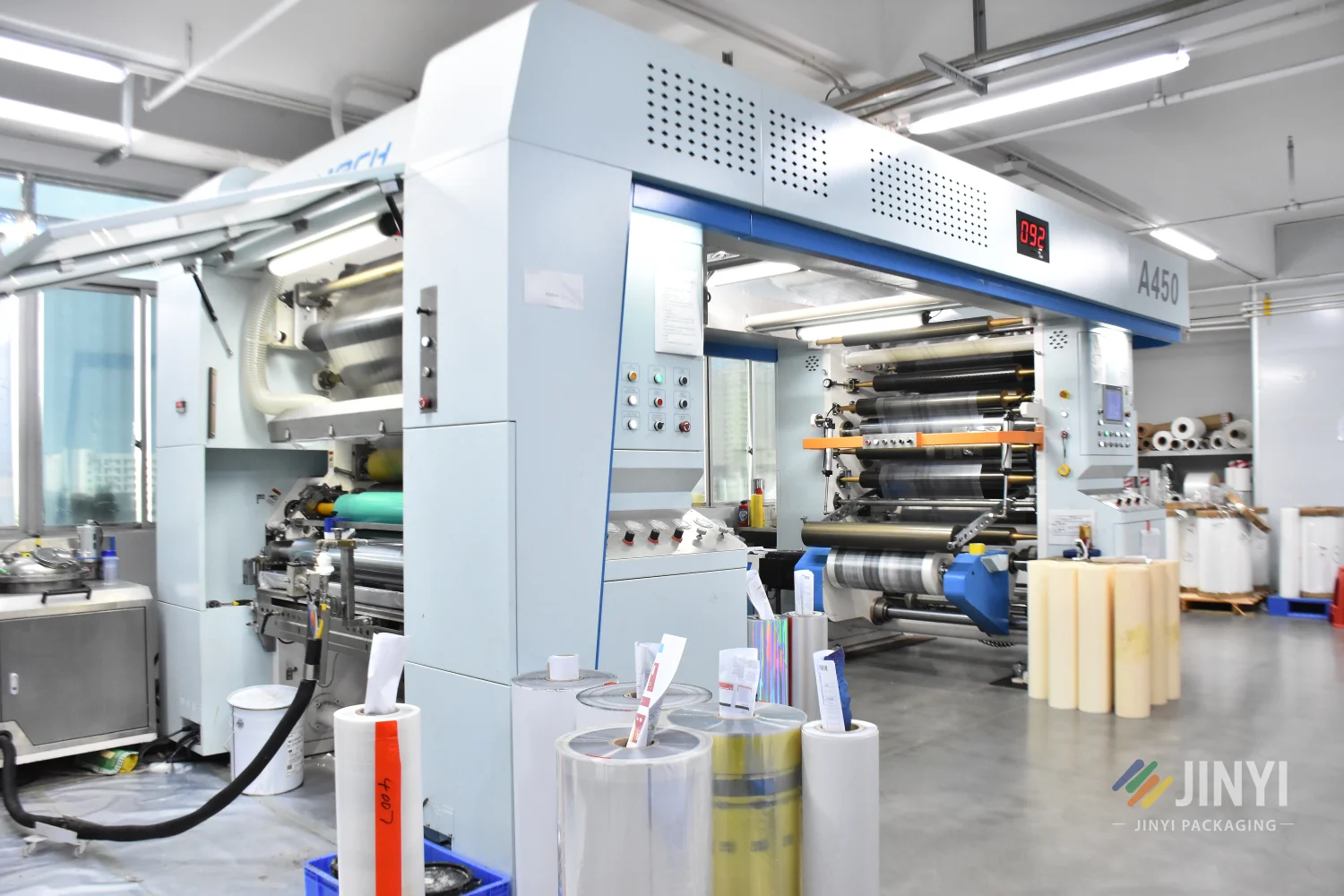
JINYI gravure printing line — the right choice for high-volume runs where lower per-unit cost is the priority
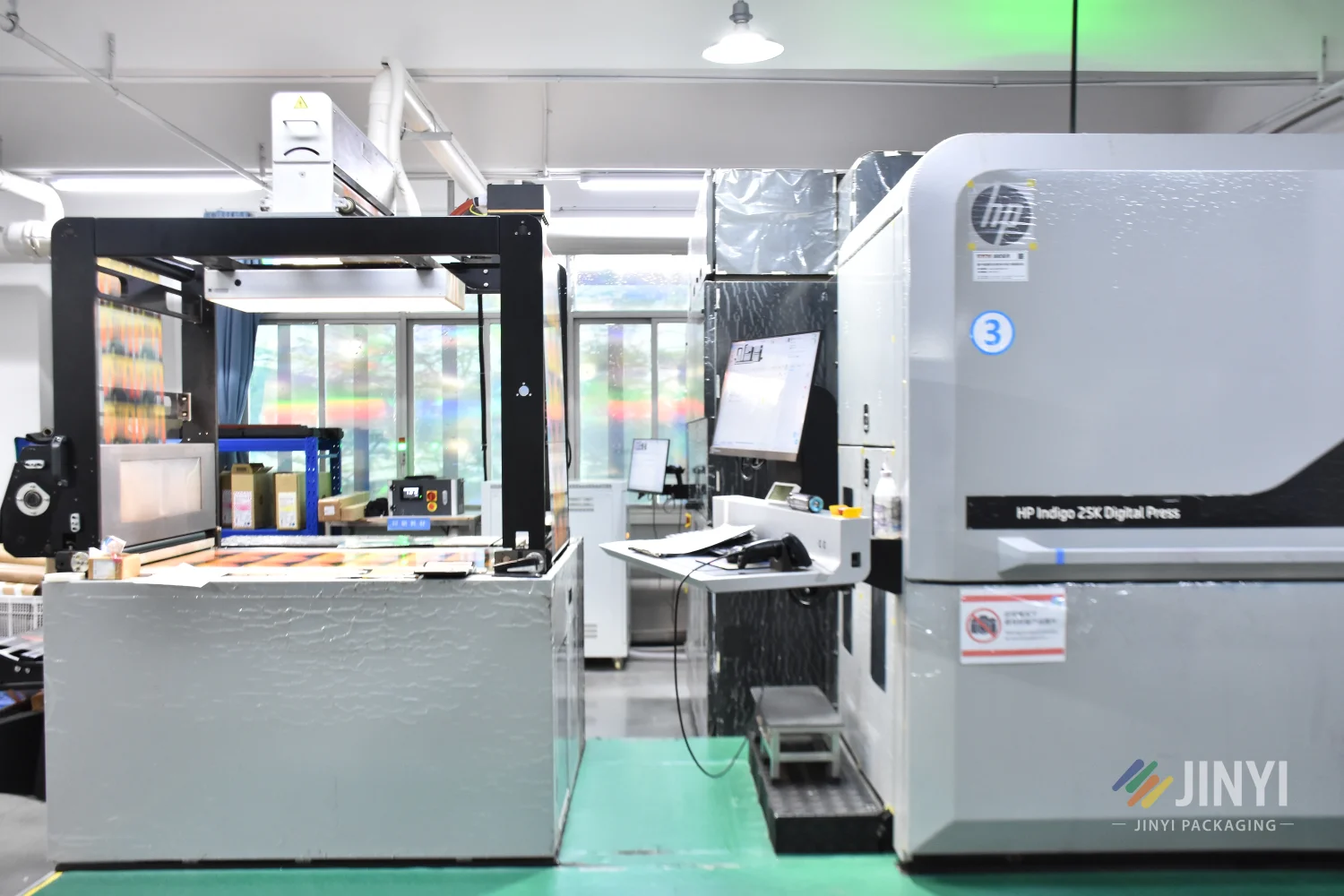
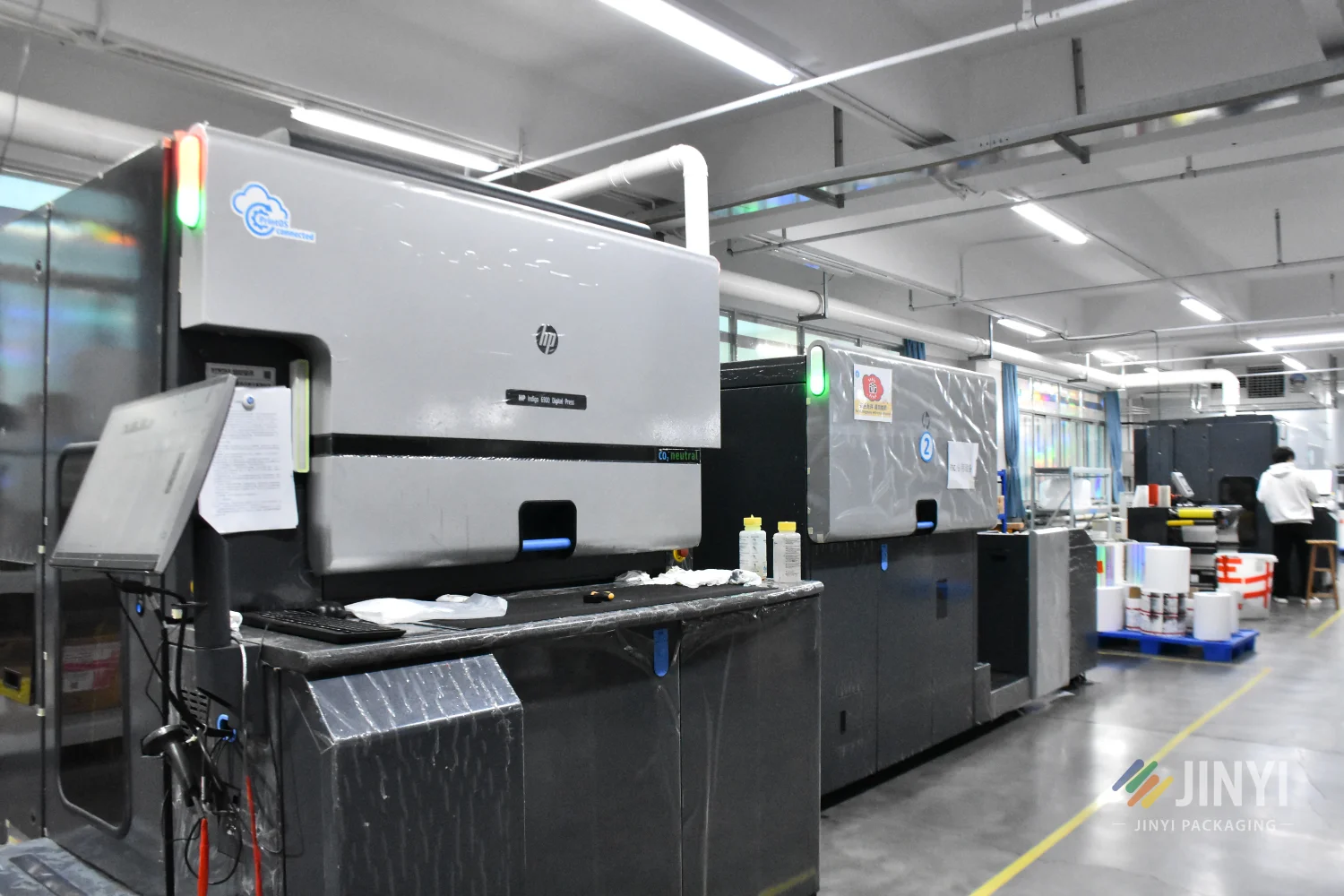
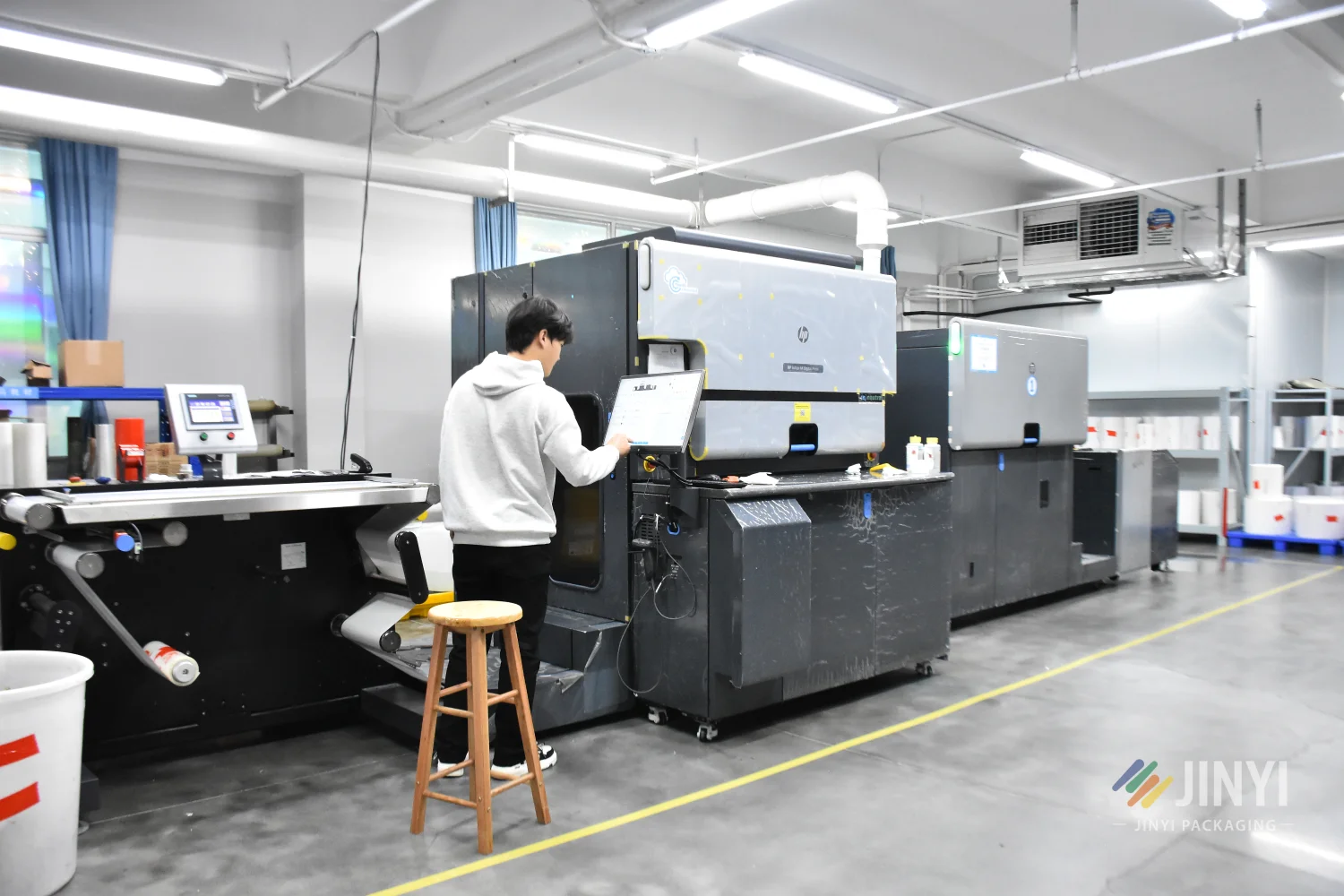
Our primary and most advanced printing capability is HP Indigo digital. JINYI operates four HP Indigo press systems: the HP Indigo 200K (our newest press, commissioned in 2025 — one of the most advanced flexible packaging digital presses currently available), the HP Indigo 25K, the HP Indigo 6K, and the HP Indigo 6900. All four presses are managed and scheduled through the ESKO Automation Engine — a production workflow system that handles file processing, colour management, press scheduling, and quality verification from a single automated platform.
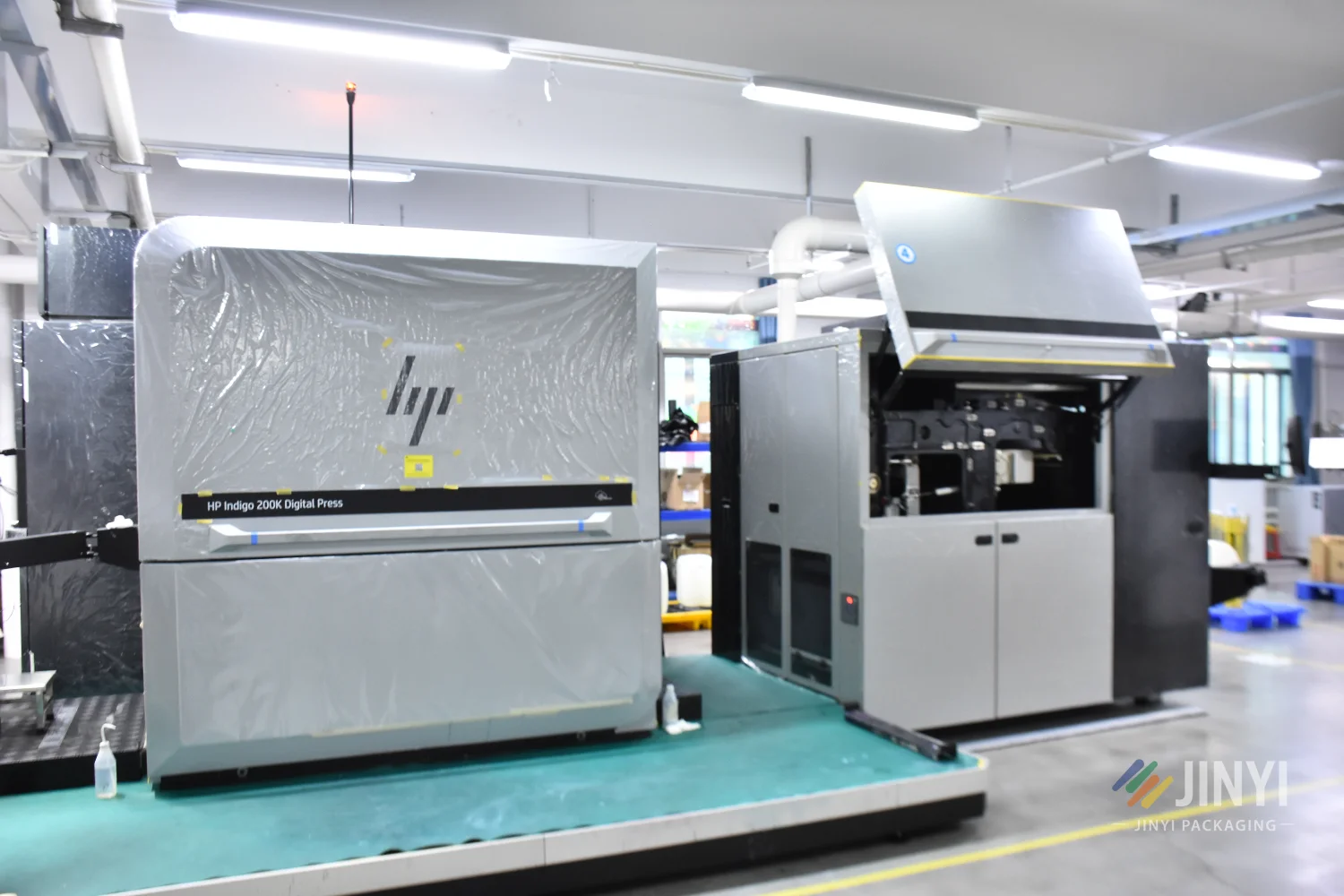
HP Indigo 200K — JINYI’s newest press, commissioned in 2025, expanding digital print capacity and reducing lead times
HP Indigo digital printing uses liquid ElectroInk — a fundamentally different technology from standard inkjet or laser printing. ElectroInk produces sharp, consistent colour at resolutions that rival gravure printing, with the critical advantage that no printing plates are required. Each job is fed digitally, which means no plate setup cost, no minimum commitment to a fixed design, and the ability to produce variable data or multiple design variants in a single press run.
HP Indigo 25K at JINYI — consistent colour output across all press systems via ESKO Automation Engine
For clients ordering custom flexible packaging, this translates directly into two measurable advantages. First, the minimum order quantity for a fully custom printed run starts from 500 units — accessible for brand launches, product tests, and seasonal SKUs where committing to 3,000 units carries too much inventory risk. Second, there is no plate fee — a cost that typically runs $800 to $2,000 per colour separation in gravure printing and is often hidden inside quoted unit prices by intermediary suppliers.
Factor
HP Indigo Digital
Gravure (Rotogravure)
Minimum order quantity
From 500 units
From 3,000 units
Plate / setup fee
None
$800–$2,000+ per colour
Colour consistency
High — managed by ESKO Automation Engine
Very high — plates are permanent
Design change flexibility
No cost — digital file update only
New plates required — significant cost
Print lead time
7–12 days production
15–25 days (includes plate making)
Per-unit cost at volume
Higher per unit at large volume
Lower per unit at large volume
Variable data / versioning
Supported — no additional cost
Not supported without new plates
Colour management across all four HP Indigo presses is centralised through the ESKO Automation Engine, which handles Pantone spot colour matching, ICC colour profile management, and press-to-press consistency checks. This means a job proofed on the HP Indigo 6K and moved to the HP Indigo 200K for a larger run will produce the same colour output — something that is not possible without a centralised workflow management system. The ESKO platform also manages preflight checks on incoming artwork files — catching common errors like incorrect colour modes, insufficient bleed, or resolution below print-safe thresholds — before the job reaches the press, eliminating production delays caused by file issues discovered mid-run.
HP Indigo 6900 press at JINYI — high-quality digital printing for custom branded flexible packaging
Pantone colour matching on HP Indigo is achieved through JINYI’s calibrated colour library, which maps Pantone solid coated references to their closest achievable HP ElectroInk equivalent. For brand colours with strict Pantone specifications — a common requirement for established brands where the colour is a trademark asset — JINYI provides a colour proof on the actual substrate before production confirmation. This physical proof shows the client exactly how their brand colour will render on their specified film under their specified finish (matte or gloss), so there are no surprises when the finished goods arrive.
The HP Indigo 200K — JINYI’s newest press, commissioned in 2025 — represents a meaningful step forward in digital flexible packaging production capability. The 200K is specifically engineered for high-speed, high-quality flexible packaging applications, running at higher throughput than earlier HP Indigo models while maintaining the colour consistency and print resolution that HP Indigo technology is known for. Its commissioning expanded JINYI’s total digital print capacity and reduced lead times on higher-volume digital print runs — particularly for clients with time-sensitive launch schedules or seasonal SKU requirements.
HP Indigo 6K digital press at JINYI — producing custom flexible packaging with zero plate fee from 500 units
For high-volume orders where gravure printing’s lower per-unit cost becomes significant, JINYI also operates gravure printing lines. Gravure uses engraved metal cylinders — one per colour separation — to transfer ink directly onto the film surface in a continuous, high-speed process. The plate cost is a one-time investment; once the cylinders are made, repeat orders carry no additional setup charge. Gravure printing is the right choice for established SKUs with predictable volume above 3,000 units where design changes are infrequent and the long-term per-unit cost advantage outweighs the upfront plate investment. At JINYI, clients can begin with HP Indigo digital and transition to gravure at volume using the same film specification, the same factory, and the same account team — eliminating the supplier transition risk that typically accompanies a print method change.
JINYI Production Transparency: During the printing stage of your order, JINYI provides real-time production photos and video clips of your bags on press — sent directly to you via your preferred messaging channel. This gives you visual confirmation that your artwork, colours, and print quality are on spec before the run completes, without having to travel to the factory or wait until the finished goods arrive.
Step 4: Lamination — Why JINYI Uses Solvent-Free Bonding as Standard
After printing, the individual film layers are bonded together through lamination — the process that creates the multi-layer structure responsible for the bag’s barrier performance. At JINYI, our standard lamination method is solvent-free lamination. This is a deliberate manufacturing choice, not the industry default.
JINYI’s solvent-free lamination line — bonding film layers without VOC emissions for safer food-contact packaging
There are two primary lamination methods in flexible packaging production. Dry lamination uses solvent-based adhesives — the adhesive is applied in solvent form, the solvent is driven off in a drying oven, and the layers are bonded under heat and pressure. Solvent-free lamination uses a 100% solids adhesive with no solvent content — the adhesive is applied directly in its reactive form and cured through a controlled chemical reaction rather than solvent evaporation.
Factor
Dry Lamination (Solvent-Based)
Solvent-Free Lamination (JINYI Standard)
Solvent residue risk
Present — requires controlled drying and testing
Zero — no solvent content
Food contact safety
Requires residual solvent testing
Inherently lower risk — no VOC migration
Environmental impact
VOC emissions from solvent evaporation
No VOC emissions
Bond strength
High — established technology
High — equivalent to dry lamination at proper cure
Curing time
24–48 hours
24–48 hours (chemical cure)
After lamination, the bonded film rolls enter a curing room where temperature and humidity are controlled to ensure the adhesive reaches full bond strength. Curing time is typically 24 to 48 hours. Rushing this stage produces delamination — layers separating during bag forming or in the field — which is one of the most common quality failures in flexible packaging produced at factories that prioritise throughput over process discipline.
Post-lamination curing at JINYI — 24 to 48 hours under controlled conditions to ensure full bond strength before slitting
Post-lamination quality checks at JINYI include peel strength testing (measuring the force required to separate bonded layers), visual inspection for delamination or adhesive voids, and solvent residual testing where applicable. Rolls that do not meet peel strength specifications are rejected before slitting.
Note: Solvent residue in flexible packaging is a food safety issue, not just a technical one. Residual VOCs can migrate into the packaged product, particularly in products with high fat content. If your packaging supplier cannot confirm their lamination method or provide a solvent residual test report, that is a risk worth investigating before committing to a production run.
Step 5: Slitting — Cutting the Laminated Film to Production Width
Once the laminated roll has completed its curing period and passed quality inspection, it moves to the slitting station. Slitting is the process of cutting the wide laminated roll — which comes off the lamination machine at master roll width, typically 600mm to 1,200mm — into narrower rolls of the precise width required for bag-making on each specific production machine.
Slitting precision directly affects the dimensional accuracy of the finished bag. A slit roll that is 1mm narrower than specification produces bags that are 1mm narrower on the seal width — which affects the seal strength and the bag’s overall appearance on shelf. JINYI’s slitting machines operate with a width tolerance of ±0.5mm, and every slit roll is measured and logged before being transferred to the bag-making line.
Film tension management during slitting is equally critical. Inconsistent tension causes roll telescoping — where the wound roll shifts laterally, creating uneven edges that jam bag-making machines or produce bags with misaligned seals. JINYI’s slitting equipment uses closed-loop tension control to maintain consistent winding tension across the full roll width.
Tip: When reviewing a supplier’s quality documentation, ask specifically about their slitting width tolerance and whether slit rolls are measured before bag-making. A supplier that cannot answer this question with a specific tolerance figure is likely not monitoring slitting quality systematically.
Step 6: Bag Making — Forming, Sealing, and Cutting
Bag making is where the flat film roll becomes a three-dimensional bag. The slit film is fed into a bag-making machine that performs a sequence of operations: folding, gusseting (for stand-up and side-gusset formats), heat sealing, punching functional holes (zipper, valve, euro slot), and cutting — all in a continuous automated process.
JINYI bag-making line — forming, sealing, and cutting custom stand-up pouches with validated seal parameters for every run
The heat sealing stage is the most technically critical operation in bag making. The inner PE layer of the laminate is the heat-seal material — it melts and bonds to itself under heat and pressure, creating the bag’s seals. Three parameters control the quality of every seal: temperature, pressure, and dwell time. If any of these is outside specification, the result is either an under-sealed bag (weak seal, potential product loss) or an over-sealed bag (burnt seal, reduced barrier integrity at the seal edge).
JINYI’s bag-making machines are set up with validated sealing parameters for each film structure before each production run. Seal temperature is monitored continuously via thermocouple sensors on the sealing jaws, and the first 20 bags of each production run are sampled for seal strength testing before the full run proceeds. Bags with seal strength below the minimum specification threshold — typically 30N/15mm for food packaging — are quarantined and the machine parameters are adjusted before the run continues.
Bag Format
Forming Method
Key Quality Parameter
Stand-up pouch
Bottom gusset fold + side seals + bottom seal
Bottom seal integrity, gusset symmetry
Flat-bottom bag
Four-corner forming + multiple seal planes
Corner weld strength, base stability
Side gusset bag
Side gusset fold + top and bottom seals
Gusset symmetry, seal uniformity under load
Three-side seal
Two-ply fold + three perimeter seals
Seal width consistency, edge straightness
Dimensional tolerances on finished bags are ±2mm on length and width, and ±1mm on gusset depth. These tolerances are verified through a sampling protocol at regular intervals throughout the production run, with results logged against the job specification. Bags that fall outside tolerance on any dimension are quarantined, the machine parameters are reviewed and adjusted, and the run continues only after the next sample confirms the dimension is back within spec.
Multiple bag-making machines running simultaneously at JINYI — supporting parallel production of different bag formats and sizes
The first article inspection — the evaluation of the first 20 completed bags from a new production run — is one of the most important quality checkpoints in the entire process. It is at this stage that any systematic errors in the machine setup become visible: seals that are consistently narrow on one side, gussets that are folding asymmetrically, print registration that has shifted from the lamination stage. Catching these issues in the first 20 bags costs minutes. Catching them after 5,000 bags have been produced costs the entire run. JINYI’s production team is required to hold the run at first article inspection until the quality checklist is fully signed off — there is no option to proceed on the assumption that things will correct themselves.
Surface finish is applied at the bag-making stage via the pre-laminated outer film — matte lamination and gloss lamination are the two standard options, with speciality finishes like spot UV and soft-touch available on specific structures. Matte lamination is the dominant choice for premium food and supplement brands — it eliminates glare under retail lighting, creates a tactile quality that signals premium positioning, and hides fingerprints and handling marks more effectively than gloss. Gloss lamination produces higher colour saturation and is preferred for high-colour artwork where vibrancy is the primary visual goal. Both finishes are available across all bag formats at JINYI with no minimum order premium.
Step 7: Functional Components — Zippers, Valves, Spouts, and Handles
Most custom flexible packaging bags include one or more functional components — features that go beyond the basic bag structure to serve a specific consumer or product protection function. At JINYI, functional components are installed either inline during bag making or as a secondary operation immediately after, depending on the component type and the production machine configuration.
Zipper installation inline during bag making at JINYI — press-to-close zippers fitted and tested as part of the continuous production process
Component
Function
Quality Test
Common Applications
Press-to-close zipper
Resealable closure after first open
Open/close cycle test, airtightness test
Coffee, matcha, snacks, supplements
Slider zipper
Easier one-handed reseal
Slider engagement force, seal retention
Pet food, large format retail bags
One-way degassing valve
Allows CO₂ out, prevents O₂ ingress
One-way gas flow test, adhesion test
Freshly roasted coffee bags
Spout
Controlled pour for liquids or powders
Weld strength, leak test at pressure
Liquid products, protein powder, baby food
Handle (die-cut or patch)
Carry function for heavy bags
Load-bearing test
Bulk bags 2kg+, pet food, rice
Tear notch
Clean, controlled first open
Tear force measurement, directional consistency
Standard on most retail formats
Euro slot / hang hole
Retail peg display
Punch accuracy, edge integrity
Retail POS display, hardware, accessories
Note: One-way degassing valves are a non-negotiable component for freshly roasted coffee packaging. Roasted coffee releases CO₂ for 7 to 14 days after roasting — a sealed bag without a valve will either inflate and fail at the seals, or the roaster must rest the coffee for a week before sealing, losing the freshness window. If you are packaging coffee within 72 hours of roasting, a valve is essential, not optional.
Step 8: Quality Control — What JINYI Checks Before Every Order Ships
Quality control at JINYI is not a single end-of-line inspection — it is a staged verification system that runs at every major production transition. This approach catches failures at the point where they occur and prevents defective material from advancing to the next stage, which is the only way to ensure the finished goods meet specification without relying on a final inspection to catch everything.
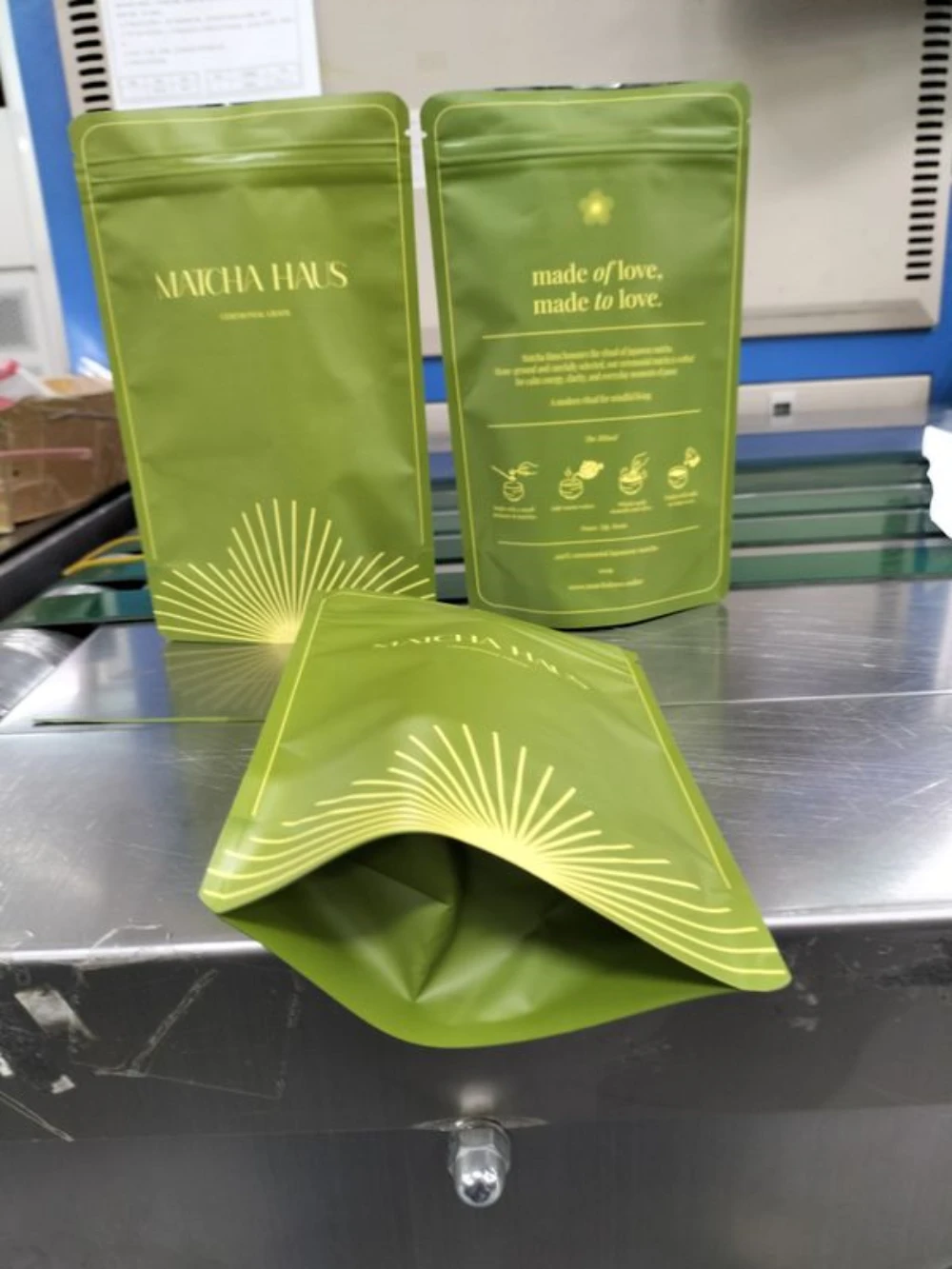
Green matcha packaging pouches freshly produced at the Jinyi factory.
QC Stage
What Is Checked
Method
IQC — incoming material
Film thickness, surface tension, opacity, barrier sampling
Densitometer, colour spectrophotometer, visual vs proof
Post-lamination
Peel strength, delamination, solvent residual
Tensile tester, visual inspection, GC testing
IPQC — during bag making
Seal strength, dimensions, zipper function, valve integrity
Tensile tester, caliper, functional test
OQC — outgoing inspection
Drop test, burst test, appearance, quantity verification
Drop rig, pressure tester, AQL sampling
Final outgoing inspection (OQC) follows AQL (Acceptable Quality Level) sampling standards — a statistically validated sampling protocol that determines how many bags from a finished production batch need to be inspected to provide a statistically meaningful quality assurance. The AQL level applied depends on the defect type: critical defects (barrier failure, seal failure) carry a tighter AQL than minor cosmetic defects (surface scratches below a defined threshold).
Every completed order ships with a full material specification document — confirming the film structure, OTR and MVTR values, food-contact certifications, print method, and QC results for the production batch. This document is provided as standard with every JINYI order, not on request — because it is the document your retail buyers, co-manufacturers, and compliance teams will ask for.
JINYI’s complimentary commercial photography service — every completed order is professionally photographed in-house, ready for e-commerce, social media, and retail use at no additional charge
JINYI Commercial Photography Service: Once your order passes final quality inspection, JINYI provides a complimentary commercial photography session for your finished packaging — shot in our dedicated product photography studio. You receive a set of high-resolution product images ready for e-commerce listings, social media, press materials, and retail presentations. This service is included with every order at no additional charge.
Step 9: Beyond the Bag — JINYI’s Full Production Capabilities
JINYI’s production capabilities extend beyond flexible packaging bags. Our HP Indigo digital press fleet — four machines including the HP Indigo 200K, 25K, 6K, and 6900, all managed through the ESKO Automation Engine — gives us the ability to produce any printed product that runs on HP Indigo technology at commercial quality.
JINYI hot stamping line — metallic foil accent finishing for premium and limited-edition flexible packaging formats
Our die-cutting department operates 30 die-cutting machines — one of the largest die-cutting capacities of any flexible packaging manufacturer in the region. Die-cutting is used for custom-shaped packaging formats, labels, stickers, and specialty cut applications. The scale of our die-cutting capability means we can handle high-volume die-cut jobs alongside regular flexible packaging production without scheduling conflicts or extended lead times.
JINYI operates 30 die-cutting machines — supporting flexible packaging, labels, stickers, and custom boxes from the same production floor
Product Category
Examples
Technology
Flexible packaging bags
Stand-up pouches, flat-bottom bags, side gusset bags, sachets
Folding cartons, gift boxes, product packaging boxes
HP Indigo digital + die-cutting
Specialty print products
Custom inserts, hang tags, branded collateral
HP Indigo digital
For brands that need their flexible packaging, product labels, and outer cartons to carry a consistent visual identity — same colour standards, same print quality, same finish — producing all three from the same facility with the same press management system eliminates the colour matching inconsistencies that occur when different product categories are sourced from different suppliers. Browse our full custom packaging product range to see the formats we produce.
Step 10: Shipping and Logistics — Getting Your Order to Your Door
Once an order passes final quality inspection and photography, it moves to the packing and dispatch stage. JINYI ships to 150+ countries via a network of established freight partners — covering express courier (DHL, FedEx, UPS) for smaller orders and urgent timelines, and sea freight via consolidated container (LCL) or full container (FCL) for volume orders where transit cost is the priority.
Every JINYI shipment is tracked from the moment it leaves our facility. Once the shipment is booked, we provide the client with a tracking number and carrier link, and we proactively monitor the shipment’s transit status throughout the journey. If a delay occurs — port congestion, customs hold, weather disruption — we notify the client immediately with an updated ETA and any action required on their end. We do not wait for clients to ask; we flag issues as they arise.
Finished orders packed and ready for dispatch at JINYI — shipped to 150+ countries via express courier and sea freight
For first-time importers, JINYI’s team can advise on Incoterms selection — whether EXW, FOB, CIF, or DDP makes the most sense for your situation — and on the import documentation required for your destination country. Packaging is not a regulated commodity in most markets, but food-contact certification documentation is sometimes required at customs for food packaging imports. We prepare and provide this documentation as part of every shipment package.
Shipping Method
Transit Time
Best For
Express courier (DHL / FedEx / UPS)
3–7 business days
Small orders, urgent timelines, samples
Air freight
5–10 business days
Medium volume, time-sensitive, high-value orders
Sea freight LCL
25–40 days (destination dependent)
Medium volume, cost-priority, non-urgent
Sea freight FCL
25–40 days (destination dependent)
Large volume, lowest per-unit freight cost
Tip: For your first order with JINYI, we recommend express courier shipping regardless of order size — even if sea freight would be more economical at your quantity. Receiving your first production run quickly allows you to verify the product in person, begin using the packaging, and confirm any specification adjustments before committing to a larger volume repeat order by sea.
Export packing at JINYI is designed to protect the finished bags through the full transit journey. Completed bags are packed in standard export cartons with appropriate inner packaging to prevent compression damage and moisture ingress during sea freight. Each carton is labelled with product description, quantity, order reference, and any client-specified labelling requirements. A packing list is prepared and included with every shipment, and a copy is provided to the client by email on the day of dispatch.
For first-time importers, JINYI’s team can advise on Incoterms selection — whether EXW, FOB, CIF, or DDP makes the most sense for your situation — and on the import documentation required for your destination country. Packaging is not a regulated commodity in most markets, but food-contact certification documentation is sometimes required at customs for food packaging imports. We prepare and provide this documentation as part of every shipment package. Clients importing into the European Union should be aware of the EU’s food-contact materials regulation (EC 1935/2004) documentation requirements — JINYI provides the relevant compliance documentation for EU-bound shipments as standard.
The Complete Ordering Process — From First Inquiry to Finished Pouch
For buyers sourcing custom flexible packaging for the first time, or evaluating JINYI as a new supplier, the process from first contact to finished goods in hand follows a consistent sequence. Understanding the timeline upfront prevents the most common frustration in custom packaging procurement: unrealistic expectations about how long the process takes.
Stage
What Happens
Timeline
1. Inquiry and specification
Requirements brief, format and material recommendation, quote
24 hours response
2. Artwork and proofing
Artwork file review, digital proof approval, spec confirmation
2–4 days
3. Sample production
Physical sample produced and shipped for client approval
3–5 days production + shipping
4. Order confirmation and payment
PO issued, deposit payment, production schedule confirmed
1–2 days
5. Production
Material sourcing, printing, lamination, bag making, QC
7–15 days (digital print)
6. Photography and packing
Complimentary product photography, export packing, final check
For digital print orders, the total time from confirmed order to goods shipped — excluding shipping transit — is typically 10 to 18 days. For gravure print orders, add 8 to 12 days for plate production. Clients who have approved samples and have existing plate assets on file can see production timelines shortened significantly on repeat orders.
JINYI’s minimum order quantity for custom digital print flexible packaging starts at 500 units per design. There is no plate fee for digital print orders. Gravure printing is available from 3,000 units per design and offers lower per-unit pricing at volume, with a one-time plate investment that amortises across the production run.
Note: Every JINYI order — regardless of size — ships with a complete material specification document covering film structure, OTR and MVTR values, layer breakdown, food-contact certifications, and production QC results. This is not an add-on service. It is standard with every order, because the brands we work with need this documentation for their retail buyers, co-manufacturers, and compliance teams.
Ready to Start Your Custom Flexible Packaging Order?
Tell us your product, format, quantity, and timeline. We will come back within 24 hours with a full specification recommendation, material documentation, and factory-direct pricing — no intermediary, no hidden fees, no guesswork.
JINYI is a source factory for custom flexible packaging with 15+ years of production experience, serving brands across food, coffee, matcha, supplements, pet food, cannabis, and consumer goods in 150+ countries. We operate four HP Indigo digital press systems — including the HP Indigo 200K commissioned in 2025 — alongside gravure printing lines and 30 die-cutting machines, all managed through the ESKO Automation Engine.
Every client receives full material specification documentation, real-time production updates, complimentary commercial photography, and proactive logistics tracking as standard. That is what From Film to Finished — Done Right means in practice.
Mark
Head of Production Management · JINYI Packaging
Mark leads production scheduling and order coordination at JINYI. With a Business Administration background and hands-on manufacturing exposure, he focuses on keeping quality, lead time, and execution stable across custom packaging orders — from the first press run to the final shipment.
Production planning On-time delivery Cross-team coordination
What is the difference between digital printing and gravure printing for flexible packaging?
Digital printing (HP Indigo) requires no printing plates, starts from 500 units, has no setup fee, and produces consistent results across short and medium runs. Gravure printing uses engraved metal cylinders, requires a one-time plate investment, and starts from 3,000 units — but delivers a lower per-unit cost at high volumes. JINYI operates both technologies, allowing clients to start with digital and move to gravure as their volume grows without changing supplier or film specification.
What film structure should I use for my product?
The right film structure depends on your product’s oxygen and moisture sensitivity, target shelf life, and distribution channel. PET/AL/PE is the standard for high-barrier applications — coffee, matcha, supplements — with a shelf life of 12 to 24 months. PET/VMPET/PE is suitable for products with faster inventory turnover and a 6 to 12 month shelf life window. If you are not sure which structure is right, tell us your product, fill weight, shelf life target, and distribution channel — we will recommend the correct specification.
What is the minimum order quantity for custom flexible packaging at JINYI?
The minimum order quantity for custom digital print flexible packaging at JINYI is 500 units per design, with no plate fee. For gravure printing, the minimum is 3,000 units per design. Both methods are available across stand-up pouches, flat-bottom bags, side gusset bags, and other flexible packaging formats.
How long does it take to produce custom printed flexible packaging?
For digital print orders, production from confirmed order to goods shipped is typically 10 to 18 days, excluding shipping transit time. This covers material preparation, printing, lamination, curing, bag making, quality inspection, and packing. Gravure print orders add 8 to 12 days for plate production on first-time orders. Repeat orders with existing plate assets on file can be produced on shorter timelines.
Does JINYI provide material specification documents with orders?
Yes — material specification documentation is included with every JINYI order as standard. This covers the film layer breakdown, OTR and MVTR values, food-contact certifications, print method, and production QC results. You do not need to request it separately. It is provided because your retail buyers, co-manufacturers, and compliance teams will ask for it — and you should have it ready.
What quality certifications does JINYI hold for flexible packaging production?
JINYI’s flexible packaging materials meet FDA food-contact requirements (US market), EC 1935/2004 food-contact regulations (EU market), and ISO 22000 food safety management standards. Our HP Indigo printing uses food-safe ElectroInk with non-toxic ink certification. Specific certification documentation for each production run is available on request and included in the material specification package shipped with every order.