JINYI shares practical packaging guidance for your decisions.
The coffee bag sitting on your shelf or landing on your customer’s doorstep does more work than most brands give it credit for. It preserves freshness through weeks of distribution. It communicates your brand’s positioning before a single word is read. It signals whether your product belongs in a specialty roaster, a supermarket aisle, or a premium DTC subscription. And it has to do all of this while surviving transport, retail handling, and the consumer’s kitchen counter.
Getting every element of that bag right — the format, the material, the surface finish, the functional features, the size — requires decisions that are more interconnected than they first appear. This guide breaks down every layer of a custom coffee bag, explains the logic behind each decision, and gives you the framework to brief a supplier with confidence. For a complete look at how flexible pouches are built from the film up, our guide to how custom stand-up pouches are made covers the full production process end to end.
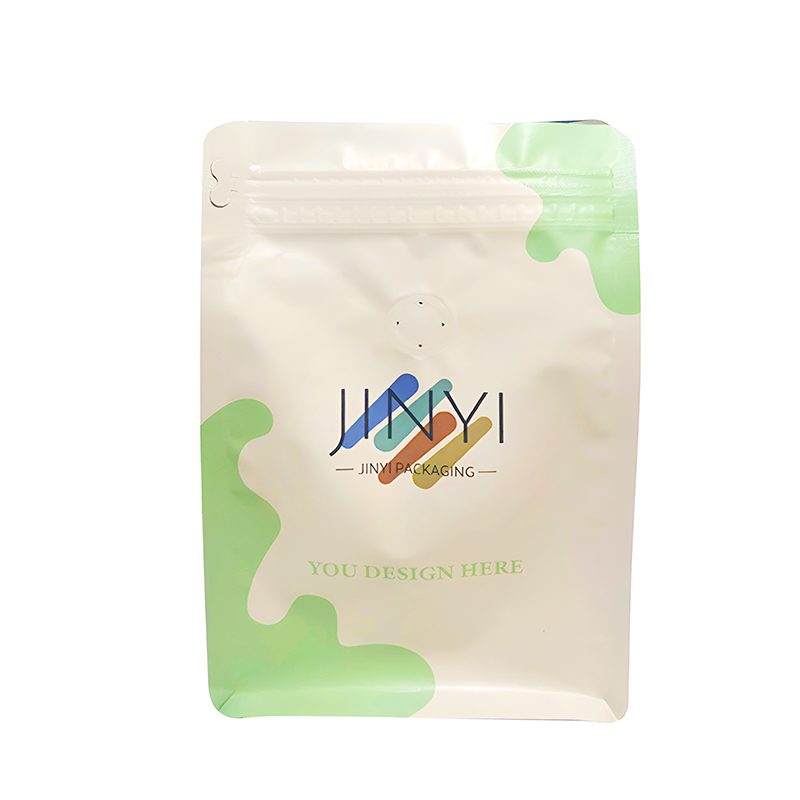
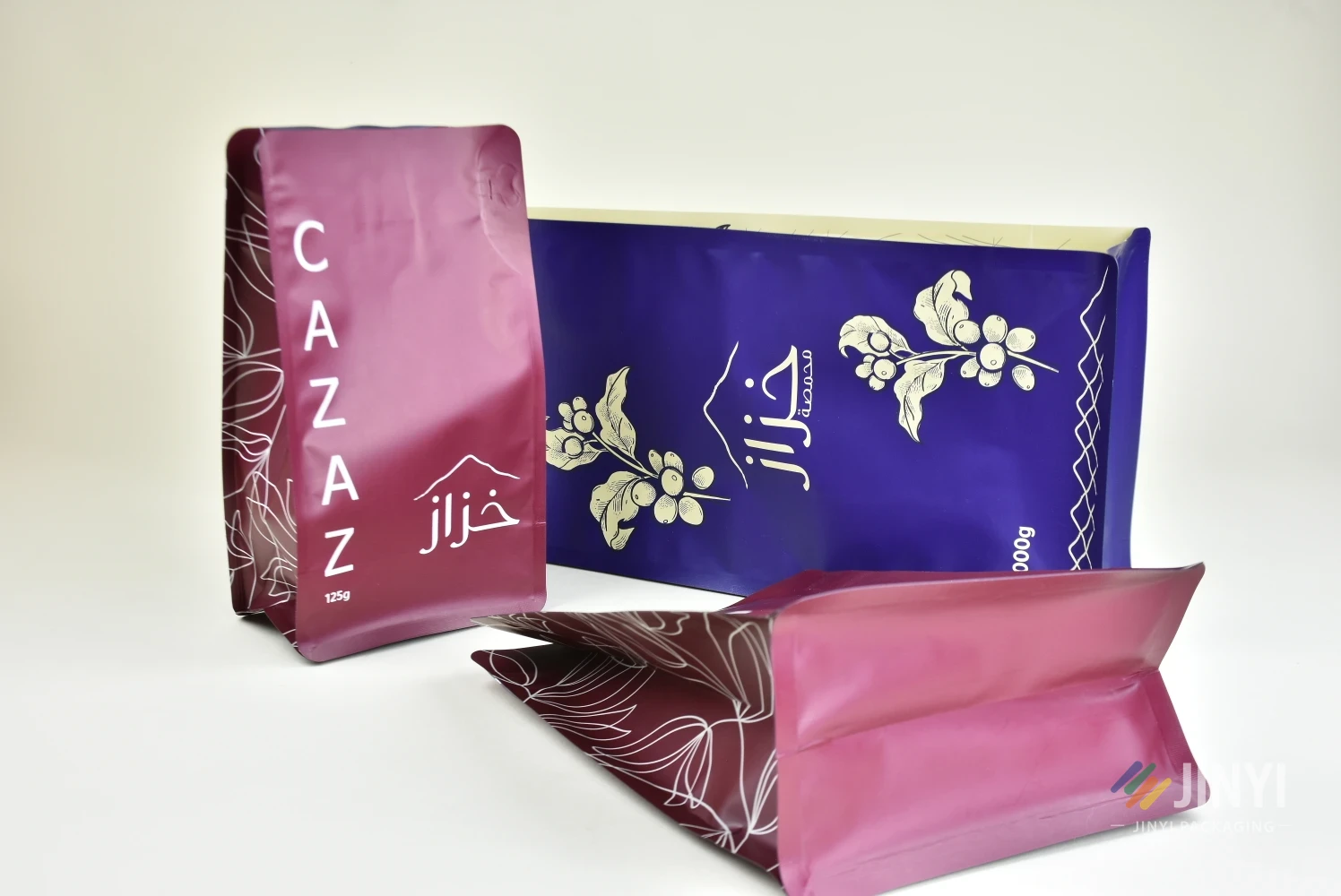
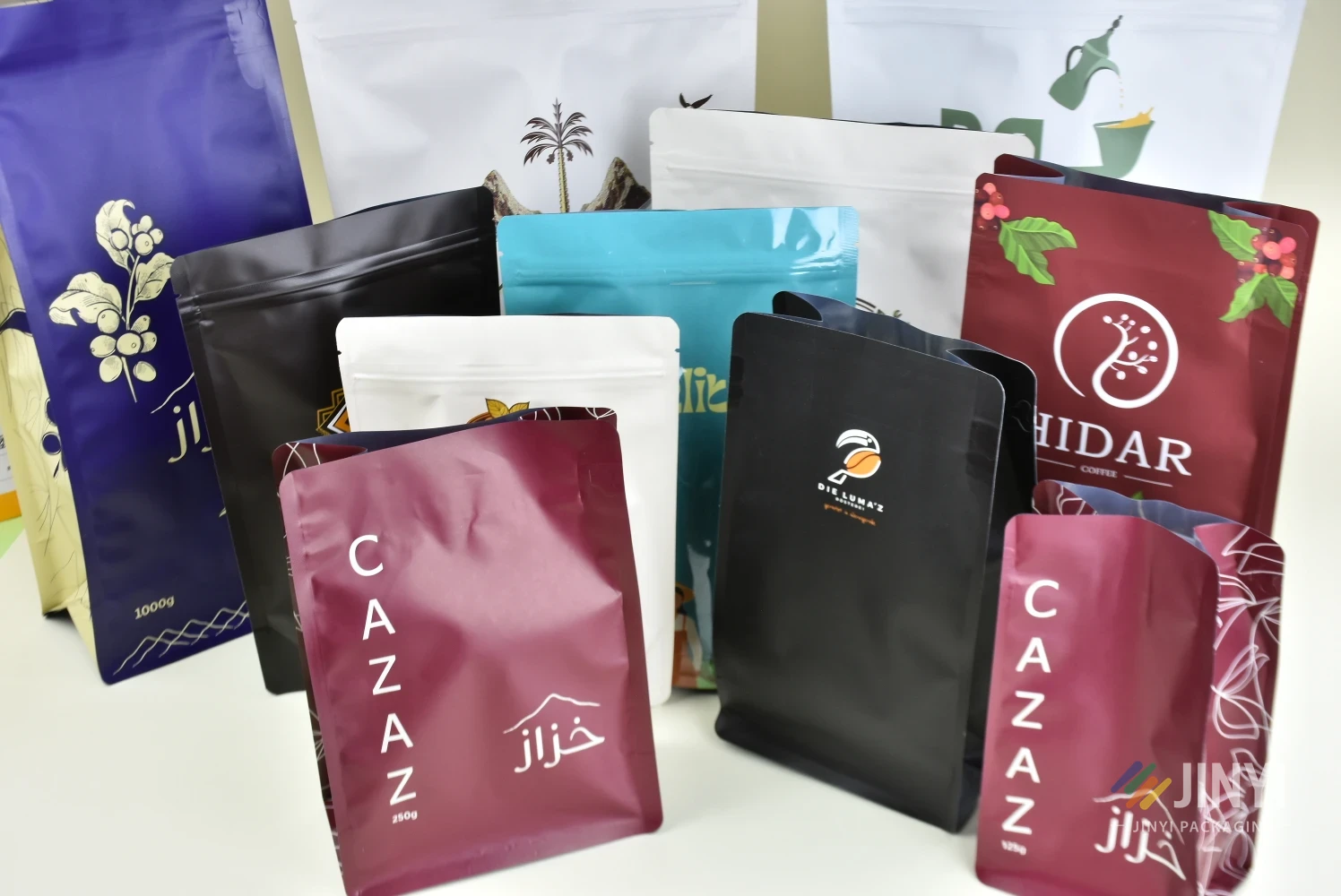
Custom flat bottom coffee bags produced at JINYI’s factory — three sizes shown, each with full matte finish and brand-specific artwork. Available from 500 units via digital print.
Coffee Bag Formats: Stand-Up Pouch, Flat Bottom Bag, and Side Gusset
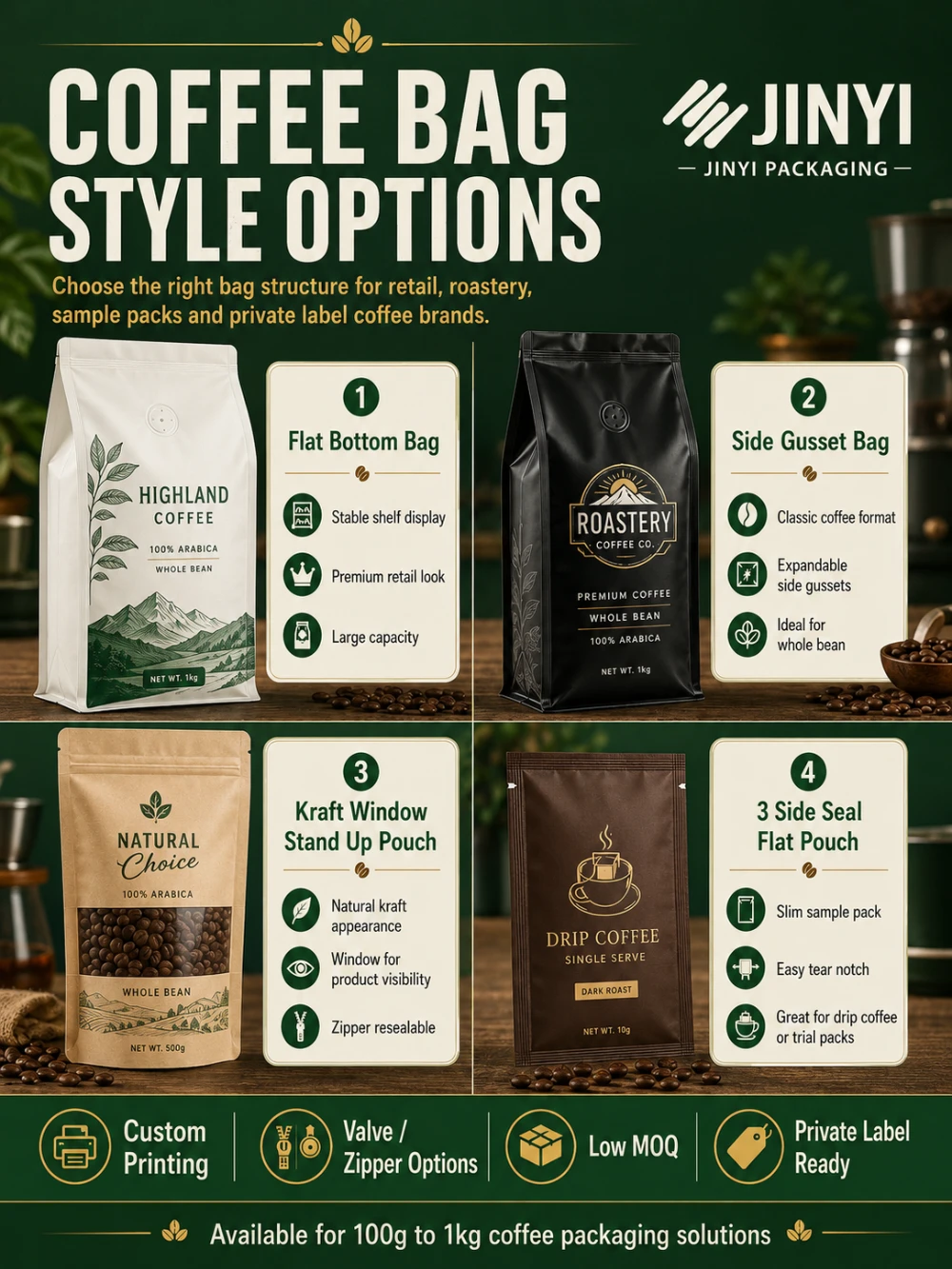
The format you choose determines how your bag stands on a shelf, how it ships, how much branding surface you have, and — in the consumer’s mind — what tier of coffee they are about to open. Three flexible formats dominate the coffee packaging market globally, and each serves a distinct brand profile and distribution model.
The stand-up pouch is the dominant format across the coffee category — from independent roasters to large-scale DTC brands. The bottom gusset expands on fill to create a stable standing base, the front panel provides generous branding surface, and the format ships flat when empty, keeping logistics costs low. Stand-up pouches are available across the widest range of sizes, materials, and finish options, and carry the lowest MOQ of any flexible coffee bag format. For most brands launching their first custom coffee bag, the stand-up pouch is the right starting point — it validates your packaging at lower unit cost before you commit to a more premium format.
The flat bottom bag — also called a box bottom bag, quad-seal bag, or block bottom bag — has become the defining format of the specialty and premium coffee segment. The base folds out flat, giving the bag a rigid, box-like standing profile that is visibly more architectural and premium than a standard stand-up pouch. It holds its shape at all fill levels, provides branding surface on four sides, and photographs significantly better in tabletop and lifestyle settings. If you are positioning your coffee at a premium price point, selling into specialty retail, or building a brand where the unboxing experience matters, the flat bottom bag is the format that signals quality before the consumer reads a word. The trade-off is a higher unit cost and typically a higher MOQ than the standard stand-up pouch.
The side gusset bag is the workhorse format for large-format coffee — typically 1kg and above — sold through wholesale, foodservice, and mass retail channels. The side-sealed construction handles heavy fills without the base deformation you can get from a stand-up pouch at high weights, and the format has been standard in commercial coffee supply chains for decades. If your primary SKU is a large-format bag for a café, office supply, or wholesale account, this is your format.
Format
Best For
Typical Fill Weight
Key Trade-Off
Stand-up pouch
DTC, e-commerce, retail, multi-SKU launches
100g – 1kg
Most cost-efficient — softer shelf profile
Flat bottom bag
Specialty retail, premium DTC, gift positioning
200g – 1kg
Best shelf presence — higher unit cost and MOQ
Side gusset bag
Wholesale, foodservice, large-format retail
1kg – 5kg
Best for heavy fills — less premium aesthetic
Tip: If you are deciding between a stand-up pouch and a flat bottom bag for your first order, start with the stand-up pouch to validate your market and your design at lower unit cost. Both formats are available in the same film structures and barrier specs — so upgrading your format in a subsequent order doesn’t mean starting from scratch on your material spec.
A Note on Stand-Up Pouch Bottom Structures: Standard Bottom vs K-Seal Bottom
Not all stand-up pouches are built the same at the base. The standard stand-up pouch has a curved gusset bottom — it expands when filled and stands upright, but as the bag empties, the curved base loses its structural support and the bag becomes progressively less stable. For products that are consumed over several days or weeks — like a 250g bag of whole beans used across multiple brew sessions — this instability becomes noticeable and frustrating for the consumer.
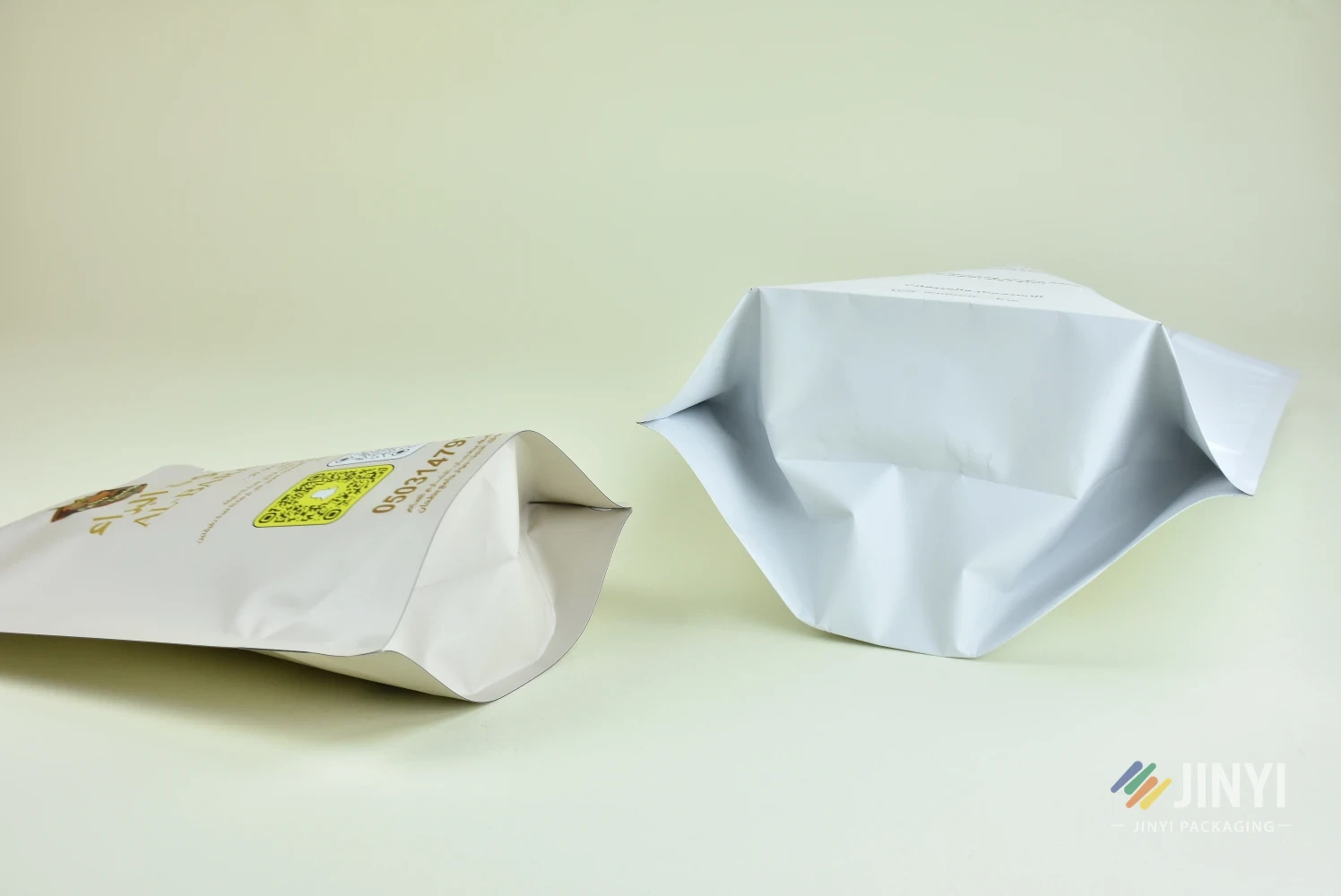
Left: standard curved bottom stand-up pouch. Right: K-seal bottom stand-up pouch. The K-seal base folds flat for consistent stability at any fill level — a meaningful upgrade for retail shelf display and consumer use over multiple sessions.
The K-seal bottom (also called a K-bottom) addresses this directly. Instead of a curved gusset, the K-seal base folds out flat, creating a near-rectangular standing footprint that maintains its stability at any fill level — full, half-empty, or nearly finished. The result is a bag that stands confidently on a retail shelf, a kitchen counter, or a café bar at every stage of the consumer’s use, not just when it is freshly filled.
Bottom Structure
Stability
Shelf Presence
Best For
Standard curved bottom
Good when full — decreases as bag empties
Rounded, soft profile
E-commerce, DTC, single-use or fast-turnover products
K-seal bottom
Consistent at all fill levels
Flat, structured, more upright
Retail shelf display, café counter, products used over multiple sessions
The K-seal bottom sits between the standard stand-up pouch and the flat bottom bag in terms of stability and cost. It provides meaningfully better shelf presence than a standard curved base, at a lower unit cost than a full flat bottom bag. For coffee brands prioritising retail performance on a tighter budget, or brands where the consumer experience of using the bag over several days matters, the K-seal bottom is worth specifying.
Tip: If you are ordering a stand-up pouch for retail and shelf stability matters to your display, ask your supplier specifically about K-seal bottom options. It is not always offered as a default — but it is available at JINYI across most stand-up pouch specifications at no significant cost premium over the standard curved base.
Material Structures for Coffee Packaging
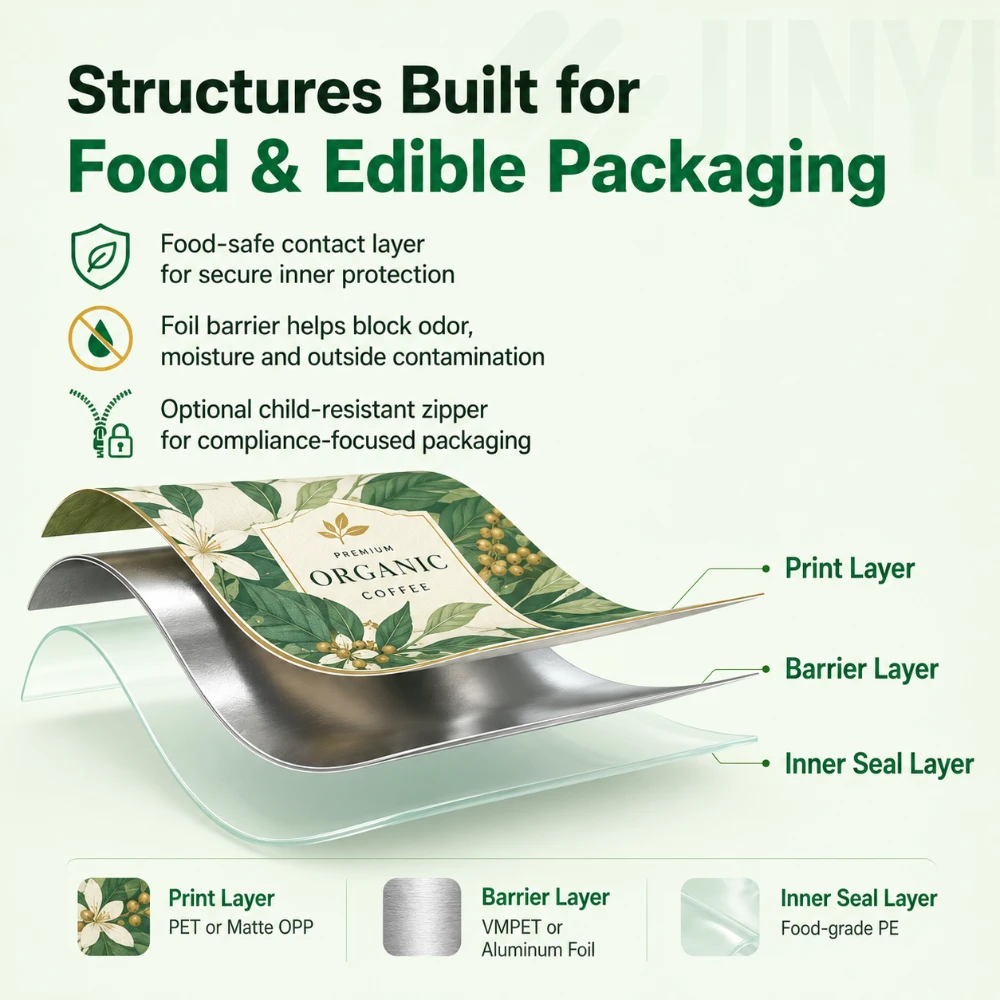
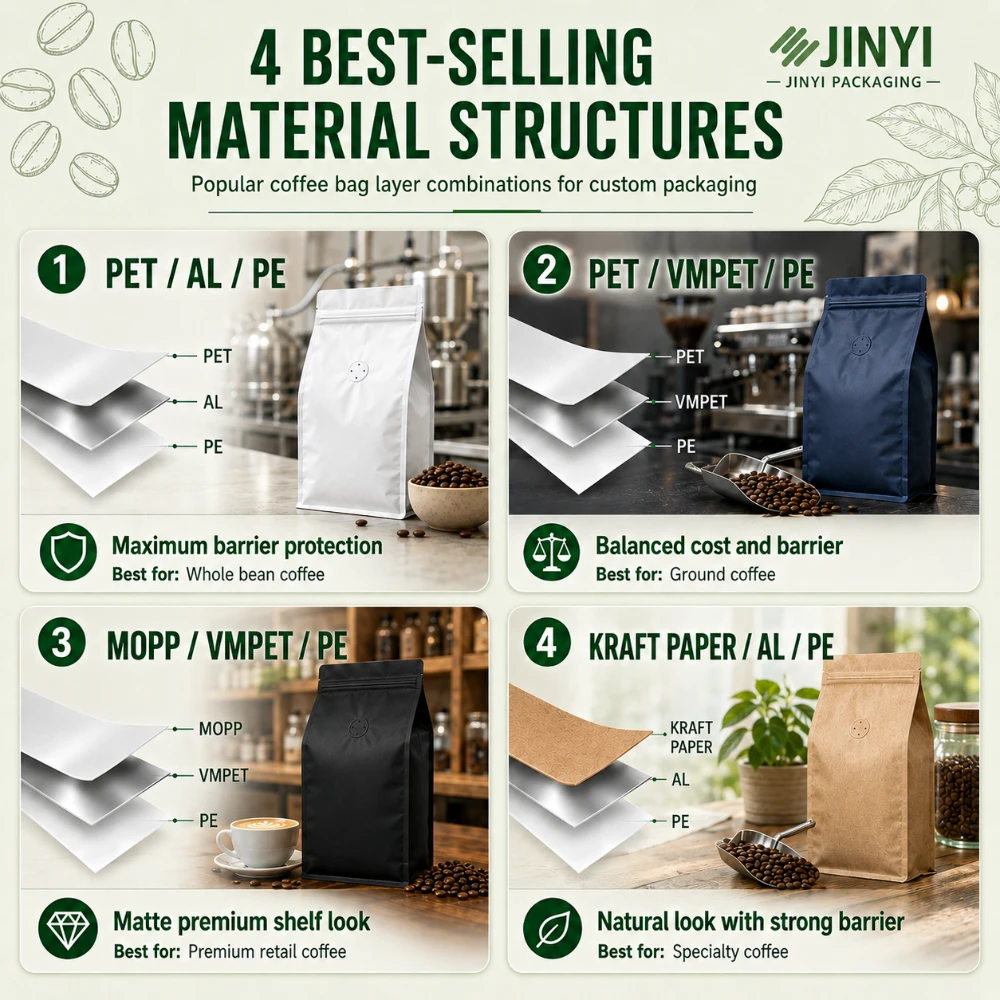
The material structure is what separates a bag that preserves your coffee through twelve months of distribution from one that lets it go stale in six weeks. Every flexible coffee bag is a multi-layer laminate — a combination of an outer print layer, a barrier layer, and a heat-seal inner layer. The barrier layer is the critical variable. It controls how much oxygen and moisture can pass through the film over time, which directly determines your coffee’s shelf life and flavour stability.
Material Structure
Barrier Level
Shelf Life Target
Brand Aesthetic
PET / AL / PE (Full Foil)
Highest — ~0.01 cc/m²/day OTR
12–24 months
Opaque metallic — strong print contrast, industry standard
Kraft / AL / PE
High — ~0.01 cc/m²/day OTR
12–18 months
Natural, earthy — dominant in specialty and artisan coffee
PET / VMPET / PE (Metalized)
Medium-High — 0.5–1.5 cc/m²/day OTR
6–12 months
Metallic sheen at lower cost — suits mid-range brands
Matte OPP / BOPP
Medium
3–6 months
Soft-touch clean look — limited for coffee without fast turnover
For most coffee brands, the choice comes down to two structures. PET/AL/PE full foil is the highest-performing option — the aluminium foil core delivers near-zero oxygen and moisture transmission, protecting freshness and flavour through the full shelf life window regardless of storage conditions or shipping environment. It is the right choice for freshly roasted whole beans and ground coffee targeting 12 months or more.
Kraft + foil laminate has become the signature material of the specialty coffee category. It provides equivalent barrier performance to full foil while the kraft paper outer layer communicates a natural, handcrafted, farm-to-cup aesthetic that resonates strongly with the specialty coffee buyer. If your brand positioning is in the artisan, single-origin, or ethical sourcing space, kraft + foil is almost certainly your material. It is worth noting that kraft paper does not support the full range of print finishes — gloss lamination is not available on kraft, but matte, natural, and uncoated surfaces work exceptionally well with the material’s character.
Note: Always confirm food-contact certification for the inner layer of your packaging before production. This is required for compliance in most major markets and is standard documentation at any reputable supplier. Ask for the certificate before you place your order — not after.
Surface Finishes and Printing Options
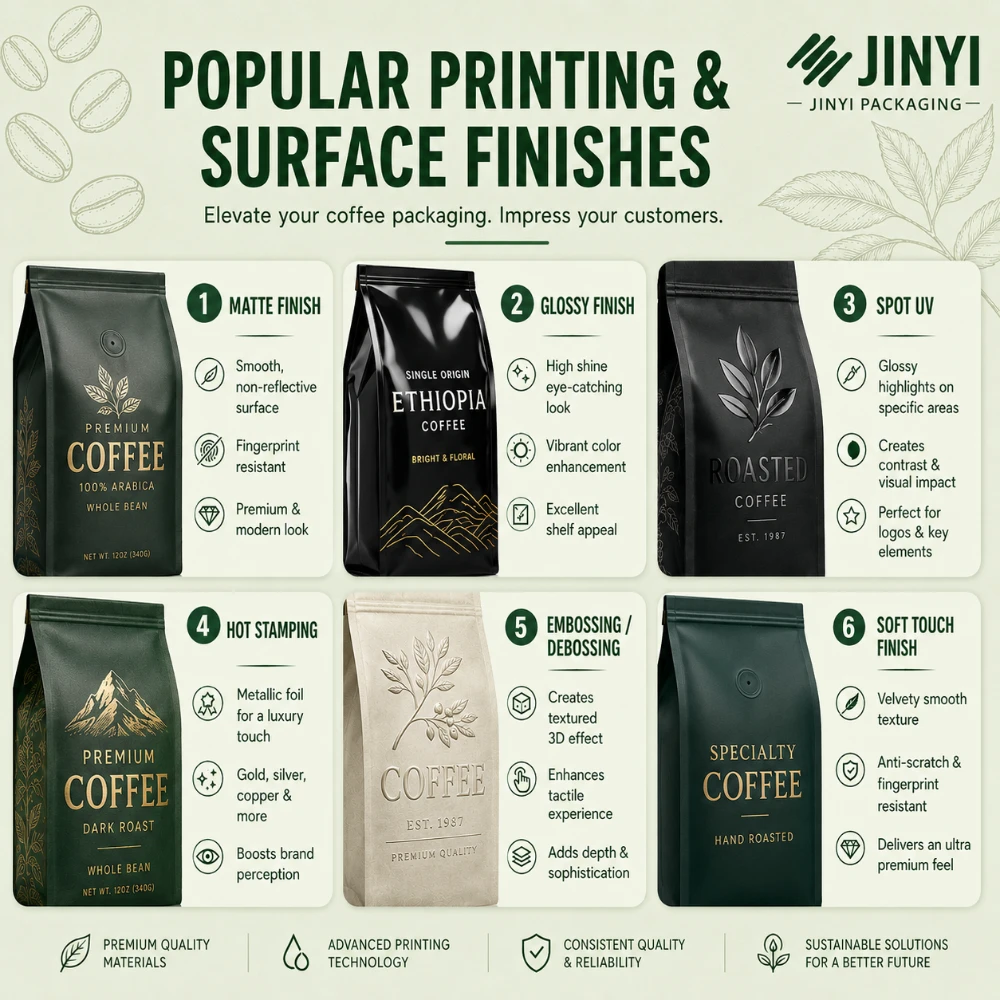
The surface finish is the first thing a buyer sees and the first thing they touch. In a category as visually competitive as specialty coffee, finish is a brand signal that communicates price point, quality, and character before the consumer reads a single word. Choosing the wrong finish — specifically, using gloss on a premium product — is one of the most common and most damaging mistakes a new coffee brand makes.
Finish / Process
What It Communicates
Best For
Matte lamination
Premium, considered, specialist — the dominant finish in specialty coffee
Specialty roasters, DTC, premium retail
Soft-touch matte
Luxury — velvet feel that elevates perceived value at the point of touch
Eye-catching, distinctive — strong for social media and limited edition drops
Brand drops, DTC social campaigns, collector editions
On printing method: digital printing and gravure printing produce different results at different volumes. Digital printing has no plate fees, works from 500 units per SKU, and is ideal for new brands, multiple SKUs, and short-run limited editions. The colour output is excellent for most design styles. Gravure printing requires a plate-making investment upfront but delivers superior colour consistency and a lower per-unit cost at scale — the right choice once your design is locked and your volume is confirmed.
Tip: If your brand uses Pantone colours as part of its identity, confirm with your supplier whether those colours are achievable via digital print or require gravure for accuracy. Some brand colours — particularly specific shades of orange, teal, and metallic — reproduce more faithfully under gravure at scale.
Functional Features: Valves, Zippers, Tear Notches, and Windows
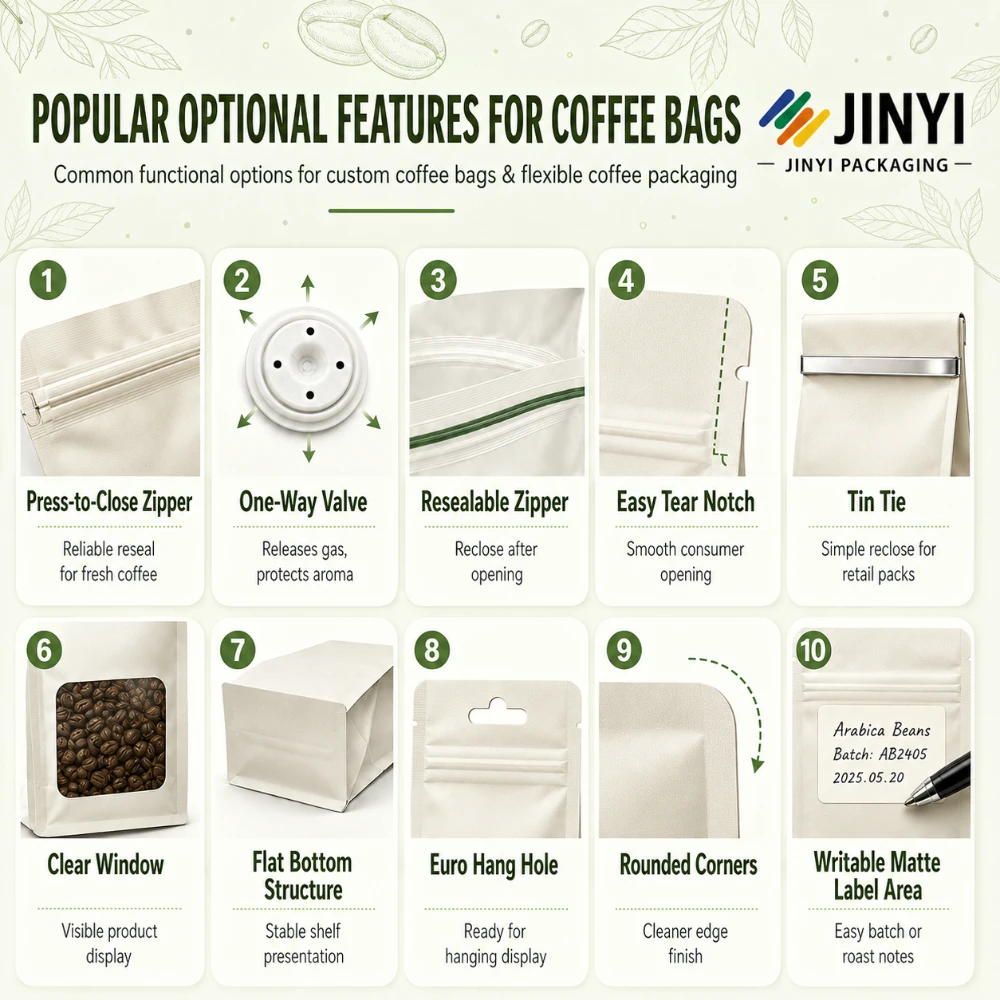
Beyond the material and the finish, a coffee bag’s performance depends on four functional components — and each one needs to be specified correctly for your product. Getting any one of them wrong creates a problem that shows up in the hands of the consumer, not in your factory QC check.
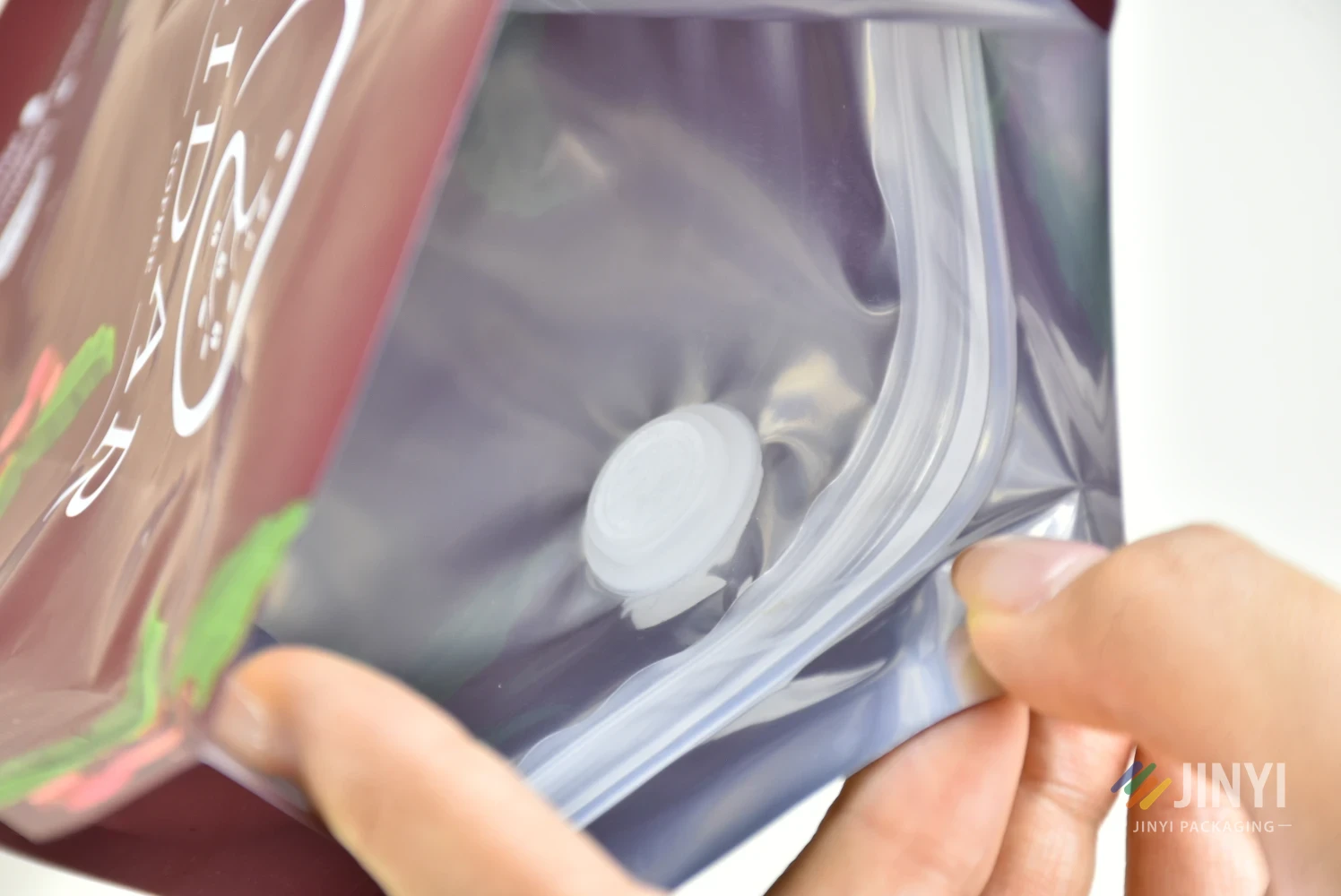
A one-way degassing valve fitted to a JINYI coffee pouch — standard spec for freshly roasted whole beans and medium-to-coarse ground coffee to prevent pressure buildup and seal failure during shipping.
One-Way Degassing Valve
Freshly roasted coffee releases CO₂ for days to weeks after roasting. Without a degassing valve, that gas pressure accumulates inside the sealed bag — distorting the bag shape, stressing the seals, and in some cases causing seal failure during shipping. The one-way valve allows CO₂ to escape while preventing oxygen from entering, protecting freshness and seal integrity simultaneously.
However, valves are not universal. For whole beans and medium-to-coarse ground coffee, a one-way valve is essential. For very fine espresso powder, the valve’s internal filter membrane — designed to block particles — may not be fine enough to prevent powder from migrating through the valve, creating leakage and consumer complaints. For very fine grinds, the two practical alternatives are: allowing the coffee to off-gas in an open environment for several days before sealing, or using nitrogen flushing at the point of filling to displace oxygen without relying on a valve. For instant coffee, no valve is needed — the product has already off-gassed completely during processing.
Coffee Type
Degassing Valve?
Reason
Freshly roasted whole beans
Essential
Continuous CO₂ release after roasting — without a valve, seals fail
Medium-to-coarse ground coffee
Recommended
Still off-gasses after grinding — valve filter membrane can handle the particle size
Very fine / espresso ground
Not recommended
Powder migrates through valve filter — use pre-degassing or nitrogen flush instead
Pre-degassed / rested beans
Optional
CO₂ mostly released before sealing — valve not critical but adds no harm
Instant coffee
Not needed
No CO₂ release — product has fully off-gassed during processing
Resealable Zipper
A resealable zipper is standard on most retail coffee bags for a straightforward reason: once opened, the consumer needs a way to reseal the bag between uses. Without a zipper, the only option is folding the top and using a clip — which most consumers don’t bother with, leading to stale coffee and negative product reviews that have nothing to do with your roast quality. Press-to-close zippers are the standard specification. For premium and boutique brands, a child-lock or double-track zipper adds a tactile quality signal that consumers notice.
Tear Notch
A tear notch — a small V or straight cut at the top edge of the bag — allows the consumer to open the bag cleanly without scissors. It is a small detail that has a disproportionate effect on the consumer’s first impression of the product. A bag that tears unevenly or requires scissors to open signals poor quality regardless of what is inside. Tear notches should be specified on both sides of the bag for left- and right-handed users.
Transparent Window
A transparent window allows the consumer to see the product inside the bag. For whole beans, this is a strong conversion tool — the visual of dark, aromatic beans triggers purchasing intent. However, a window reduces the barrier performance of the film at that point, because the transparent material has a higher OTR than the surrounding foil laminate. For most whole bean coffees with high turnover, this is an acceptable trade-off. For products where maximum barrier performance is required, specify a fully opaque bag with no window.
Note: The combination of valve position, zipper height, and tear notch placement all need to be confirmed on the dieline before artwork is applied. A zipper placed too close to the valve, or a tear notch that cuts through a critical print area, creates problems that are expensive to fix after production. Review the dieline carefully before approving artwork.
Custom Size Options for Coffee Bags
Bag size is determined by three dimensions — width, height, and gusset depth — and must be matched to your fill weight, not just your product weight. Different coffee origins, roast levels, and grind sizes have different densities, which means 250g of one coffee may require a meaningfully different bag volume than 250g of another. Always confirm your bag dimensions against your actual filled product before committing to production.
A selection of custom coffee bags produced at JINYI’s factory — stand-up pouches and flat bottom bags across multiple formats, finishes, and brand designs. Every bag in this range was produced factory-direct for real client orders.
Fill Weight (Whole Beans)
Typical Bag Size (W × H × G)
Common Format
100g
110 × 180 × 70 mm
Stand-up pouch
200g – 250g
130 × 210 × 80 mm
Stand-up pouch / flat bottom
340g (12oz)
150 × 230 × 90 mm
Stand-up pouch / flat bottom
500g
160 × 260 × 100 mm
Stand-up pouch / flat bottom
1kg
190 × 310 × 120 mm
Stand-up pouch / side gusset
These are reference dimensions — actual sizes should always be confirmed with your supplier based on your specific product density and fill method. Ground coffee is denser than whole beans and typically requires a smaller bag volume for the same weight. Nitrogen-flushed bags are filled under pressure and may require a slightly larger bag to accommodate the headspace. Confirm your fill weight and method before the dieline is finalised.
Tip: If you are launching in the North American market, confirm whether your fill weight is specified in grams or ounces — standard US coffee retail sizes are 8oz (227g), 10oz (284g), 12oz (340g), and 2lb (907g). Aligning your bag size to these convention weights makes your product easier to compare on shelf and in e-commerce listings.
How to Brief Your Supplier: What Information You Need to Prepare
A well-prepared brief gets you an accurate quote, a correct dieline, and a production run that matches what you expected. An incomplete brief leads to back-and-forth that adds days to your timeline, spec errors that only surface at sample stage, and costs that weren’t in the original quote. Before you contact a supplier, have answers to the following:
Information Required
Why It Matters
Bag format (stand-up / flat bottom / side gusset)
Determines structure, MOQ, lead time, and unit cost
Fill weight and product type (beans / ground / instant)
Determines bag dimensions and whether a degassing valve is needed
Target shelf life
Determines barrier spec (OTR and MVTR requirements)
Material preference (foil / kraft / VMPET)
Affects barrier performance, print options, and unit cost
Determines whether digital or gravure print is more cost-effective
Target market (EU / US / Asia / other)
Determines compliance and certification requirements
Required dispatch date
Determines whether sample round is feasible within your timeline
Tip: If you have your artwork ready when you make first contact, send it along with your brief — even if it’s a draft. A supplier who can see your design immediately has a much clearer picture of your finish requirements, colour complexity, and print method needs, which means a more accurate quote and fewer clarification rounds.
Compliance and Certification Requirements for Coffee Packaging
Compliance requirements are not optional extras you address after launch — they are part of your packaging specification from day one. Selling coffee into the EU, the US, the UK, Australia, or most regulated markets requires your packaging to meet specific food-contact safety standards, and a supplier who cannot provide the relevant documentation is not a viable partner for a brand with serious retail ambitions.
Certification / Requirement
What It Covers
Required For
Food-contact certification (inner layer)
Confirms the inner film layer is safe for direct food contact
All markets — EU, US, UK, Australia
Ink migration test report
Confirms print inks do not migrate into food product
EU (mandatory), US (best practice)
ECO PASSPORT / OEKO-TEX
Covers ink and adhesive safety for organic and clean-label products
Organic certified brands, EU premium retail
ISO 9001 (supplier)
Quality management system certification at the supplier level
Most retail buyers require supplier ISO certification
Recyclability declaration
Confirms whether the packaging structure is recyclable and under which scheme
EU Extended Producer Responsibility (EPR) compliance
Request all relevant documentation before production begins — not after. A reputable supplier will have these certificates readily available and will provide them without hesitation. If a supplier is evasive about compliance documentation, treat that as a serious signal before committing your order.
Note: EU Extended Producer Responsibility (EPR) regulations are tightening across most member states — brands selling packaged goods into the EU are increasingly required to register their packaging and contribute to national recycling schemes. Confirm with your supplier whether your chosen film structure qualifies as recyclable under your target market’s framework before you finalise your spec.
MOQ, Lead Times, and How to Order Factory-Direct
Most custom packaging suppliers quote 4–6 weeks for production alone. At JINYI, orders without a sample requirement are dispatched within 7–15 days from artwork approval — shipping time not included. That timeline applies across stand-up pouches, flat bottom bags, and side gusset bags, for both digital and gravure print runs, including multi-SKU orders where several variants are produced simultaneously.
Format
Print Method
Typical MOQ
Dispatch from Artwork Approval
Stand-up pouch
Digital print
500 pcs
7–15 days
Stand-up pouch
Gravure print
3,000 – 5,000 pcs
7–15 days
Flat bottom bag
Digital print
500 pcs
7–15 days
Flat bottom bag
Gravure print
3,000 – 5,000 pcs
7–15 days
Side gusset bag
Gravure print
3,000 – 5,000 pcs
7–15 days
Stage
Without Sample
With Sample
Quote and spec confirmation
1 – 3 days
1 – 3 days
Dieline and artwork approval
2 – 5 days
2 – 5 days
Sample production and review
Not required
7 – 10 days
Production and dispatch
7 – 15 days
7 – 15 days
Total to dispatch
10 – 23 days
17 – 33 days
Tip: The most common source of delay at any supplier is artwork revision loops — every round of changes adds 2–5 days. Have your design direction and colour palette finalised before you engage your supplier. If you are working with a designer, brief them using the dieline template from your supplier rather than designing to a generic template and retrofitting later.
JINYI Client Case Study: On’Ze Coffee — Specialty Roaster, Fort Worth, Texas
On’Ze Coffee is a specialty roaster based in Fort Worth, Texas, built on 25 years of passion for coffee and the conviction that every cup is a moment of connection. They roast fresh every week in small batches, source directly from farms in Colombia, Costa Rica, and Chiapas México, and have built their brand around a single, clear idea: coffee is more than a drink — it is a bridge between people.
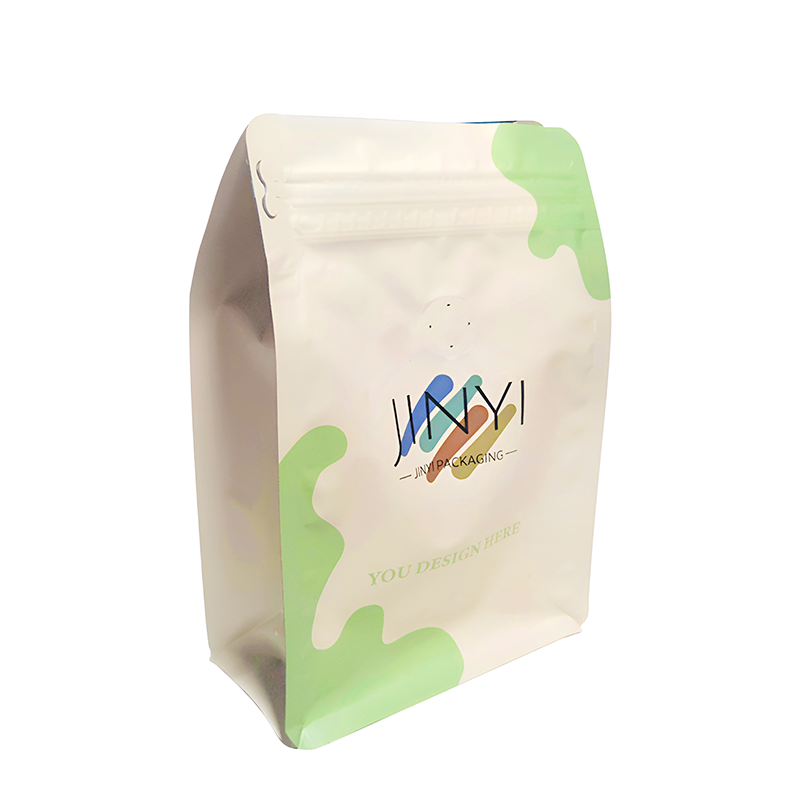
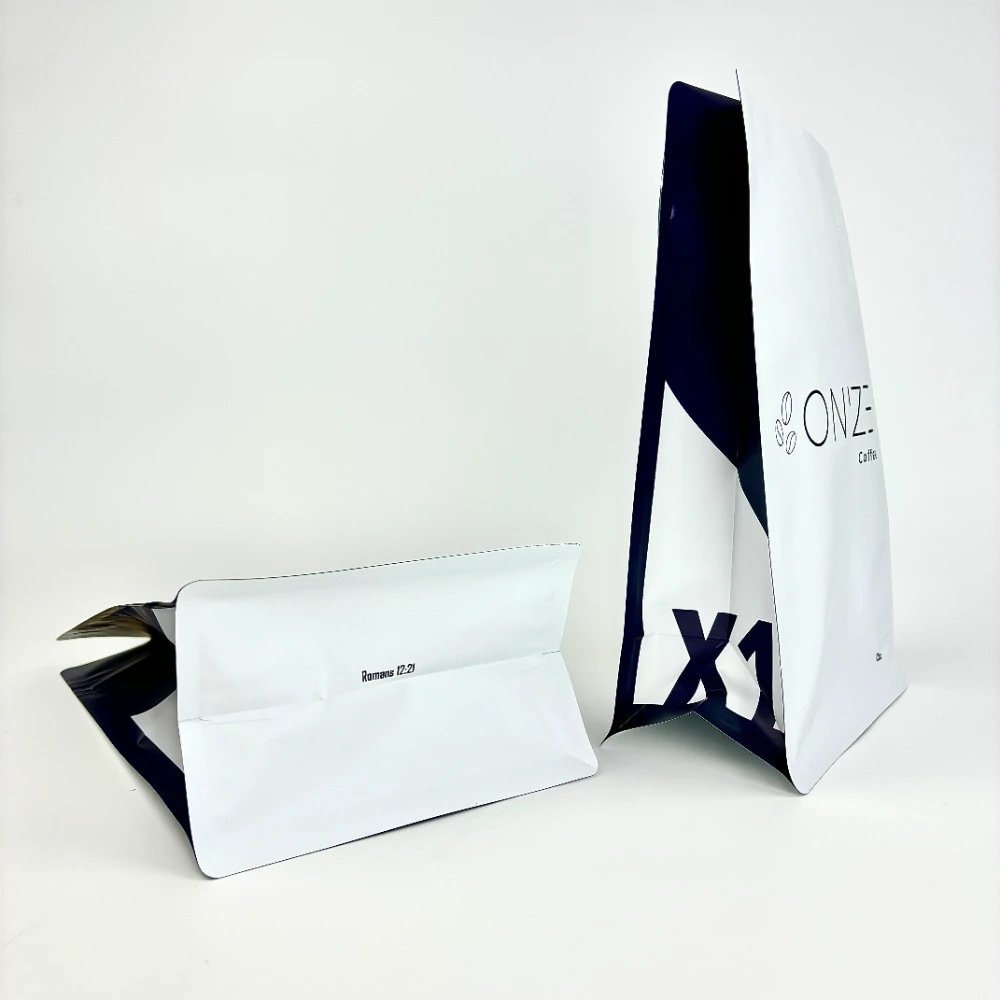
Side view of JINYI custom flat-bottom coffee bags — quad-seal structure with stable base, suitable for premium specialty coffee retail display
A brand with that level of intentionality behind the product cannot afford packaging that undermines it. On’Ze came to JINYI for custom flat bottom bags — the format that matches their positioning. The flat base, the four branding surfaces, the architectural standing profile: everything about the flat bottom bag communicates that the product inside it was made with care. The specification they selected — matte white finish, one-way degassing valve, resealable zipper — reflects exactly what a freshly roasted, small-batch specialty coffee requires: protection from the roasting floor to the consumer’s first cup, and a bag that communicates quality before it is opened.
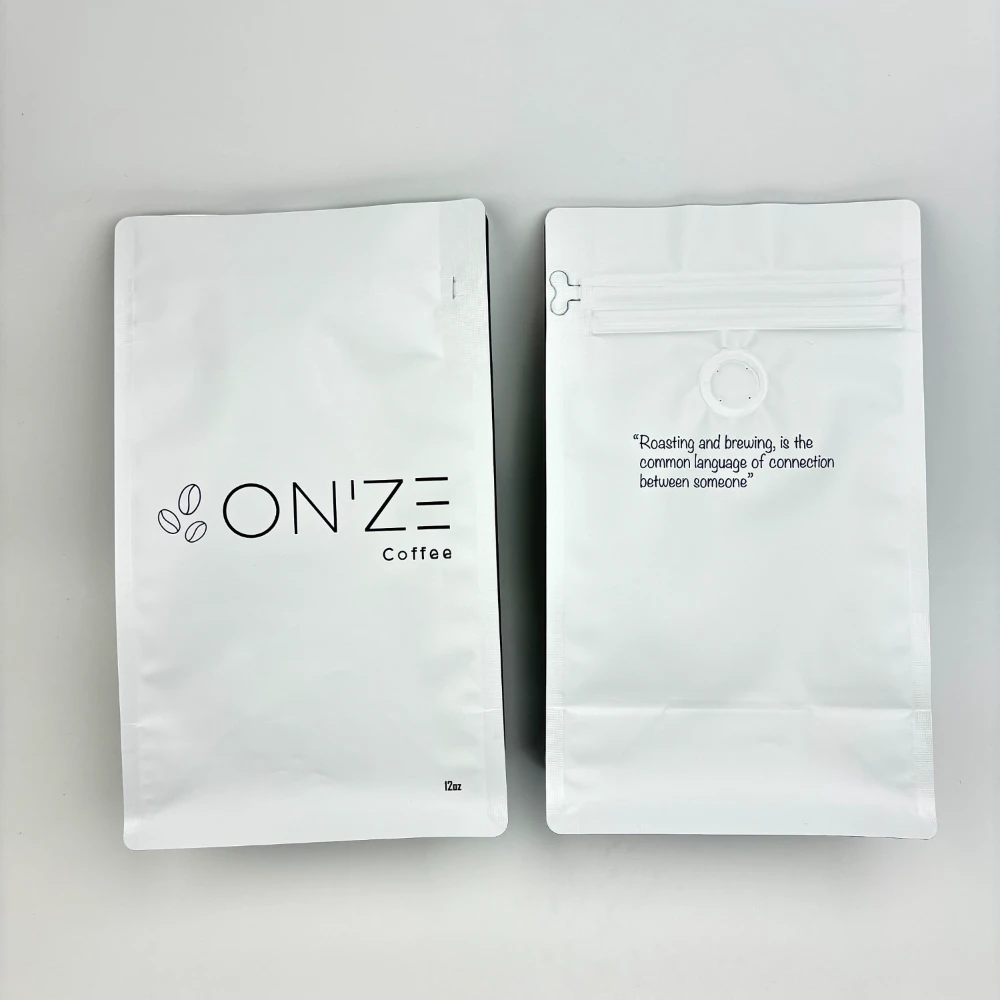
Custom flat-bottom coffee bags produced at JINYI for ONZE Coffee — white minimal branding on PET/AL/PE high-barrier structure, factory-direct from 500 units
On’Ze Coffee’s custom flat bottom bags — produced at JINYI’s factory with matte white finish, one-way degassing valve, and resealable zipper.
On’Ze Coffee is based in Texas. Their packaging is produced at JINYI’s factory in China and shipped directly to their roasting operation. The quote on the back of the bag — “Roasting and brewing, is the common language of connection between someone” — says everything about the brand. The bag it’s printed on says everything about the production standard they require. JINYI delivered both.
What You Get When You Order with JINYI
Every JINYI order comes with more than the bags. From the moment you place your order to the moment your packaging is ready to ship, we provide three value-added services at no additional cost — because a bag that looks right in production needs to look right everywhere else too.
Service
What You Receive
How It Helps Your Brand
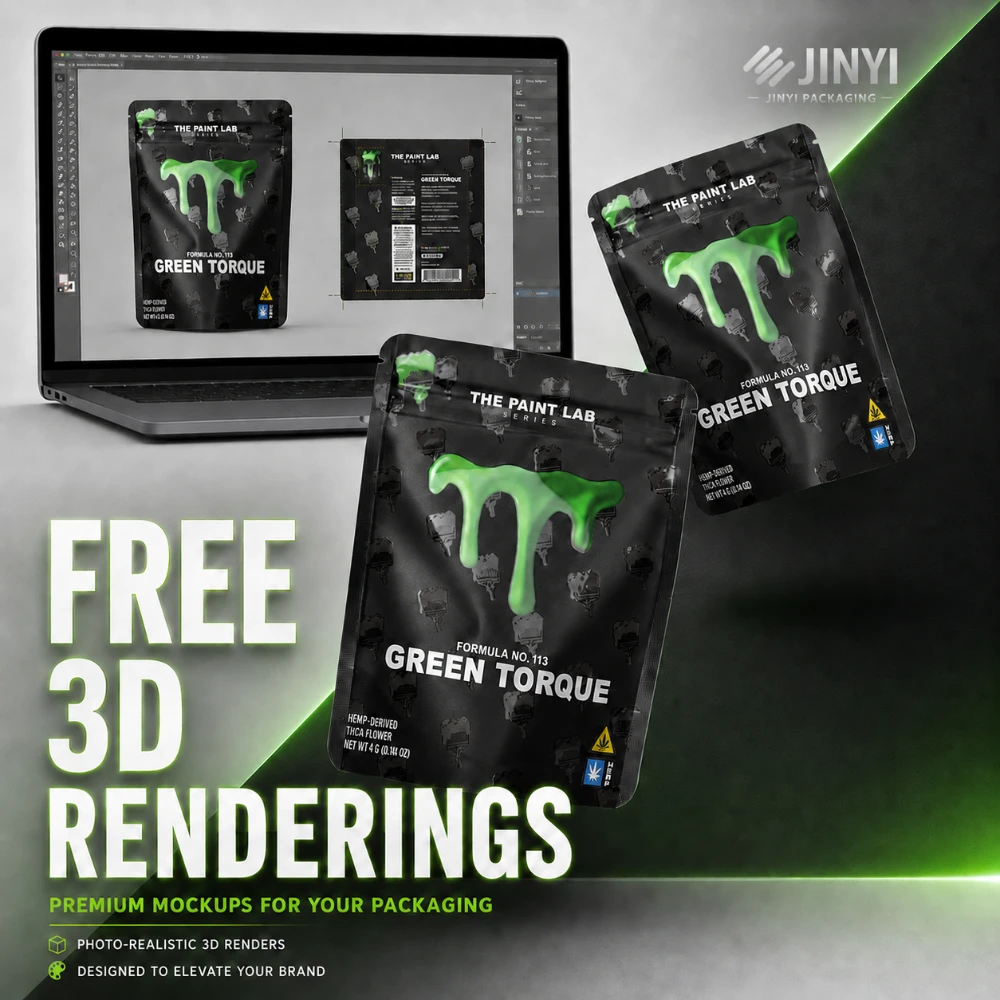
Free 3D Rendering
Photorealistic 3D mockup of your bag with your artwork applied
Visualise exactly how your packaging will look before production begins — share with investors, retail buyers, or your team for sign-off
Production Process Video
Video footage of your order being produced at our factory
Full transparency on how your bags are made — use it for brand storytelling, supplier verification, or customer trust-building on your website and social media
Professional Product Photography
High-quality product photos of your finished bags, ready to use
Immediately deployable on your e-commerce product pages, social media, and marketing materials — no photoshoot required on your end
These three services reflect a straightforward belief: a brand that invests in great packaging deserves to be able to use it effectively from day one. The 3D rendering lets you sell the vision before the bags arrive. The production video builds the trust that converts a first-time buyer into a returning account. The product photography removes one of the biggest practical barriers new brands face when launching — the cost and logistics of getting professional photos done quickly.
Note: The 3D rendering is available before you place your order — so you can confirm exactly how your artwork looks on your chosen bag format and finish before committing to production. Contact us with your artwork and spec to receive your rendering.
Custom coffee bag packaging is one of the most layered decisions a coffee brand makes — and one of the most consequential. The format, the material, the finish, the functional features, and the size all interact to determine how your coffee performs, how your brand reads, and how your packaging holds up across the entire distribution chain. Getting every layer right requires a supplier who understands the spec, documents everything, and delivers consistently.
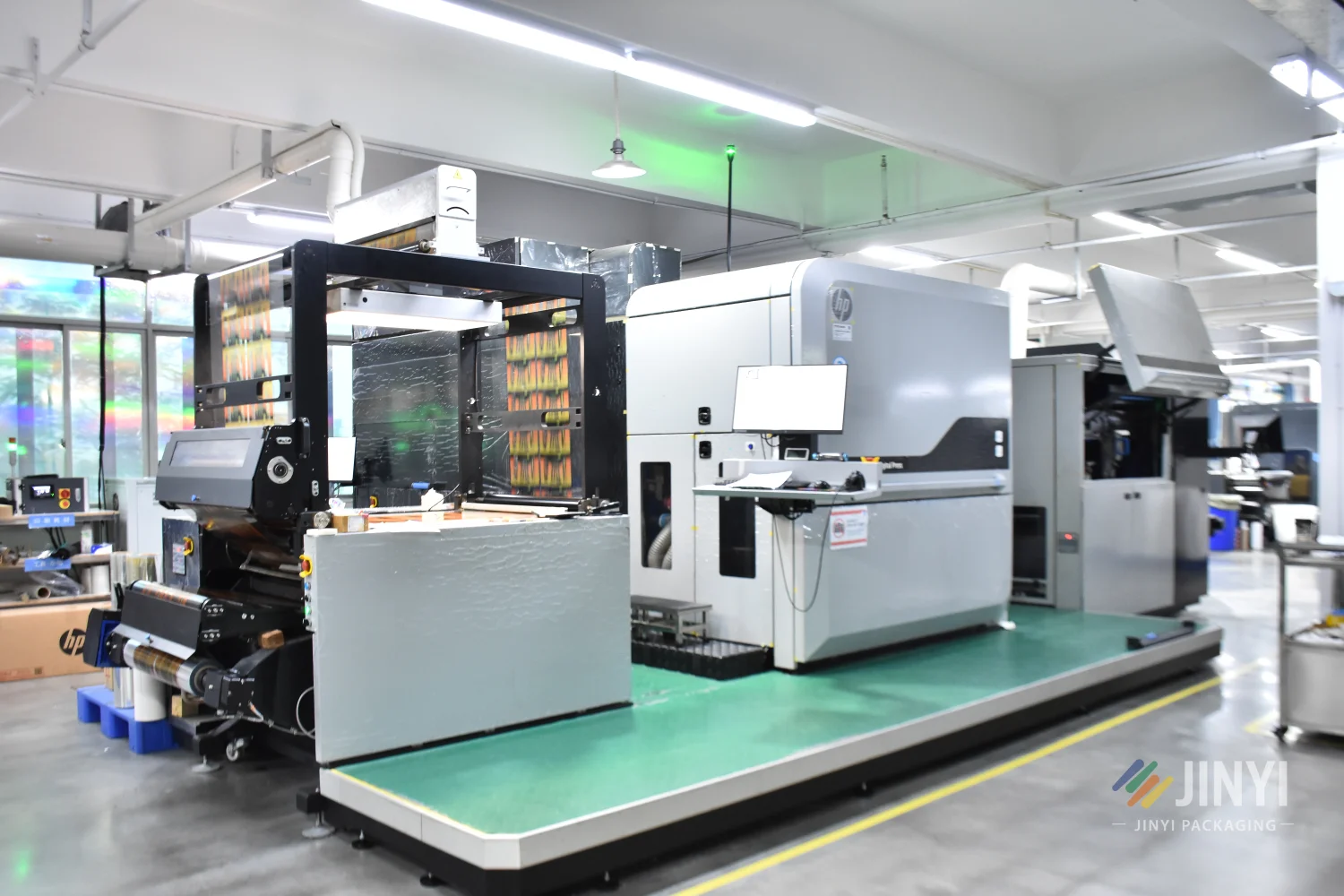
At JINYI, that is exactly what we are built for. Fifteen years of flexible packaging production, HP digital and gravure print under one roof, 7–15 day dispatch from artwork approval, full material certification as standard, and three complimentary services — 3D rendering, production video, and professional photography — with every order. From film to finished. Done right. Explore our full coffee packaging solutions to see what is possible for your brand.
Get Your Custom Coffee Bag Quote — Factory-Direct
Tell us your format, fill weight, material, finish, functional features, and volume. We will come back with a full spec recommendation, 3D rendering, material documentation, and a factory-direct quote — within 24 hours.
JINYI is a source factory for custom flexible packaging with 15+ years of production experience, serving coffee, food, supplement, pet food, and consumer goods brands across 150+ countries. Our facility runs HP digital print systems alongside multiple gravure printing lines — giving brands a clear path from small launch orders to full-scale production without changing suppliers.
Every client receives full material specification documentation, free 3D rendering, production process video, and professional product photography as standard. That is what From Film to Finished — Done Right means in practice.
Elsa
Business Development Manager · JINYI Packaging
Elsa leads business development and customer order management at JINYI. With 8 years in foreign trade across Yiwu and Dongguan, she has a sharp understanding of market demand and what buyers actually need — turning real customer insight into the right packaging decisions.
Customer needs Order management Business development
What is the best coffee bag format for a new specialty roaster?
For most new specialty roasters, the stand-up pouch is the right starting format — it carries the lowest MOQ (from 500 units via digital print), the widest range of material and finish options, and works well across DTC, e-commerce, and retail channels. Once volume is confirmed and you are ready to invest in premium shelf presence, transitioning to a flat bottom bag is a natural upgrade that does not require changing your material spec.
Does every coffee bag need a one-way degassing valve?
No. Valves are essential for freshly roasted whole beans and medium-to-coarse ground coffee, where CO₂ continues to release after roasting. They are not recommended for very fine espresso powder (where powder can migrate through the valve filter), and are not needed for instant coffee (which has fully off-gassed during processing). For fine grinds, the alternatives are pre-degassing before sealing or nitrogen flushing at the point of fill.
What material should I use for a 12-month shelf life coffee bag?
PET/AL/PE full foil laminate is the recommended spec for coffee targeting 12 months or more. The aluminium foil core delivers near-zero oxygen and moisture transmission. For specialty and artisan brands where natural aesthetics matter, kraft + foil laminate provides equivalent barrier performance with a kraft paper outer layer that communicates handcrafted, farm-to-cup positioning.
How long does custom coffee bag production take at JINYI?
Orders without a sample requirement are dispatched within 7–15 days from artwork approval — significantly faster than the industry average of 4–6 weeks. Including a sample round adds 7–10 days. Total time from first contact to dispatch is typically 10–33 days depending on whether samples are requested. Shipping time to your location is additional.
What is the minimum order quantity for custom coffee bags?
Via JINYI’s HP digital print, stand-up pouches start from 500 units per SKU with no plate fee. Flat bottom bags typically start from 1,000 units. Side gusset bags and gravure print runs generally require 3,000 units or more. Contact us with your full spec for a confirmed minimum order quantity and quote.
What free services does JINYI include with every coffee bag order?
Every JINYI order includes three complimentary services: a photorealistic 3D rendering of your bag with your artwork applied (available before production), a production process video showing your order being made at our factory, and professional product photography of your finished bags ready for immediate use on your website and social media.
Should I use matte or gloss finish on my coffee bag?
Matte finish is the standard for specialty and premium coffee — it communicates quality, photographs cleanly, and positions your product correctly at a premium price point. Gloss finish is standard for mass-market and supermarket coffee, where bold colour and high visibility on a crowded shelf are the priority. Using gloss on a premium product will undermine your price point regardless of what the label says. When in doubt, look at what the brands at your target price tier are using and match that standard.