JINYI shares practical packaging guidance for your decisions.
Liquid IV is not a conventional supplement brand. It is an electrolyte drink mix company that built its consumer base through social media before the term “TikTok brand” existed, scaled through Costco before most DTC brands understood wholesale, and was acquired by Unilever in 2020 while continuing to operate with its own identity and growth trajectory. The packaging strategy behind this growth is worth examining closely — because Liquid IV does something structurally unusual that most supplement brands do not: they ship 30 individual electrolyte stick packs inside a single resealable outer pouch, creating a dual-format packaging system where the outer bag is the retail unit and the inner stick packs are the consumption unit. This breakdown covers what Liquid IV packaging is actually made of, why the dual-format architecture works, how the film structure protects the vitamins and electrolytes inside, and what the brand’s design and sustainability decisions tell supplement brands about packaging at scale.
How Liquid IV Turned Electrolyte Science Into a Multi-Channel Phenomenon
Liquid IV launched in 2012 with a single product and a single claim: their Hydration Multiplier electrolyte drink mix hydrates faster than water alone. The science behind that claim — Cellular Transport Technology (CTT), an optimised ratio of sodium, glucose, and potassium that leverages the body’s natural co-transport mechanisms to accelerate water absorption — was not new. Oral rehydration therapy using similar electrolyte ratios has been used in medical and humanitarian contexts for decades. What Liquid IV did was translate that science into a consumer product, package it in a convenient single-serve format, and build a brand identity around the accessibility and portability of the format rather than its clinical origins.
The growth trajectory followed two parallel paths that most consumer brands choose between rather than pursue simultaneously. The DTC channel — direct website sales and subscription — built the brand’s core community, generated the social proof and user-generated content that drove organic discovery, and allowed Liquid IV to maintain direct consumer relationships and data ownership. The wholesale channel — Costco, Target, Walmart, CVS — provided the scale and distribution reach that DTC alone could not achieve. The electrolyte drink mix packaging decision sits at the intersection of both: the same product, the same stick pack format, in packaging configurations optimised for each channel’s shelf dynamics and consumer purchase behaviour.
The Unilever acquisition in 2020 gave Liquid IV access to global distribution infrastructure and supply chain scale while the brand maintained its operational identity. By that point, the packaging architecture — individual electrolyte drink mix stick packs inside a resealable outer pouch — was already the format that consumers associated with the brand. Changing it after acquisition would have been a brand equity risk. Maintaining it while scaling to new markets was the logical decision, and Liquid IV’s packaging has remained structurally consistent since.
Note: Liquid IV’s CTT technology claim depends entirely on the electrolyte and vitamin content of each serving being intact at the point of consumption. A stick pack that has been compromised by moisture ingress — producing clumping, vitamin degradation, or electrolyte chemical changes — cannot deliver the CTT mechanism as formulated. The packaging specification is not separate from the product claim. It is what makes the product claim credible through the full supply chain and shelf life cycle.
The Dual-Format System — Electrolyte Stick Pack Inside a Resealable Pouch
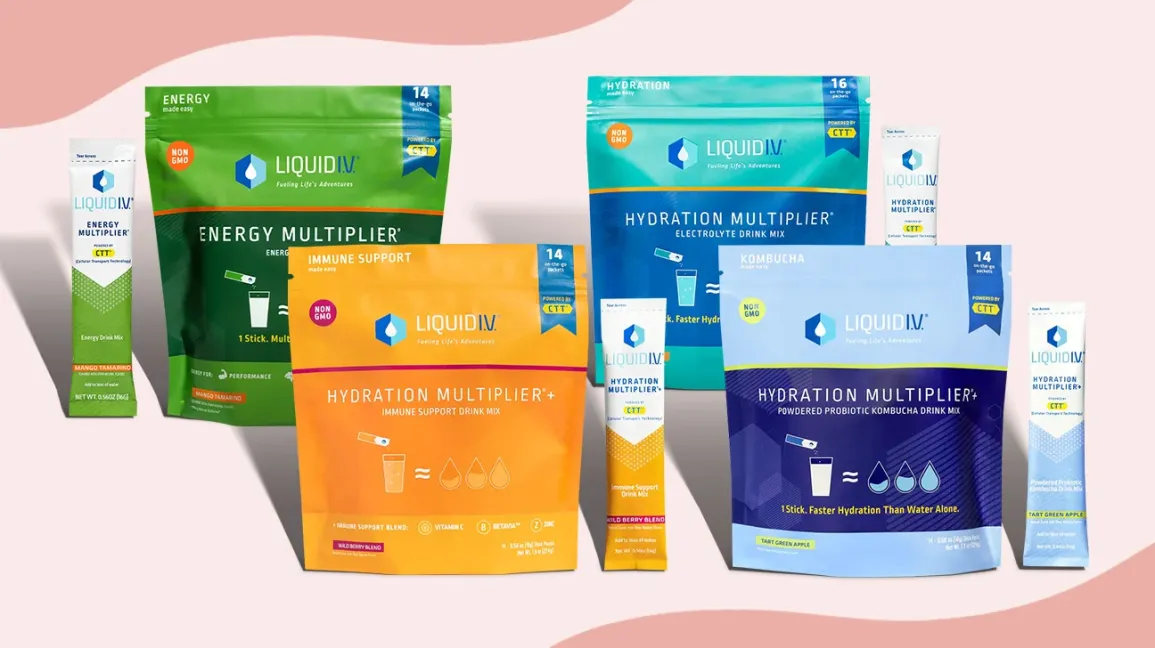
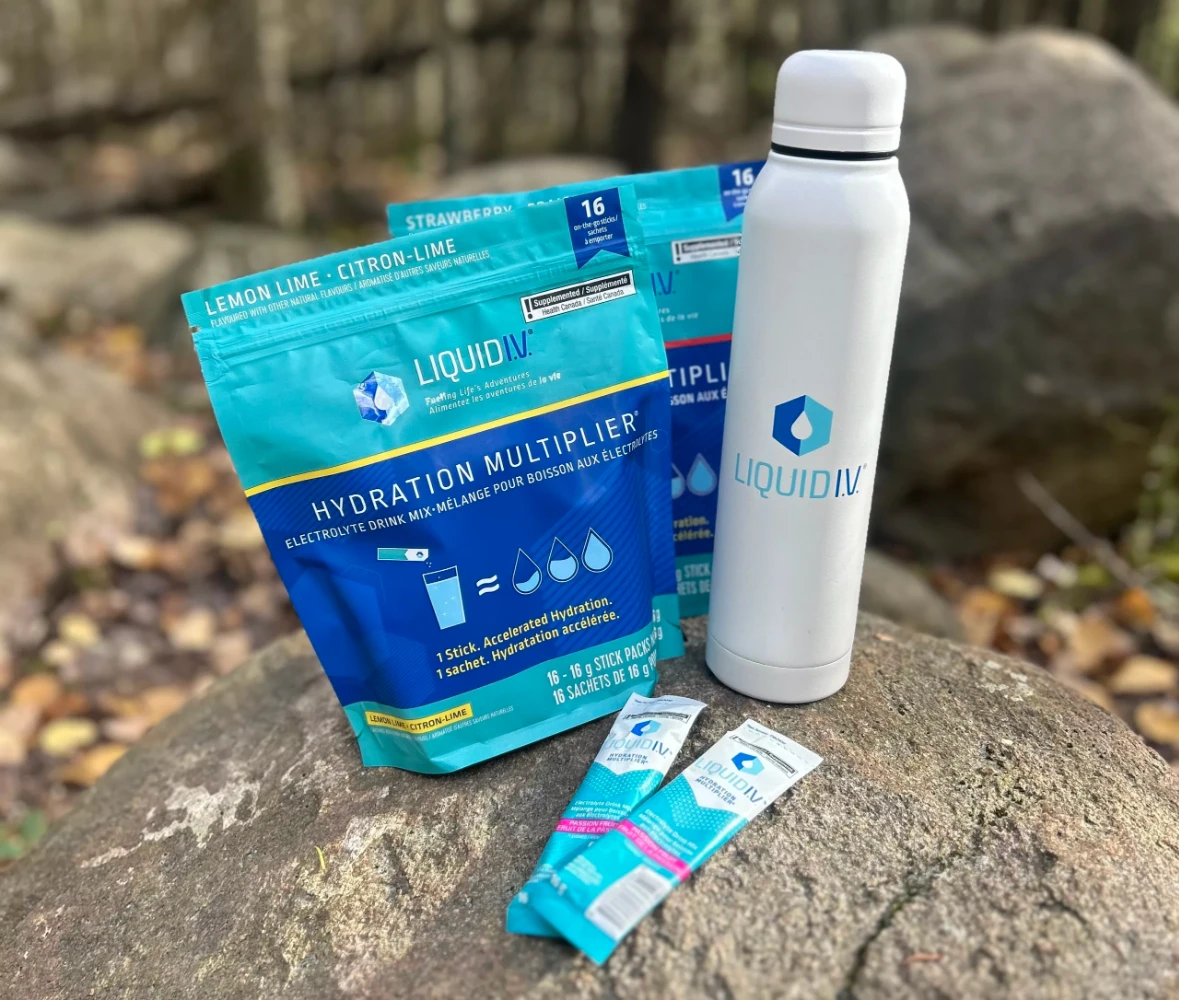
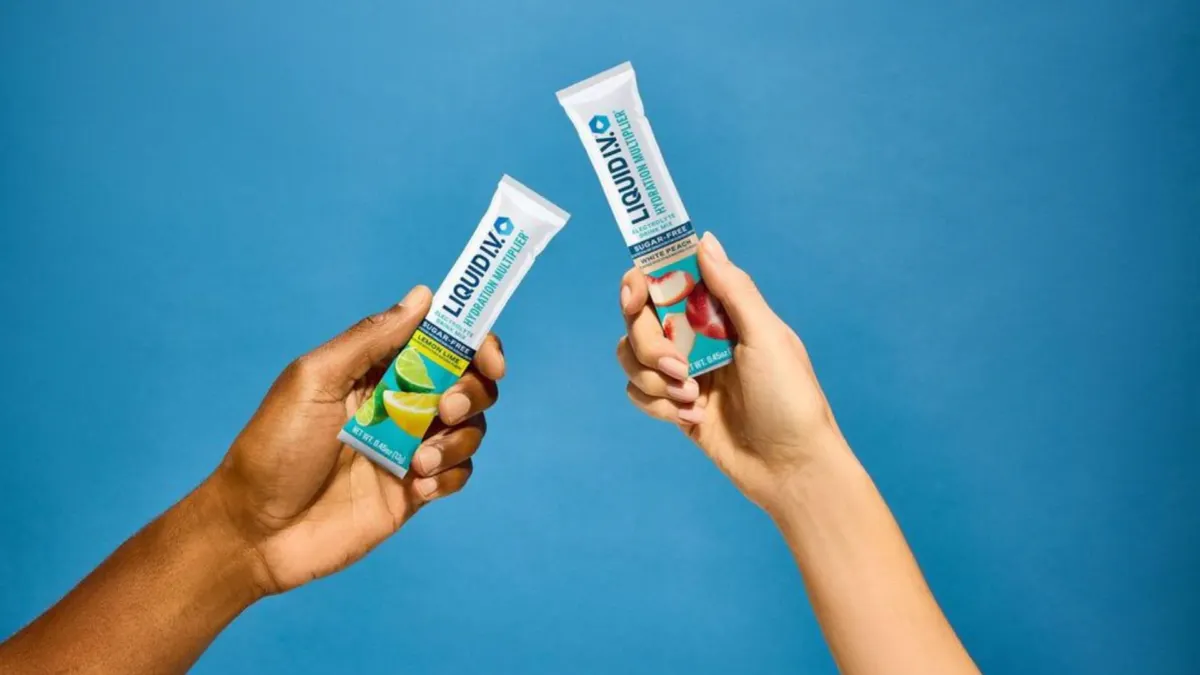
Liquid IV’s primary retail format is structurally distinctive: 16 or 30 individual single-serve electrolyte stick packs, each sealed in their own pillow bag (back-seal pouch), housed inside a resealable outer stand-up pouch. The two packaging layers serve completely different functions — and understanding why both are necessary explains the dual-format architecture that Liquid IV has maintained across their entire product range.
The individual electrolyte stick pack — the pillow bag format — is the consumption unit. Each stick pack contains a single serving of Hydration Multiplier powder, sealed in a high-barrier foil laminate that protects the electrolytes and vitamins from moisture and light. The stick pack is designed for portability: it fits in a pocket, a gym bag, a travel kit. The tear notch at one end allows clean, one-handed opening without scissors. The pillow bag format produces each stick at very high speed on vertical form-fill-seal (VFFS) automated lines — enabling the production volumes that Liquid IV’s Costco and mass retail distribution requires at a per-stick cost that makes the retail price point viable.
The outer resealable pouch is the retail unit. It provides the shelf presence — the wide printable front panel carrying Liquid IV’s brand identity, the flavour name, and the key product claims — that drives purchase decisions in physical retail environments. It also provides a resealable electrolyte pouch that keeps the remaining stick packs organised and protected between uses, reducing the consumer experience friction of managing loose individual packets. At Costco, where the standard format is a 30-stick resealable pouch, the outer bag’s structural integrity — its ability to stand on a shelf, survive the handling of a warehouse environment, and maintain its shape through the full consumption cycle — is as important as its printable surface.
Format Layer
Format Type
Primary Function
Design Priority
Inner — consumption unit
Pillow bag (back-seal stick pack)
Product protection · portability · single serve
Barrier performance · tear notch · production speed
Outer — retail unit
Resealable stand-up pouch
Shelf presence · brand communication · organisation
Tip: The dual-format architecture — individual pillow bag stick packs inside a resealable outer stand-up pouch — is applicable to any powder supplement brand where single-serve portability and multi-serve retail presence are both important. The inner pillow bag handles the consumer’s on-the-go use case. The outer pouch handles the retail shelf and home storage use case. Both can be produced factory-direct from 500 units at JINYI, with matched design systems that maintain brand visual consistency across both packaging layers.
Film Structure — What Protects the Electrolytes and Vitamins Inside
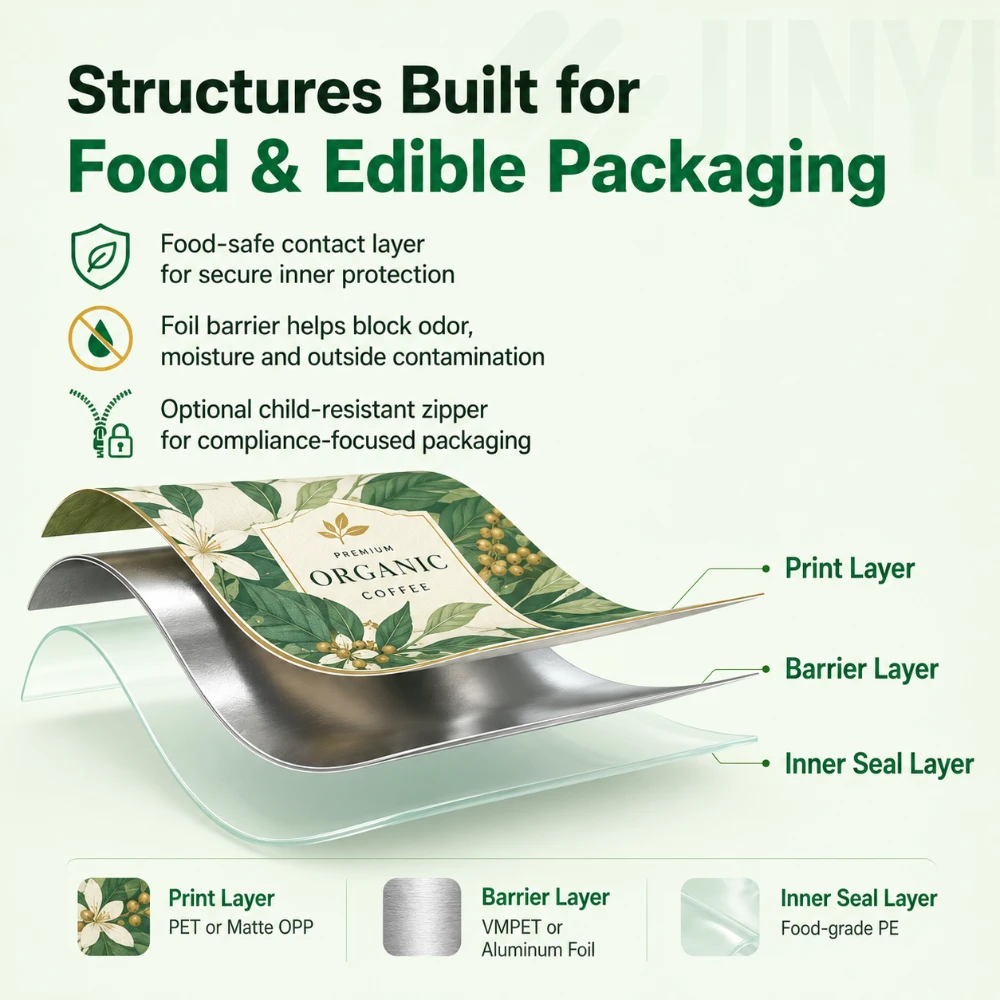
Liquid IV’s individual electrolyte stick packs use a high-barrier foil laminate — the same PET/AL/PE three-layer structure that protects premium coffee, matcha powder, and sensitive supplement formulas across the category. Understanding why this Liquid IV packaging material specification is necessary requires understanding what the product actually contains and what happens to those ingredients on environmental exposure.
Liquid IV’s Hydration Multiplier contains five essential vitamins — B3, B5, B6, B12, and Vitamin C — alongside the core electrolyte blend of sodium, potassium, and glucose. Vitamin C (ascorbic acid) is one of the most oxygen-sensitive vitamins in the supplement category: it oxidises rapidly on exposure to oxygen, converting to dehydroascorbic acid and losing its biological activity. B vitamins, particularly B12, are sensitive to both light and moisture. The electrolytes themselves — potassium citrate, sodium citrate — are hygroscopic: they absorb moisture from their environment, which causes clumping and can alter the chemical form of the electrolyte compound over time. A stick pack that allows oxygen or moisture ingress does not just shorten shelf life. It degrades the specific nutrients that Liquid IV’s CTT mechanism depends on — producing a product that tastes the same but delivers less of what the label claims.
The PET/AL/PE film structure addresses all three exposure pathways simultaneously. The aluminium foil middle layer delivers near-zero oxygen transmission (OTR approximately 0.01 cc/m²/day) and complete UV blocking. The outer PET layer provides structural rigidity, the print substrate for Liquid IV’s colour-coded flavour design, and scratch resistance through the supply chain. The inner PE layer provides the heat-seal surface that creates the back centre seam and the two end seals of the pillow bag format, as well as food-contact safety at the product interface. For a complete understanding of how pillow bag and stand-up pouch structures are manufactured — from raw film through lamination, forming, and sealing — our guide to how custom stand-up pouches are made covers the full production sequence in detail.
Back seal + end seals · food contact · product containment
Note: For any electrolyte or hydration supplement brand making vitamin content claims on their packaging, the film specification is a compliance requirement, not just a quality preference. If your stick pack allows Vitamin C degradation over its stated shelf life, the vitamin content at point of consumption may not match the label claim. This is a regulatory risk in most markets. Specify your pillow bag film structure against the most sensitive ingredient in your formula — not the average sensitivity of all ingredients.
Design Language — Bold Colour, Maximum Shelf Velocity
Liquid IV’s packaging design system is built around one primary requirement: immediate flavour identification at the point of purchase, both in physical retail and on a phone screen. Their solution is a high-saturation colour-per-flavour system — each flavour has a dominant colour that covers the majority of the stick pack and the outer pouch front panel. Lemon Lime is yellow-green. Passion Fruit is deep purple. Tropical Punch is coral orange. Strawberry is bright red. From ten feet away in a Costco aisle, or at thumbnail size on an Amazon product listing, the consumer does not need to read the flavour name to know which variant they are looking at. The colour does that identification work instantly.
This approach places specific demands on colour management in production. Each flavour’s dominant colour must be reproduced consistently across every production run — because the consumer’s purchase decision at repeat order is made partly on colour recognition. A lemon lime pouch that runs slightly too green, or a passion fruit pouch that runs slightly too blue, breaks the visual consistency that the identification system depends on. For brands producing multiple flavour variants with a colour-per-flavour system, establishing Pantone references for each flavour colour and locking those references across all production batches is not optional — it is what makes the system work over time.
The design density on Liquid IV’s outer pouch is moderate — the brand name, the product line name, key claims (3x electrolytes, 8 vitamins), and the flavour name are all present on the front panel, but the dominant colour field means the design reads clearly even with that information load. Compare this to Bloom Nutrition’s minimal front panel — which uses almost no claims text on the front — or Huel’s typography-only approach. Liquid IV sits between these extremes: enough claims text to communicate the product’s value proposition at first glance, but not so much that the colour identification system is overwhelmed.
Brand
Colour System
Design Density
Primary Channel Signal
Liquid IV
One colour per flavour — high saturation
Moderate — claims + colour dominant
Mass retail + Costco shelf velocity
Bloom Nutrition
Pink family — shade varies by product
Minimal — brand + product name only
DTC + TikTok content value
Huel
Black / White by product tier
Typographic only — no imagery
DTC efficiency — no persuasion needed
Tip: A colour-per-flavour design system is one of the most effective tools for managing a multi-SKU supplement or beverage powder range — but it requires committing to Pantone references for each flavour colour before the first production run and maintaining those references across every subsequent batch. Build the colour standard documentation into your first production order, not as an afterthought when you add a second flavour and discover the colours do not match on shelf.
Sustainability — Liquid IV’s Zero Waste Packaging Commitment
Liquid IV’s official sustainability position states a commitment to zero-waste packaging — a target that acknowledges their current packaging is not yet there. The PET/AL/PE laminate used in their stick packs, like most multi-layer flexible packaging, is not currently recyclable through standard household recycling streams. The multiple polymer and metal layers cannot be separated economically at scale in existing recycling infrastructure.
The challenge Liquid IV faces on the path to zero-waste packaging is the same challenge Huel faced before their monomaterial transition: finding a recyclable structure that maintains sufficient barrier performance to protect the vitamin and electrolyte content through the full shelf life and distribution cycle. For a single-serve stick pack format, the barrier requirement is particularly stringent — the stick pack may be exposed to temperature variation, humidity, and mechanical stress in a gym bag or travel kit before it is opened, and the product must perform as formulated when it is. A monomaterial recyclable structure that cannot maintain near-zero moisture transmission in those conditions produces a product that clumps, degrades, or fails to deliver its label claim before the consumer uses it.
The multi-layer PET/AL/PE structure that Liquid IV currently uses is not a barrier to their sustainability goals — it is the baseline that their recyclable replacement must match. Just as Huel invested years in technical development to produce a monomaterial structure that met their distribution requirements before making the switch, Liquid IV’s path to zero-waste packaging will require the same engineering discipline: validating that the barrier performance, structural strength, and consumer experience of the recyclable format genuinely match the current specification before committing to a transition. Both structures have their place — the question is always whether the recyclable alternative has reached the performance bar required for the specific product and distribution model.
Note: For supplement and hydration brands building a sustainability roadmap for their packaging, the most credible approach is the one Huel demonstrated: define the performance requirements your packaging must meet, find the recyclable structure that meets those requirements, validate it rigorously before transitioning, and communicate the timeline honestly. A sustainability commitment that does not specify the performance threshold the recyclable alternative must reach is a marketing statement, not an engineering plan.
How to Source the Same Packaging Structure Factory-Direct
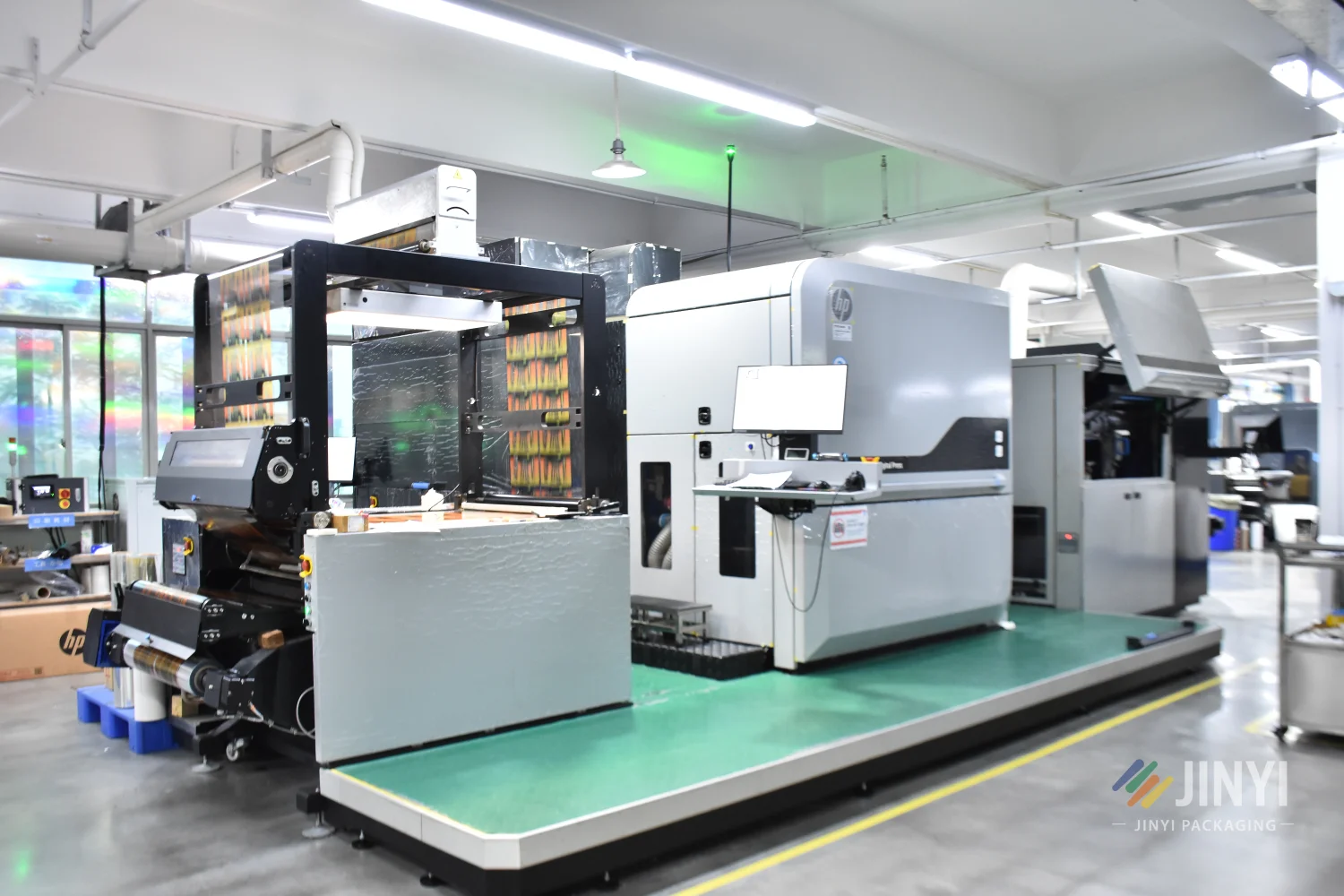
The pillow bag electrolyte packaging and resealable stand-up pouch system that Liquid IV uses are both standard flexible packaging production specifications. Neither format is proprietary, and you do not need Liquid IV’s scale or Unilever’s supply chain to access either. At JINYI, both formats are available factory-direct from 500 units via HP digital print with no plate fee — the pillow bag stick pack for your single-serve consumption unit and the stand-up pouch for your retail outer packaging, both in PET/AL/PE high-barrier laminate with the colour accuracy management that a colour-per-flavour design system requires.
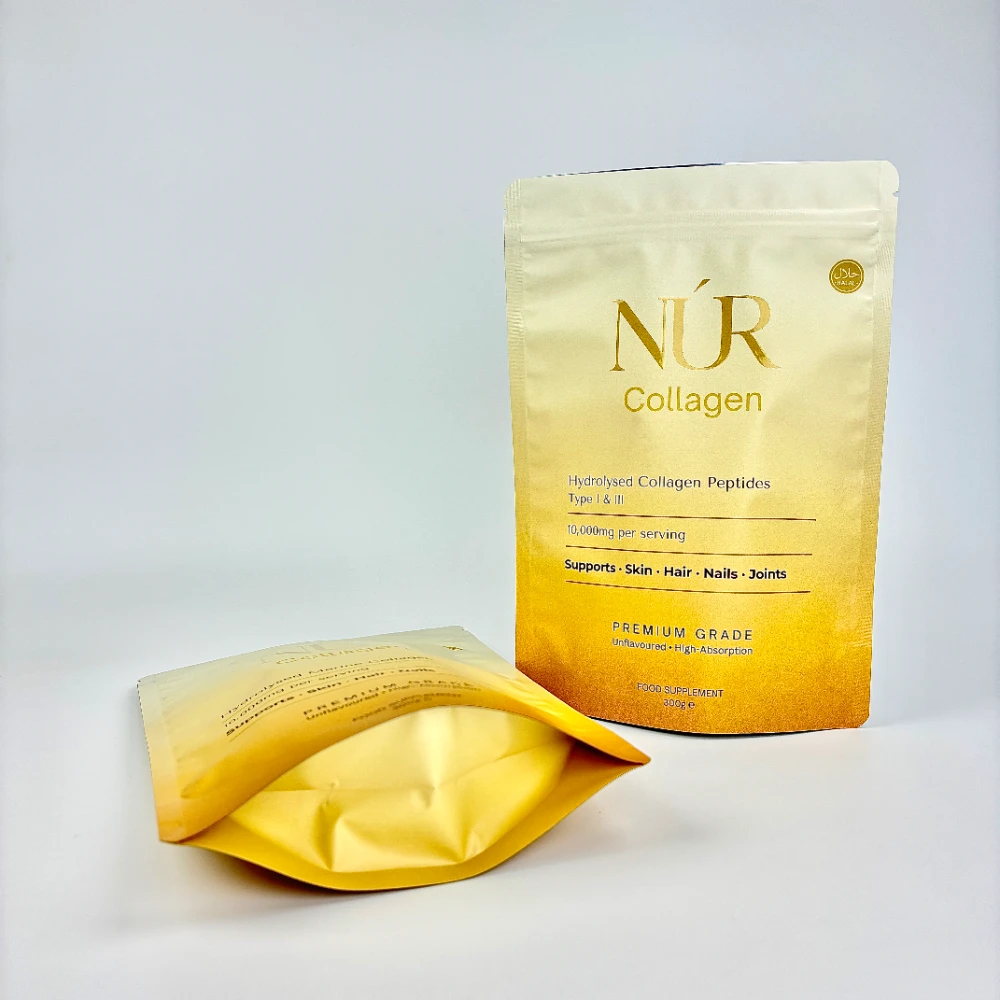
Custom supplement stand-up pouches produced at JINYI for NUR Collagen — gold gradient print with structured base, showing front display and bottom gusset detail, factory-direct from 500 units with no plate fee
For custom electrolyte stick pack suppliers, the critical production variables beyond the film specification are the back seal integrity and the end seal consistency. A pillow bag electrolyte packaging failure — a back seam that separates under pressure, or an end seal that does not fully close across the full bag width — produces a product that arrives to the consumer open, clumped, or compromised. At JINYI, seal integrity is verified through a sampling protocol at the start of every production run, with first-article inspection confirming seal strength before the full batch proceeds. Full material specification documentation — OTR, MVTR, film layer breakdown, food-contact certifications — is included with every order as standard.
Spec
Platform / Intermediary
JINYI Direct Factory
MOQ
500–3,000 units typical
From 500 units (digital print)
Pillow bag stick pack
Confirm per supplier
Available alongside stand-up pouch
Colour proof on film
Varies by supplier
Available before production confirmation
Material spec document
Rarely provided as standard
Included with every order
Plate / setup fee
Often included in unit price
None for digital print
Scale path
Platform pricing, limited flexibility
Digital → gravure at volume, unit cost drops
Get a Factory-Direct Quote for Your Electrolyte Packaging
Tell us your stick pack dimensions, fill weight, active ingredients, flavour count, and quantity. We will come back within 24 hours with a full specification recommendation — film structure, barrier spec, colour proof availability, and material documentation — at factory-direct pricing.
JINYI is a source factory for custom flexible packaging with 15+ years of production experience, serving food, supplement, nutrition, coffee, and consumer goods brands across 150+ countries. We produce pillow bags, stand-up pouches, flat-bottom bags, and side gusset bags in PET/AL/PE, PET/VMPET/PE, and other barrier specifications — via HP Indigo digital print from 500 units and gravure printing at volume — with full material documentation and complimentary commercial photography included as standard with every order.
That is what From Film to Finished — Done Right means in practice.
Elsa
Business Development Manager · JINYI Packaging
Elsa leads business development and customer order management at JINYI. With 8 years in foreign trade across Yiwu and Dongguan, she has a sharp understanding of market demand and what buyers actually need — turning real customer insight into the right packaging decisions.
Customer needs Order management Business development
What packaging does Liquid IV use for their hydration multiplier?
Liquid IV uses a dual-format packaging system: individual single-serve electrolyte stick packs in a pillow bag (back-seal pouch) format, housed inside a resealable stand-up outer pouch containing 16 or 30 sticks. The pillow bag is the consumption unit — portable, single-serve, tear-open. The outer stand-up pouch is the retail unit — providing shelf presence, brand communication, and organised storage for the remaining sticks between uses.
What film material is Liquid IV packaging made from?
Liquid IV’s individual electrolyte stick packs use a PET/AL/PE high-barrier laminate — a polyester outer layer for the colour print and structural rigidity, an aluminium foil middle layer providing near-zero oxygen transmission and UV blocking, and a polyethylene inner layer for heat sealing and food contact. This structure protects the Vitamin C, B vitamins, and hygroscopic electrolyte compounds in the formula from the oxygen, light, and moisture exposure that would degrade their potency over the shelf life.
Why does Liquid IV use individual stick packs instead of a single large pouch?
The individual stick pack format serves the core consumer use case: portability. A single-serve electrolyte stick pack goes in a pocket, gym bag, or travel kit and is ready to use with 16 oz of water anywhere. A large resealable pouch requires measuring and a scoop. The dual-format system combines both: the portability of the individual stick pack and the retail shelf presence and organised home storage of the outer resealable pouch.
Is Liquid IV packaging recyclable?
Liquid IV’s current PET/AL/PE multi-layer laminate packaging is not recyclable through standard household recycling streams. The brand has committed to zero-waste packaging as a long-term goal. The technical challenge is finding a monomaterial recyclable structure that maintains the near-zero barrier performance required to protect the vitamin and electrolyte content through the full shelf life and distribution cycle — the same challenge that Huel addressed before their monomaterial packaging transition.
Can I get the same electrolyte stick pack and resealable pouch as Liquid IV factory-direct with low MOQ?
Yes. Both the pillow bag electrolyte stick pack format and the resealable stand-up outer pouch are standard flexible packaging production specifications available at JINYI from 500 units via HP digital print with no plate fee. Both formats are available in PET/AL/PE high-barrier laminate with Pantone-accurate colour management. Full material specification documentation is included with every order as standard.