JINYI shares practical packaging guidance for your decisions.
RYZE Superfoods describes itself as the world’s best-selling mushroom coffee brand — and the numbers support that claim. Founded in Boston by Andrée Werner and Rashad Hossain, the brand grew from a personal frustration with conventional coffee’s jitters and crashes into a product that blends six adaptogenic mushrooms with organic Arabica coffee and MCT oil. By 2024, RYZE had accumulated hundreds of thousands of verified reviews and built one of the most recognisable wellness brands in the functional beverage category. What makes RYZE particularly instructive for any brand thinking about packaging is how deliberately their earthy brown stand-up pouch was designed — not just to contain the product, but to function as a visual identity system perfectly calibrated for the wellness content ecosystem on TikTok and Instagram where the brand was built. This breakdown covers what RYZE mushroom coffee packaging is actually made of, why the design choices were made, what the USDA Organic certification means for packaging specification, and how to source the same structure factory-direct.
How RYZE Built the World’s Best-Selling Mushroom Coffee Brand on TikTok
RYZE did not emerge from a traditional food and beverage launch strategy. It emerged from a personal story — two founders who relied on coffee for energy but experienced anxiety, jitters, and afternoon crashes, discovered functional mushrooms as a solution, and formulated a product that delivered the ritual of coffee with what they believed were the health benefits of adaptogenic fungi. That founder story — relatable, personal, and outcome-oriented — became the brand’s primary content engine on TikTok, where thousands of users documenting their morning routines, wellness rituals, and energy management strategies encountered RYZE organically through algorithm-driven content discovery.
The functional coffee and mushroom coffee category had existed before RYZE — Four Sigmatic had been selling mushroom coffee since 2012 — but RYZE’s TikTok-native growth strategy, aggressive DTC subscription model, and early commitment to a USDA Organic certification allowed them to build volume and brand equity simultaneously. By making the product accessible through a 30-day money-back guarantee and positioning it explicitly as “coffee, but better,” RYZE lowered the barrier to first purchase and then relied on the product’s performance — and the packaging’s visual presence in consumer content — to drive repeat purchases and word-of-mouth.
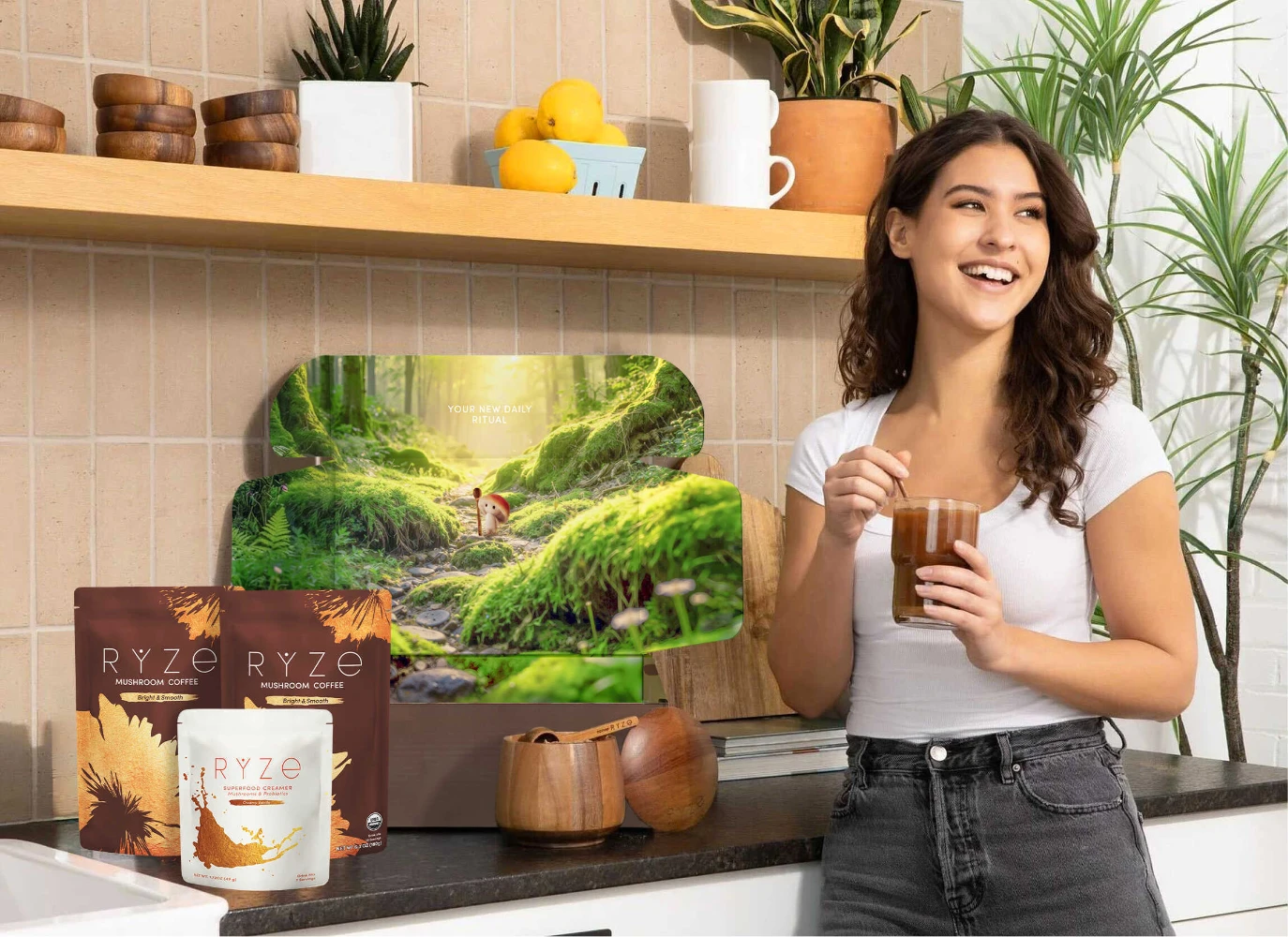
The packaging is central to this strategy in a way that is easy to underestimate. On TikTok, the product appears in thousands of videos without any brand involvement — users filming their morning routine, their desk setup, their travel kit, or their daily wellness stack. In each of these videos, the RYZE pouch is present in the frame. The earthy brown colour, the clean typography, and the consistent design system across all product variants means that a viewer who encounters the pouch in one creator’s video will recognise it immediately in another creator’s video — without needing to see the brand name legibly. The packaging has achieved the same passive brand distribution function that Bloom Nutrition’s pink pouch achieves in the women’s wellness space, but through a completely different colour and aesthetic language targeted at a different consumer psychographic.
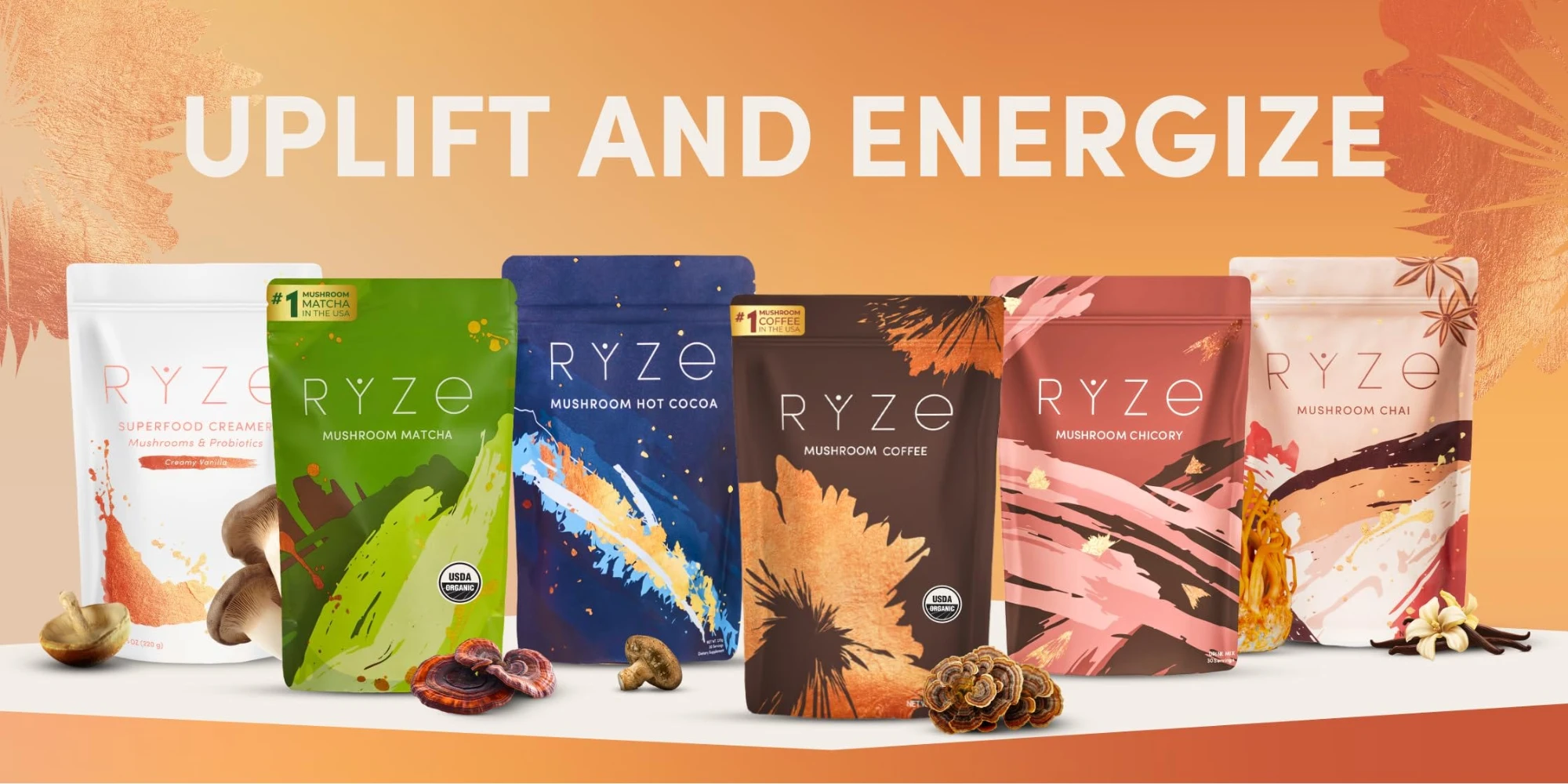
RYZE’s product line has expanded significantly beyond the original mushroom coffee — now covering mushroom matcha, mushroom hot cocoa, mushroom chicory, overnight oats, and a superfood creamer. Every product uses the same earthy colour palette and design system, creating a visual library that is immediately recognisable as RYZE regardless of which product appears in consumer content. This is brand architecture embedded in packaging design — the same systematic visual thinking that allows a consumer to identify any RYZE product from across a room or at thumbnail size on a phone screen.
Note: RYZE’s growth demonstrates a packaging principle that applies equally to functional coffee brands and any DTC wellness brand: the packaging must work in two environments simultaneously — on the retail shelf or DTC unboxing, and in the consumer’s organic social content. These two environments have different requirements. Shelf presence rewards size, colour saturation, and information density. Social media presence rewards colour consistency, minimal clutter, and aesthetic coherence with the creator’s broader visual style. RYZE’s earthy palette is optimised for the second environment without sacrificing the first.
What Bag Format Does RYZE Mushroom Coffee Use?
RYZE’s primary retail and DTC format is a stand-up pouch containing 30 servings of mushroom coffee powder. The standard package dimensions are approximately 9.73 x 6.23 x 2.95 inches with a net weight of 6.35 oz (approximately 180g) — a format sized to be compact enough for DTC shipping without excessive dimensional weight charges, while providing sufficient front panel area for RYZE’s design system and product information.
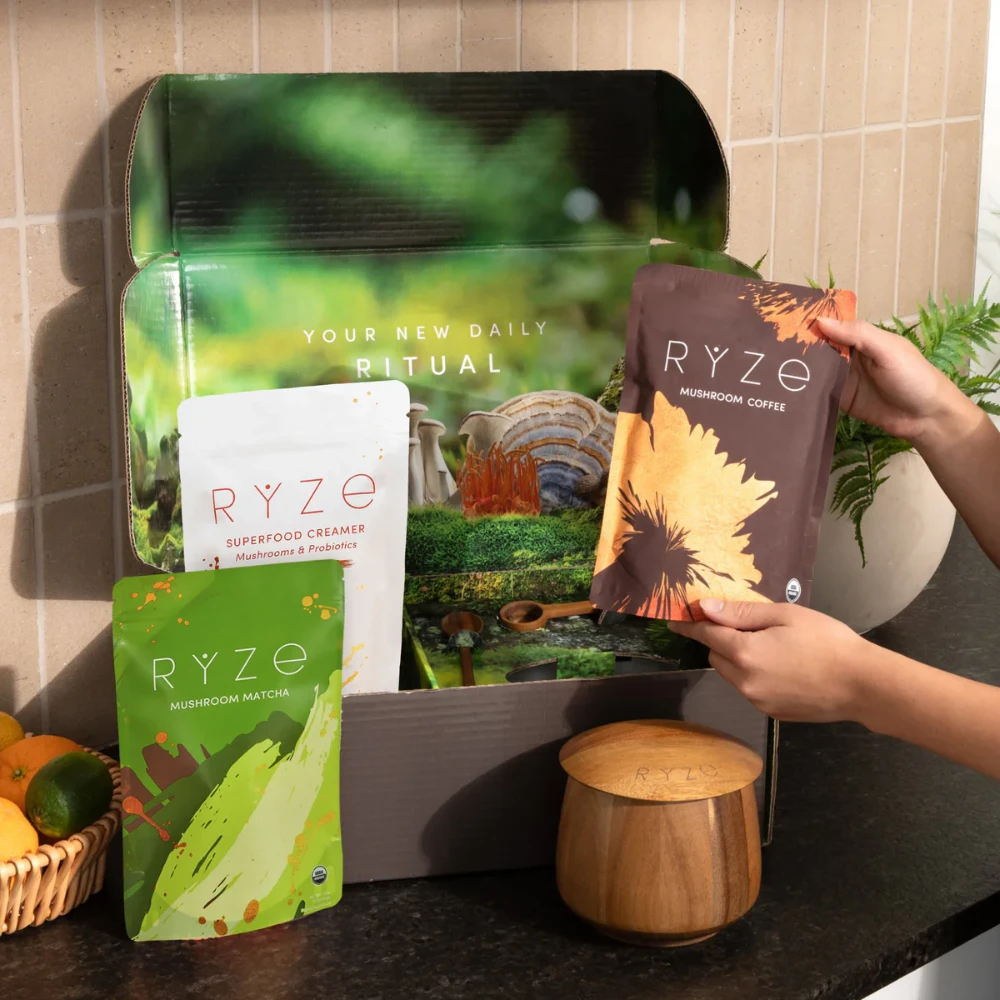
The stand-up pouch format was the correct choice for RYZE’s business model for several interconnected reasons. DTC e-commerce is their primary channel — and the stand-up pouch ships flat before filling, minimises dimensional weight in courier shipping, and presents well in the unboxing moment that DTC brands depend on for first-impression brand communication. The format also photographs well for the flat-lay product imagery that dominates wellness content on Instagram, and stands upright on a kitchen counter or desk surface for the lifestyle photography and video content that drives organic social discovery.
The resealable zipper is standard across all RYZE powder SKUs. A 30-serving pouch is a product the consumer opens and closes daily for a month — the zipper’s performance over repeated use is a significant factor in consumer satisfaction and repeat purchase behaviour. RYZE’s consumer community, like Huel’s, has historically discussed zipper performance as a packaging experience factor, which reflects a category-wide challenge: fine instant coffee and mushroom powder migrates into the zipper channel during handling, reducing grip and airtightness over time. Specifying a zipper profile with sufficient channel depth to accommodate powder migration without losing closure performance is a packaging brief requirement that RYZE addresses in their production specification.
RYZE’s product line extension — mushroom matcha, mushroom cocoa, mushroom chicory — uses the same stand-up pouch format across all variants, with product differentiation carried entirely by colour and typography changes within the same earthy design system. This format consistency across a growing product range is a deliberate packaging architecture decision: it allows RYZE to manage a single pouch format specification across multiple SKUs, reducing the complexity and cost of their packaging supply chain while maintaining visual coherence across the brand’s product library.
RYZE Product
Format
Servings
Design Colour
Mushroom Coffee
Stand-up pouch
30 servings
Warm brown / earth tone
Mushroom Matcha
Stand-up pouch
30 / 60 servings
Sage green / earth tone
Mushroom Hot Cocoa
Stand-up pouch
20 servings
Deep brown / earth tone
Mushroom Chicory
Stand-up pouch
30 / 60 servings
Warm tan / earth tone
Superfood Creamer
Stand-up pouch
15 servings
Cream / neutral earth tone
Tip: For functional beverage and wellness brands building a multi-SKU product line, using the same stand-up pouch format specification across all variants — differentiated only by colour and typography — is the most cost-efficient packaging architecture. It allows you to manage a single film specification, a single zipper specification, and a single production tooling setup across your entire range, while giving consumers a clear visual system for navigating which product is which. Build the colour differentiation system before your second SKU launches, not after.
Film Structure — Recyclable Packaging and What It Has to Protect
RYZE states across their product packaging and official communications that they use 100% recyclable packaging — a commitment that sets them apart from most functional coffee and supplement brands, which still rely on traditional multi-layer PET/AL/PE foil laminates that cannot be processed in standard recycling streams. Achieving recyclability in a packaging format that must also protect a sensitive multi-ingredient formula is a genuine technical challenge — and understanding why requires first understanding what the formula actually demands from its packaging.
The six adaptogenic mushrooms in RYZE’s Super6 blend — Cordyceps, Reishi, Turkey Tail, King Trumpet, Shiitake, and Lion’s Mane — contain active compounds including beta-glucans, polysaccharides, and triterpenes that are sensitive to oxidation. The MCT oil in the formula is a fat that oxidises on exposure to oxygen and light, producing rancidity and off-flavours. The organic Arabica instant coffee component is sensitive to both moisture and oxygen. The prebiotic fibre blend is hygroscopic — it absorbs ambient moisture and causes clumping. In a standard multi-ingredient functional coffee blend, this combination of sensitivities would traditionally point directly to a PET/AL/PE aluminium foil laminate as the packaging specification of choice — the aluminium foil middle layer being the most reliable way to achieve near-zero oxygen and moisture transmission simultaneously.
RYZE’s decision to use 100% recyclable packaging means they have taken a different path — one consistent with the broader industry movement toward monomaterial recyclable structures that brands like Huel and Lavazza have also pursued. A 100% recyclable flexible pouch is typically a monomaterial polyethylene (PE) structure, where all layers are from the same polymer family so the bag can be processed in standard PE recycling streams without material separation. Advanced barrier PE films — using EVOH barrier layers within an all-polyolefin structure, or high-density PE grades engineered for improved oxygen and moisture resistance — have made it possible to achieve barrier performance that approaches, though does not always fully match, the aluminium foil benchmark. RYZE has not publicly disclosed the specific film specification or the barrier performance data of their recyclable pouch, so a direct OTR comparison is not available. What is documented is the brand’s recyclability commitment and the product’s market performance — which suggests the barrier performance is sufficient for their shelf life and DTC distribution requirements. For a complete guide to how film structures are manufactured and how barrier specifications are selected for coffee products, our coffee bag packaging complete guide covers the full decision framework, and our guide to how custom stand-up pouches are made covers the production process in detail.
Ingredient
Sensitivity
Packaging Requirement
Adaptogenic mushrooms (beta-glucans)
Oxygen — potency degradation
Low OTR barrier
MCT oil
Oxygen + light — rancidity
Low OTR + UV barrier
Organic Arabica instant coffee
Oxygen + moisture — flavour loss
Low OTR + low MVTR
Prebiotic fibre (acacia/inulin)
Moisture — hygroscopic clumping
Low MVTR + hermetic heat seal
Film Structure
OTR
Recyclability
Best Application
PET / AL / PE
~0.01 cc/m²/day
Requires specialist stream
Maximum barrier — long shelf life, global distribution
Monomaterial PE (recyclable)
Advanced engineering
Standard PE recycling stream
DTC brands with sustainability commitment — RYZE approach
Note: For functional coffee and mushroom coffee brands evaluating their packaging specification, RYZE’s recyclable packaging commitment demonstrates that 100% recyclable structures can be viable for this product category — but the decision requires validating that the specific recyclable film achieves sufficient barrier performance for your formula’s most sensitive ingredient and your distribution chain’s timeframe. Both PET/AL/PE and monomaterial recyclable structures have their place: the right choice depends on your product’s actual shelf life requirement and your sustainability goals, not a blanket preference for one over the other.
The Earth-Tone Design Strategy — Packaging Built for Wellness Content
RYZE’s packaging design is not built for a grocery shelf. It is built for a phone camera. The warm brown, ochre, and sage-green palette that spans their product range is a deliberate alignment with the visual language of wellness content on TikTok and Instagram — a content ecosystem dominated by natural textures, earth tones, wooden surfaces, linen fabrics, and minimalist kitchen aesthetics. A RYZE pouch placed on a wooden kitchen counter, next to a ceramic mug, in a morning routine video does not interrupt the visual flow of that content. It belongs in the frame. That belonging is a competitive advantage that no amount of paid advertising can replicate.
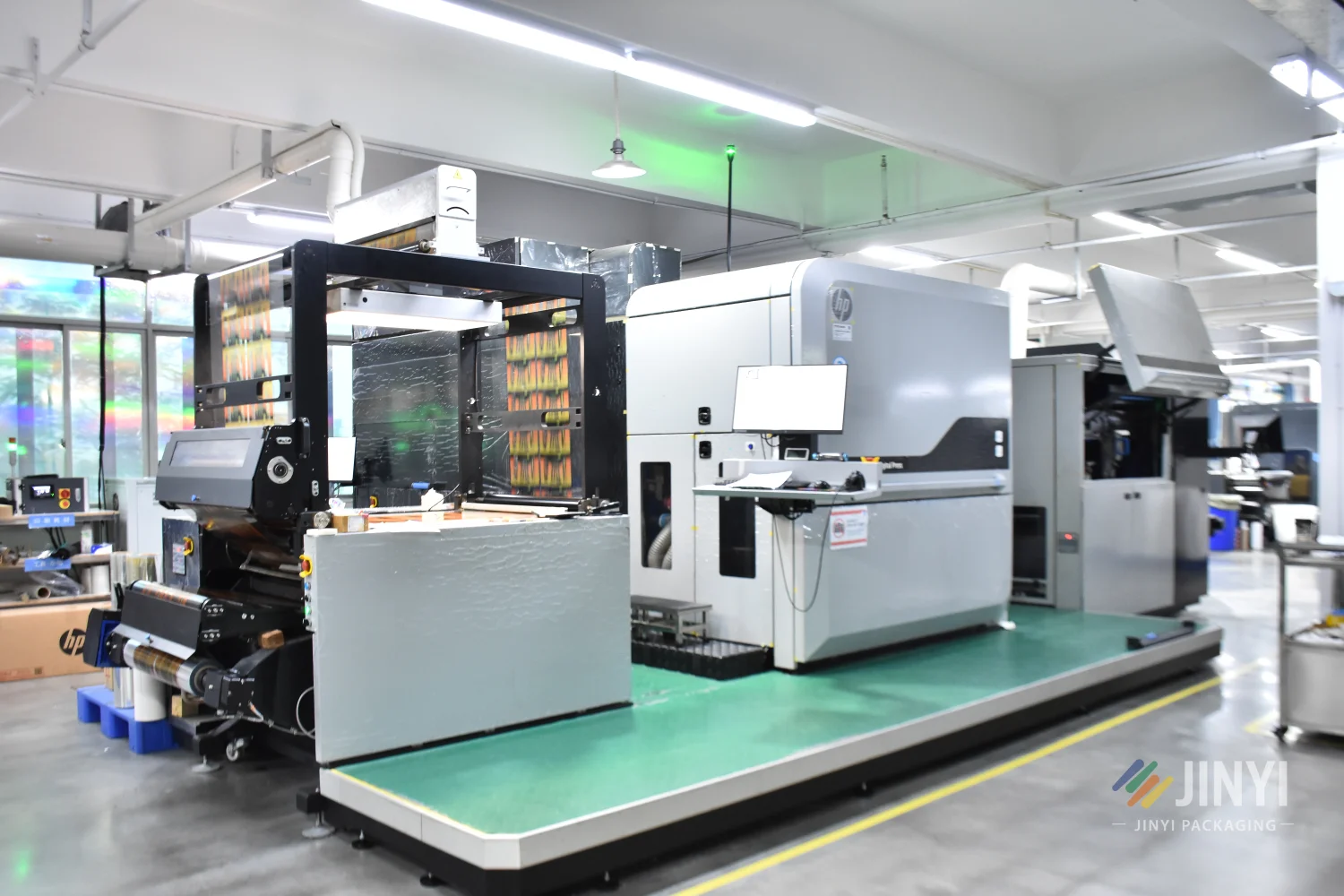
The design approach places specific demands on the printing process. Earth tones — warm browns, muted ochres, desaturated greens — occupy a narrow colour band where small shifts in ink saturation or warmth change the feel of the design significantly. A brown that runs slightly too red reads as rust. A sage green that runs slightly too bright reads as artificial rather than natural. These are the colours that require the most careful Pantone specification and the most rigorous press-to-press consistency management — precisely because their appeal depends on their quietness, and any deviation makes them louder than they should be. At JINYI, colour management for earth-tone designs is handled through calibrated ICC profiles across our HP Indigo press fleet via the ESKO Automation Engine, with density verification at multiple points during each production run.
Comparing RYZE’s design strategy to other major functional beverage and coffee brands makes the differentiation clear. Where Peet’s Coffee uses deep, saturated colour fields and geometric pattern to communicate intensity and craft — a design built for grocery shelf presence — and where Starbucks uses detailed illustration and brand narrative to communicate heritage at scale, RYZE uses muted naturalism to communicate organic quality and lifestyle integration. The three approaches target three different consumer relationships with coffee — and produce three completely different packages, each with their own film specification matched to their brand’s sustainability commitments and distribution requirements.
Brand
Design Palette
Primary Channel
Consumer Signal
RYZE
Warm brown / earth tones
DTC + TikTok wellness content
Organic, natural, lifestyle-integrated
Peet’s Coffee
Deep green / dark geometric
Mass retail + DTC
Craft, depth, freshness obsession
Starbucks
Dark green / illustrated narrative
Global retail + café
Heritage, scale, global quality
Lavazza
Rich Italian colour palette
Global retail + foodservice
Italian craftsmanship, 130-year tradition
Tip: Before finalising your functional coffee or wellness beverage packaging design, identify the content ecosystem where your consumer discovers and shares products — TikTok, Instagram, YouTube, Pinterest — and analyse the dominant visual language of that ecosystem in your product category. Your packaging should feel native to that environment, not foreign to it. RYZE’s earth-tone palette feels native to wellness content. A neon-saturated design on the same product would feel like an intrusion. The content ecosystem your consumer inhabits is as important an input to your packaging brief as the product’s barrier requirements.
USDA Organic Certification — What It Actually Means for Packaging Specification
RYZE carries USDA Organic certification across their product range — a certification that most consumers associate with the ingredients inside the bag but which also has implications for the packaging materials that come into contact with those ingredients. Understanding what organic certification requires at the packaging level is important for any brand in the functional food or beverage category pursuing or planning to pursue organic certification, because the packaging specification is part of the certification audit — not a separate decision.
USDA National Organic Program (NOP) regulations require that all substances used in organic production and handling — including packaging materials that come into contact with organic products — must not contain prohibited synthetic substances that could contaminate the organic product. For flexible packaging, this specifically applies to the inner PE layer (the food-contact surface), the adhesives used in lamination, and the printing inks used on the outer PET layer. The inner PE food-contact layer must be manufactured from materials that meet FDA 21 CFR requirements for food-contact safety — which is a baseline requirement for any food packaging, but is particularly scrutinised in organic certification audits because the certifying body must verify that no prohibited substances can migrate from the packaging into the organic product.
The printing inks on the outer PET layer are also a certification consideration. While the inks are applied to the outer surface of the PET and are separated from the food contact surface by the aluminium foil middle layer, organic certification audits typically require documentation confirming that low-migration inks are used — inks formulated to minimise the risk of volatile organic compounds or photoinitiators migrating through the laminate structure to the food-contact surface. At JINYI, every production run on HP Indigo presses uses HP ElectroInk — a low-migration ink system with food-contact safety certification — and the material specification documentation provided with every order includes ink safety confirmation that can be presented to organic certification bodies during audit.
The lamination adhesives used in standard flexible packaging structures — bonding the outer print layer to the barrier layer, and the barrier layer to the inner seal layer — are a third certification checkpoint. JINYI uses solvent-free lamination as standard across all production, which eliminates the solvent residue risk that dry-lamination processes carry. The solvent-free adhesive system is cured through a chemical reaction rather than solvent evaporation, producing zero VOC emissions and a laminate with no residual solvent content — which satisfies both food-safety and organic certification documentation requirements simultaneously, regardless of whether the film structure is a traditional multi-layer laminate or a monomaterial recyclable construction.
Packaging Element
Organic Certification Requirement
JINYI Standard
Inner PE food-contact layer
FDA 21 CFR food-contact compliance
Certified — included in material spec document
Printing inks (outer PET)
Low-migration inks — no prohibited substance migration
HP ElectroInk — low migration certified
Lamination adhesives
No solvent residue, no prohibited substances
Solvent-free lamination — zero VOC, zero residue
Overall documentation
Full material compliance chain for certification audit
Included with every order as standard
Note: If your brand is pursuing USDA Organic certification or equivalent certifications in other markets (EU Organic, JAS in Japan, etc.), ask your packaging supplier for the full material compliance documentation before placing your first order — not after. The certification audit will require this documentation, and gaps in the compliance chain at the packaging level can delay or prevent certification approval. At JINYI, this documentation is provided as standard with every order, including food-contact certifications, ink migration data, lamination adhesive safety data, and OTR/MVTR test results.
How to Source the Same Packaging Structure Factory-Direct
RYZE’s stand-up pouch with a resealable zipper, matte finish, and earth-tone colour system is a format available to any brand at any volume — the recyclable monomaterial structure RYZE uses reflects their sustainability commitment, but the format architecture itself is standard flexible packaging. At JINYI, stand-up pouches are available factory-direct from 500 units via HP digital print with no plate fee — in both traditional high-barrier PET/AL/PE laminates and recyclable monomaterial structures, depending on your product’s barrier requirements and sustainability goals. The material specification documentation provided with every order — OTR, MVTR, film layer breakdown, food-contact certifications, ink migration data, and lamination adhesive safety data — covers all the documentation requirements for USDA Organic certification audits, retail buyer compliance teams, and any other regulatory or quality assurance process your brand needs to satisfy.
For functional coffee and mushroom coffee brands building a multi-SKU product line — whether you are launching a single mushroom coffee blend or building a full wellness beverage portfolio across multiple functional formats — the packaging architecture decision is worth making before your first production run rather than after. Committing to a single stand-up pouch format specification across all SKUs, differentiated by colour and typography within a consistent design system, gives you the cost efficiency of single-format procurement while maintaining the visual differentiation that allows consumers to navigate your range. RYZE’s product line demonstrates this architecture at scale; the same approach is available to brands launching at 500 units with HP digital print and scaling to gravure at volume without changing their format or film specification. For a complete understanding of coffee-specific packaging considerations — format selection, film structure, degassing valve options, and channel-specific requirements — our coffee bag packaging complete guide covers the full decision framework.
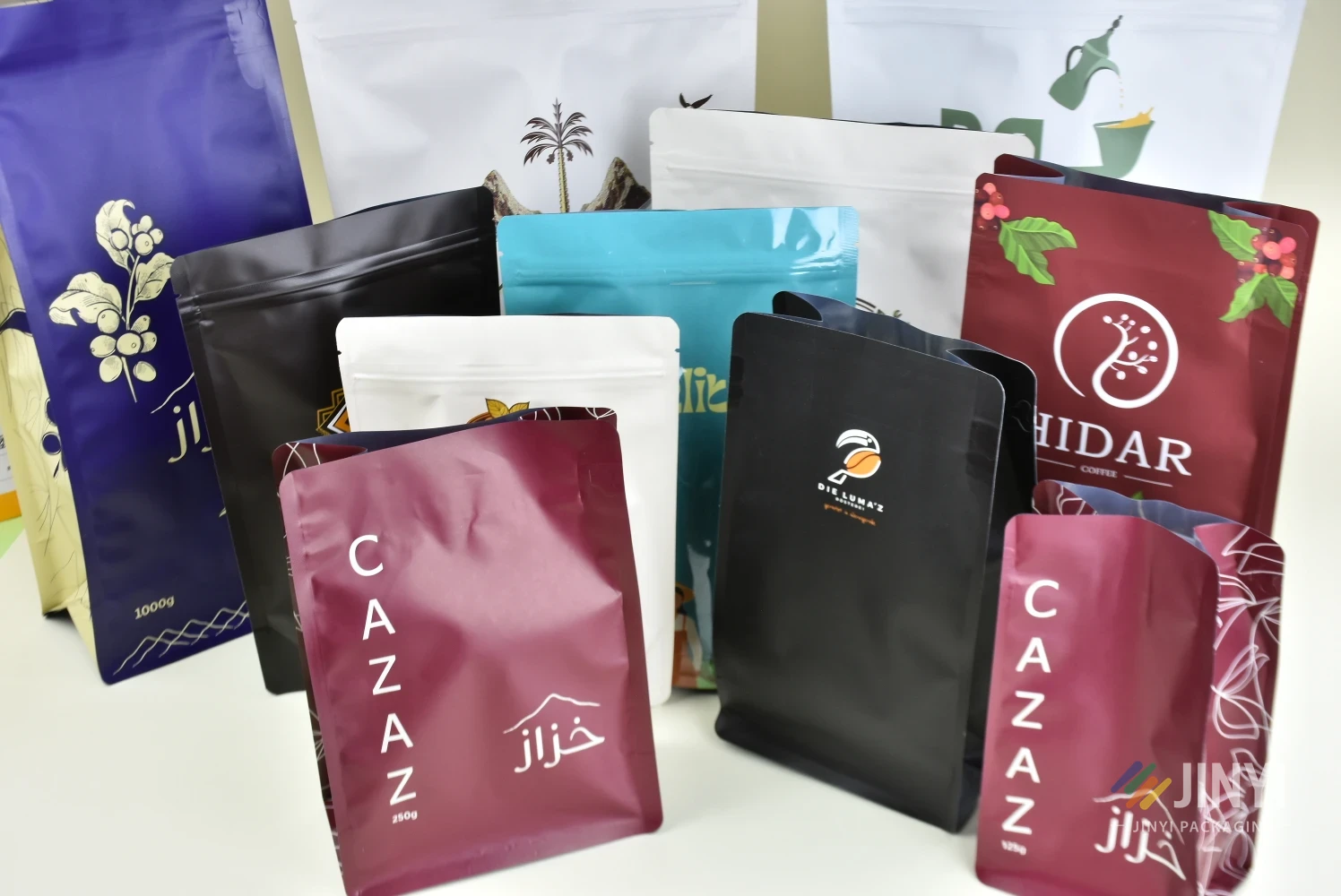
A selection of custom coffee bags produced at JINYI’s factory — stand-up pouches and flat bottom bags across multiple formats, finishes, and brand designs. Every bag in this range was produced factory-direct for real client orders.
For brands looking to understand the full range of packaging decisions in the specialty coffee and functional beverage category, our breakdowns of Starbucks coffee packaging, Peet’s Coffee packaging, and Lavazza’s packaging cover comparable film and format decisions from three different positioning strategies in the same category — from mass-market heritage branding to precision freshness positioning to Italian craft tradition. Our coffee packaging solutions page covers the full range of formats, materials, and configurations available factory-direct.
Spec
Platform / Intermediary
JINYI Direct Factory
MOQ
500–3,000 units typical
From 500 units (digital print)
Plate / setup fee
Often included in unit price
None for digital print
Organic certification documentation
Rarely provided as standard
Full compliance chain — included with every order
Earth-tone colour accuracy
Varies by supplier
Managed via ESKO + calibrated ICC profiles
Lamination method
Confirm per supplier
Solvent-free — zero VOC, zero residue
Scale path
Platform pricing, limited flexibility
Digital → gravure at volume, unit cost drops
Get a Factory-Direct Quote for Your Functional Coffee Packaging
Tell us your formula, fill weight, design direction, organic certification requirements, and quantity. We will come back within 24 hours with a full specification recommendation — film structure, compliance documentation, colour proof availability, and factory-direct pricing.
JINYI is a source factory for custom flexible packaging with 15+ years of production experience, serving food, supplement, coffee, functional beverage, and consumer goods brands across 150+ countries. We produce stand-up pouches, flat-bottom bags, pillow bags, and side gusset bags in PET/AL/PE, PET/VMPET/PE, and other barrier specifications — via HP Indigo digital print from 500 units and gravure printing at volume — with full material documentation, solvent-free lamination, and complimentary commercial photography included as standard with every order.
That is what From Film to Finished — Done Right means in practice.
Elsa
Business Development Manager · JINYI Packaging
Elsa leads business development and customer order management at JINYI. With 8 years in foreign trade across Yiwu and Dongguan, she has a sharp understanding of market demand and what buyers actually need — turning real customer insight into the right packaging decisions.
Customer needs Order management Business development
RYZE uses a stand-up pouch with a resealable zipper and matte finish as their primary format across all powder products — mushroom coffee, mushroom matcha, mushroom cocoa, mushroom chicory, and superfood creamer. The standard mushroom coffee pouch contains 30 servings at approximately 6.35 oz (180g). All variants use an earthy colour palette within a consistent design system, differentiated by colour and typography across product lines.
What film material is RYZE Mushroom Coffee packaging made from?
RYZE uses 100% recyclable packaging across their product range — a commitment they state publicly on their packaging and official communications. This means their pouches are produced from a recyclable film structure, most likely a monomaterial polyethylene (PE) construction, rather than the traditional multi-layer PET/AL/PE aluminium foil laminate used by most functional coffee brands. RYZE has not publicly disclosed their specific film specification or barrier performance data. What is documented is that the recyclable structure is sufficient to protect the formula’s adaptogenic mushroom bioactives, MCT oil, and organic coffee through their DTC distribution chain and shelf life window.
Why does RYZE use earthy brown packaging instead of bright colours?
RYZE’s earthy brown and muted earth-tone palette is a deliberate alignment with the visual language of wellness content on TikTok and Instagram — where the brand was built. Natural textures, warm tones, wooden surfaces, and minimalist kitchen aesthetics dominate wellness content on these platforms. A RYZE pouch placed in a morning routine video or wellness flat-lay feels native to that visual environment rather than intrusive. The packaging is designed to generate passive brand exposure through consumer-created content, which requires it to be visually compatible with the creator’s broader aesthetic — not to stand out from it.
Does USDA Organic certification affect the packaging specification?
Yes. USDA Organic certification requires that packaging materials in contact with certified organic products do not contain prohibited synthetic substances. For flexible packaging, this means the food-contact inner PE layer must meet FDA 21 CFR food-contact safety requirements, printing inks must be low-migration certified, and lamination adhesives must be free of solvent residue. Organic certification audits typically require documentation confirming compliance across all three elements — documentation that should be requested from your packaging supplier before your first order, not after.
Can I get the same mushroom coffee packaging as RYZE factory-direct with low MOQ?
Yes. Stand-up pouches with resealable zippers and earth-tone matte finish are available at JINYI from 500 units via HP digital print with no plate fee — in both traditional PET/AL/PE high-barrier laminates and recyclable monomaterial PE structures, depending on your product’s barrier requirements and sustainability goals. Full material specification documentation — including food-contact certifications, ink migration data, lamination adhesive safety data, OTR, and MVTR — is included with every order as standard, covering the documentation requirements for USDA Organic certification audits and retail buyer compliance teams.