JINYI shares practical packaging guidance for your decisions.
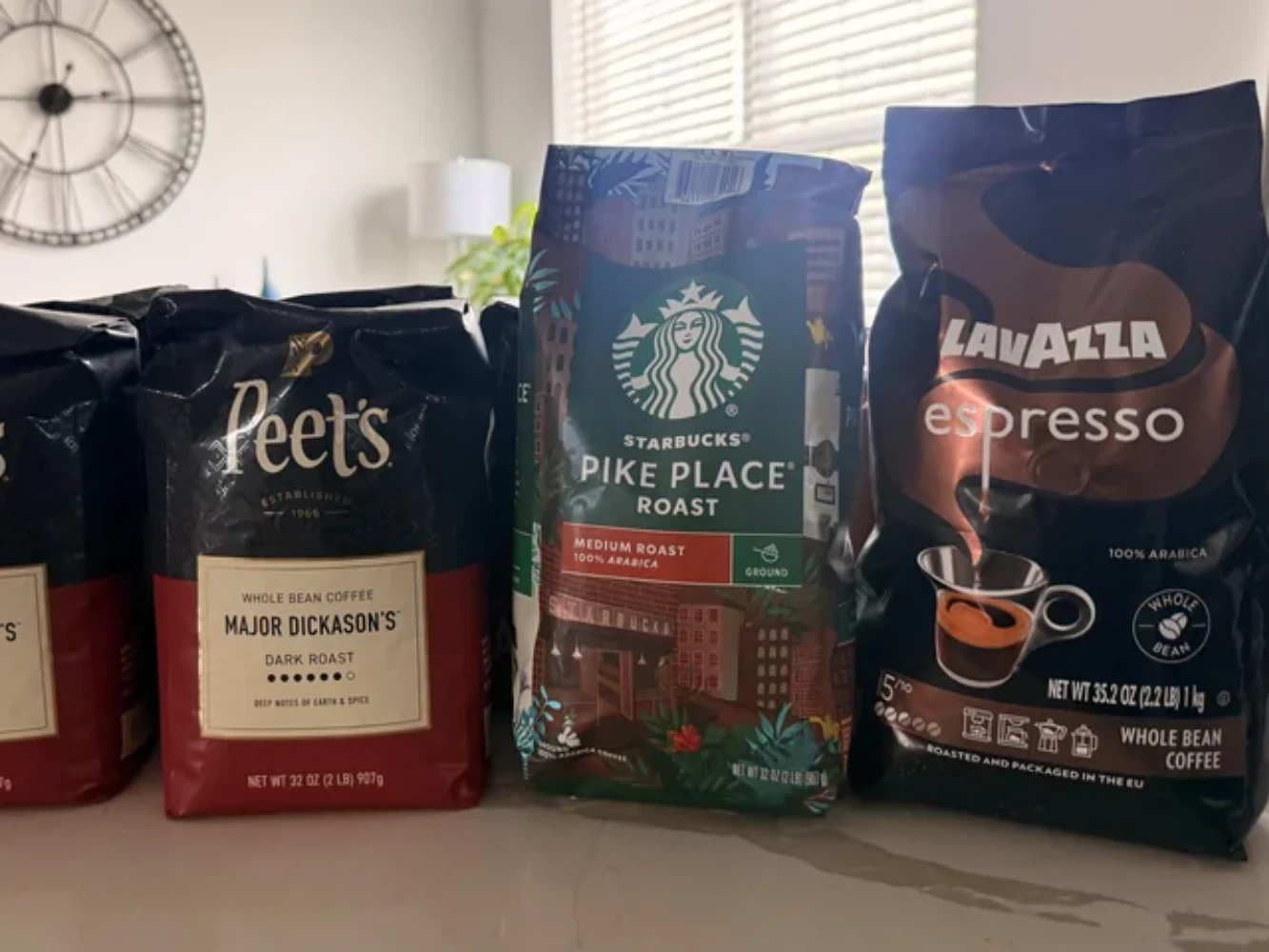
Before Starbucks existed, there was Peet’s. Alfred Peet opened his first store in Berkeley in 1966 and directly mentored the three founders of Starbucks — teaching them what dark-roasted, carefully sourced specialty coffee was supposed to taste like. That origin story matters for this breakdown, because it explains why Peet’s approaches packaging the way they do. A brand whose entire identity is built around depth of roast, quality of sourcing, and an obsessive commitment to freshness does not choose its packaging casually. Every decision — the dark colour, the film structure, the roast date printed on every bag, the one-way degassing valve — connects directly back to the freshness promise the brand has made since 1966. This breakdown covers what Peet’s Coffee packaging is actually made of, why those choices were made, and how to source the same structure factory-direct.
What Makes Peet’s Coffee’s Packaging Philosophy Different
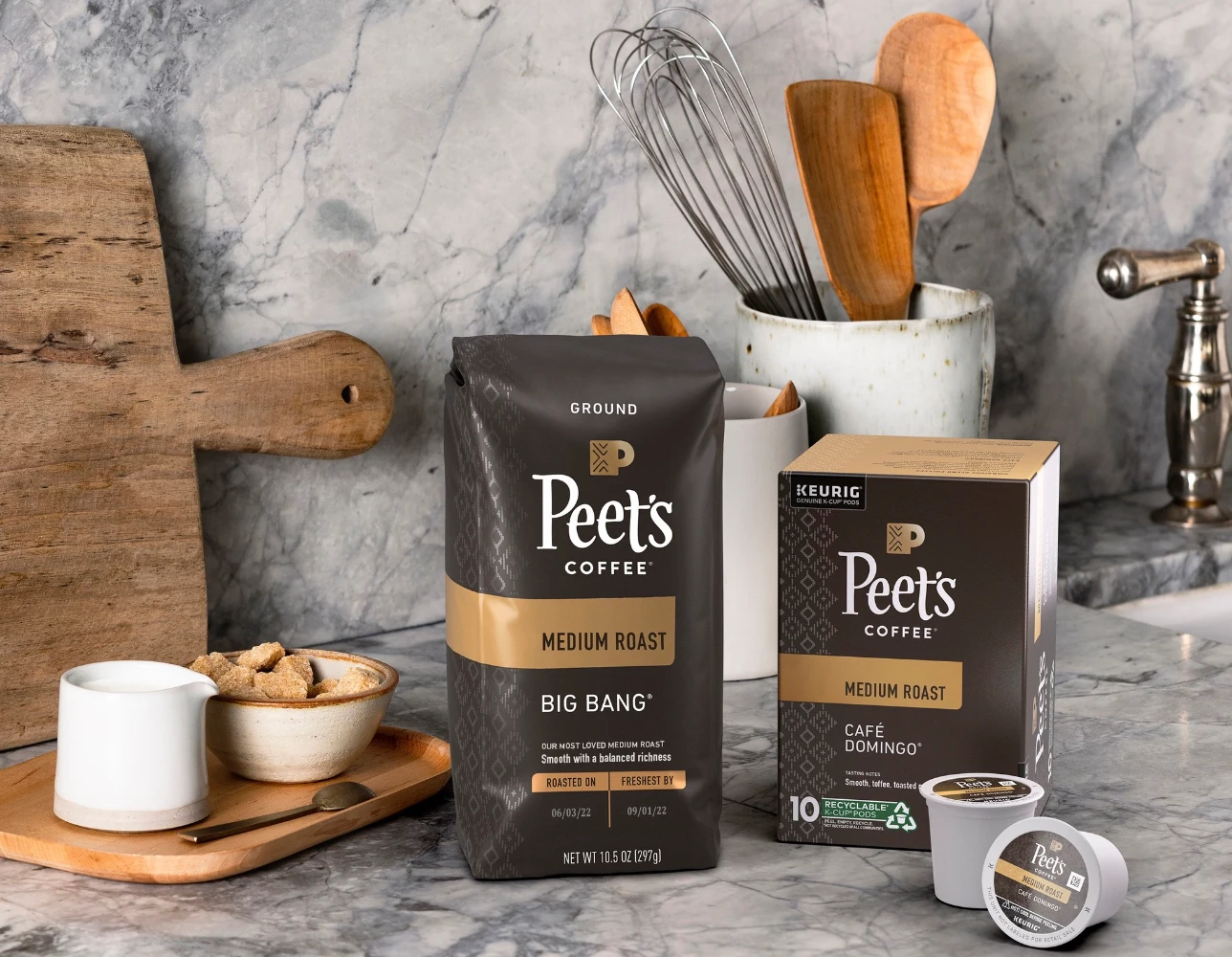
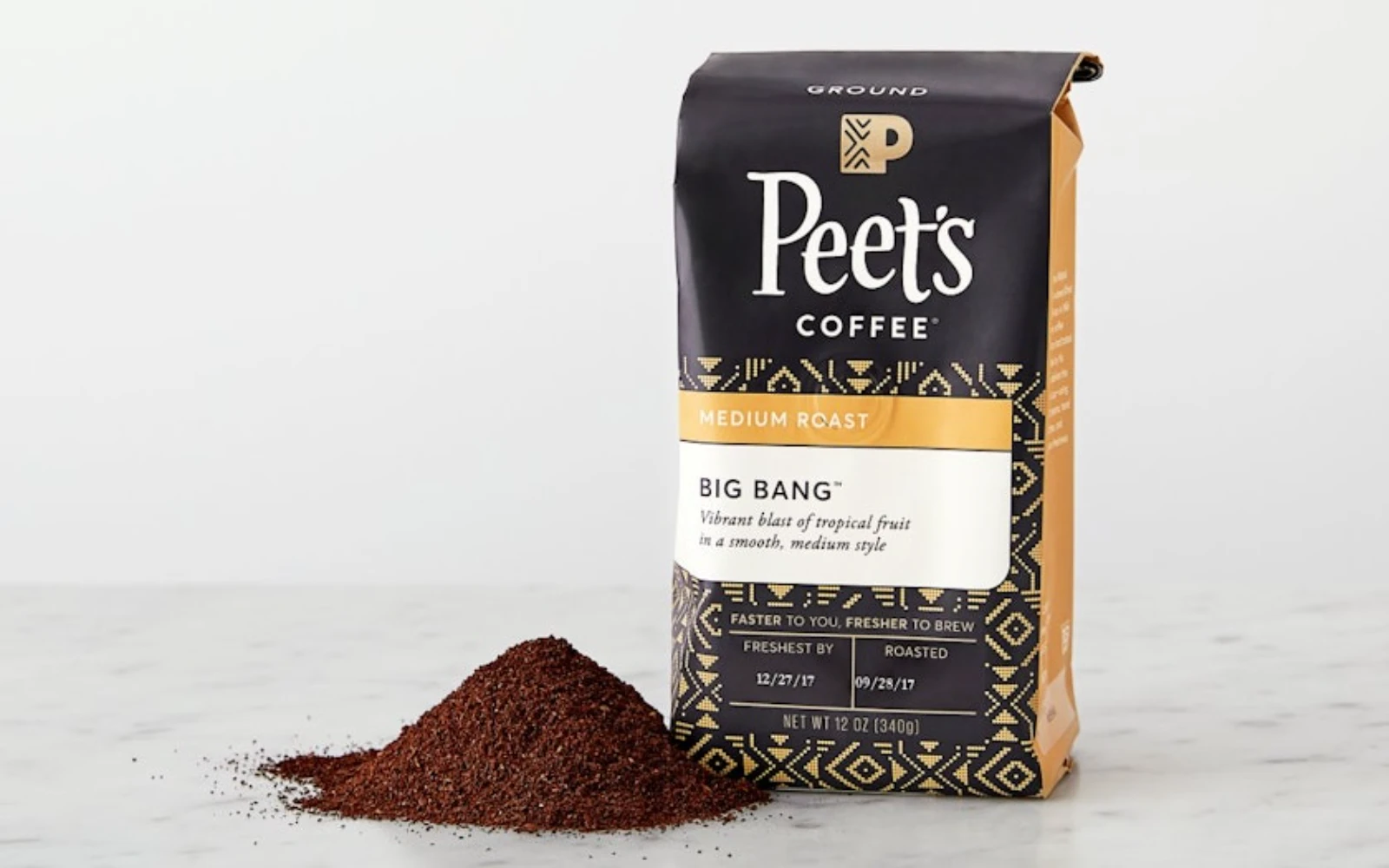
Peet’s Coffee operates under a brand promise that is unusually specific for a mainstream retail coffee brand: “Obsessed with Fresh.” This is not a general freshness claim of the kind that appears on most food packaging. It is a operational commitment — Peet’s roasts to order and ships directly to retail shelves, and they print the actual roast date on every bag so consumers can verify when the coffee was made. In a category where most brands print only a best-before date, Peet’s prints the roast date. That is a level of transparency that immediately invites scrutiny — and a level of packaging performance that must back it up.
The freshness commitment creates a direct connection between the brand’s marketing positioning and its packaging specification. If the bag does not protect the coffee through the full retail distribution cycle — from roastery to warehouse to shelf to consumer — the roast date on the front panel becomes evidence of how long the coffee has been sitting in inadequate packaging rather than a transparency signal. The film structure, the degassing valve, and the opaque barrier layer are not packaging decisions made independently of the brand strategy. They are what makes the brand strategy credible.
Peet’s packaging also reflects a brand identity that sits between the extremes of the specialty coffee visual spectrum. Where Blue Bottle Coffee uses white minimalism and typography alone to communicate precision and restraint, and where Starbucks uses detailed illustration and narrative to communicate heritage and scale, Peet’s uses deep, saturated colour fields and geometric pattern to communicate depth and intensity. The packaging looks like the coffee tastes — dark, bold, and purposeful. That alignment between product character and packaging visual language is a design discipline that the best coffee brands execute consistently, and Peet’s has maintained it across decades of product line expansion.
It is also worth noting that Peet’s is currently in the middle of a packaging refresh. Walmart product listings carry the notice “PEET’S COFFEE HAS A NEW LOOK” — indicating a full-line redesign is underway or recently completed. The underlying format and film structure remain consistent; the visual language is being updated. For brands watching how established specialty coffee labels approach packaging evolution, Peet’s redesign is a real-time case study in refreshing without abandoning brand equity.
Note: Peet’s Coffee commits to delivering coffee within 90 days of the roast date. This is a retail shelf life window, not a quality best-before — the roast date transparency is what allows consumers to make their own judgement about freshness rather than trusting a generic expiry date. For any coffee brand considering roast date transparency, the packaging infrastructure must support the promise: high barrier film, a functional degassing valve, and a distribution chain fast enough to make the date meaningful.
What Bag Format Does Peet’s Coffee Use?
Peet’s Coffee’s primary retail format across their whole bean and ground coffee range is the stand-up pouch (also called a Doypack). Their standard retail sizes are 10.5 oz, 12 oz, and 18 oz — covering the trial, standard, and bulk purchase occasions within the everyday grocery and mass retail environment. The stand-up pouch at these weights delivers the shelf stability Peet’s needs across the full range of their retail channels: independent grocery stores, Whole Foods, Walmart, Target, Safeway, and their own cafés all stock the same retail format.
The choice of stand-up pouch over a flat-bottom bag is a distribution logic decision, not a premium positioning decision. Peet’s distributes through an unusually wide range of retail environments — from premium natural food stores to mass market grocery chains to convenience formats — and the stand-up pouch performs reliably across all of them. A flat-bottom bag, which provides a wider, more structured shelf footprint and is the preferred format in premium specialty retail, carries a higher unit cost and works best in controlled specialty retail environments where shelf space is managed carefully. Blue Bottle Coffee, which distributes primarily through its own cafés and DTC channel, uses flat-bottom bags precisely because their distribution is more controlled. Peet’s broader, faster-moving distribution model makes the stand-up pouch the more practical primary format.
For their DTC subscription channel — coffee roasted to order and shipped directly to the consumer — Peet’s uses a similar flexible pouch format with the same high-barrier film structure but optimised for postal and courier transit rather than retail shelf display. The subscription format needs to survive the rigours of courier handling — drop tests, compression, and temperature variation — without the structural support of a retail shelf. The flexible pouch handles this better than any rigid format at equivalent cost.
Factor
Stand-Up Pouch (Peet’s Primary)
Flat-Bottom Bag
Shelf stability
Good — bottom gusset when filled
Excellent — structured flat base
Print area
2 main panels, tapered shape
4–5 panels, wide flat front
Unit cost
Lower — standard format
Higher — more complex production
Channel fit
Mass retail, grocery, DTC, café
Specialty retail, premium DTC
MOQ at JINYI
From 500 units (digital print)
From 500 units (digital print)
Tip: If your coffee brand is launching into both specialty retail and mass grocery simultaneously, the stand-up pouch is the more versatile starting format — it performs across both channel types without the premium cost of a flat-bottom bag. If you are launching exclusively into specialty retail or a premium DTC channel where the shelf footprint and visual presence of the bag are primary differentiators, the flat-bottom format is worth the additional unit cost. For a complete comparison of both formats for coffee brands, our guide to stand-up pouches vs flat-bottom bags for coffee covers the decision in detail.
Film Structure — What’s Inside the Dark Bag
Peet’s Coffee bags are fully opaque — the deep, saturated colour covers the entire bag surface with no transparent window. This is a functional decision as much as an aesthetic one. Coffee’s primary enemies are oxygen, moisture, and UV light — all three accelerate the degradation of the aromatic compounds and volatile oils that make freshly roasted coffee taste the way it does. An opaque bag blocks UV light entirely. Combined with a high-barrier film structure, it creates the controlled internal environment that Peet’s freshness commitment requires.
The film structure across Peet’s retail coffee range is a standard high-barrier three-layer laminate: PET / AL / PE. The outer PET layer is the print substrate — this is where the deep colour base coat and geometric artwork are applied through reverse printing on the inner surface of the PET film before lamination. The PET provides structural rigidity and scratch resistance that keeps the printed surface looking clean through the retail distribution cycle. The middle aluminium foil layer is what delivers the near-zero oxygen and moisture barrier performance — an OTR of approximately 0.01 cc/m²/day and an MVTR at the same level. The inner PE layer provides the heat-seal surface and food-contact safety at the inner bag wall.
The deep colour of Peet’s bags is produced by a full-coverage dark ink base coat applied to the inner surface of the PET outer layer before lamination — the aluminium foil beneath reflects the colour back through the transparent PET, producing the saturated, rich surface colour that characterises their packaging across the product range. This is the same technique used by Bulletproof Coffee’s black bags, but with a significantly more complex colour and pattern layer on top. A black base coat produces a stable, even surface; a dark green or dark brown base coat with geometric pattern layered on top requires precise colour management to ensure the pattern reads cleanly against the base without colour bleed or registration shift.
Layer
Material
Function
Outer
PET (Polyester)
Reverse print substrate · dark colour base · structural rigidity · scratch resistance
Heat seal layer · food-contact safe · aroma containment
Film Structure
OTR
UV Block
Best For
PET / AL / PE
~0.01 cc/m²/day
100%
Freshness-forward specialty coffee — roast date transparency
PET / VMPET / PE
0.5–1.5 cc/m²/day
95%+
Standard retail coffee — longer distribution chain
Kraft / PE
50–200 cc/m²/day
Minimal
Short shelf life, fast-turnover local roasters only
Note: For specialty coffee brands printing a roast date on their packaging — or planning to — the film structure must support the freshness claim through the full retail distribution window. PET/AL/PE at near-zero OTR is the correct specification. A brand that prints a roast date on a bag with a VMPET barrier is making a freshness claim the packaging cannot fully support over a 90-day retail window in variable storage conditions. The bag spec and the brand promise must align.
The Roast Date Promise — And Why the Degassing Valve Is Non-Negotiable
The roast date printed on every Peet’s bag is the most visible expression of their freshness commitment — but it creates a packaging requirement that most brands do not have to manage at the same intensity. When you commit to roasting to order and delivering to shelves within days of roasting, you are sealing coffee that is actively producing carbon dioxide. Freshly roasted coffee releases CO₂ continuously for 7 to 14 days after roasting — a byproduct of the Maillard reaction during the roast that leaves CO₂ trapped in the cellular structure of the bean, slowly releasing as the beans degas.
If a freshly roasted bag is sealed without a degassing valve, the accumulated CO₂ pressure has nowhere to go. The bag inflates — visibly, noticeably, and with increasing pressure on the heat seals at the bottom and sides. Eventually, either the seals fail and the bag leaks, or the pressure becomes significant enough to deform the bag structure. Neither outcome is acceptable for a brand whose front panel carries a roast date and whose retail promise is fresh coffee. The alternative — resting the coffee for a week or more before sealing, to allow CO₂ to escape naturally — defeats the entire point of roasting to order. Peet’s would be sealing week-old coffee and printing the original roast date, which is not what the roast date promise is supposed to communicate.
The one-way degassing valve is what makes the roast date promise operationally viable. The valve allows CO₂ to exit the sealed bag — the pressure differential created by gas buildup inside the bag pushes the valve disc open, gas escapes, and the disc reseals. Oxygen from outside cannot enter through the valve because the pressure differential runs in the wrong direction — there is no inward pressure differential to force the disc open from the outside. The valve solves the CO₂ problem without compromising the oxygen barrier that the aluminium foil middle layer provides.
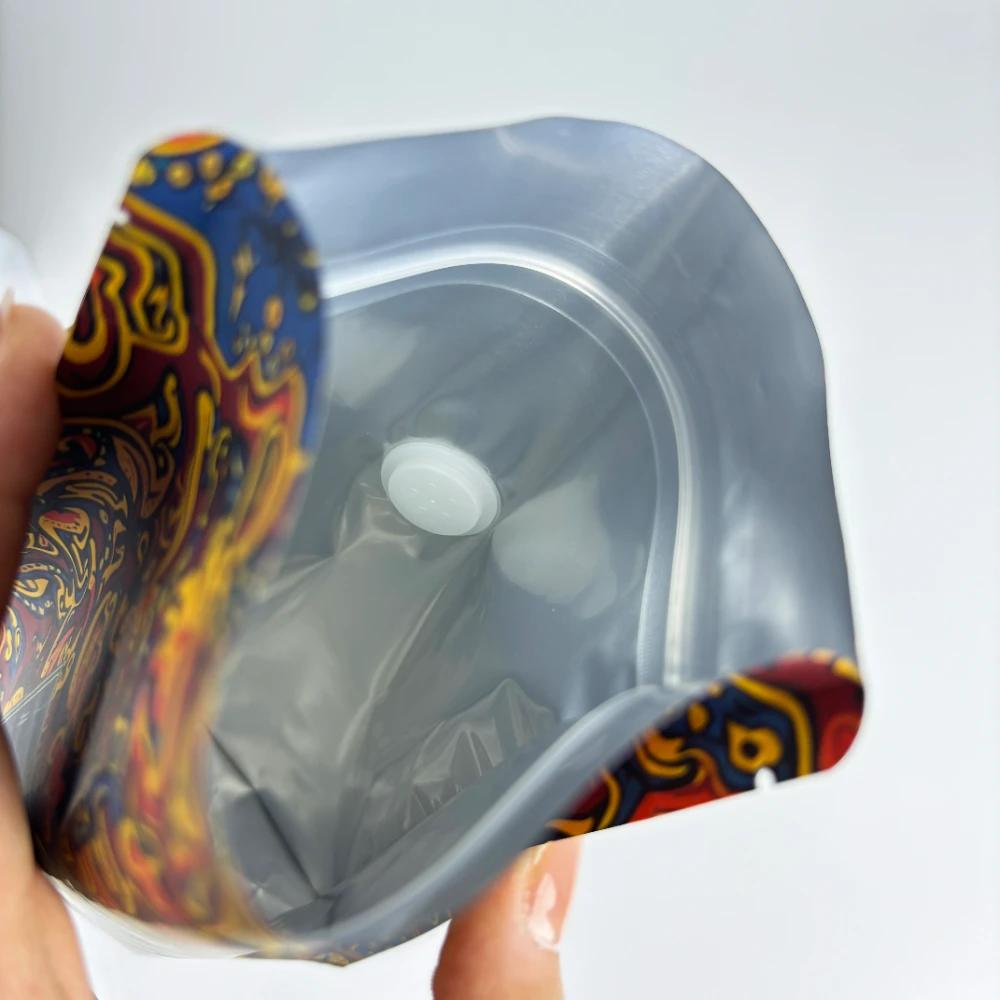
Close-up interior view of a one-way degassing valve installed at JINYI — the valve disc mechanism allows CO₂ produced by freshly roasted coffee to escape while blocking oxygen ingress, protecting flavour and freshness through the full retail shelf life. Valve integrity is verified as part of JINYI’s outgoing quality inspection on every production batch.
Valve quality matters more than most buyers realise. A low-quality degassing valve — insufficient adhesive bond to the bag surface, a rubber disc that stiffens and loses flexibility over time, or a silicone oil seal that dries out — can begin allowing oxygen ingress before the product is consumed. For a brand that has printed the roast date on the front panel and built its retail identity around freshness transparency, a valve that fails partway through the bag’s shelf life is a direct contradiction of the brand promise. The valve installation quality, the adhesive bond strength, and the valve’s gas-flow performance across the temperature range the bag will experience in distribution and storage are all production variables worth specifying and verifying. To understand how degassing valves are installed and tested as part of the full bag production process, our guide to how custom stand-up pouches are made covers the complete manufacturing sequence in detail.
Tip: If your coffee is freshly roasted and you are sourcing bags without a degassing valve, you have two options — neither of which is good. You rest the coffee for 7 to 14 days before sealing, losing the freshness window entirely. Or you seal immediately and accept that the bag will inflate, deform, and potentially fail at the seals. For any coffee brand packaging within 72 hours of roasting, a one-way degassing valve is not a feature. It is a production requirement.
Design Language — Dark, Bold, and Geometric
Peet’s packaging design system is built around deep, saturated colour fields and geometric pattern — a visual language that communicates the character of their coffee before the consumer reads a single word. Their flagship Major Dickason’s Blend uses a rich, dark green background with intricate geometric ornament. Their French Roast line uses deep brown tones that echo the colour of the roast itself. Across the range, the design approach is consistent: dark base, geometric or ornamental pattern, confident typographic presentation of the product name and roast information. The packaging looks like what the coffee tastes like — it is heavy with presence, not light or delicate.
This design approach makes specific demands on the printing process that brands considering a similar visual direction should understand before briefing a packaging supplier. Geometric patterns are characterised by clean edges, precise colour boundaries, and repeating structures — which means any deviation in print registration is immediately visible. On an illustrated design where edges are organic and slightly variable, a half-millimetre registration shift disappears into the illustration. On a geometric pattern where every line is straight and every colour boundary is crisp, the same registration shift produces a visible colour halo at every edge. The pattern requires printing precision that illustrated or photographic designs are more forgiving about.
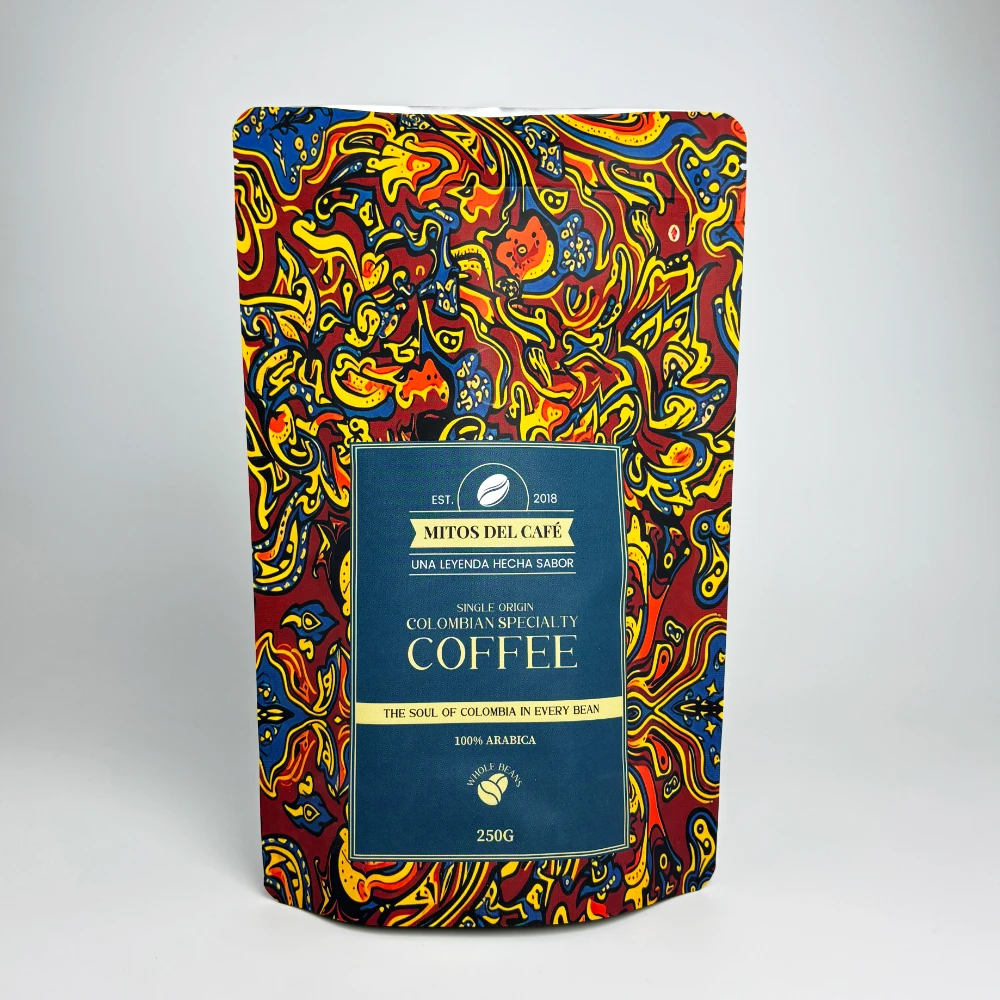
Custom specialty coffee stand-up pouch produced at JINYI — full-coverage geometric pattern print on dark base, demonstrating high-precision colour registration achievable via HP Indigo digital print from 500 units
The deep base colour also requires careful ink coverage management. Full-coverage dark inks — particularly dark greens and deep browns — need to be applied at consistent density across the full bag surface to produce an even, saturated appearance. Inconsistent ink coverage shows as a patchy or mottled surface under retail lighting, which is particularly visible on dark-coloured bags precisely because the dark field amplifies any variation. At JINYI, colour density is managed through calibrated ICC profiles across our HP Indigo press fleet via the ESKO Automation Engine, with density verification at multiple points during each production run.
Brand
Design Language
Base Colour
Print Demand
Brand Signal
Peet’s Coffee
Geometric pattern, bold colour
Deep green / dark brown
High registration precision, even coverage
Depth, intensity, craft
Starbucks
Illustrated artwork per SKU
Dark green / black / white
Multi-colour accuracy, Pantone matching
Heritage, scale, craft narrative
Blue Bottle
Typography only — no pattern
White / off-white
White base coat consistency, type precision
Precision, restraint, purity
Tip: Geometric pattern on a dark base is one of the most demanding print briefs in flexible packaging — not because the design is complicated to create, but because the production tolerances required to execute it cleanly are tighter than for illustrated or photographic designs. If your brand is considering this design direction, request a physical colour proof on your actual film specification before committing to a production run, and ask your supplier specifically about their registration tolerance and ink density consistency on dark base coat applications.
How to Source the Same Packaging Structure Factory-Direct
The dark stand-up pouch in PET/AL/PE with a one-way degassing valve, matte finish, and geometric or full-coverage dark print is a standard production specification. It is not proprietary to Peet’s Coffee, and you do not need their volume to access it. At JINYI, the same structure is available from 500 units via HP digital print — no plate fee, degassing valve included as standard on all coffee bag orders, dark base coat applied before lamination, and a full material specification document provided with every order covering OTR, MVTR, film layer breakdown, and food-contact certifications.
For brands considering a roast date transparency strategy — printing the roast date rather than only a best-before date — the packaging specification is a prerequisite for making that commitment credible. The PET/AL/PE film structure, the properly installed and tested degassing valve, and the distribution speed between roaster and shelf must all be in place before the roast date on the front panel becomes an asset rather than a liability. JINYI provides the material specification documentation that allows you to verify and communicate your packaging’s barrier performance to retail buyers, compliance teams, and consumers who want to understand what is protecting their coffee.
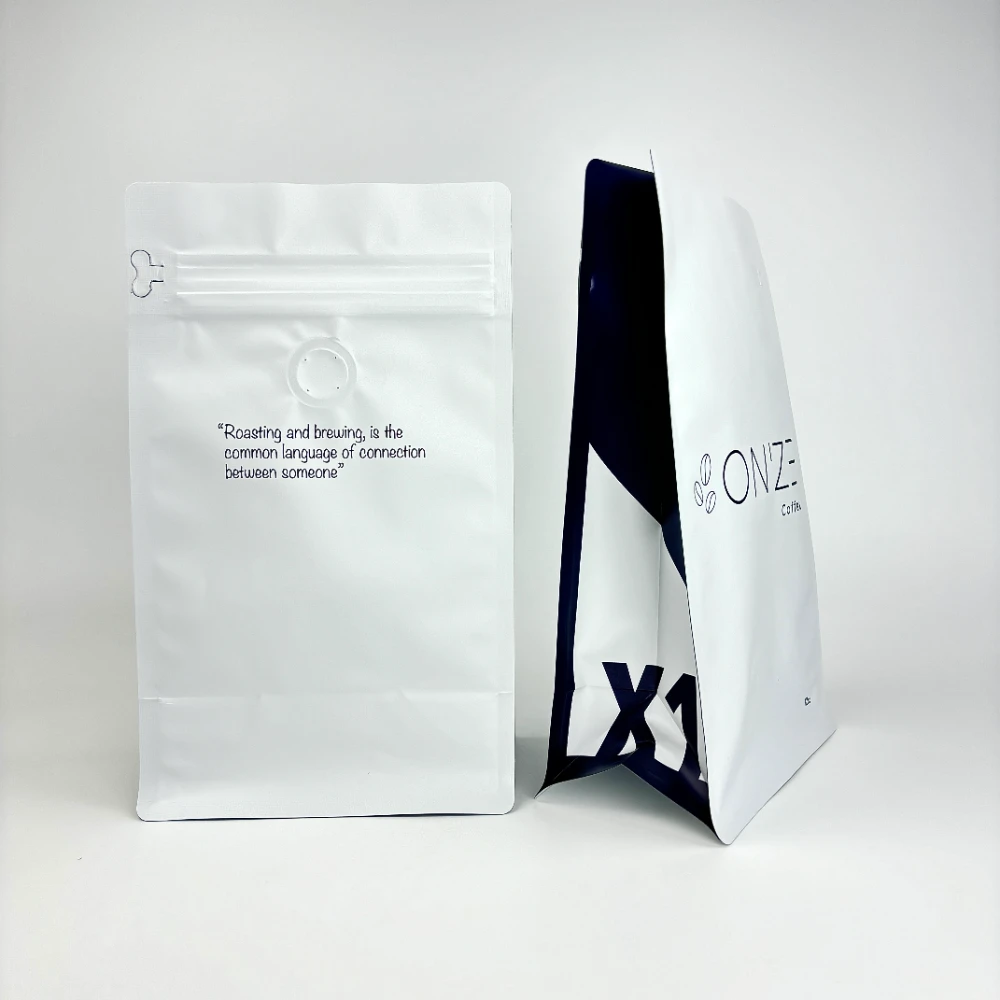
Custom white flat-bottom coffee bags produced at JINYI — clean minimal design on high-barrier PET/AL/PE structure, available factory-direct from 500 units with no plate fee
For coffee brands looking to understand how the packaging decisions of other specialty brands compare to Peet’s approach, our breakdowns of Starbucks coffee packaging and Blue Bottle Coffee packaging cover two different design and format strategies in the same specialty segment — illustrated narrative versus typographic minimalism, both on comparable high-barrier film structures. Our coffee packaging solutions page covers the full range of formats, materials, and configurations available for specialty coffee brands at any volume.
Spec
Platform / Intermediary
JINYI Direct Factory
MOQ
500–3,000 units typical
From 500 units (digital print)
Plate / setup fee
Often included in unit price
None for digital print
Degassing valve
Optional add-on
Standard on all coffee bag orders
Dark base coat print
Confirm per supplier
Available — density managed via ESKO
Material spec document
Rarely provided as standard
Included with every order
Scale path
Platform pricing, limited flexibility
Digital → gravure at volume, unit cost drops
Get the Same Structure for Your Coffee Brand
Tell us your bag format, target shelf life, design approach, and quantity. We will come back within 24 hours with a full spec recommendation, material documentation, and a factory-direct price — degassing valve included.
JINYI is a source factory for custom flexible packaging with 15+ years of production experience, serving food, supplement, coffee, and consumer goods brands across 150+ countries. We produce stand-up pouches, flat-bottom bags, and side gusset bags in PET/AL/PE and other high-barrier structures — via HP Indigo digital print from 500 units and gravure printing at volume — with degassing valve installation, full material documentation, and complimentary commercial photography included as standard with every order.
That is what From Film to Finished — Done Right means in practice.
Elsa
Business Development Manager · JINYI Packaging
Elsa leads business development and customer order management at JINYI. With 8 years in foreign trade across Yiwu and Dongguan, she has a sharp understanding of market demand and what buyers actually need — turning real customer insight into the right packaging decisions.
Customer needs Order management Business development
What bag format does Peet’s Coffee use for retail?
Peet’s Coffee uses stand-up pouches (Doypacks) as their primary retail format, available in 10.5 oz, 12 oz, and 18 oz sizes across their whole bean and ground coffee range. The stand-up pouch format works across Peet’s wide retail distribution network — from Whole Foods to Walmart to their own cafés — at a unit cost and shelf performance level that makes it the practical choice for broad multi-channel distribution. Their DTC subscription channel uses a similar flexible pouch format optimised for courier transit.
Why does Peet’s Coffee print the roast date on every bag?
Peet’s prints the roast date — not just a best-before date — as part of their “Obsessed with Fresh” brand commitment. Roasting to order and shipping directly to retail shelves, they commit to delivering coffee within 90 days of the roast date. The printed date allows consumers to verify the coffee’s freshness independently rather than relying on a generic expiry date. For this commitment to be credible, the packaging must support it: high-barrier film, a functional degassing valve, and a fast distribution chain are all prerequisites for the roast date to be an asset rather than a liability.
What film material is Peet’s Coffee packaging made from?
Peet’s Coffee bags use a PET/AL/PE high-barrier laminate — a polyester outer layer for the dark colour base and geometric print, an aluminium foil middle layer providing near-zero OTR (approximately 0.01 cc/m²/day) and complete UV blocking, and a polyethylene inner layer for heat sealing and food contact. The deep colour appearance is produced by a full-coverage dark ink base coat applied to the inner surface of the PET before lamination, with the aluminium foil reflecting the colour back through the transparent PET.
Does Peet’s Coffee packaging have a degassing valve?
Yes. Every Peet’s Coffee retail bag includes a one-way degassing valve. Because Peet’s roasts to order and seals coffee within days of roasting, freshly roasted beans are actively releasing CO₂ at the point of sealing. Without a degassing valve, the accumulated CO₂ pressure would inflate and eventually fail the bag seals. The valve allows CO₂ to exit while preventing oxygen ingress — making the roast-to-seal window operationally viable without compromising the barrier performance of the aluminium foil structure.
Can I get the same dark matte coffee bag as Peet’s Coffee factory-direct with low MOQ?
Yes. The dark stand-up pouch in PET/AL/PE with a one-way degassing valve is a standard production specification available at JINYI from 500 units via HP digital print with no plate fee. Dark base coat printing, geometric or full-coverage colour print, and degassing valve installation are all available as standard on coffee bag orders. Full material specification documentation — OTR, MVTR, film layer breakdown, and food-contact certifications — is included with every order.