JINYI shares practical packaging guidance for your decisions.
Lavazza has been roasting coffee in Turin since 1895. That is 130 years of packaging decisions — from the original metal tin to the vacuum brick that redefined retail coffee freshness in 1971, to the flexible soft bags distributed across 140 countries today, and now to the monomaterial recyclable structures the brand is actively rolling out across its product range. Few brands offer a more complete picture of how coffee packaging technology has evolved and where it is heading. This breakdown covers what Lavazza coffee packaging is actually made of across their product range — the formats, the film structures, the freshness technologies, and the sustainability transition underway — and what those choices mean for coffee brands sourcing flexible packaging today.
130 Years of Packaging Innovation — Why Lavazza’s Packaging History Matters
Luigi Lavazza opened his first grocery store in Turin in 1895, and the company he founded has remained family-owned and Turin-headquartered ever since. That continuity matters for understanding their packaging decisions. Lavazza has not changed hands between private equity firms or been folded into a conglomerate that optimises packaging for margin. Every major packaging decision the brand has made over 130 years has been made with a long-term view — and the packaging evolution reflects that.
The packaging history follows a clear sequence of technological steps. The original metal tin provided strong barrier protection but was expensive, heavy, and non-resealable after opening. In 1971, Lavazza patented the vacuum-sealed brick pack for their Qualità Rossa blend — a ground coffee format that removed oxygen entirely from the sealed package through vacuum extraction, dramatically extending shelf life and setting a new freshness standard for retail ground coffee that competitors spent decades trying to match. The vacuum brick became the company’s global signature format and remains their dominant retail format in European markets today.
The flexible soft bag format — the stand-up pouch and flat-bottom bag range that carries their retail whole bean and ground coffee lines globally — represents the next phase. Flexible bags offer lower material weight, lower logistics cost, consumer-friendly resealable closures, and a large printable surface for the brand’s increasingly sophisticated design work. The most recent chapter — Lavazza’s transition toward monomaterial recyclable structures — is underway now, and it represents the most technically complex packaging challenge the brand has undertaken since the vacuum brick itself. In November 2024, Lavazza launched their Dolcevita line in new packaging, signalling a full visual and material refresh across the retail range. Understanding this full arc from tin to vacuum brick to flexible bag to recyclable monomaterial is the most useful context for any coffee brand making packaging decisions today.
Note: Lavazza is the world’s sixth-largest coffee roaster and distributes across 140 countries. Their packaging decisions influence supplier capabilities, retailer expectations, and consumer packaging literacy at a scale that shapes what the category looks like globally. When Lavazza commits to a packaging format or material technology, the broader industry notices.
What Bag Formats Does Lavazza Use Today?
Lavazza’s retail packaging portfolio covers three primary formats, each serving a distinct consumer occasion and distribution channel. Understanding which format Lavazza applies to which product line — and why — gives coffee brands a practical framework for their own format decisions.
The vacuum brick pack is Lavazza’s most recognisable format — particularly for their Qualità Rossa blend, which is among the highest-volume retail ground coffee products in Europe. The vacuum brick is a fully sealed, oxygen-free package achieved by extracting all air from the package before sealing, then applying an external hermetic seal. The result is a package with near-zero internal oxygen — extending the shelf life of pre-ground coffee to 24 months or beyond under ambient storage conditions without a degassing valve, without nitrogen flushing, and without any active atmosphere modification. The trade-off is that vacuum bricks cannot be used for freshly roasted whole bean coffee — the CO₂ still outgassing from freshly roasted beans would re-pressurize the package within hours of sealing. Vacuum bricks are the format of choice for pre-ground coffee with a predictable, extended shelf life requirement.
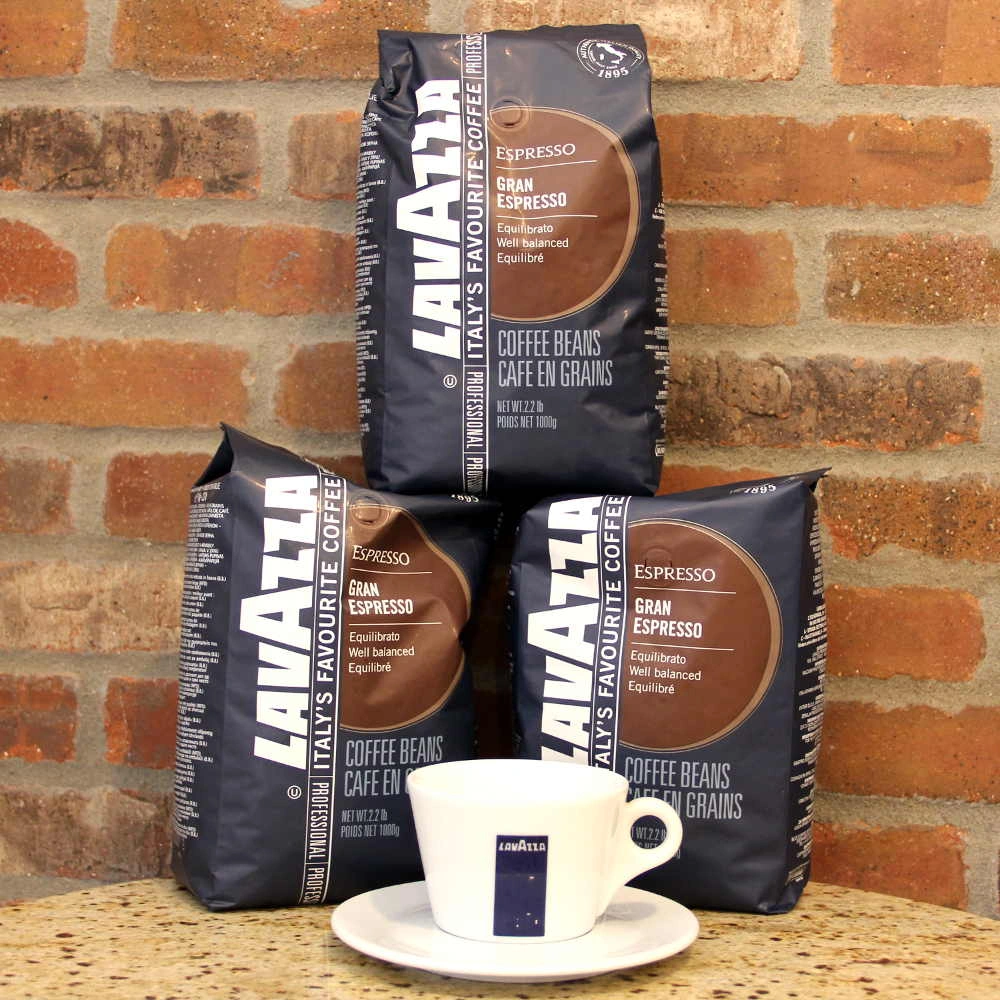
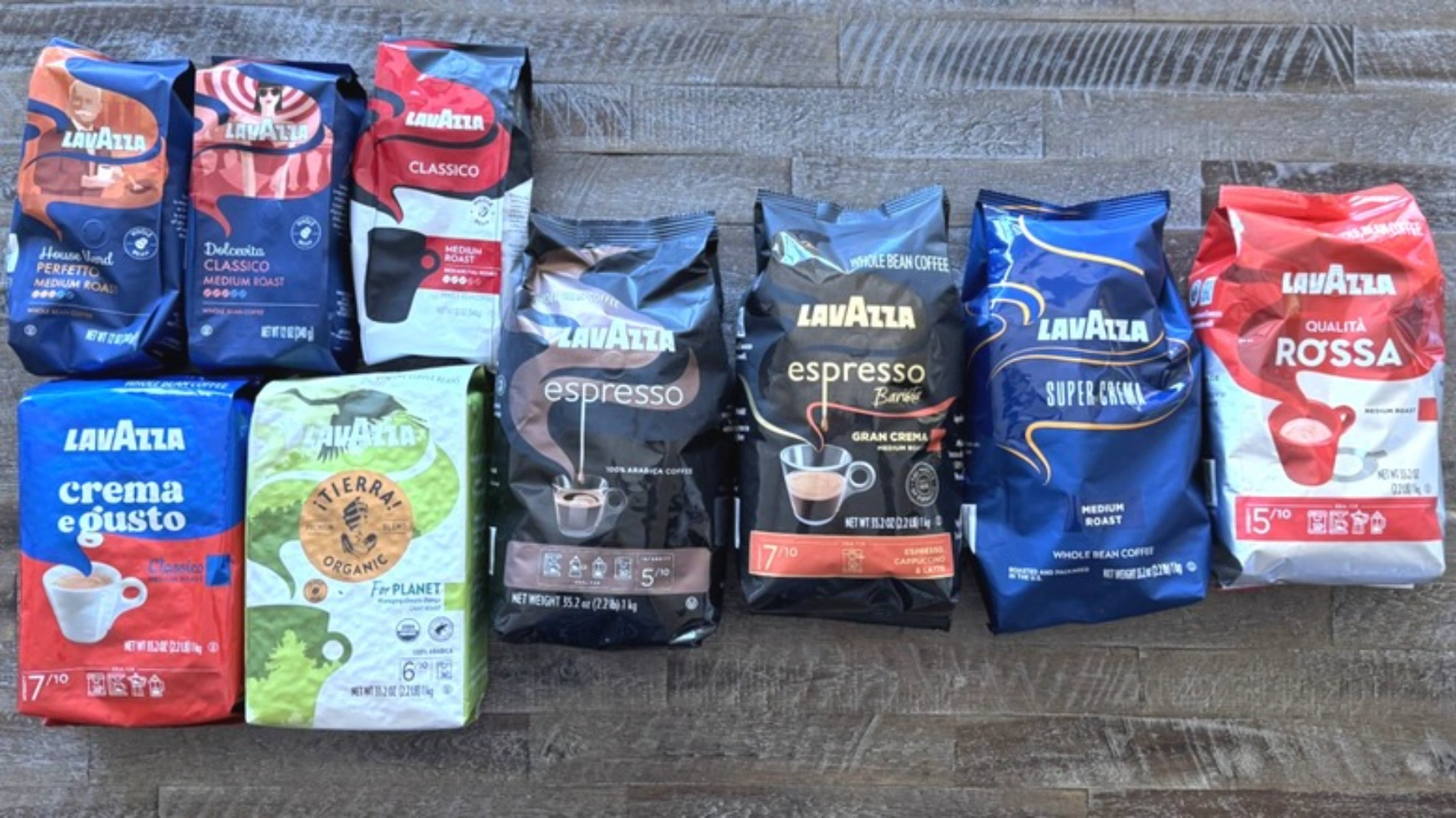
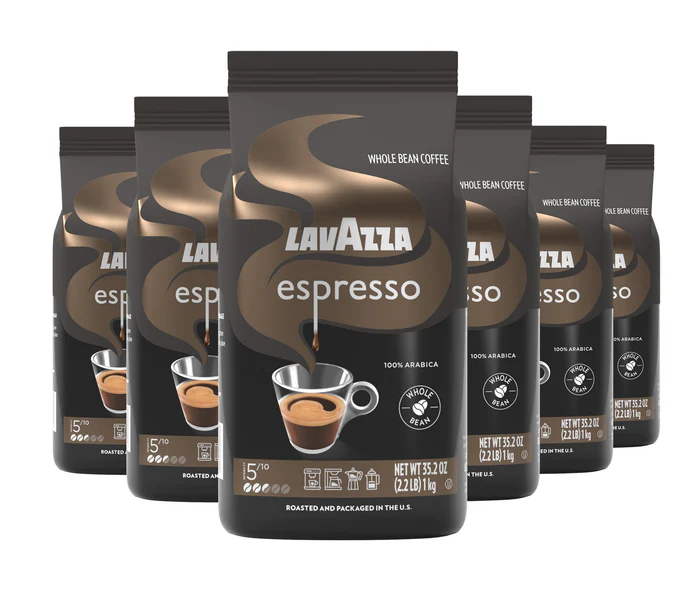
The flexible soft bag — Lavazza’s primary format for whole bean coffee globally and a significant part of their ground coffee range in North American markets — is a stand-up pouch or flat-bottom bag in a high-barrier flexible laminate. Their 12 oz retail soft bags cover blends including Super Crema, Espresso, Gran Crema, and the Qualità Rossa retail pouch alongside the brick. The stand-up pouch format dominates the smaller retail sizes (250g to 500g), while the flat-bottom bag appears in their premium and larger-format SKUs where shelf stability and print canvas are priorities. All whole bean soft bags are fitted with a patented one-way degassing valve — a feature Lavazza specifies across their entire whole bean range because freshly roasted beans continue to release CO₂ after packaging.
The nitrogen-flushed soft pack is a third format used for Lavazza’s filter coffee and drip-format products — single-dose filter packs and portion packs designed for office coffee systems and foodservice. These are sealed with nitrogen flushing rather than vacuum extraction, replacing internal oxygen with inert nitrogen gas before sealing. Nitrogen flushing is compatible with flexible bag formats where vacuum extraction would collapse the bag structure, and it delivers similar oxygen displacement performance to vacuum sealing in a format that can accommodate varying product densities and fill profiles.
Format
Freshness Method
Best For
Key Lavazza SKU
Vacuum brick
Full vacuum extraction
Pre-ground coffee, long shelf life, mass retail
Qualità Rossa (Europe)
Flexible soft bag (whole bean)
One-way degassing valve
Whole bean, resealable, DTC + retail
Super Crema, Gran Crema, Espresso
Flexible soft bag (ground)
Nitrogen flush or valve
Ground coffee, retail pouch format
Qualità Rossa (North America)
Filter / portion pack
Nitrogen flush
Foodservice, office coffee, single-serve
Top Class Filter Packs
Tip: The format decision for a new coffee brand often comes down to one question: is the coffee being packaged within 72 hours of roasting, or is it pre-rested ground coffee? Freshly roasted whole bean needs a degassing valve in a flexible bag. Pre-ground coffee that has been rested can use either a valve-equipped flexible bag or a vacuum brick if the target shelf life is 18 months or longer. For brands launching their first SKU, our guide to stand-up pouches vs flat-bottom bags for coffee covers the format decision in detail.
Film Structure — The Science Behind the Italian Bag
Lavazza’s flexible soft bags use the standard high-barrier multi-layer laminate that has defined premium retail coffee packaging for decades: PET / AL / PE. The outer polyester layer provides the print substrate for their full-colour Italian-inspired artwork. The middle aluminium foil layer delivers near-zero oxygen and moisture transmission — an OTR of approximately 0.01 cc/m²/day — protecting the volatile aromatic compounds in the coffee that determine flavour and freshness through the retail distribution cycle. The inner polyethylene layer provides the heat-seal surface and food-contact safety at the inner bag wall.
For their whole bean range, the film structure works in combination with two freshness technologies applied at the point of sealing. The first is the one-way degassing valve — fitted to every whole bean bag to allow the CO₂ produced by freshly roasted beans to exit the sealed package without allowing oxygen to enter. The second is nitrogen flushing on select SKUs — the practice of displacing residual oxygen from inside the bag with inert nitrogen gas immediately before sealing, bringing internal oxygen content close to zero and extending the effective shelf life beyond what the valve alone achieves. These two technologies work on different problems: the valve manages the CO₂ pressure build-up from inside, while nitrogen flushing manages the residual oxygen from outside. Together, they create the near-zero oxygen environment that protects Lavazza’s coffee through distribution channels that may span continents and multiple months of transit and storage.
The vacuum brick uses a fundamentally different approach. Rather than managing gas exchange through valves and flushing, the vacuum brick simply removes all gas from the package before sealing — no oxygen, no CO₂, no nitrogen. This is why the vacuum brick achieves shelf lives of 24 months or more for pre-ground coffee without any active atmosphere management after sealing. The film structure of the vacuum brick is a foil-laminate similar to the flexible bag — PET/AL/PE or equivalent — but applied in a rigid brick geometry that maintains its shape under vacuum rather than collapsing. To understand how these film structures are produced at the manufacturing level — from raw film through lamination, bag forming, and valve installation — our complete guide to how custom stand-up pouches are made covers every production stage in detail.
Film Structure
OTR
Freshness Technology
Shelf Life
PET / AL / PE (flexible bag)
~0.01 cc/m²/day
Degassing valve + N₂ flush
12–18 months
PET / AL / PE (vacuum brick)
~0.01 cc/m²/day
Full vacuum extraction
24+ months
PET / VMPET / PE
0.5–1.5 cc/m²/day
Degassing valve
12 months
Monomaterial PE (recyclable)
Advanced engineering
Degassing valve + N₂ flush
12 months (target)
Note: Nitrogen flushing and degassing valves address different problems and are most effective when used together for freshly roasted whole bean coffee. The valve manages CO₂ pressure from inside the bag after sealing. Nitrogen flushing manages residual oxygen inside the bag at the moment of sealing. A bag with only a valve but no nitrogen flush will still have residual oxygen at the point of sealing — which begins degrading the coffee immediately. A bag with nitrogen flush but no valve will experience CO₂ pressure build-up from freshly roasted beans. Together, they create the optimal internal atmosphere for freshness preservation.
Lavazza’s Sustainability Transition — Two Structures, Two Strengths
Lavazza’s multi-layer PET/AL/PE packaging already represents the performance gold standard in retail coffee packaging — near-zero OTR, complete UV blocking, 24-month shelf life on vacuum-packed formats, and proven reliability across a global distribution network spanning 140 countries. From a pure product protection standpoint, the structure has nothing left to prove. The sustainability transition Lavazza is now pursuing does not stem from any inadequacy in the existing structure’s performance. It stems from a separate, parallel objective: end-of-life recyclability.
Multi-layer laminates combining polyester, aluminium foil, and polyethylene cannot be processed in standard recycling streams because their layers are made from incompatible materials that cannot be separated economically at scale. The bag performs exceptionally well through its useful life — and then presents a recycling challenge at end of life. Lavazza’s response has been a phased, technically rigorous transition: in 2020, their first soft pack without aluminium foil; in 2021, improved barrier versions of the same; in 2022, monomaterial polyethylene structures; in 2023, the extension of monomaterial structures to whole bean packaging; in 2024, monomaterial polypropylene vacuum packs. The result across this transition has been a 40% reduction in CO₂ emissions from primary flexible packaging — a material outcome achieved alongside, not instead of, maintaining product quality.
The technical challenge of monomaterial coffee packaging is achieving adequate barrier performance from a single-polymer structure. Standard polyethylene has an OTR significantly higher than aluminium foil — which is why the industry defaulted to multi-layer laminates in the first place. Lavazza and their material partners have addressed this through advanced film engineering: specially formulated high-barrier PE grades, EVOH barrier layers within an all-polyolefin structure, and precise lamination parameters that achieve barrier performance approaching, though not yet matching, the aluminium foil benchmark. The trade-off is deliberate and transparent: for product lines with faster inventory turnover and shorter distribution chains, the monomaterial structure delivers sufficient barrier performance. For products requiring 18-month or 24-month shelf life across long-haul global distribution, the multi-layer PET/AL/PE structure remains the right specification.
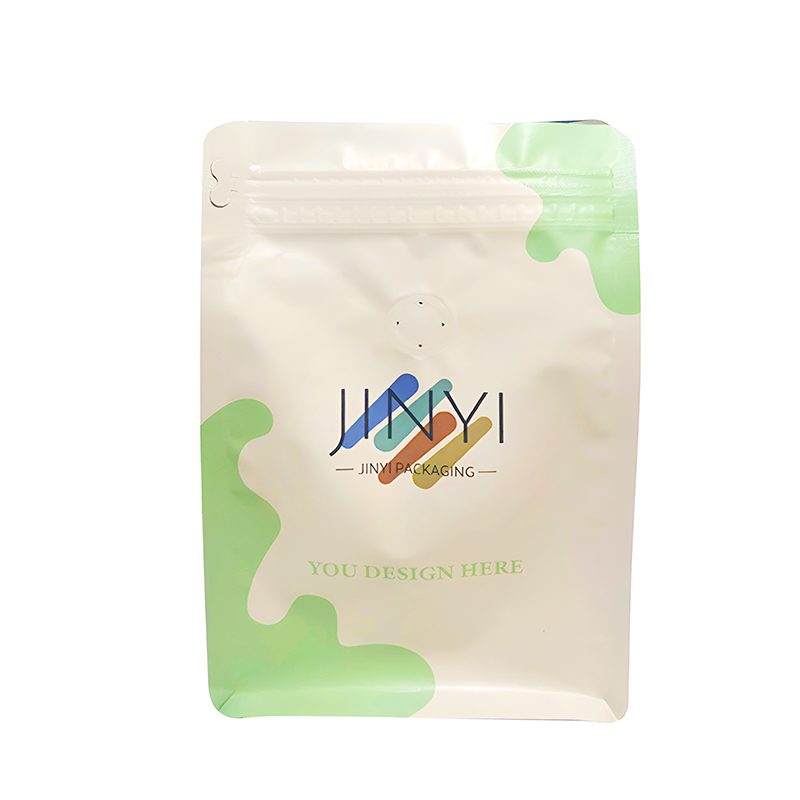
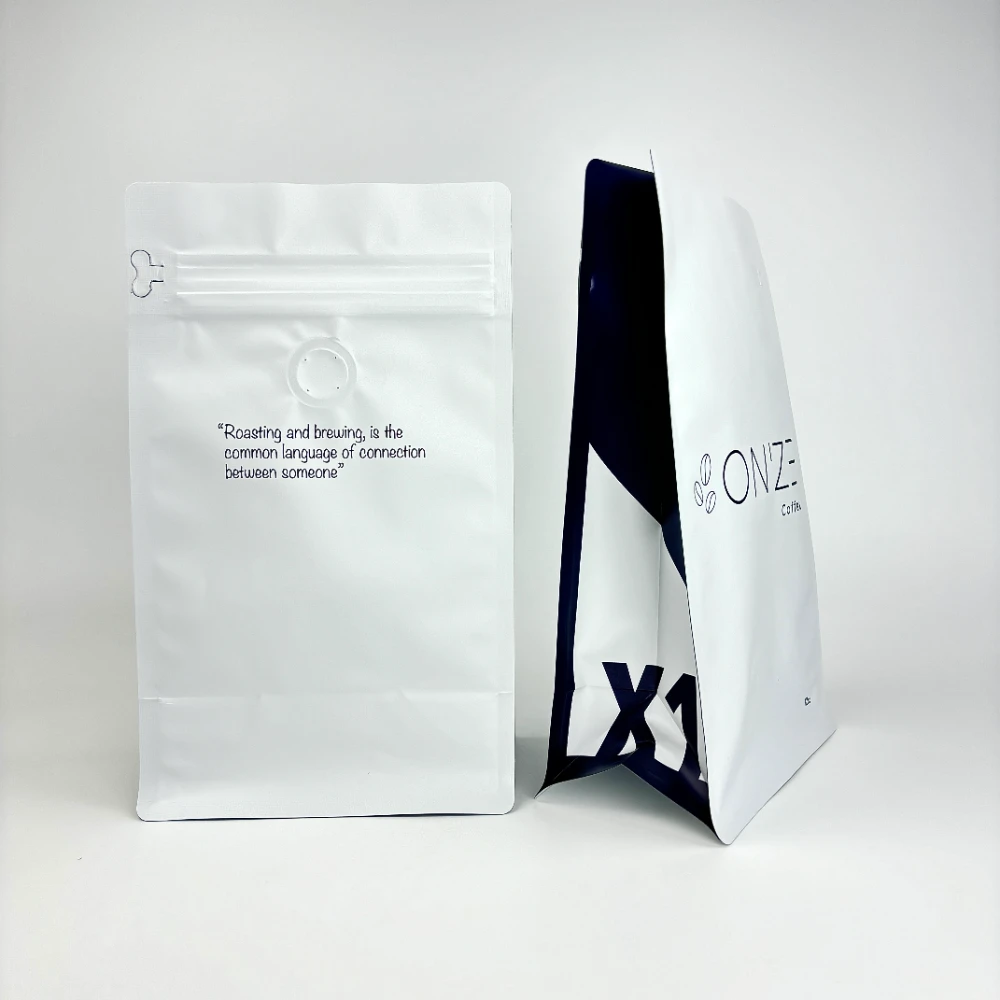
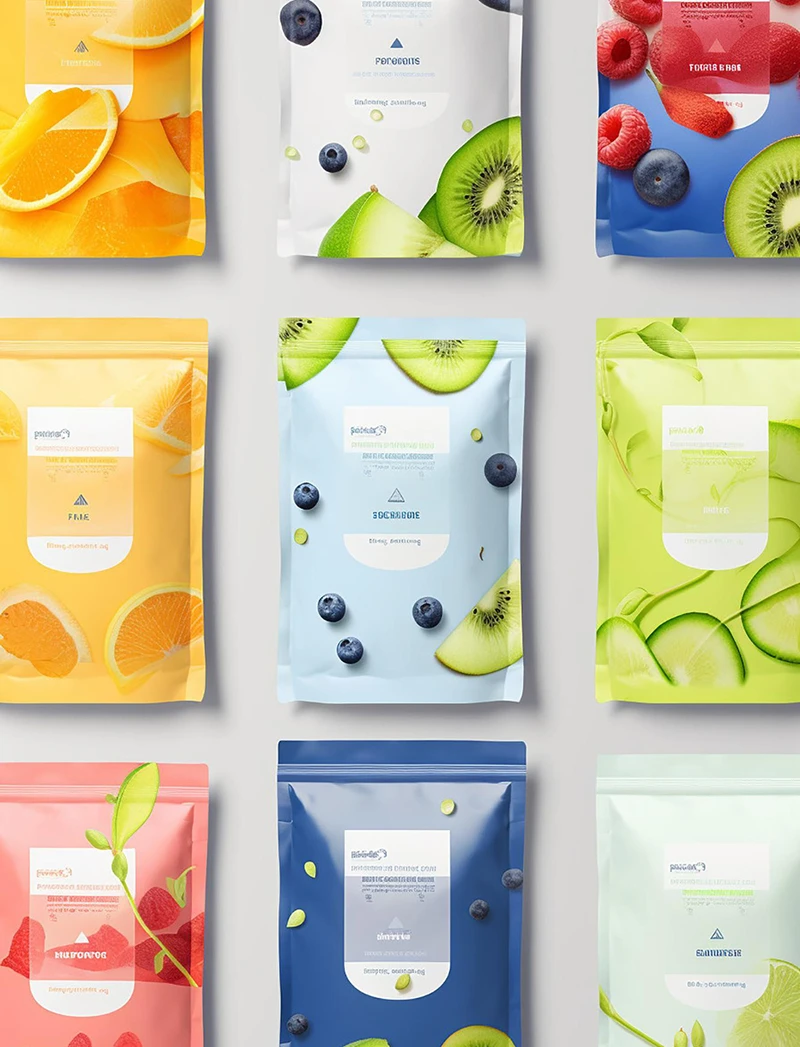
Custom white flat-bottom coffee bags produced at JINYI — clean minimal design on high-barrier PET/AL/PE structure, available factory-direct from 500 units with no plate fee
Dimension
Multi-Layer PET/AL/PE
Monomaterial PE/PP (Recyclable)
Barrier performance
Maximum — OTR ~0.01 cc/m²/day
Very good — advanced engineering PE/PP
Shelf life
12–24+ months
12 months (target under standard conditions)
Recyclability
Requires specialist recycling stream
Compatible with PE/PP recycling streams
CO₂ impact
Standard — aluminium production carbon cost
40% lower — Lavazza’s measured outcome
Best application
Long distribution chains, extended shelf life, global retail
Fast-turnover DTC, European retail, sustainability-positioned brands
Market maturity
Fully mature — decades of proven performance
Rapidly developing — Lavazza at the leading edge
Lavazza’s approach is instructive precisely because they are not choosing between the two structures — they are deploying both, matching the structure to the product’s specific shelf life requirement, distribution chain, and target market. Qualità Rossa ground coffee in European mass retail — a product with long distribution chains and a 24-month shelf life requirement — stays in the proven PET/AL/PE vacuum brick. Whole bean products with faster turnover and a European sustainability-conscious retail audience move toward monomaterial structures. The decision framework is: match the packaging specification to the product’s actual requirements, not to an ideological position about which material is “better.”
Note: For coffee brands considering a sustainability move in their packaging, Lavazza’s phased approach is the most practical model available. They did not switch their entire range overnight — they identified the products where monomaterial structures could meet the barrier requirement, transitioned those first, and continued developing the technology for products where the barrier gap is not yet closed. A brand that switches to monomaterial before the barrier performance matches the product’s actual shelf life requirement is trading one problem for another.
The Dolcevita Redesign — What Lavazza’s New Look Tells Brands About Visual Evolution
In November 2024, Lavazza launched a new packaging design for their Dolcevita line — a full visual refresh inspired by the Italian concept of “La Dolce Vita,” featuring bold colours, intricate pattern, and the sophisticated design vocabulary that characterises premium Italian consumer goods. The new packaging covers all products in the Dolcevita range including bagged coffee and capsule formats, and represents the most significant visual update to a Lavazza consumer line in recent years.
The Dolcevita redesign is an example of a brand managing visual evolution without disrupting brand equity. Lavazza’s core visual language — the warm Italian colour palette, the sense of occasion and quality, the Italian cultural reference points — remains intact in the new design. What changes is the execution: more contemporary typography, bolder colour expression, a more distinctive pattern language that reads clearly at both retail shelf size and e-commerce thumbnail. The redesign is not a departure from what Lavazza is — it is a sharpening of how they communicate it.
For the print production side, Lavazza’s Italian-inspired design language places specific demands on colour management. The warm terracotta, deep burgundy, and rich golden tones that characterise Italian design require precise Pantone matching and ink density consistency across production runs — because these colours occupy a narrow band where small shifts in saturation or warmth change the emotional tone of the design significantly. A terracotta that runs slightly too cool reads as beige. A burgundy that runs slightly too dark reads as brown. These are the colour management challenges that distinguish premium food and beverage packaging production from commodity flexible packaging.
Tip: When a brand redesigns packaging across a full product line — as Lavazza did with Dolcevita — the most common production risk is colour inconsistency between the first print run and subsequent repeat orders. Establishing a colour standard — specific Pantone references, confirmed ink density readings, and approved physical colour swatches — at the first production run and locking those parameters for repeat orders is what maintains visual consistency across the range over time. Ask your supplier how they document and carry forward colour standards between production batches.
How to Source the Same Coffee Packaging Structure Factory-Direct
The packaging structures Lavazza uses across their flexible bag range — PET/AL/PE high-barrier laminates in stand-up pouch and flat-bottom formats, with one-way degassing valves and nitrogen-flush compatibility — are standard flexible packaging production specifications. At JINYI, the same structures are available factory-direct from 500 units via HP digital print with no plate fee. Degassing valve installation is included as standard on all coffee bag orders. Full material specification documentation — OTR, MVTR, film layer breakdown, and food-contact certifications — is included with every order.
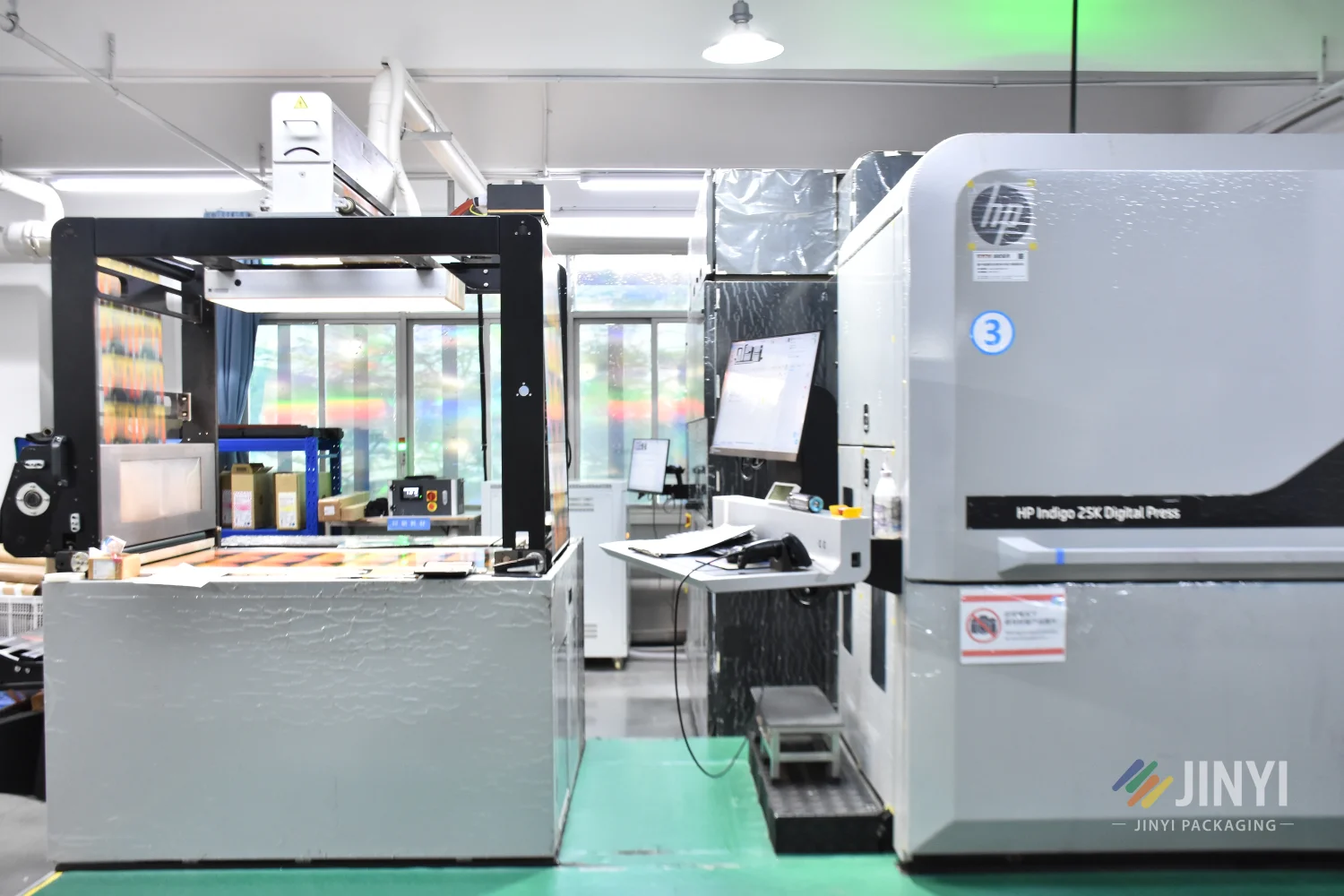
For coffee brands building toward the kind of design-forward, high-colour packaging that Lavazza’s Dolcevita range exemplifies, our HP Indigo digital press fleet — managed through the ESKO Automation Engine — delivers the Pantone accuracy and colour density consistency that premium Italian-inspired design requires. A physical colour proof on the actual film specification is available before production confirmation, so you can verify colour output on the real substrate before committing to a full production run.
HP Indigo 25K at JINYI — consistent colour output across all press systems via ESKO Automation Engine
For coffee brands at the early stage of packaging decisions — choosing between a stand-up pouch and a flat-bottom bag, deciding on degassing valve placement, or working out the right film specification for their distribution chain — our guide to stand-up pouches vs flat-bottom bags for coffee covers those decisions in detail. For broader context on how other major specialty coffee brands approach comparable packaging decisions, our breakdowns of Starbucks coffee packaging, Peet’s Coffee packaging, and Blue Bottle Coffee packaging cover three different format and design strategy approaches in the same specialty segment.
Spec
Platform / Intermediary
JINYI Direct Factory
MOQ
500–3,000 units typical
From 500 units (digital print)
Plate / setup fee
Often included in unit price
None for digital print
Degassing valve
Optional add-on
Standard on all coffee bag orders
N₂ flush compatibility
Confirm per supplier
Supported — advise at quote stage
Colour proof on film
Varies by supplier
Available before production confirmation
Material spec document
Rarely provided as standard
Included with every order
Get the Same Structure for Your Coffee Brand
Tell us your bag format, freshness requirement, design approach, and quantity. We will come back within 24 hours with a full spec recommendation — film structure, valve, nitrogen flush compatibility, and material documentation — at factory-direct pricing.
JINYI is a source factory for custom flexible packaging with 15+ years of production experience, serving food, supplement, coffee, and consumer goods brands across 150+ countries. We produce stand-up pouches, flat-bottom bags, and side gusset bags in PET/AL/PE, PET/VMPET/PE, and other barrier specifications — via HP Indigo digital print from 500 units and gravure printing at volume — with degassing valve installation, nitrogen-flush compatibility, full material documentation, and complimentary commercial photography included as standard.
That is what From Film to Finished — Done Right means in practice.
Elsa
Business Development Manager · JINYI Packaging
Elsa leads business development and customer order management at JINYI. With 8 years in foreign trade across Yiwu and Dongguan, she has a sharp understanding of market demand and what buyers actually need — turning real customer insight into the right packaging decisions.
Customer needs Order management Business development
What packaging formats does Lavazza use for retail coffee?
Lavazza uses three primary retail formats. The vacuum brick pack — most recognisable for their Qualità Rossa blend in European markets — uses full vacuum extraction to achieve shelf lives of 24 months or more for pre-ground coffee. The flexible soft bag — stand-up pouches and flat-bottom bags — covers their whole bean range globally and ground coffee in North American markets, with one-way degassing valves fitted as standard on whole bean SKUs. Nitrogen-flushed filter and portion packs serve their foodservice and office coffee channel.
What film structure is Lavazza coffee packaging made from?
Lavazza’s flexible soft bags use a PET/AL/PE high-barrier laminate — a polyester outer layer for print quality, an aluminium foil middle layer providing near-zero OTR and complete UV blocking, and a polyethylene inner layer for heat sealing and food contact. Their vacuum bricks use an equivalent foil-laminate structure applied in a rigid brick format. Lavazza is actively transitioning selected product lines to monomaterial PE and PP structures for recyclability, where the product’s shelf life and distribution requirements are met by the monomaterial barrier performance.
Is Lavazza coffee packaging recyclable?
Lavazza is actively transitioning toward recyclable monomaterial packaging — their phased approach began in 2020 with aluminium-free soft packs, expanded to monomaterial PE structures in 2022, extended to whole bean packaging in 2023, and reached monomaterial PP vacuum packs in 2024. The transition has delivered a 40% reduction in CO₂ emissions from primary flexible packaging. Their multi-layer PET/AL/PE formats remain in production for product lines where the monomaterial barrier performance has not yet matched the required shelf life specification.
What is the difference between Lavazza’s vacuum pack and soft pack?
The vacuum brick removes all air from the package before sealing — achieving near-zero internal oxygen without a degassing valve or nitrogen flush, and delivering shelf lives of 24 months or more for pre-ground coffee. It cannot be used for freshly roasted whole bean coffee because the CO₂ still outgassing from freshly roasted beans would re-pressurize the package after sealing. The flexible soft bag uses a degassing valve to manage CO₂ from freshly roasted beans, and may additionally use nitrogen flushing to displace residual oxygen at sealing — achieving 12 to 18 month shelf life in a resealable consumer-friendly format.
Can I get recyclable monomaterial coffee bags factory-direct with low MOQ?
Yes. JINYI produces custom coffee bags in both standard PET/AL/PE high-barrier laminates and recyclable PE monomaterial structures, from 500 units via HP digital print with no plate fee. Full material specification documentation — OTR, MVTR, film layer breakdown, food-contact certifications, and recyclability certification where applicable — is included with every order. Degassing valve installation and nitrogen-flush compatibility are available as standard on all coffee bag orders. Contact us to discuss which structure best matches your product’s shelf life requirement and distribution channel.