JINYI shares practical packaging guidance for your decisions.
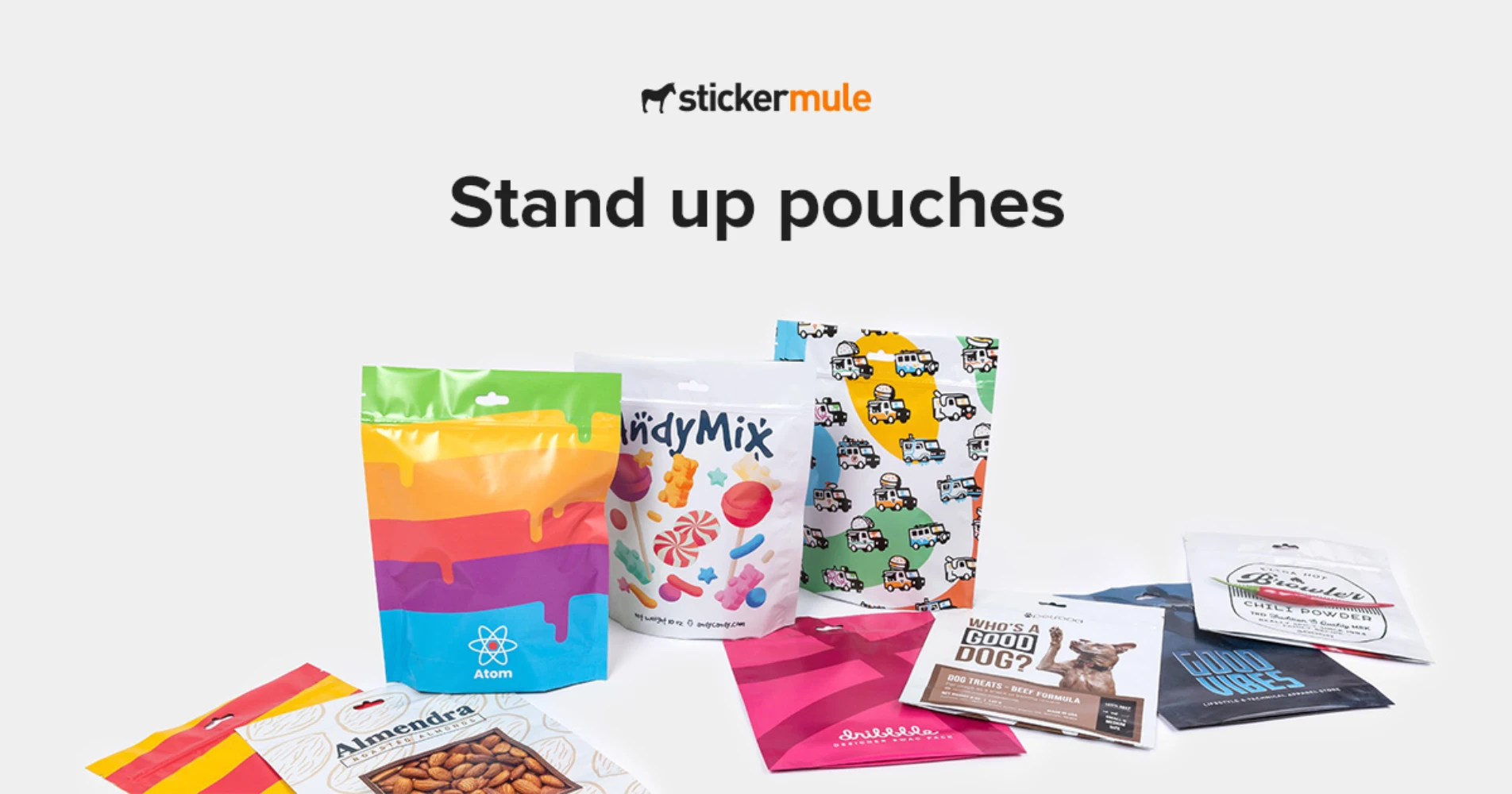
If you have spent any time looking for custom stand-up pouches online, Sticker Mule has probably come up. Fast proofs, free shipping, no minimum order intimidation. For a brand testing its first run of packaging, those things are genuinely appealing. But once your volume grows — or once your product demands more than a basic pouch — the conversation changes, and the platform’s constraints become the story.
This article is not here to dismiss Sticker Mule. It is here to give you the full picture: what the platform actually provides for packaging pouches, where the structural and customization ceiling sits, and what ordering directly from a manufacturer changes — in price, in options, and in how your product ends up looking and functioning on a shelf.
What Does Sticker Mule Actually Offer for Custom Packaging Pouches?
Sticker Mule built its reputation on stickers and labels. Custom stand-up pouches are a more recent addition to their product line, positioned as a natural extension for small brands that already use the platform for their labels and promotional materials. That origin matters — the pouch offering was designed around the same philosophy as their core business: make it fast, keep it simple, and let the brand handle everything else.
Their custom stand-up pouches come in two sizes. The small option has external dimensions of 5 inches by 6 inches with an internal capacity of 4.5 by 4.5 inches. The large option measures 7.75 inches by 10 inches with an internal depth of 6.75 by 9 inches. Those are the only two sizes available — no intermediate options, no oversized formats, no custom dimensions.
The material is a laminated METPET (metalized polyester film) with a matte polyethylene inner layer. The structure provides a functional level of barrier protection, and the metallic interior gives the pouch a foil-like appearance when opened. Both sides can be printed in full color with full bleed. A press-to-close resealable zipper is included as standard. You can optionally add a hang hole punch.
The pouches meet FDA food contact requirements for specified food types and EU food contact regulations. Production turnaround is approximately four business days from proof approval, with free shipping included. The minimum order is 10 units. Physical pre-production samples are not available — you order a small quantity to evaluate the product.
Quick summary: Two sizes. One material. Full-color print on both sides. Zipper and hang hole as your only structural variables. Fast and accessible — as long as your product fits what the platform has already decided to offer.
What Does Sticker Mule Custom Packaging Actually Cost at Different Volumes?
The headline price of $29 for 50 pouches is attention-grabbing. At that scale, you are paying roughly $0.58 per pouch including shipping — competitive for a small test run, and genuinely difficult for a factory to match at that quantity. The problem is that the per-unit cost does not decrease dramatically as volume scales, because the platform is not structured around bulk production economics.
Sticker Mule operates a print-on-demand model. Each order is produced as a standalone job. There is no setup cost amortized across a long run, and no volume discount tier that approaches what a dedicated flexible packaging factory offers once you pass the 500-unit threshold. The gap between platform pricing and factory-direct pricing opens meaningfully at scale — and the wider the gap, the more it reshapes the annual economics of your packaging line.
Order Quantity
Sticker Mule (est. per unit)
Direct Factory (est. per unit)
Notes
50 units
~$0.58
Not standard / sample only
Platform advantage at this stage
500 units
~$0.38–0.45
~$0.28–0.38
Gap begins to open
1,000 units
~$0.32–0.40
~$0.18–0.28
Factory pricing clearly lower
5,000+ units
~$0.28–0.35
~$0.10–0.18
Factory model dominant at scale
Pricing estimates are illustrative and vary by material spec, print complexity, and bag format. Request a direct quote for an accurate comparison.
At 1,000 units, a $0.15 per-unit difference is $150 per order. At 5,000 units with a $0.20 difference, that is $1,000 per production run. For a brand ordering three or four times a year, the compound annual difference covers a significant portion of other growth costs. But price is not the only issue. The deeper constraint is what the platform structurally cannot provide, regardless of how much you are willing to pay.
What Structural Features Are Simply Not Available on the Platform?
This is the section that matters most for product-focused brands. Structure determines whether your product stays fresh, whether it can be merchandised correctly on a retail shelf, and whether the physical experience of using the package matches what your brand promises.
Bag format is fixed at one option. Sticker Mule offers a standard stand-up pouch with a bottom gusset only. There is no flat-bottom bag for brands that need a premium, stable retail presence. There is no side gusset bag for coffee or dry goods that benefit from a traditional block-bottom structure. There is no pillow bag format for single-serve or promotional packaging. The format is making decisions that should belong to your product brief.
Only two sizes are offered. The small and large options cover common applications — but there is no medium size, no tall narrow format for spice or specialty tea packaging, and no oversized bag for bulk or club-pack retail formats. If your fill weight sits awkwardly between the two sizes, you either overpay for unused packaging volume or compress the product to fit a format not designed around your specification.
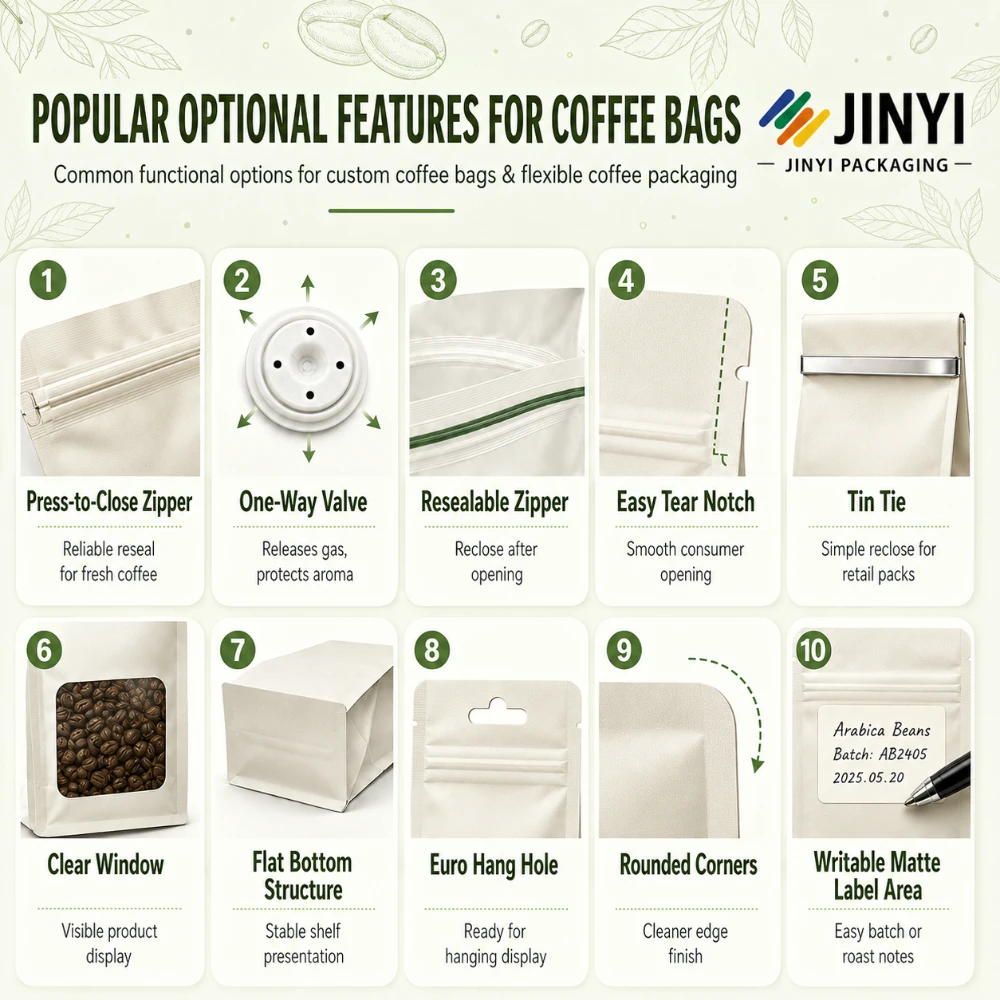
There is no one-way degassing valve. This is a hard stop for fresh-roasted coffee. Coffee releases CO₂ continuously after roasting — without a valve, gas pressure builds inside a sealed pouch and either stresses the seal or forces a multi-day off-gassing wait before packaging. Sticker Mule’s product feedback forums show this has been among the most-requested features since the pouch product launched. It remains unavailable.
There is no transparent window option. Window pouches — where a clear film panel allows the consumer to see the product inside — are standard across premium food, supplement, pet food, and specialty ingredient packaging. They increase purchase confidence and help consumers make faster decisions on shelf. No window option is available in any size or format through the platform.
Zipper type and position are fixed. Every Sticker Mule pouch comes with a standard press-to-close resealable zipper at a fixed position. There is no slider zipper option, no child-resistant closure for regulated product categories, and no tear notch placement choice.
Structural add-ons are minimal. The hang hole punch is the only structural option beyond print. Euro slots, custom tear notch positioning, bottom spouts, and tamper-evident seals are not available at any order volume.
The pattern: Each structural limitation is a deliberate decision that allows Sticker Mule to serve the widest possible audience with the fewest variables. That works for a platform — but only by removing options that real products often require, at any price point.
What About Material Specification, Print Finishing, and Surface Treatment?
Even within a METPET + PE laminate structure, there is a wide range of engineering decisions that determine how a pouch performs. Oxygen transmission rate, moisture vapor transmission, seal strength, and light-blocking performance are specifications that matter for shelf-stable food products, premium supplements, and specialty coffee. Sticker Mule does not publish these barrier specifications, and you cannot request an alternative material grade.
No material alternatives. You cannot request a kraft paper outer for a natural product aesthetic, a clear PET outer for a transparent pouch, or a high-barrier aluminum foil laminate for products requiring extended shelf life or light exclusion. The material structure is fixed regardless of what your product or brand positioning requires.
Print surface finish is matte only. The METPET structure gives the exterior a consistent matte appearance. There is no gloss lamination, no soft-touch coating, and no mixed-finish specification — for example, a matte base with a high-gloss print panel. For brands where the tactile quality of packaging is part of the product experience, this is a meaningful constraint.
No specialty print finishing. Foil stamping, spot UV coating, embossing, metallic Pantone inks, and soft-touch lamination are production capabilities at flexible packaging factories. None are available through Sticker Mule. For brands competing in premium retail categories where shelf presence is a measurable differentiator, the print finish ceiling limits how far the packaging can carry the brand.
No Pantone color matching. Sticker Mule uses digital full-color CMYK reproduction. Brand-specific Pantone colors — which many established brands specify to ensure consistency across packaging, labels, and retail fixtures — cannot be matched. For brands where color consistency across all touchpoints matters, digital-only reproduction introduces variation that cannot be controlled run-to-run.
When Does Sticker Mule Custom Packaging Actually Make Sense?
It is worth being direct: Sticker Mule’s pouch offering is a genuinely good solution for specific situations. The platform was built to serve a different need than factory-direct production, and for that need it performs well.
Testing a new product before committing to a production run. If you need 50 to 200 pouches to validate demand, gather retailer feedback, run a DTC pre-launch, or produce product photography samples, the low minimum and fast turnaround make Sticker Mule a practical starting point. At that stage, structural limitations rarely affect the goal.
Non-food or low-barrier products. Small accessories, craft materials, bath products, or general merchandise that does not require specific food-grade lamination performance, light blocking, or high moisture resistance is well-served by the METPET + PE structure. If barrier specification is not relevant to your product, the material constraint becomes irrelevant.
Speed is the primary constraint. Four business days production plus two-day shipping is genuinely fast. If you have a pop-up, a trade show, or a short-run seasonal product with a fixed date — and the pouch spec is acceptable — the platform’s speed advantage is real.
Early-stage brand with limited cash allocation for packaging. At under 500 units, the per-unit cost difference is modest. For a brand conserving cash before validating its market, avoiding the MOQ discussion of factory-direct can make practical sense — with the understanding that the transition will come.
What Does Ordering Directly from a Packaging Factory Actually Unlock?
The shift from a platform to a direct manufacturer is not just a price renegotiation. It is a change in how packaging is designed, specified, approved, and produced — and in what decisions remain in your hands versus the platform’s pre-set defaults.
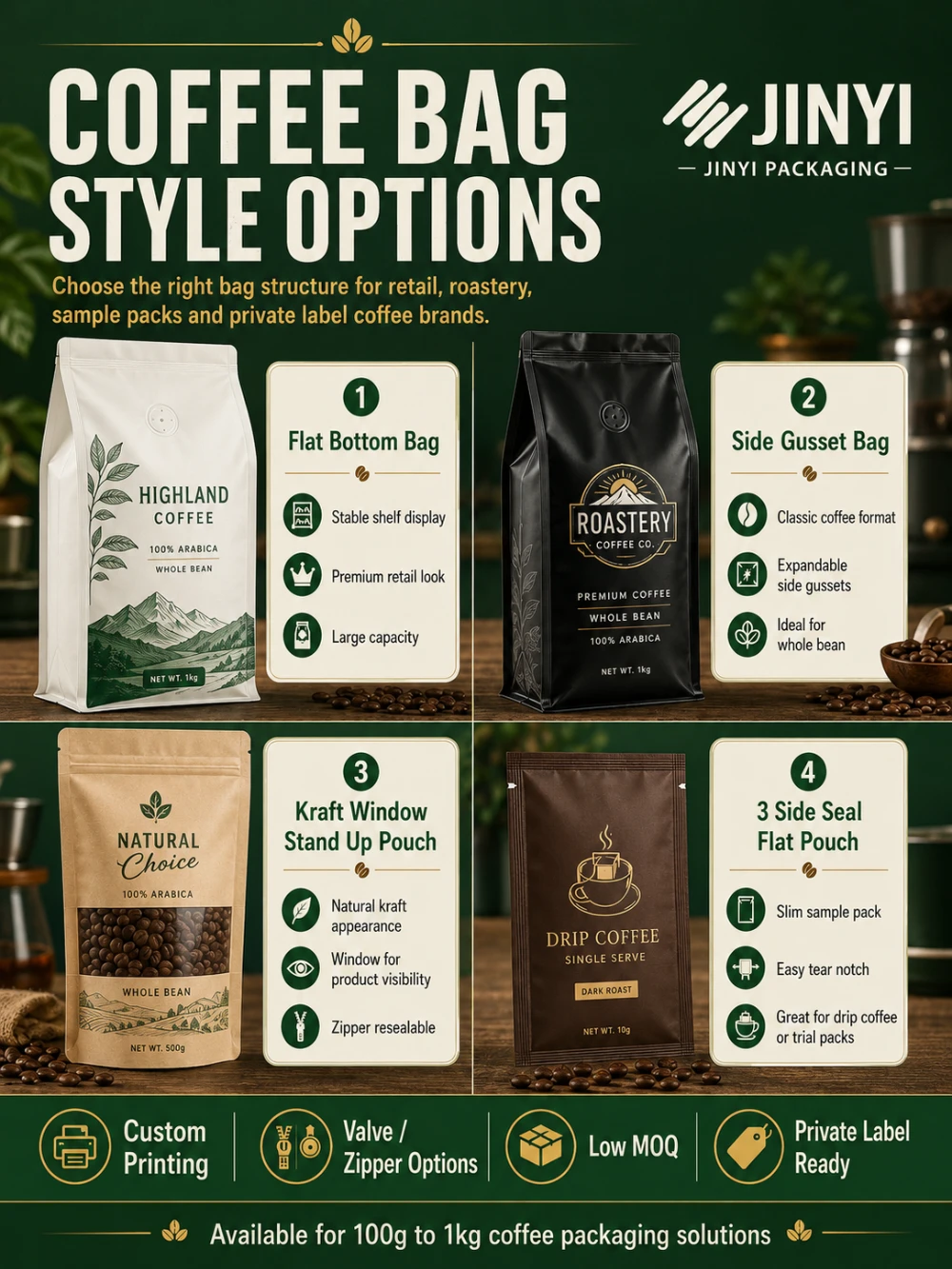
Full bag format selection. A direct factory works from your product requirements and produces the appropriate format. Stand-up pouches, flat-bottom bags, side gusset bags, and pillow bags are all available within the same production line. The format decision belongs to your product brief, not the platform’s catalog.
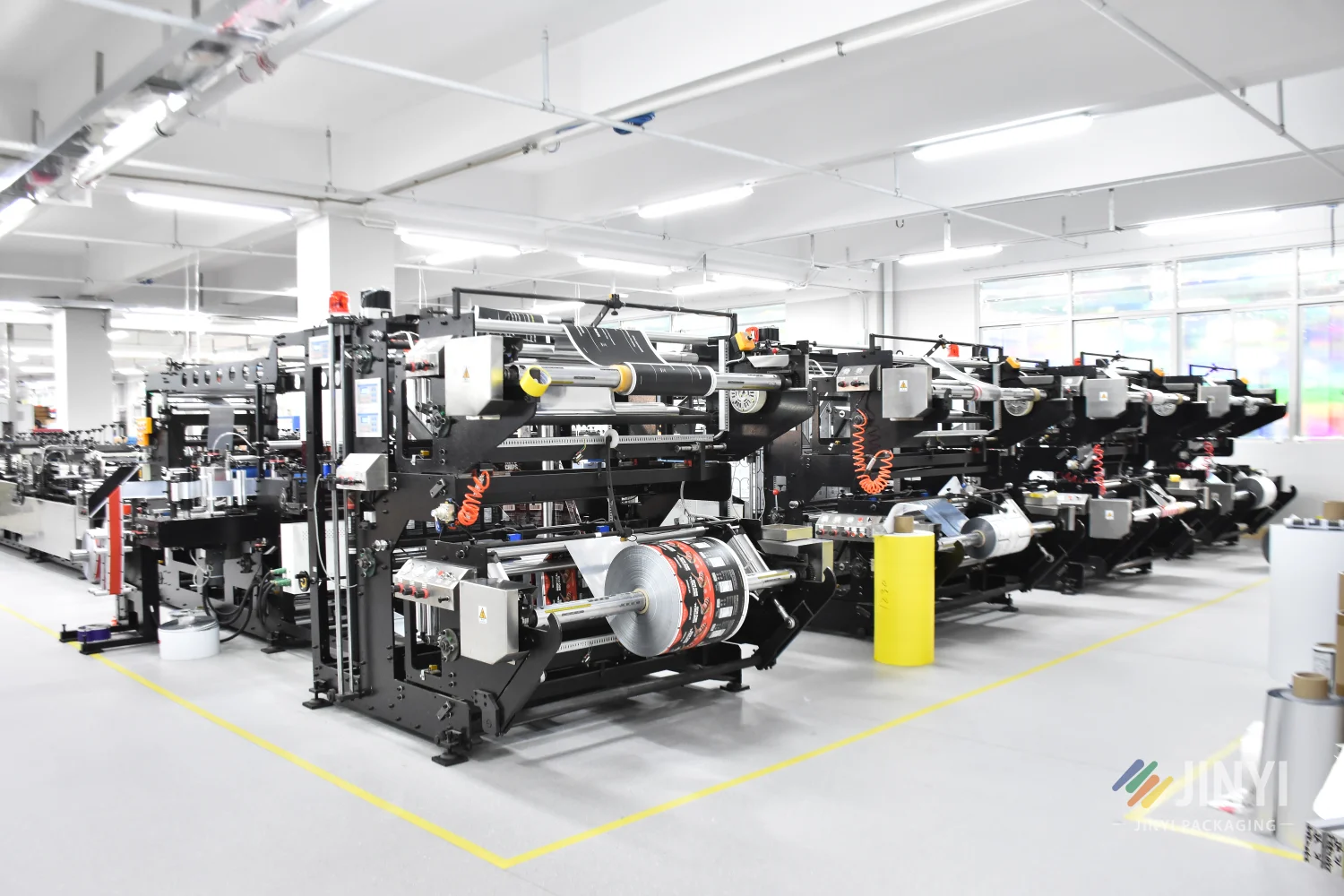
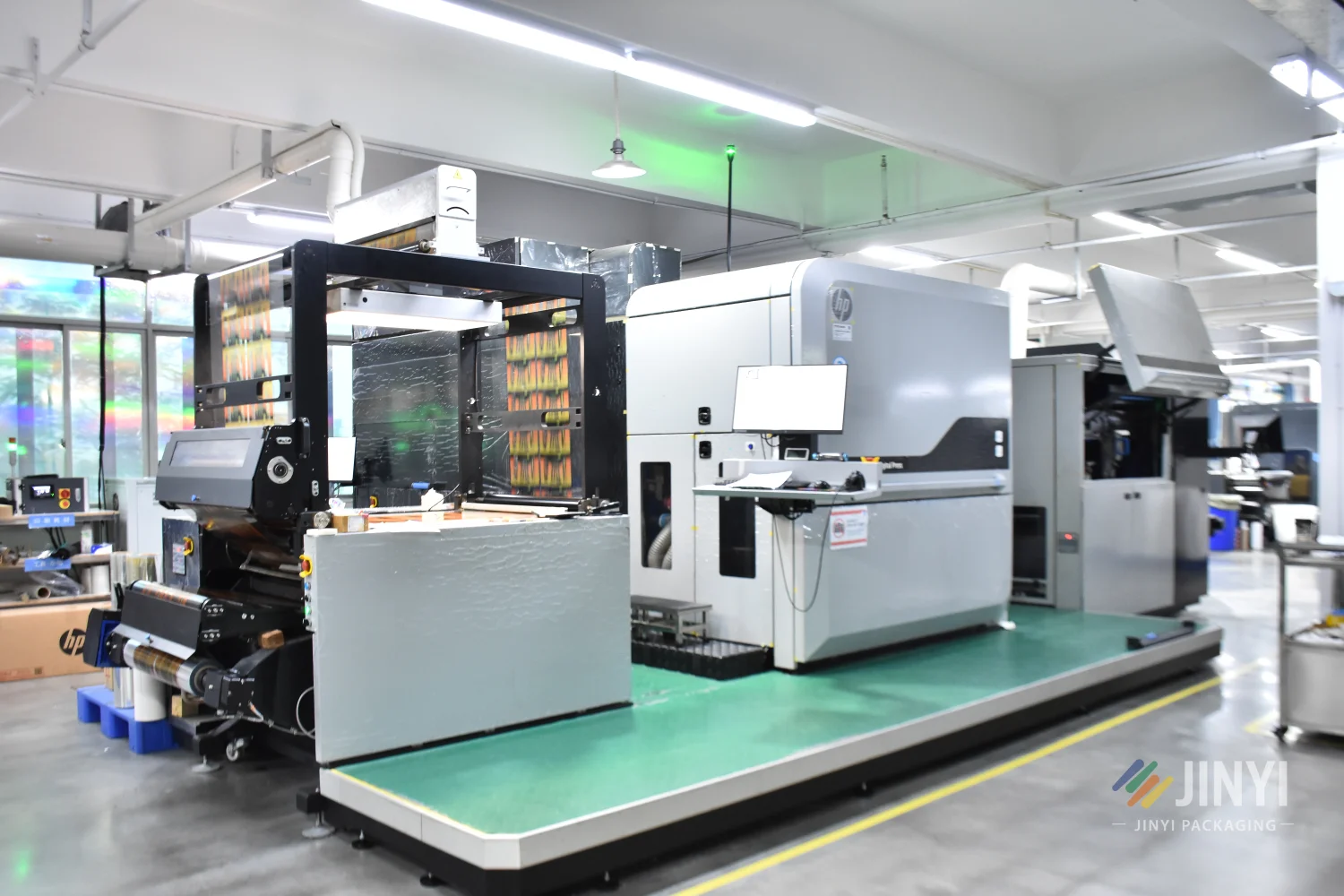
JINYI bag-making line — forming, sealing, and cutting custom stand-up pouches with validated seal parameters for every run
Fully custom dimensions. Any combination of length, width, and gusset depth can be produced to your fill specification. This matters for food brands where packaging-to-product ratio affects consumer perception, and for subscription brands where dimensional consistency across SKUs is essential.
One-way degassing valve. For fresh-roasted coffee, a factory-installed one-way valve is a standard production option. It allows CO₂ to escape after sealing without admitting oxygen — which is what makes it possible to package freshly roasted coffee immediately after roasting. If you are in the specialty coffee business, this is a non-negotiable specification that the platform model cannot provide. See how this applies across the broader coffee packaging solution.
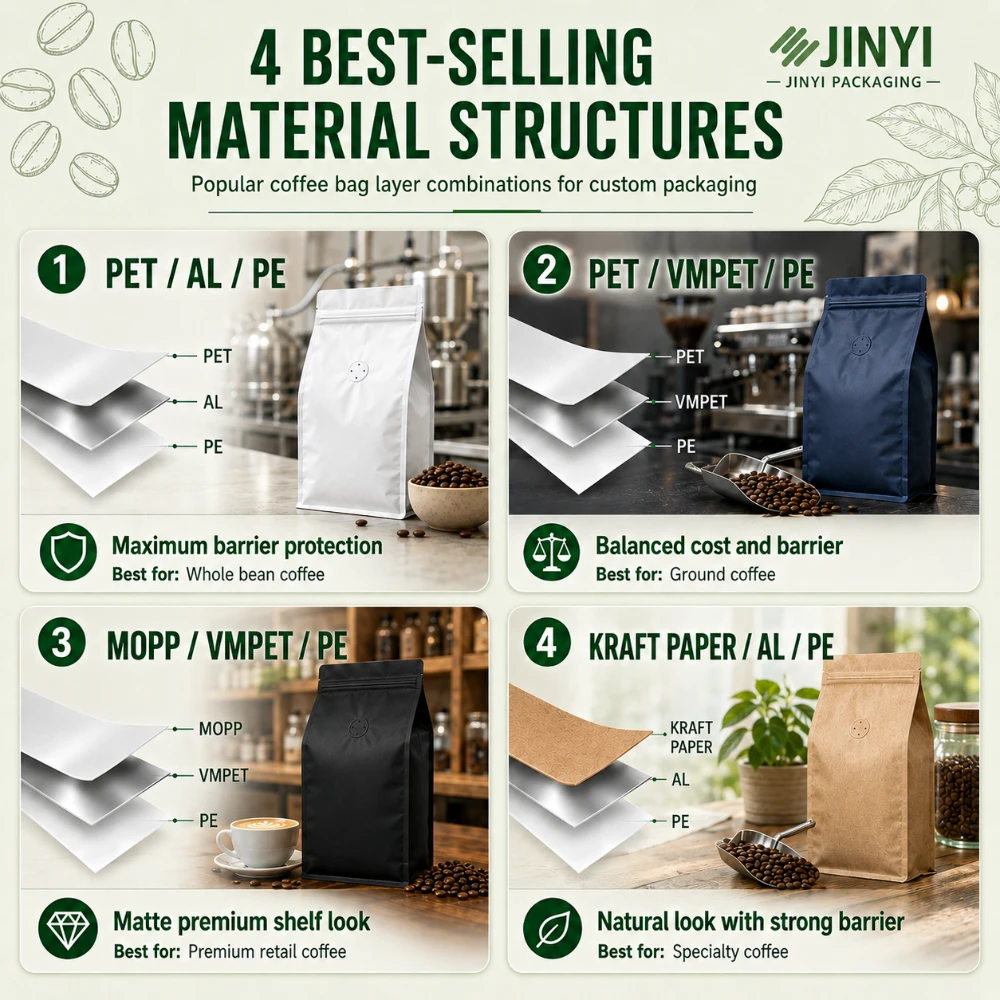
Material specification and barrier engineering. A factory produces to a laminate specification. You can request a kraft paper outer for a natural product aesthetic, an aluminum foil laminate for maximum barrier performance, or a food-contact inner layer with published OTR and MVTR specifications. The material decision is an engineering choice made for your product.
Print finishing and surface treatment. Matte lamination, gloss lamination, soft-touch coating, spot UV, and foil stamping are production capabilities — not premium upgrades from a separate supplier. For brands competing in retail where shelf presence is a measurable variable, these finishing options are the difference between packaging that reads as a category entry and one that reads as a category leader.
Physical pre-production sample. A platform generates a digital proof. A factory produces a physical pre-production sample — a real bag built to your specification that you can fill, seal, photograph, and evaluate before the full production run is approved. For a detailed walkthrough of how the full factory process works, the step-by-step guide to custom stand-up pouch production covers each stage in detail.
The core difference: A platform optimizes for simplicity and accessibility at low volume. A factory optimizes for specification accuracy, cost efficiency at scale, and the ability to engineer a package around a product — not adapt a product to fit a fixed catalog format.
How Do You Decide Which Model Fits Where Your Brand Is Right Now?
The right packaging supplier depends on where your brand sits in its growth cycle, what your product actually requires, and what you are optimizing for at this stage. This is not a binary judgment — many brands start with a platform and transition to factory-direct as their volume and product specification evolve. The question is whether you are planning that transition or discovering it under pressure.
Packaging Decision Factor
Sticker Mule
Direct Factory
Volume under 500 units
✓ Practical and fast
Possible but less economical
Volume 1,000+ units per run
Cost premium grows
✓ Significantly more economical
Fresh coffee (one-way valve required)
✗ Not available
✓ Standard option
Retail shelf product (window required)
✗ Not available
✓ Standard option
Premium finish (foil, soft-touch, spot UV)
✗ Not available
✓ Available on request
Custom dimensions required
✗ Two sizes only
✓ Fully customizable
Flat-bottom or side gusset format
✗ Stand-up only
✓ Multiple formats
Custom material / high-barrier spec
✗ Fixed material only
✓ Engineered to spec
Turnaround under 1 week
✓ 4-day production + 2-day ship
Standard 15–25 business days
Physical pre-production sample
✗ Digital proof only
✓ Physical sample before approval
Pantone / brand color matching
✗ Digital CMYK only
✓ Available with approval process
The brands that get into difficulty are the ones that start on a platform, grow volume, and then discover mid-growth that switching suppliers requires a new dieline, new material approval, a new physical sample process, and a new supplier relationship — while managing existing inventory and customer expectations simultaneously. The earlier you understand where your product specification is headed, the smoother that transition becomes.
Ready to See What a Factory Can Do for Your Packaging?
If your product needs a valve, a window, a custom dimension, or a finish the platform can’t produce — the conversation with JINYI is where that gets resolved. No platform markup. No fixed catalog.
JINYI is a source factory for custom flexible packaging with 15+ years of production experience, serving food, supplement, coffee, pet food, and consumer goods brands across 150+ countries. We produce stand-up pouches, flat-bottom bags, pillow bags, and side gusset bags in PET/AL/PE, PET/VMPET/PE, and other barrier specifications — via HP Indigo digital print from 500 units and gravure printing at volume — with full material documentation included as standard with every order.
That is what From Film to Finished — Done Right means in practice.
Elsa
Business Development Manager · JINYI Packaging
Elsa leads business development and customer order management at JINYI. With 8 years in foreign trade across Yiwu and Dongguan, she has a sharp understanding of market demand and what buyers actually need — turning real customer insight into the right packaging decisions.
Customer needs Order management Business development
Does Sticker Mule offer a one-way degassing valve for coffee pouches?
No. A degassing valve is one of the most consistently requested features in Sticker Mule’s product feedback community and remains unavailable. Fresh-roasted coffee continues releasing CO₂ after sealing — without a one-way valve, pressure builds inside the sealed pouch and compromises seal integrity, or forces a multi-day off-gassing wait before packaging. Coffee brands that need a valve need to work with a flexible packaging factory that produces to specification.
What sizes are available for Sticker Mule custom stand-up pouches?
Two sizes only: small at 5″ × 6″ external dimensions, and large at 7.75″ × 10″ external dimensions. No intermediate, oversized, or custom dimension options are available. Brands requiring specific fill dimensions, non-standard aspect ratios, or custom opening widths need to work directly with a packaging manufacturer.
What material are Sticker Mule stand-up pouches made from?
Laminated METPET (metalized polyester film) outer with a matte polyethylene inner layer. The pouches meet FDA food contact requirements for specified food categories and comply with EU food contact regulations. The material specification is fixed — alternative structures such as kraft paper outers, aluminum foil laminates, or custom barrier grades are not available through the platform.
Can I get foil stamping, soft-touch finish, or spot UV on Sticker Mule pouches?
No. The platform uses full-color digital printing on a fixed matte surface. Specialty print finishing — foil stamping, spot UV, soft-touch lamination, embossing, and metallic Pantone inks — is not available at any order volume. These are standard production capabilities at custom flexible packaging factories and are commonly specified by brands in premium food, beverage, and supplement categories.
What is the minimum order quantity for custom pouches from a direct factory?
At JINYI, standard custom pouch orders typically start from 500 units via HP Indigo digital print. For brands currently at lower volumes and planning to scale, starting the factory conversation early allows both sides to align on the right entry point before volume pressure creates urgency.
How long does a factory order take compared to Sticker Mule?
Sticker Mule delivers in approximately 4 business days production plus 2-day shipping — a genuine speed advantage for urgent, low-volume needs. A custom flexible packaging factory typically operates on a 15 to 25 business day production lead time from final artwork approval, plus transit. The factory timeline reflects production scheduling, physical sample approval, and the full print approval process. For orders where specification accuracy and material performance matter, the longer lead time is the cost of a package that performs correctly.
Can I start with Sticker Mule and switch to a direct factory later?
Yes, and it is a common path. The practical consideration is that switching requires a new dieline, new material approval, a physical sample process, and a new supplier relationship — ideally not under inventory pressure. If your product will eventually need a valve, a window, custom dimensions, or a finish the platform cannot produce, establishing a factory relationship before those features become urgent makes the transition far smoother.