JINYI shares practical packaging guidance for your decisions.
LMNT (pronounced “element”) is a US-based electrolyte brand founded in 2018 by Robb Wolf, a research biochemist and former strength coach. The brand is built around a single, specific formulation: 1000mg sodium, 200mg potassium, and 60mg magnesium per serving — with no sugar, no fillers, and no artificial ingredients. That formula was developed as a direct response to what Robb Wolf saw as chronically under-salted hydration advice, particularly for people following low-carbohydrate or ketogenic diets where electrolyte loss is accelerated. LMNT has grown into one of the most recognized names in the functional hydration category, sold through its own DTC channel, Amazon, and an expanding retail footprint across North America.
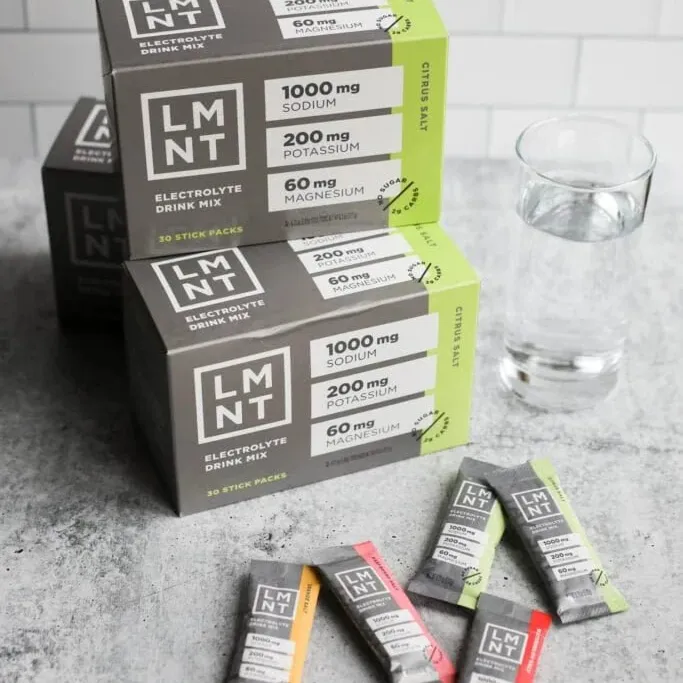
LMNT’s packaging does not try to do everything at once. There is no oversized resealable pouch competing for pantry space, no premium jar suggesting a long-term relationship with the product. What they chose instead is a stick pack — a single-serve format that forces a decision: one serving, right now, mixed into water. That choice is not accidental. It is a positioning decision expressed in packaging form.
The stick pack itself is a technically demanding format. Getting it right — seal integrity under powder contamination, easy tear without a notch, moisture and oxygen barrier that keeps electrolyte salts dry and free-flowing — requires a laminate structure built specifically for these conditions. LMNT has not published its film specification publicly, but the observable properties of the pack tell a clear story about the structure underneath.
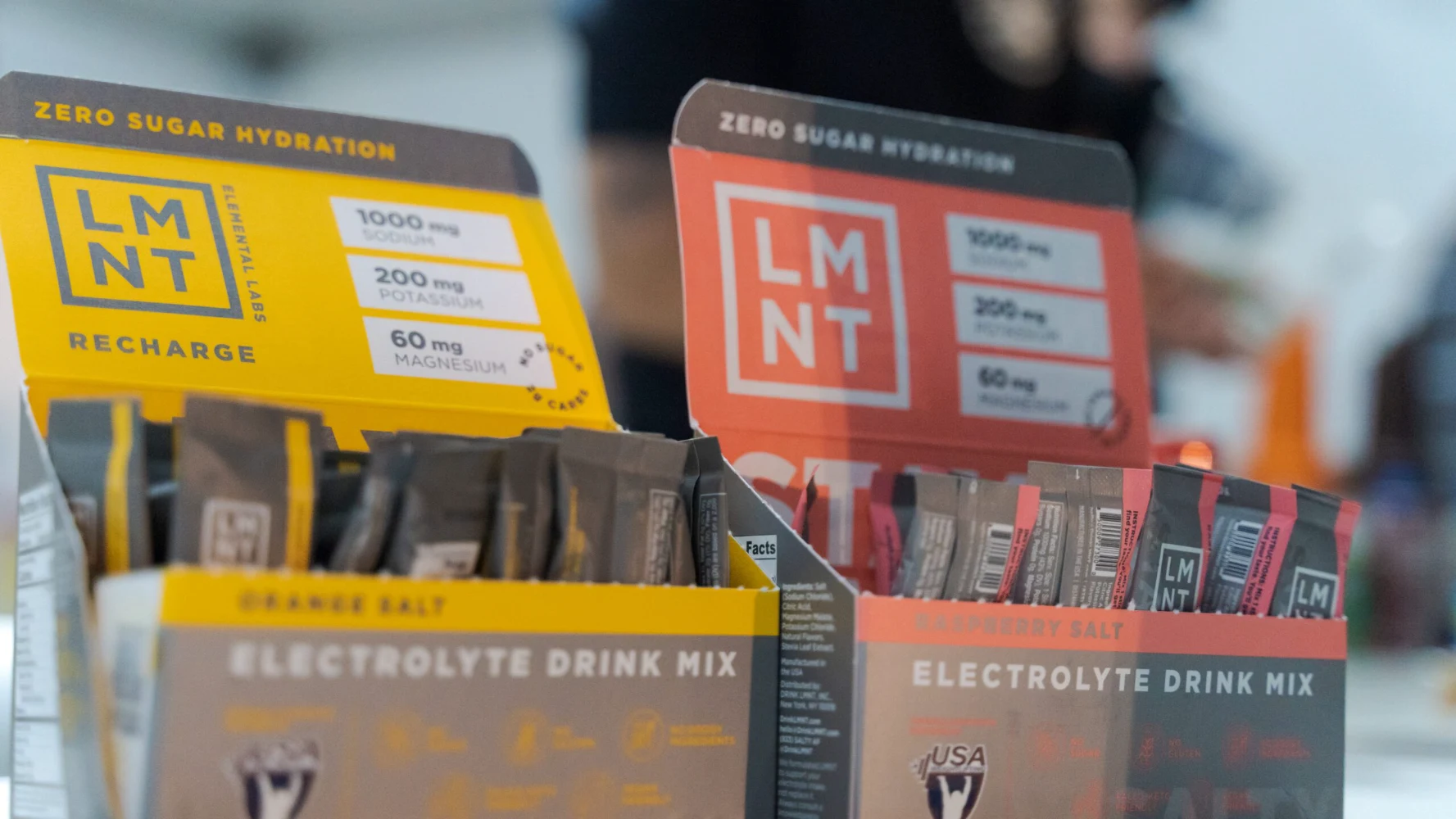
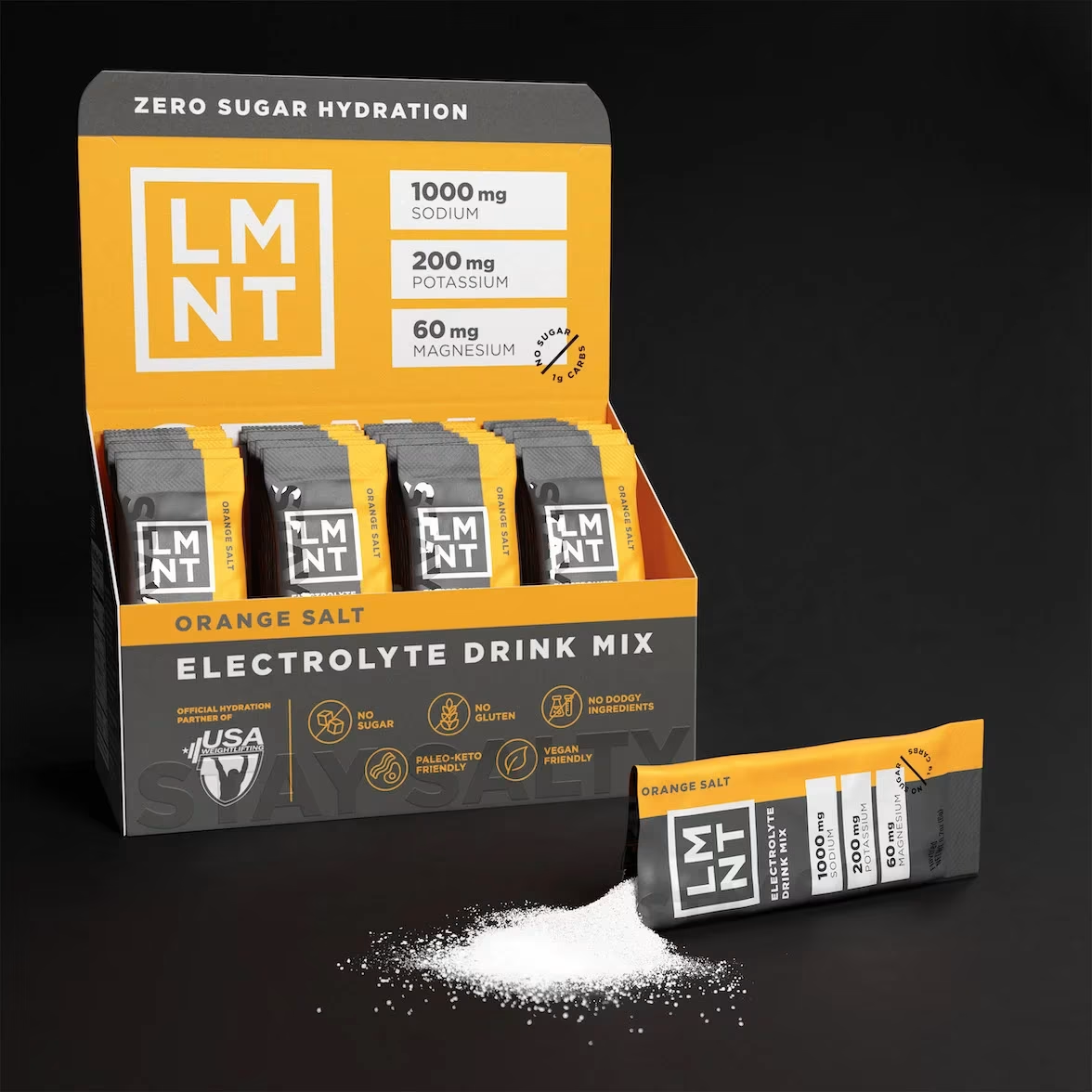
Around the stick packs sits a custom carton — full-color printed, with spot gloss UV on select elements and a die-cut purse-style closure. That box is doing different work than the stick pack: it handles the brand experience, the retail shelf moment, and the DTC unboxing. The two formats operate as a system, and understanding why each was specified the way it was is useful for any brand designing similar packaging for electrolyte powders or dry supplements.
Why Did LMNT Choose Stick Packs Over a Bulk Pouch or Canister?
The stick pack format is not the easiest format to produce or the cheapest per-unit. Compared to a bulk resealable pouch or a plastic canister, the stick pack requires more film per gram of product, more individual seals, and more precise fill-and-seal machine coordination to handle fine electrolyte powder without contaminating the seal area. Brands choose it when the single-serve format earns its cost — and for LMNT, it clearly does.
The core argument is behavioral. A stick pack removes every barrier between the product and consumption: no scooping, no measuring, no questioning whether you took the right amount. One pack, one serving, tear and pour. For a brand built on a specific electrolyte ratio — 1000mg sodium, 200mg potassium, 60mg magnesium — that precision is part of the product promise. A bulk pouch with a scoop introduces variability that undermines the formulation logic.
The portability argument follows directly. Stick packs fit in a gym bag, a jacket pocket, a carry-on without liquid restrictions. This matters for a brand whose core user is an athlete or active professional who uses electrolytes mid-training or while traveling. The format supports the use case in a way that a 500g bulk pouch simply cannot replicate.
It is also worth noting what the format communicates at a category level. A stick pack signals clinical precision and single-use discipline — associations that align with the brand’s positioning around science-backed formulation and health optimization, not casual hydration. Compare this to Liquid IV’s packaging approach, which uses the same stick pack format but with a softer visual language and a wider flavor range — the format is shared, but the packaging systems diverge in design logic from there.
From a production standpoint: The stick pack is a high-precision format. Fine powders migrate into seal zones during filling, which means the film’s sealing layer and the machine’s seal jaw configuration both need to be specified correctly to achieve consistent hermetic seals across a high-speed multi-lane fill line. This is not a format where a generic film off a commodity roll performs reliably at scale.
What Film Structure Does LMNT’s Stick Pack Most Likely Use?
LMNT has not published a formal material specification for their stick pack film. What follows is an analysis of the observable properties of the pack, cross-referenced with standard laminate structures used for electrolyte powder stick packs at this performance level. LMNT has confirmed in their customer Q&A that the packets are not recyclable due to their multi-layer construction — which is consistent with a foil laminate structure.
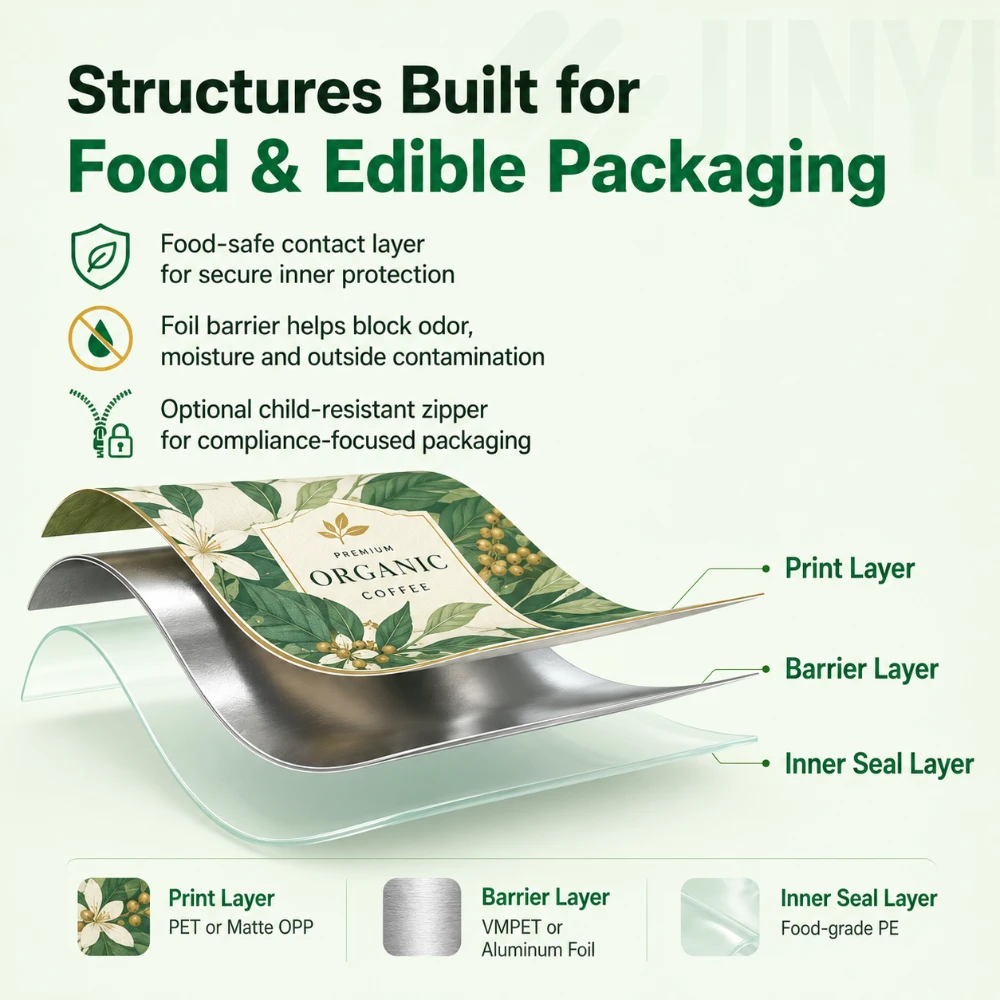
Based on observable characteristics — metallic interior appearance, matte outer surface, and stated non-recyclability — the estimated structure is a standard three-layer laminate as follows:
Layer (Outside → Inside)
Estimated Material
Function
Print Layer (outside)
PET or Matte OPP (estimated)
Print substrate for full-color reverse printing; abrasion resistance; structural stiffness for fin-seal forming
Barrier Layer (middle)
Aluminum Foil (AL)
Near-zero OTR (est. ≤0.01 cc/m²/day); near-zero MVTR; complete UV and light block; moisture exclusion for hygroscopic powder
Inner Seal Layer (inside)
Food-grade PE
Heat-seal surface; food contact compliance; compatible with vertical fin-seal and cross-seal on stick pack machines
Note: Film structure is estimated based on observable pack properties and industry-standard specifications for electrolyte powder stick packs. LMNT has not published official material documentation.
The aluminum foil barrier layer is the functional core of this structure. Electrolyte salts — sodium chloride, magnesium malate, potassium chloride — are hygroscopic: they absorb atmospheric moisture readily, which causes caking, clumping, and reduced solubility. A foil laminate with an OTR of approximately 0.01 cc/m²/day and near-zero MVTR (moisture vapor transmission rate) provides the barrier level needed to keep fine powder free-flowing for the product’s full shelf life, even in humid distribution and storage environments.
This is why VMPET (metalized polyester) is not typically sufficient for this application. VMPET provides an OTR of approximately 0.5–2.0 cc/m²/day — significantly higher than aluminum foil — and its moisture barrier degrades when the metallized layer is flexed or creased, which happens repeatedly in stick pack filling and handling. For a product whose quality depends on the powder remaining dry and free-flowing, the specification logic points clearly to aluminum foil rather than a more cost-efficient metallized alternative.
The easy-tear outer layer is a deliberate usability decision. LMNT’s stick packs can be torn open cleanly along the top without a pre-cut notch — a characteristic of specifically engineered easy-tear OPP grades, where the film’s orientation and thickness are calibrated to tear predictably under hand tension. For a product used during exercise or on the move, a reliable no-notch tear is a functional specification, not just a convenience feature.
For brands looking to produce a similar single-serve format, JINYI’s pillow bag packaging line covers the stick pack and sachet format range in foil laminate and other barrier specifications — with material documentation included as standard.
The Outer Carton: Spot UV, Die-Cut Closure, and What the Box Is Actually Doing
The stick pack handles product protection. The carton handles everything else — brand presence on the retail shelf, DTC unboxing experience, and the tactile moment when a customer first picks up the product. LMNT’s carton is specified to do this work precisely, without overdesigning.
The box dimensions are a custom size: 5.5 inches by 5.5 inches by 2 inches — a shallow square format that sits distinctively on a shelf and ships efficiently without excessive void fill. At this dimension, the carton presents a large front face relative to its depth, which gives the full-color print maximum visibility. The square footprint also differentiates it from the standard rectangular supplement box format used by most competitors.
The print specification includes full-color process printing with selective spot gloss UV coating — applied specifically over the product photography of the stick packs on the front panel and over the “Stay Salty” text element. This is a deliberate finishing decision: the spot UV creates a tactile and visual contrast between the gloss-coated focal points and the surrounding matte-printed surface, drawing the eye to the product imagery without covering the entire face in gloss. The result is a premium feel at a cost-efficient execution — spot UV on selected elements is considerably less expensive than a full-panel gloss laminate while achieving stronger visual differentiation.
The closure mechanism is a die-cut purse-style flap — the top of the box is scored and perforated to close without adhesive, relying on a friction-fit die-cut slot. This construction serves two functions: it allows the box to be opened and reclosed multiple times without losing structural integrity, and it eliminates the visible glue tab that standard tuck-end cartons require. From a production standpoint, this is an auto-lock bottom box type construction adapted for a purse-top closure — a format that requires precise die-cutting and scoring to achieve consistent closure tension across a production run.
The perforations on the sides of the box serve an additional function: they allow the top panel to flex slightly as it closes, which makes the closure feel intentional and satisfying rather than stiff or fragile. This level of structural detail in a secondary packaging carton reflects a brand that understands the unboxing moment as part of the product experience — not an afterthought to be handled with the cheapest available box construction.
On spot UV specification: Spot UV is applied as a separate coating pass after the base print. The registration between the print and the UV coating needs to be precise — off-register spot UV looks worse than no spot UV at all. For brands specifying this finish for the first time, the pre-production proof stage is where alignment is confirmed on the physical sample, not on screen.
How the Stick Pack and Carton Work as a Two-Format Packaging System
LMNT’s packaging is a two-format system where each component has a distinct job, and the two formats are designed to work in sequence rather than independently. Understanding this division of labor matters for any brand building a similar system.
The stick pack’s job is product integrity and point-of-use experience. It maintains the electrolyte powder’s physical state from the fill line to the moment the consumer tears it open — dry, free-flowing, and correctly portioned. The packaging interaction lasts approximately three seconds: tear, pour, discard. The visual design on the stick pack is functional — flavor color coding, brand name, and enough information to confirm what the consumer is using — but it is not the primary brand communication surface.
The carton’s job is brand communication and channel performance. At retail, it holds shelf position and communicates brand identity from a distance — color field, typography, product photography — within the two seconds a shopper gives it before moving on. In DTC, it creates the unboxing moment: the tactile closure, the interior print, the arrangement of the individual stick packs inside. LMNT has used the interior of the box to extend brand communication — the inside panels carry additional copy, and the box has been used to include a brand story card and a salt dealer sticker in DTC shipments.
The visual language is consistent across both formats: the same color palette, the same typography weight, the same no-fuss graphic approach. This consistency is not automatic — it requires that both the stick pack film print and the carton print are managed to the same color references, which means either Pantone specification or a tightly controlled CMYK profile across two different print processes (rotogravure or flexo for the film, offset or digital for the carton).
This two-format system structure is common in the premium supplement and electrolyte category. Compare how AG1 approaches its packaging system — a resealable bulk pouch as the primary format, with a very different secondary packaging logic that reflects a different usage pattern and channel strategy. The format choice at the primary level cascades through every other packaging decision that follows.
The Recyclability Problem — and Why It Is Not Simply a Brand Failure
LMNT has been transparent about this: their stick pack film is not recyclable. The multi-layer laminate structure — specifically the aluminum foil layer bonded between polymer films — cannot be separated through any standard municipal recycling stream. The layers are adhesive-laminated together specifically to create an inseparable barrier system, which is precisely what makes the structure effective at protecting the product. This is not a manufacturing oversight. It is the direct consequence of choosing aluminum foil as the barrier layer.
The engineering reality is that the barrier performance levels required for electrolyte powder packaging — near-zero OTR, near-zero MVTR — cannot currently be achieved with a mono-material recyclable film at the same cost, reliability, and proven shelf-life track record as a foil laminate. Recyclable mono-material barrier films (typically BOPP-based or PE-based with barrier coatings) offer OTR values in the range of 0.5–5.0 cc/m²/day — sufficient for some low-sensitivity products, but not for hygroscopic electrolyte powders in markets with variable humidity and extended shelf life requirements.
This is worth understanding clearly: multi-layer foil laminate structures are not an inferior or lazy choice. They are the correct engineering choice for products with high barrier requirements. The recyclability limitation is a genuine constraint of current materials technology, not a failure of brand commitment to sustainability. Brands working with lower-sensitivity dry products — some teas, certain spice formats, snacks with shorter shelf life targets — may have valid options in mono-material or reduced-layer recyclable structures. For high-barrier electrolyte powders, that transition requires either a meaningful compromise in shelf life specification or a significant investment in emerging barrier coating technology that is not yet at production-cost parity.
What LMNT can address more directly is the carton — the secondary packaging. A paperboard carton is recyclable in most markets, and specifying FSC-certified stock, soy-based inks, and water-based coatings (rather than solvent-based) for the carton is a meaningful and achievable step that does not compromise product integrity. The sustainability story for a two-format packaging system is often better told through the secondary packaging, where material flexibility exists, than through the primary pack, where barrier requirements constrain the options.
For brands navigating this: If sustainability is a priority, the most practical near-term path is to reduce the total amount of film used per serving (optimize fill weight and pack dimensions) and to make the secondary packaging as sustainable as possible. Committing to a recyclable primary film before the barrier technology is proven at your product’s shelf life requirement is a risk that typically surfaces at the worst possible moment — after product has been distributed.
What Brands Producing Electrolyte or Supplement Stick Packs Need from a Factory
The packaging system LMNT has built is a useful reference point for any brand working in the electrolyte powder or dry supplement category. The decisions are replicable — and they require a manufacturer that can handle both the primary flexible packaging and the secondary carton within a coherent production and documentation framework.
JINYI bag-making line — forming, sealing, and cutting custom stand-up pouches with validated seal parameters for every run
For the stick pack format, the critical factory capabilities are: foil laminate film production in the correct structure for the product’s barrier requirements; fin-seal and cross-seal compatibility for vertical form-fill-seal stick pack machines; material documentation (OTR, MVTR, food contact certifications) provided as standard with the order; and physical pre-production samples that can be run through the brand’s filling equipment before the production roll stock is committed.
For brands that need a resealable pouch format alongside or instead of the stick pack — a variety pack pouch, a refill format, or a retail display unit — stand-up pouch production in equivalent foil laminate specifications is part of the same production line. The material specification carries across formats without requiring a separate supplier relationship.
For the carton, the requirements are: precise die-cutting and scoring for the closure construction; spot UV registration accuracy confirmed on the physical proof; consistent color output across a run — particularly important when the carton color needs to match the stick pack film print closely. JINYI’s auto-lock bottom box production covers this construction type, and our display box range covers retail counter and shelf-display secondary packaging for brands building retail distribution alongside their DTC channel.
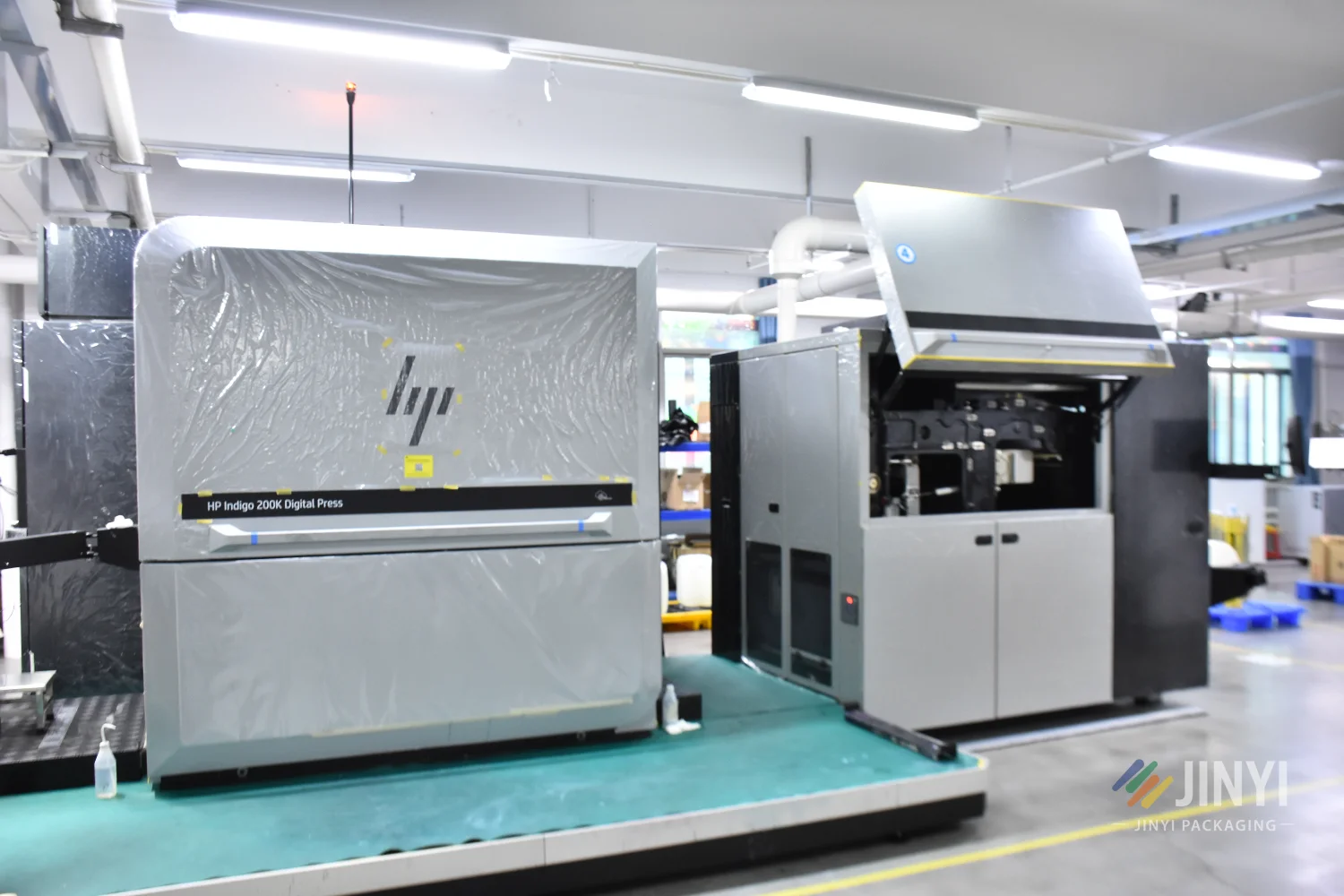
The practical advantage of working with a factory that handles both formats is specification alignment. When the stick pack film and the carton are produced under the same color management system — ESKO Automation Engine in JINYI’s case, managing output across HP Indigo digital presses — the color consistency between the two formats is controlled rather than hoped for. This matters more than most brands anticipate until the first time a carton and a stick pack arrive from two different suppliers and the brand color reads differently on each.
HP Indigo 200K — JINYI’s newest press, commissioned in 2025, expanding digital print capacity and reducing lead times
Building a Stick Pack and Carton System for Your Brand?
JINYI produces foil laminate pillow bags and stick pack formats alongside auto-lock cartons and display boxes — with material documentation, physical pre-production samples, and color-managed output across both formats as standard. If you are specifying a similar packaging system, the conversation starts with your product’s barrier requirement and fill weight.
JINYI is a source factory for custom flexible packaging with 15+ years of production experience, serving food, supplement, coffee, pet food, and consumer goods brands across 150+ countries. We produce stand-up pouches, flat-bottom bags, pillow bags, and side gusset bags in PET/AL/PE, PET/VMPET/PE, and other barrier specifications — via HP Indigo digital print from 500 units and gravure printing at volume — with full material documentation included as standard with every order.
That is what From Film to Finished — Done Right means in practice.
Elsa
Business Development Manager · JINYI Packaging
Elsa leads business development and customer order management at JINYI. With 8 years in foreign trade across Yiwu and Dongguan, she has a sharp understanding of market demand and what buyers actually need — turning real customer insight into the right packaging decisions.
Customer needs Order management Business development
What material is LMNT’s stick pack film made from?
LMNT has not published an official film specification. Based on observable properties — metallic interior, matte outer surface, and confirmed non-recyclability — the estimated structure is a standard three-layer laminate: a PET or Matte OPP print layer on the outside, an aluminum foil barrier layer in the middle, and a food-grade PE inner seal layer. The aluminum foil barrier is what gives the pack its near-zero OTR and moisture resistance, which is required to keep electrolyte powder dry and free-flowing.
Why are LMNT stick packs not recyclable?
The multi-layer foil laminate structure bonds aluminum foil between polymer layers using adhesive lamination. The layers cannot be separated in standard municipal recycling streams. This is not a design flaw — it is the consequence of specifying aluminum foil as the barrier layer, which is the material required to achieve the near-zero OTR and MVTR performance that hygroscopic electrolyte powders need. Current recyclable mono-material barrier films do not yet reliably match foil laminate barrier performance for this product type.
What is spot UV coating on a carton and how is it applied?
Spot UV is a gloss coating applied selectively to specific areas of a printed surface rather than the entire panel. It is applied as a separate pass after the base print, using a UV-cured varnish that dries instantly under UV light. The result is a high-gloss, tactile area that contrasts with the surrounding matte-printed surface. LMNT uses spot UV on the product photography and the “Stay Salty” text on their carton front panel. Registration accuracy between the base print and the UV coating is critical — confirmed on the physical pre-production proof before production runs.
Why does LMNT use a custom carton size rather than a standard box?
LMNT’s 5.5″ × 5.5″ × 2″ carton is a custom size that serves a specific purpose: the square format differentiates the box from standard rectangular supplement packaging on shelf, provides a large front face for brand graphics relative to the box depth, and ships efficiently in DTC configurations. Standard box sizes are designed around common volume ranges, not specific brand or shelf positioning goals. For brands building retail distribution, a custom carton size is often worth the tooling investment once volume justifies it.
Can the same factory produce both the stick pack film and the carton?
Yes, and for brands building a consistent packaging system, this is the preferred approach. When flexible film printing and carton printing are managed under the same color management system, the consistency between the two formats is controlled rather than approximated. JINYI produces foil laminate pillow bags and sachet formats alongside auto-lock bottom cartons and display boxes, with color output managed through ESKO Automation Engine across HP Indigo digital presses.
What is the minimum order for custom stick pack or pillow bag production?
At JINYI, custom flexible packaging in foil laminate specifications is available from 500 units via HP Indigo digital print. For brands at an earlier stage that need to validate their fill process and pack dimensions before committing to a full production run, the pre-production physical sample process is the right starting point — it produces a real bag in your specified material and dimensions that can be run through your filling equipment before production is approved.
How does LMNT’s packaging compare to Liquid IV’s approach?
Both brands use the stick pack format for the same functional reason: precise single-serve dosing of electrolyte powder in a portable, portable format. The divergence is in the brand language overlaid on the format — LMNT’s system uses a more austere, science-forward graphic approach with a muted color palette, while Liquid IV’s uses a broader flavor range and more vibrant visual language. The packaging system design reflects each brand’s positioning, not a difference in underlying format logic. For a detailed breakdown of Liquid IV’s packaging decisions, see our Liquid IV packaging analysis.