JINYI shares practical packaging guidance for your decisions.
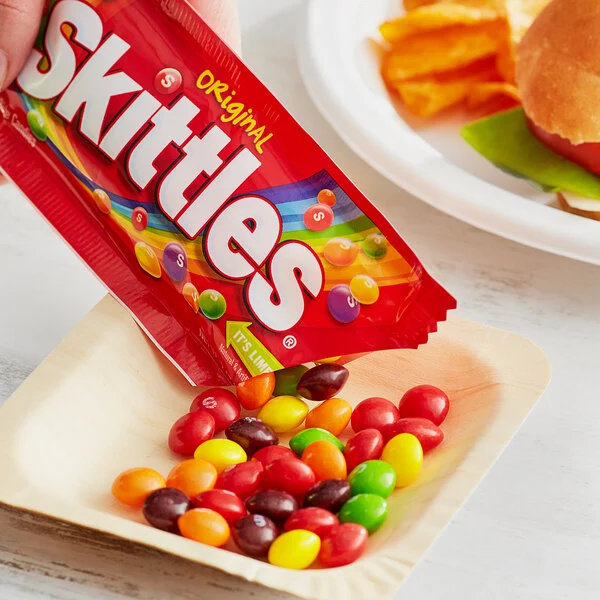
Skittles has been telling you to taste the rainbow since the slogan was coined by New York advertising agency D’Arcy Masius Benton & Bowles in the early 1980s — but the candy itself predates the slogan by nearly a decade. The product was first manufactured commercially in the United Kingdom in 1971 by Jack Candies Ltd., a Mars-affiliated British distributor. A U.S. trademark was filed in 1974. By 1979, Skittles was being imported into the American market; by 1982, domestic production had begun, and the rainbow-colored fruit candy with the hard sugar shell and the lowercase “S” imprinted on each piece was on its way to becoming one of the most recognized confectionery brands in the world. Today, Skittles is owned by Mars Wrigley — the confectionery and snacking division formed when Mars, Inc. acquired Wrigley in 2008 and later merged it with its chocolate segment. Mars, Inc. itself reports annual revenues of approximately $55 billion as of 2025, and Skittles is one of the brand portfolio’s confirmed billion-dollar properties.
The rainbow is not just a marketing theme for Skittles — it is the brand’s primary asset, more immediately recognizable than the logo, more defensible than the flavor profile, and more central to how consumers identify the product at a distance than any text on the bag. When Skittles temporarily stripped all color from its packaging for Pride Month in 2016 — releasing an all-white bag with an all-white candy interior — the campaign worked precisely because removing the rainbow from a Skittles bag was so jarring that it made international news. You cannot do that with a brand where the color is decorative. You can only do it when the color is the brand. That fact shapes everything about how the Skittles packaging system is designed, produced, and maintained across its full range of formats.
This article breaks down the Skittles packaging system from a factory perspective: the three formats the brand uses and why each targets a different retail context, why the euro hole on the stand-up pouch is a deliberate retail strategy rather than a convenience feature, what the film structure looks like, how the rainbow color system is managed across a multi-flavor range, and what Mars Wrigley’s 2026 natural dye transition means for a packaging system built around one of the most color-dependent brands in the category.
Three Formats, Three Retail Contexts: How Skittles Covers Every Shelf
Skittles operates across three distinct flexible packaging formats — and each one targets a specific retail context, consumption occasion, and shopper behavior. The three formats are not interchangeable variations of the same brief; they are three different packaging solutions to three different commercial problems.
The pillow bag is the primary retail format. A back-sealed, end-sealed tube produced on a high-speed VFFS machine, the pillow bag runs from the single-serve 1.5oz size through the standard 2.17oz and the mid-range 7.2oz to larger sharing sizes. There is no zipper and no reseal mechanism — the bag is designed for a consumption session that finishes the contents. The format keeps per-unit cost low, runs at maximum line speed, and delivers the full rainbow graphic across a clean front panel. For a candy that most consumers eat in one sitting, the pillow bag is the correct format, and the economics of the pillow bag at Skittles’ volume are decisive.
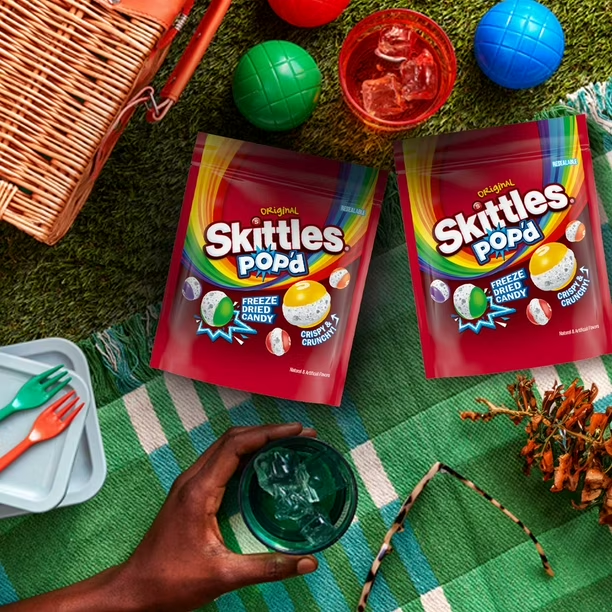
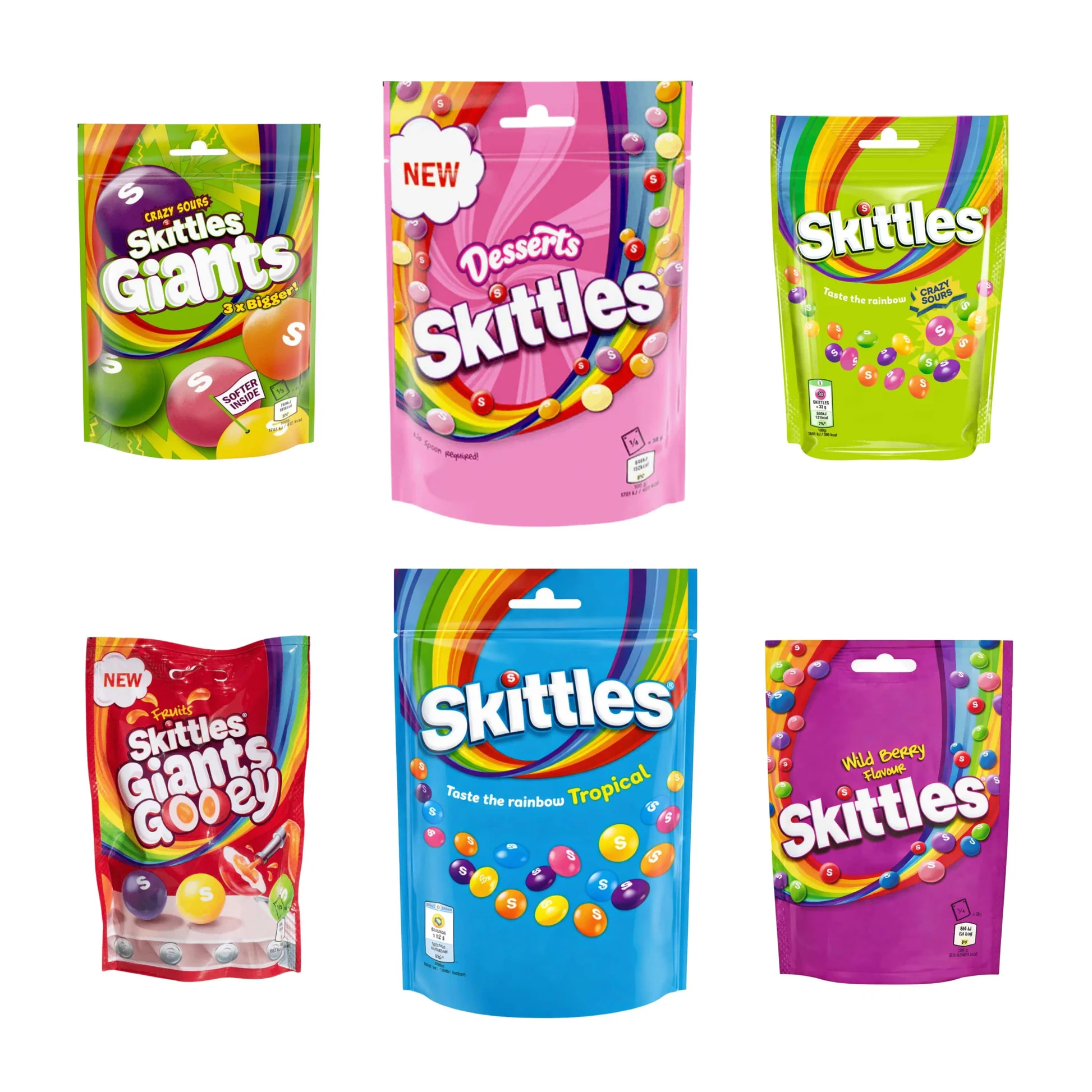
The stand-up pouch with euro hole serves the larger sharing and family-size range. A stand-up pouch with a base gusset stands upright on a flat shelf — but the euro hole (a punched aperture in the top seal area, typically 8mm diameter) also allows the bag to hang from a peg hook. This dual-display capability is a deliberate retail strategy, covered in detail in the section below. The stand-up format typically includes a resealable zipper for the larger sizes, where multi-session consumption is the expected use pattern.
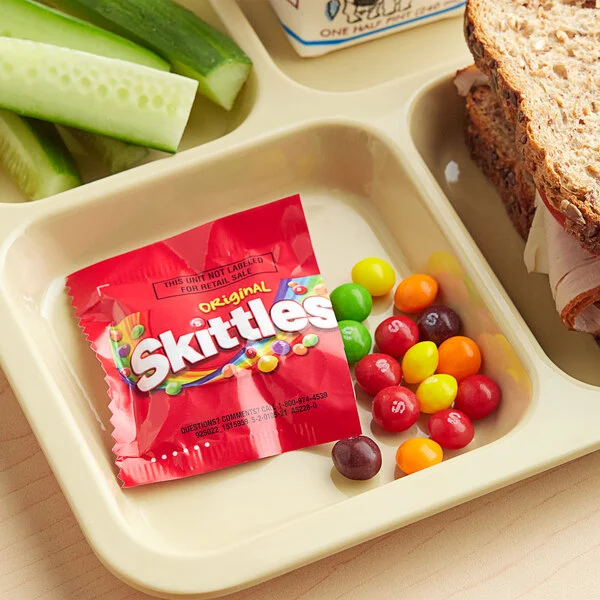
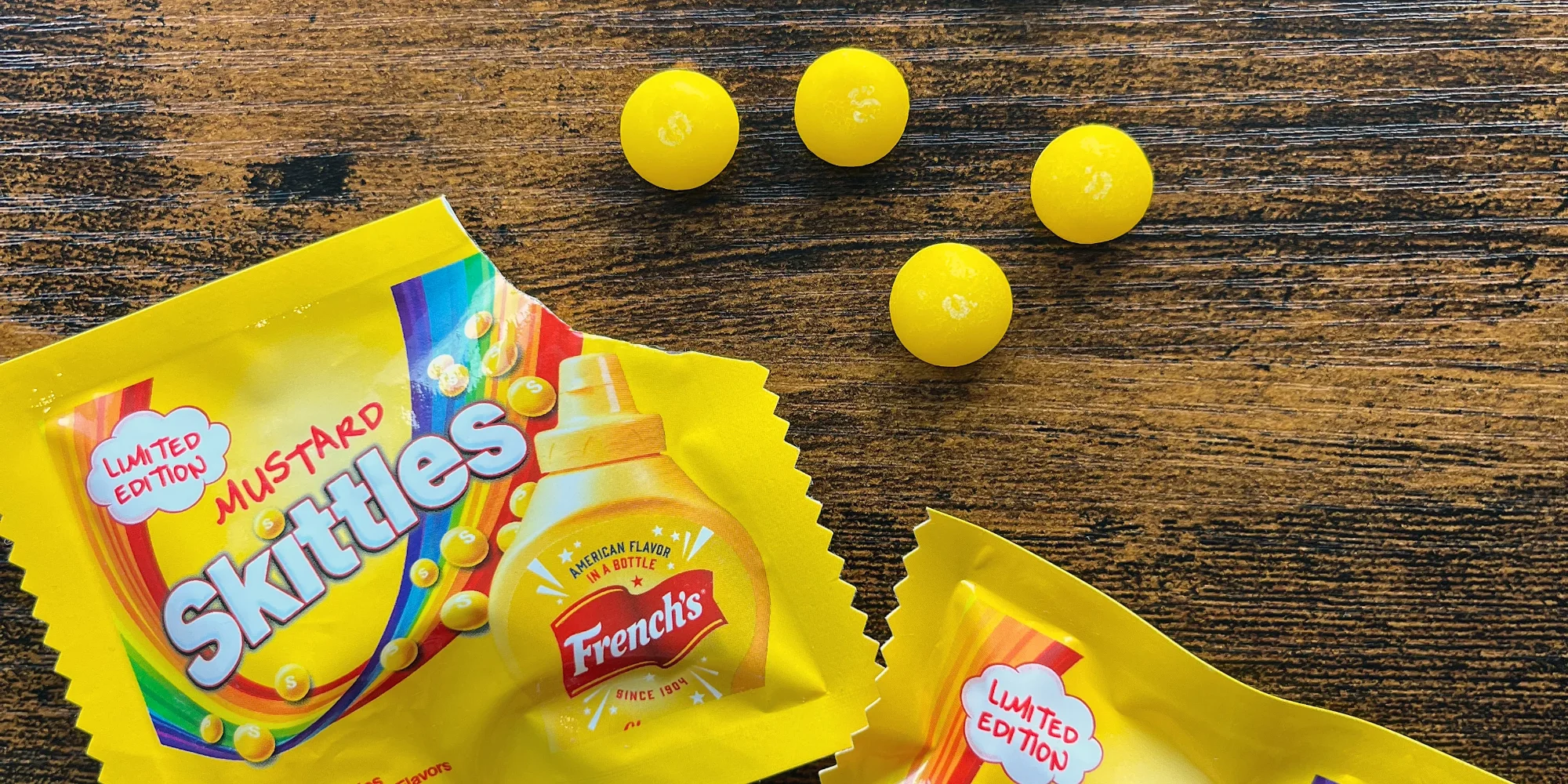
The 3-side seal flat pouch appears in the single-serve and mini-bag range, sold individually or as individual packets within a multipack box. The 3-side seal format — sealed on three edges with an open top that is then heat-sealed after filling — is the simplest and most compact flexible packaging structure available, suited to small fill weights and high-volume, low-cost production. Each individual mini-bag in a multipack is independently sealed and shelf-stable; the outer box or bag holding the multipacks is a secondary retail unit rather than a primary barrier layer.
Factory Take — On Adding a Euro Hole to a Stand-Up Pouch: Skittles uses the euro hole on its stand-up sharing bags because at their distribution scale, the same bag needs to function in both flat-shelf and peg-hook retail environments simultaneously — that dual capability is worth the minor structural accommodation. For a smaller candy brand deciding whether to add a euro hole: if your product will be placed in convenience store checkout lanes, pharmacy impulse aisles, or any retail environment where peg hooks are the primary display fixture, the euro hole earns its cost. The accommodation is straightforward — the top seal area needs to be wide enough to accommodate the hole without compromising the seal integrity above it, typically an additional 15–20mm of headspace. The cost is a marginal increase in film use per unit. If your distribution is exclusively flat-shelf grocery, the euro hole adds cost without adding commercial value.
The Rainbow as a Film Brief: What “Taste the Rainbow” Demands From the Printing System
The Skittles rainbow is not a single design element — it is a color management system that has to reproduce consistently across billions of bags, multiple production facilities, dozens of flavor variants, and fifty-plus years of brand history. The Original flavor bag uses a specific arc of red, orange, yellow, green, and purple against a white background. The Tropical bag uses a different color palette — yellows, oranges, pinks — against a tropical imagery background. The Wild Berry bag uses deep purples and reds. The Sour bag uses an intensified, high-contrast version of the Original palette. The Sweet Heat bag uses warm reds and oranges. Each variant has its own color profile, but all of them belong to the same visual family — vivid, saturated, immediately identifiable as Skittles regardless of which flavor is in hand.
Maintaining this consistency across high-volume gravure printing requires a disciplined color management infrastructure: defined LAB values for each color element in the design, Delta E tolerance specifications that control how far any printed color can deviate from the target before a bag is rejected, and cylinder engravings that reproduce the same ink lay-down across millions of impressions without drift. For a brand where the color is the brand, color management is not a production quality metric — it is a brand protection function. A Skittles bag where the red runs too orange, or the purple reads as blue, is not just an off-spec product; it is a brand signal that has failed at its most basic function.
The 2016 Pride campaign demonstrated this in the most striking way possible. Mars Wrigley produced an all-white Skittles bag — same shape, same logo position, same “S” typography, but with all color removed from both the bag and the candy inside. The message on the back of the pack explained the decision directly: “You have the rainbow. We have the rainbow. And usually that’s just hunky-dory. But this Pride, only one rainbow deserves to be the centre of attention — yours.” The campaign generated international coverage not because of the message alone, but because the visual shock of a colorless Skittles bag was so extreme. That level of brand recognition — where removing the color is news — is what a tightly controlled color system, maintained consistently over decades, actually produces.
For brands developing their own multi-flavor confectionery range, the Skittles color system illustrates a principle that applies regardless of scale: a flavor-coded color system that is distinctive enough to create instant recognition across variants, and consistent enough that all variants read as the same brand, is a packaging asset that has to be built deliberately. It does not emerge from individual design decisions made per SKU. It requires a defined palette, a defined hierarchy of which colors differentiate and which unify, and a print specification that maintains the system across production runs over time.
Film Structure: What a Skittles Bag Is Actually Made Of
Like all hard-shelled candy packaging, the primary engineering brief for a Skittles bag is moisture management. The hard sugar shell that gives each Skittle its characteristic snap is hygroscopic — it absorbs ambient moisture and softens, losing the textural contrast between the hard exterior and the chewy interior that defines the eating experience. The film needs to control moisture vapor transmission rate (MVTR) across the product’s shelf life, in the range of humidity conditions it will encounter through distribution and retail. This is the same brief as a gummy candy bag — moisture first, oxygen secondary — though the specific MVTR target differs because the hard shell’s moisture sensitivity is different from a gelatin-based gummy’s.
Importantly, Skittles packaging does not require nitrogen flushing. The candy contains no fats or oils that would oxidize in the presence of oxygen and produce rancid off-flavors — the product’s deterioration pathway is almost entirely moisture-driven. A bag that blocks moisture vapor effectively is doing the primary protective work; oxygen barrier is a secondary consideration. This means the film structure does not need the heavy-duty metallized or foil barrier layers that chip, nut, and meat snack packaging requires. As we explored when looking at Haribo’s gummy packaging logic, confectionery’s moisture-not-oxygen brief allows for simpler, lighter, and lower-cost film structures than most other snack categories.
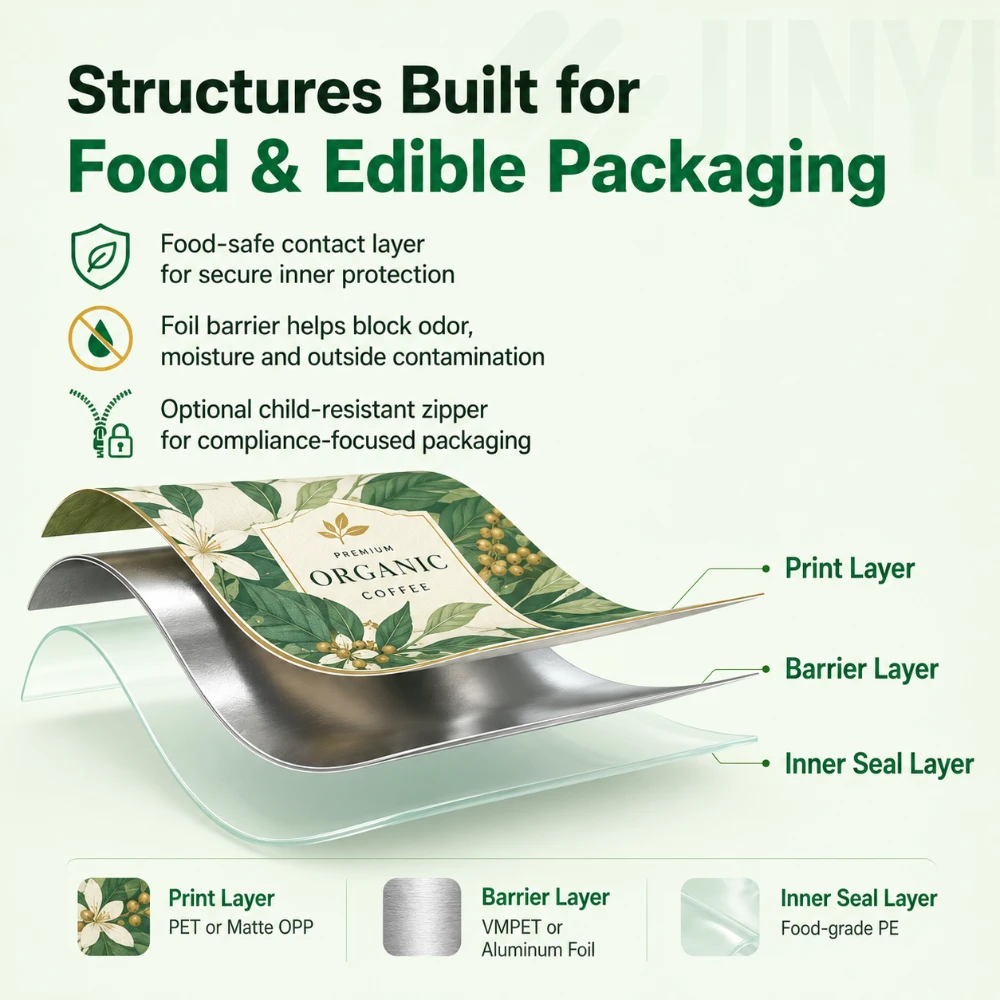
The structural routes available for a candy bag of this type are as follows. Mars Wrigley has not published official film specifications for Skittles packaging, and the structure below is estimated on the basis of the product’s requirements.
Route A — BOPP / PE (two-layer): A printed BOPP outer film laminated directly to a food-grade PE sealant. The BOPP layer provides stiffness for VFFS runnability and the primary moisture barrier. The PE inner layer provides heat-seal performance and food contact compliance. This is the simplest and lowest-cost structure capable of meeting the moisture management brief for a hard candy with a standard retail shelf life. The sour candy variants — which contain citric acid as a flavor component — require the inner PE to be validated for acid contact, for the same reason we noted for Sour Patch Kids’ citric acid inner film requirements.
Route B — PET / PE (two-layer, improved performance): Replacing BOPP with PET as the outer layer improves moisture barrier slightly, improves stiffness and puncture resistance significantly, and allows finer print detail reproduction — relevant for the Skittles rainbow graphics where color saturation and detail matter. The trade-off is cost. For the larger stand-up pouch format, where the bag’s physical demands are greater than for a small pillow bag, PET/PE is a plausible upgrade from BOPP/PE.
Route C — BOPP / VMPET / PE (three-layer with metallized barrier): Adding a metallized PET layer significantly improves both moisture and oxygen barrier. This is the same structure used in chip bags — where it is justified by the oxygen sensitivity of fried snack oils — but for standard hard candy, the metallized layer is providing oxygen barrier that the product does not need. The incremental moisture barrier benefit of the metallized layer over a well-specified BOPP/PE structure may or may not justify the added cost, depending on the target shelf life and distribution environment. The full process of how these layers are laminated and converted is covered in our guide on how custom pouches are made from film to finished bag.
Note: Film structure is estimated based on Skittles’ product requirements and industry-standard specifications for hard candy packaging. Mars Wrigley has not published official material documentation. Standard pillow bags likely use BOPP/PE; stand-up pouches may use PET/PE for improved stiffness; sour variants require acid-contact validated inner film. Specifications vary by format, market, and SKU.
Factory Take — On Barrier Specification for Hard Candy: Skittles’ choice to use a lightweight two-layer structure — no metallized layer, no nitrogen flushing — is the right call for this product category, and not a cost-cutting shortcut. Hard candy’s deterioration pathway is moisture-driven, not oxygen-driven. Adding a metallized VMPET barrier layer adds cost and weight while providing oxygen barrier that the product does not need. If a packaging supplier quotes you a three-layer metallized structure for a hard candy application without explaining what the extra barrier is protecting against, that is a specification worth questioning. The barrier spec should follow from the product’s actual failure modes, not from a default structure template.
The Euro Hole: Small Feature, Significant Retail Logic
The euro hole — the punched aperture at the top of the Skittles stand-up pouch — is a standard feature in flexible confectionery packaging and an easy detail to overlook. Its function is straightforward: it allows the bag to be hung from a peg hook in a retail display fixture, in addition to standing upright on a flat shelf. The hole is typically 8mm in diameter, positioned in the center of the top seal area with enough clearance above the seal line that the structural integrity of the seal is not compromised by the aperture. The result is a bag that can be merchandised in two entirely different retail contexts without requiring a different package design for each.
The commercial logic for this dual capability is specific to the retail environments where candy is sold. In a grocery store, confectionery typically occupies a dedicated aisle with flat shelving — the stand-up pouch’s base gusset allows it to sit stably in a shelf facing without additional support. But candy is also one of the highest-impulse-purchase categories in retail, and impulse purchase display fixtures — the racks at checkout lanes, the spinning tower displays at pharmacy counters, the hook strips at convenience store counters — almost universally use peg hooks rather than flat shelving. A brand whose packaging can only stand, but not hang, is excluded from these fixtures. A brand whose packaging can do both can place its product wherever the retailer has space, regardless of whether that space is a flat shelf or a peg hook array.
For Skittles, which sells through every retail channel from convenience stores to club stores, the euro hole on the stand-up pouch is not a convenience feature — it is a distribution flexibility tool. The same bag that stands in a Target candy aisle can hang at a 7-Eleven checkout counter. That flexibility has a direct impact on how many retail placements the brand can negotiate, and therefore on how many units it sells.
Factory Take — Euro Hole Placement and Seal Integrity: The structural requirement for a euro hole is simple but easy to underspecify: the hole center needs to be at least 15–20mm above the bottom edge of the top seal, and the seal itself needs to be wide enough that the aperture does not create a tear path into the sealed zone. A hole too close to the seal line will tear during hanging — particularly in a fully loaded bag — defeating the purpose of the feature and creating a product integrity failure at the point of sale. For a brand adding a euro hole to a stand-up pouch for the first time, confirm the hole position and seal width in the physical sample stage rather than assuming the default will be adequate. The cost of a failed seal at a checkout hook is higher than the cost of getting the specification right before production.
The 2026 Natural Dye Shift: When the Rainbow Has to Change
In August 2025, Mars announced that it would begin offering natural dye versions of Skittles Original — along with M&M’s Chocolate, Extra Gum Spearmint, and Starburst Original — starting in 2026. The announcement came after years of public pressure and a direct legal challenge: in 2025, the Texas Attorney General announced an investigation into Mars for failing to fulfill a commitment the company had made in 2016 to remove artificial colors from its products within five years. Mars had reversed that commitment in the intervening years, citing consumer research suggesting that “many consumers across the world do not find artificial colors to be ingredients of concern within the confectionery space.” The 2025 regulatory and legislative environment — including the “Make America Healthy Again” movement’s pressure on food manufacturers — changed that calculation.
For a brand whose entire identity is built on color, transitioning away from artificial dyes is a more technically and commercially complex decision than it is for most food brands. Artificial dyes — Red 40, Yellow 5, Yellow 6, Blue 1, Blue 2 — produce highly saturated, photostable colors that reproduce consistently across large production runs and maintain their appearance across the product’s full shelf life. Natural colorants derived from fruit, vegetable, and mineral sources — beet juice, turmeric, spirulina, radish extract — are less saturated, more variable in hue across production batches, and significantly more susceptible to degradation from heat, light, and pH changes over time. For a candy brand where the red has to read as the same red on a Skittles bag in January and in August, in a warehouse and on a sunlit store shelf, the stability of that color is a technical specification, not an aesthetic preference.
The packaging implication is direct: if the natural colorants in the candy itself are more light-sensitive than their artificial counterparts, the packaging film’s light barrier specification may need to increase. A BOPP/PE structure provides moderate light barrier through the opacity of the inks and film layers, but a candy with colors that degrade visibly under UV exposure might benefit from a film with additional UV-blocking properties in the outer layer. This is a niche consideration for most candy brands, but for Skittles — where the color of each candy piece is the product’s most fundamental quality signal — it is worth tracking as the natural dye transition rolls out.
Sourcing Custom Candy Packaging: Format, Film, and Color System
The Skittles packaging system — three formats for three retail contexts, a tightly controlled color system across a multi-flavor range, a lightweight film structure matched to moisture-not-oxygen barrier requirements, and a euro hole that unlocks peg-hook display — is directly applicable to any confectionery brand thinking through its own packaging strategy. The format decisions follow from the retail channels. The film decisions follow from the product’s actual failure modes. The color decisions follow from how the brand needs to communicate at the point of sale. Getting these in the right order — retail channel first, film spec second, color system third — is the difference between a packaging system that works and one that looks right but underperforms commercially.
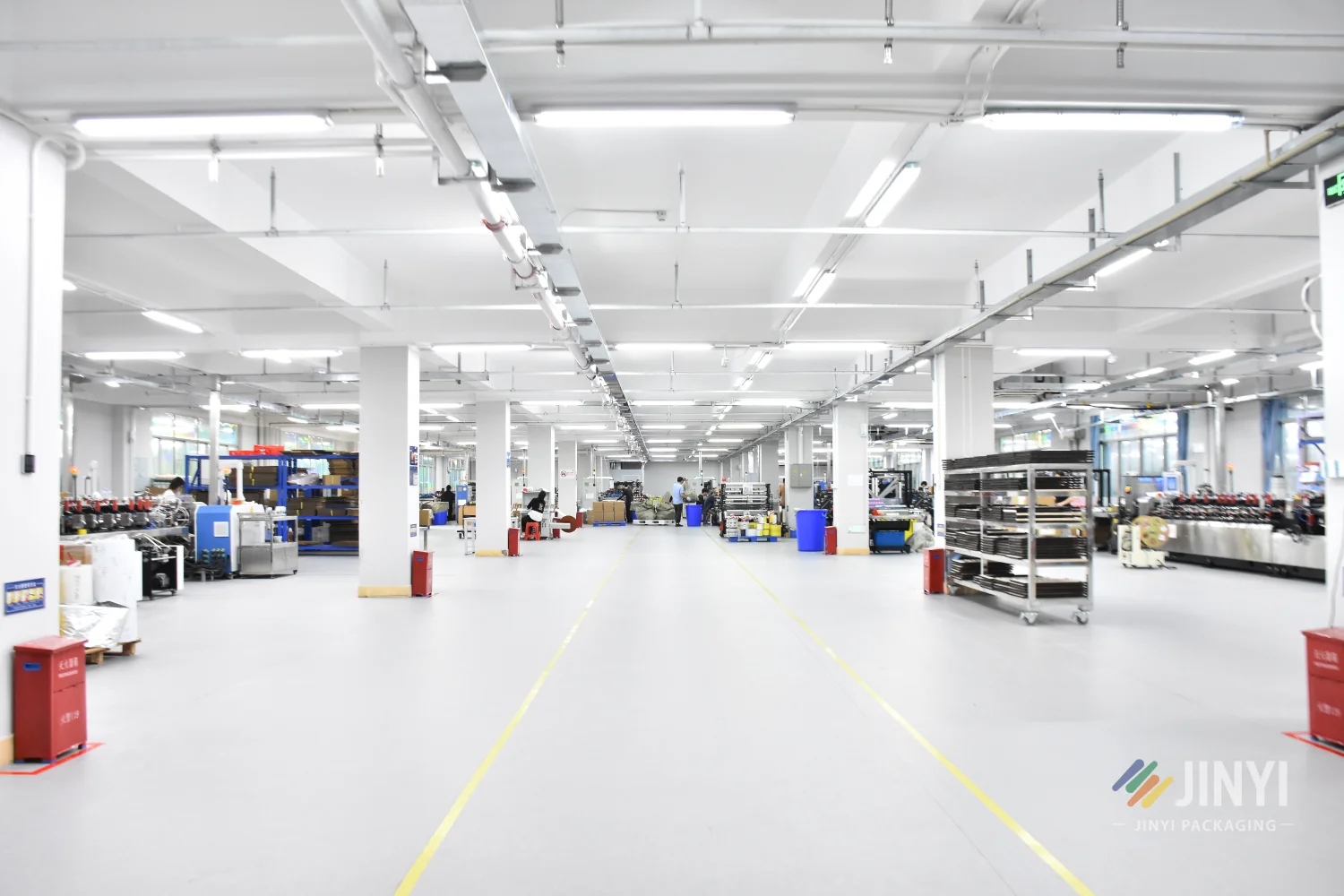
Inside JINYI — a clean, well-organised production floor running HP Indigo digital and gravure printing alongside bag-making and lamination lines
At Jinyi Packaging Co., Ltd. — a 10,443㎡ source factory serving brands across 70+ countries — pillow bags, stand-up pouches with euro holes, and 3-side seal flat pouches are all produced as part of the standard confectionery packaging range. Film structures from BOPP/PE for standard candy to PET/PE for improved stiffness, with acid-contact validated inner film for sour or citric acid-containing products. For brands with sustainability commitments or European market exposure, recyclable mono-material PE structures are available alongside conventional laminates — with the same caveat that applies across all confectionery applications: barrier validation against the specific product and shelf life target is required before committing to a production run.
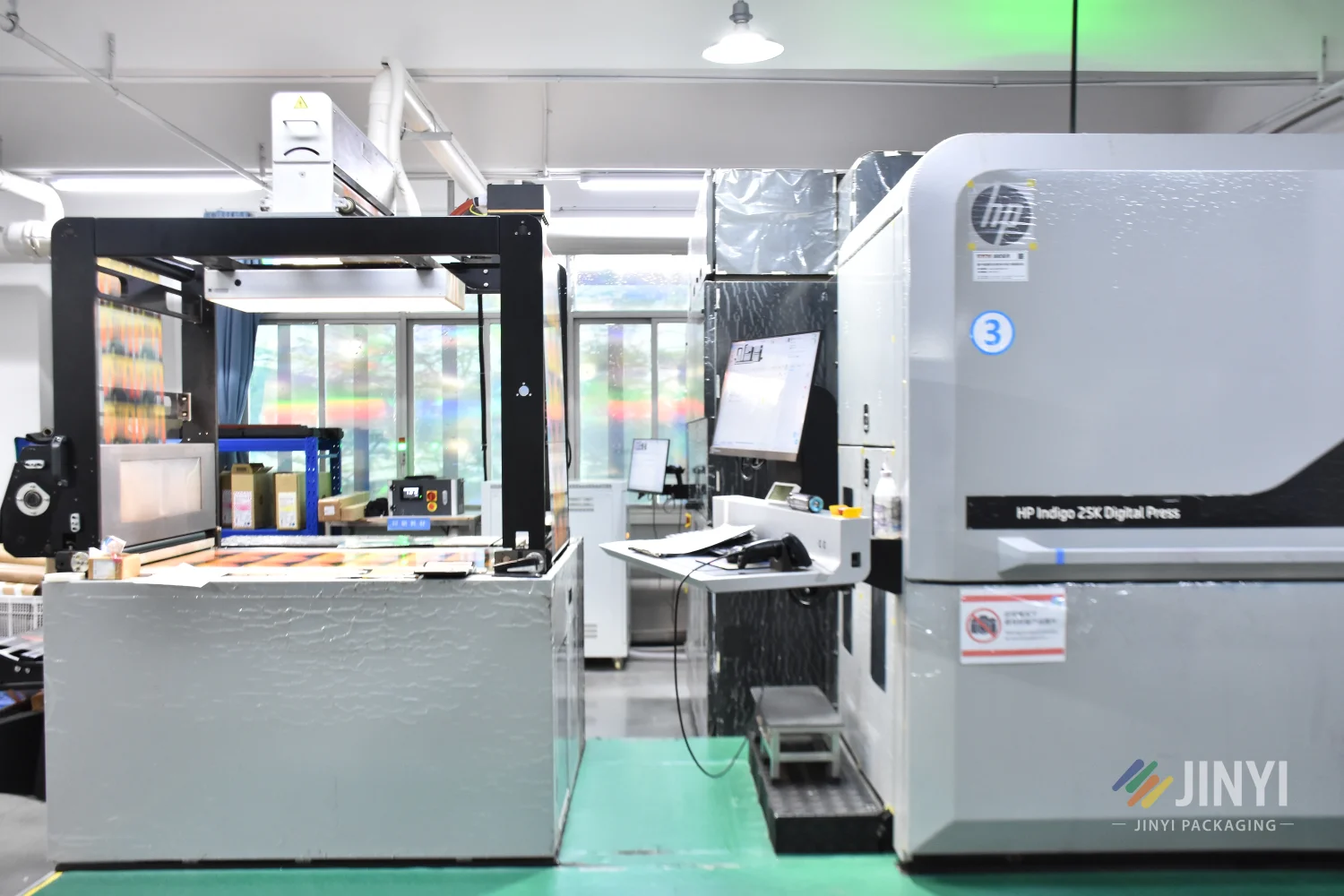
For multi-flavor ranges where color system management is central to the brief, the HP Indigo digital press fleet at JINYI — including HP Indigo 25K for high-speed short-run production and HP Indigo 6K for fast-turnaround color samples — handles color-critical confectionery graphics from 500 units per SKU, with ΔE ≤1.5 output consistency across all variants in the same production run. A brand launching five flavor variants simultaneously can validate all five color profiles on physical samples before committing to gravure cylinders, confirming that the red reads correctly as red and the purple reads correctly as purple across all variants before a single production cylinder is engraved. Every JINYI order includes free 3D mockup rendering before production, production progress updates at each stage, and free e-commerce photography of the finished bags.
HP Indigo 25K at JINYI — consistent colour output across all press systems via ESKO Automation Engine
Sourcing custom candy or confectionery packaging?
JINYI produces pillow bags, stand-up pouches with euro holes, and 3-side seal flat pouches in BOPP/PE and PET/PE structures — with acid-contact validated inner film for sour products, full-color digital or gravure printing, and free 3D mockup, production updates, and e-commerce photography with every order. From 500 units.
JINYI is a source factory for custom flexible packaging with 15+ years of production experience, serving food, supplement, coffee, pet food, and consumer goods brands across 70+ countries. We produce stand-up pouches, flat-bottom bags, pillow bags, and side gusset bags in PET/AL/PE, PET/VMPET/PE, and other barrier specifications — via HP Indigo digital print from 500 units and gravure printing at volume — with full material documentation included as standard with every order.
That is what From Film to Finished — Done Right means in practice.
Elsa
Business Development Manager · JINYI Packaging
Elsa leads business development and customer order management at JINYI. With 8 years in foreign trade across Yiwu and Dongguan, she has a sharp understanding of market demand and what buyers actually need — turning real customer insight into the right packaging decisions.
Customer needs Order management Business development
Standard Skittles pillow bags are estimated to use a two-layer BOPP/PE structure — a printed polypropylene outer film laminated to a food-grade polyethylene sealant. Stand-up sharing pouches may use PET/PE for improved stiffness. Sour variant bags require acid-contact validated inner film. Mars Wrigley has not published official film specifications for its Skittles packaging.
Why does the Skittles stand-up pouch have a hole at the top?
The hole is a euro hole — a standard 8mm punched aperture that allows the bag to hang from a peg hook in addition to standing upright on a flat shelf. This dual display capability allows Skittles to be merchandised in both grocery shelf and impulse-purchase peg hook environments without requiring two different bag designs. It is a retail distribution strategy built into the packaging format.
Why don’t Skittles bags need nitrogen flushing like chip bags?
Nitrogen flushing protects against oxidative rancidity — the degradation of fats and oils when exposed to oxygen. Skittles contain no significant fat or oil content that would oxidize. The primary deterioration pathway for hard candy is moisture absorption, which softens the sugar shell. The packaging is engineered to control moisture vapor transmission, not oxygen, making nitrogen flushing unnecessary.
What are the three Skittles packaging formats?
Skittles uses pillow bags for standard retail sizes consumed in a single sitting, stand-up pouches with euro holes for larger sharing and family sizes that need to work in both flat-shelf and peg-hook retail environments, and 3-side seal flat pouches for single-serve mini bags sold individually or within multipack boxes. Each format targets a different consumption occasion and retail channel.
Is Skittles switching to natural dyes?
In August 2025, Mars announced it would begin offering natural dye versions of Skittles Original in 2026, following pressure from consumer groups and a Texas Attorney General investigation related to a 2016 commitment to remove artificial colors. Mars has not committed to converting its entire Skittles portfolio and has noted it will share timelines for additional products when fully effective and scalable solutions are identified.
How is Skittles packaging different from Haribo or Sour Patch Kids?
All three are confectionery products with moisture-first barrier requirements and no nitrogen flushing. The key differences are format range — Skittles runs three formats including a euro hole stand-up pouch, while Haribo and Sour Patch Kids primarily use pillow bags and standard stand-up pouches — and color system complexity. Skittles’ rainbow is the brand’s primary asset, requiring tighter color management across more variants than most candy brands. Sour Patch Kids’ acid coating creates additional inner film requirements that standard Skittles do not have, though Skittles Sour shares this requirement.
Can I order custom candy bags with euro holes at low minimum quantities?
Yes. Through HP Indigo digital printing, custom pillow bags, stand-up pouches with euro holes, and 3-side seal flat pouches can be produced from 500 units per SKU. This allows a brand to validate format, film specification, and color accuracy on physical samples before committing to a gravure production run. JINYI includes free 3D mockup rendering, production progress updates, and e-commerce photography with every order.