JINYI shares practical packaging guidance for your decisions.
For supplement powder brands, packaging is not a secondary decision. It is a product integrity decision, a compliance decision, and a brand positioning decision — all at once. Get the barrier spec wrong and your powder clumps, oxidises, or loses potency before it reaches the consumer. Get the format wrong and your brand reads below its price point. Get the MOQ wrong and you’re locked into volumes that don’t match your launch strategy.
This guide covers every decision that matters before you place your first custom powder packaging order: why powder products demand stricter specs than most categories, which pouch format fits your product and channel, what material and barrier structure your formulation actually requires, how finish choices affect your brand’s retail and DTC performance, and what MOQ and lead times to expect from a factory-direct supplier. For a deeper look at how flexible pouches are built from the film up, our complete guide to how custom stand-up pouches are made covers the full production process.
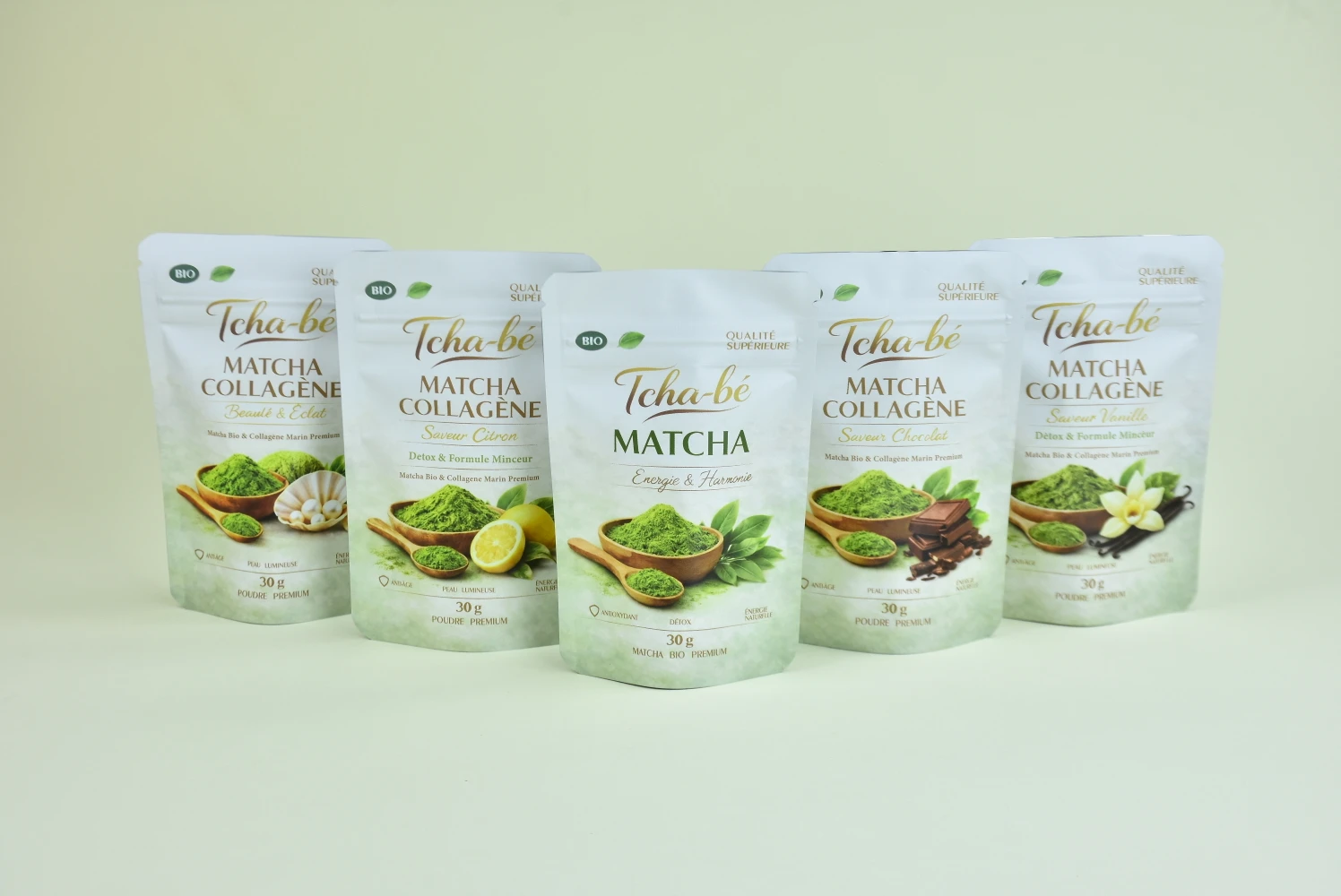
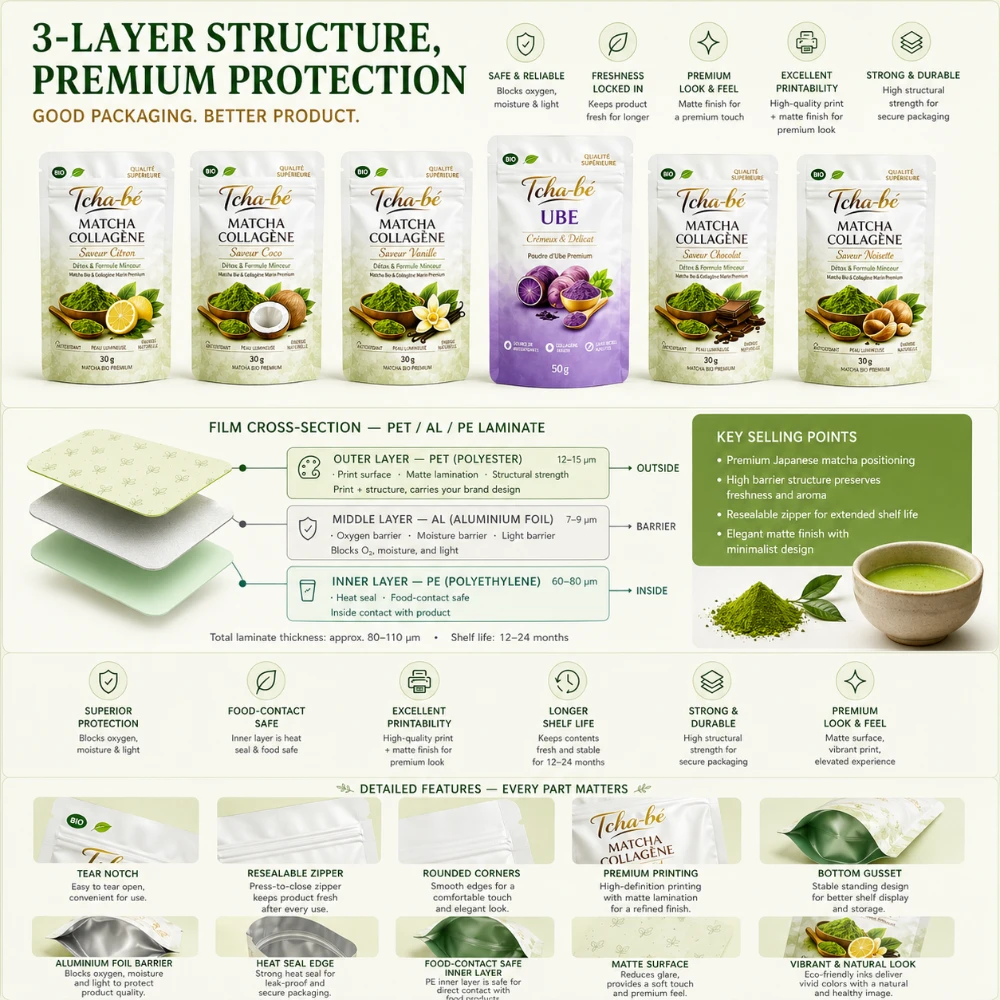
Tcha-bé’s matcha supplement powder range, custom printed and produced at JINYI’s factory — multiple SKUs launched simultaneously via digital print at low MOQ.
Powder products require higher barrier specs than most food categories — moisture ingress is the primary enemy, and a single weak seal point can compromise an entire batch.
Stand-up pouches are the dominant format for supplement powder brands — versatile, cost-efficient, and available from 500 units via digital print with no plate fee.
PET/AL/PE full foil laminate is the recommended material for most supplement powders targeting 12+ months shelf life — it eliminates oxygen and moisture ingress at the film level.
Surface finish is a brand signal as much as a packaging spec — matte and soft-touch finishes dominate the premium health and wellness category for a reason.
Digital printing supports multiple SKUs at low volume — the right path for brands launching several flavours or variants simultaneously without committing to high MOQ per SKU.
JINYI dispatches within 7–15 days from artwork approval (no sample required) — significantly faster than the industry average of 4–6 weeks.
Always confirm food-contact certification and barrier data before production — these are non-negotiable for supplement compliance in the EU and most major markets.
Why Powder Products Have Stricter Packaging Requirements
Powder is one of the most demanding fill types in flexible packaging. The physical characteristics that make it effective as a supplement format — fine particle size, high surface area, hygroscopic behaviour — are exactly the characteristics that make it vulnerable to packaging failure. A supplement powder that absorbs moisture clumps, cakes, and loses its ability to dissolve properly. A powder exposed to oxygen oxidises, loses potency, and in some formulations changes colour or develops off-flavours. Neither outcome is recoverable after the bag is sealed.
The fine particle size of most supplement powders — collagen, matcha, plant-based proteins, adaptogens, greens blends — means that even small gaps in seal integrity create a pathway for moisture ingress that accelerates degradation across the entire product. This is why powder packaging specs need to be tighter than what works for granular products like coffee or dry pet food. The margin for error is smaller, and the consequences of getting it wrong show up faster and more visibly.
There is also the regulatory dimension. Supplement products sold in the EU, North America, and most major markets are subject to food-contact safety requirements that cover the inner layer of your packaging, the inks and adhesives used in the laminate, and in some cases the specific barrier performance claims you make on the label. A supplier who cannot provide this documentation is not a viable partner for a compliant supplement brand — regardless of how competitive their price is.
Low OTR barrier film + oxygen absorber or nitrogen flush
UV / light exposure
Photodegradation of active ingredients
Opaque film construction — no transparent window
Seal failure
Moisture and oxygen ingress through compromised seal points
Consistent heat-seal spec + QC at production
Powder migration
Fine particles contaminate zipper track, affecting reseal performance
Wider zipper track + clean-fill spec at filling stage
Note: Static charge is a common issue with fine supplement powders — the powder clings to the inner film surface and to the zipper track after opening, creating a mess that consumers notice and complain about. Specifying an anti-static inner layer is worth discussing with your supplier if your formulation is particularly fine or prone to clinging.
Pouch Formats for Supplement Powder: Which One Fits Your Brand?
The format you choose determines how your product is perceived at retail, how it performs in DTC photography, and how efficiently it ships. For supplement powder brands, three flexible formats cover the vast majority of the market — and each serves a different product profile and brand positioning.
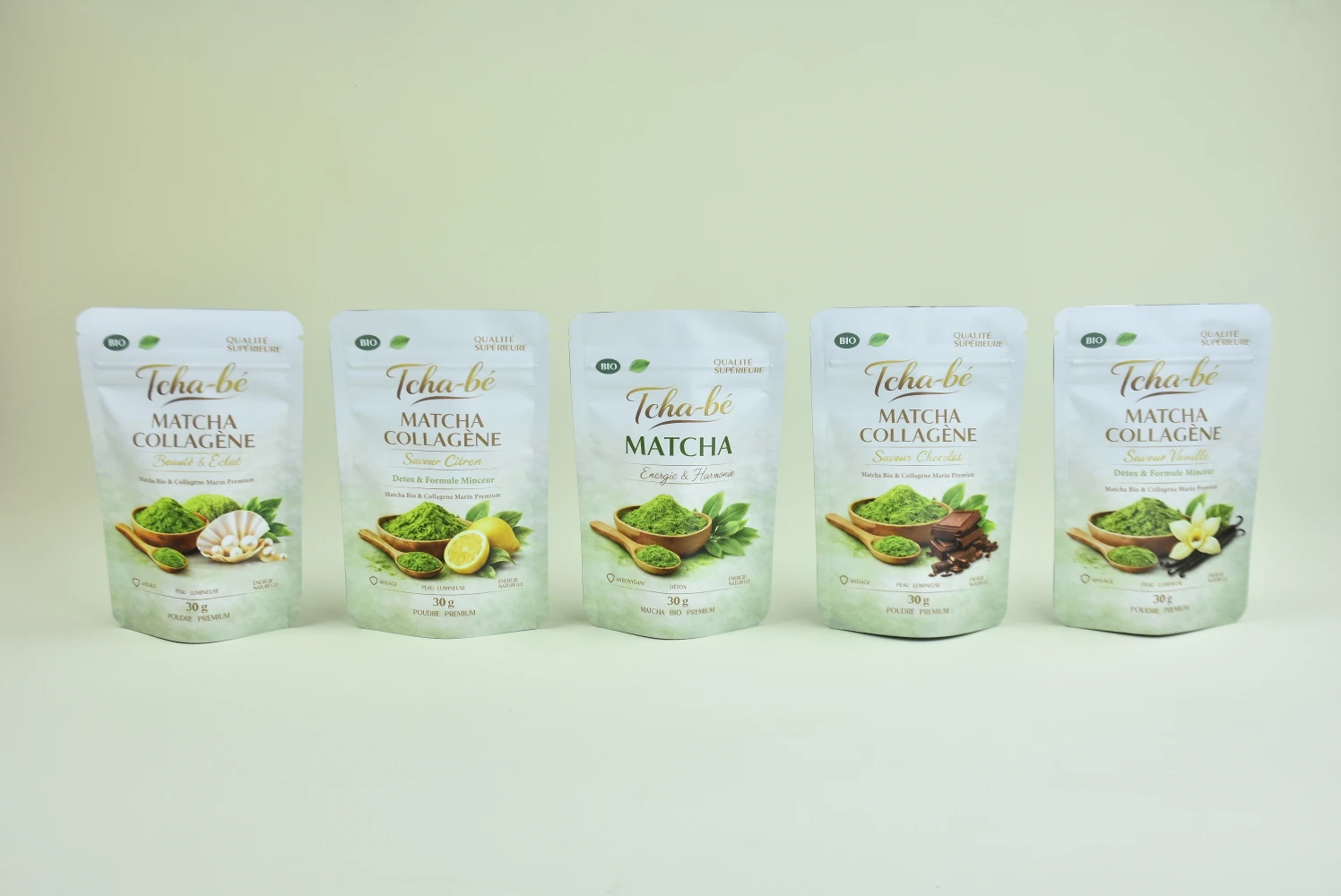
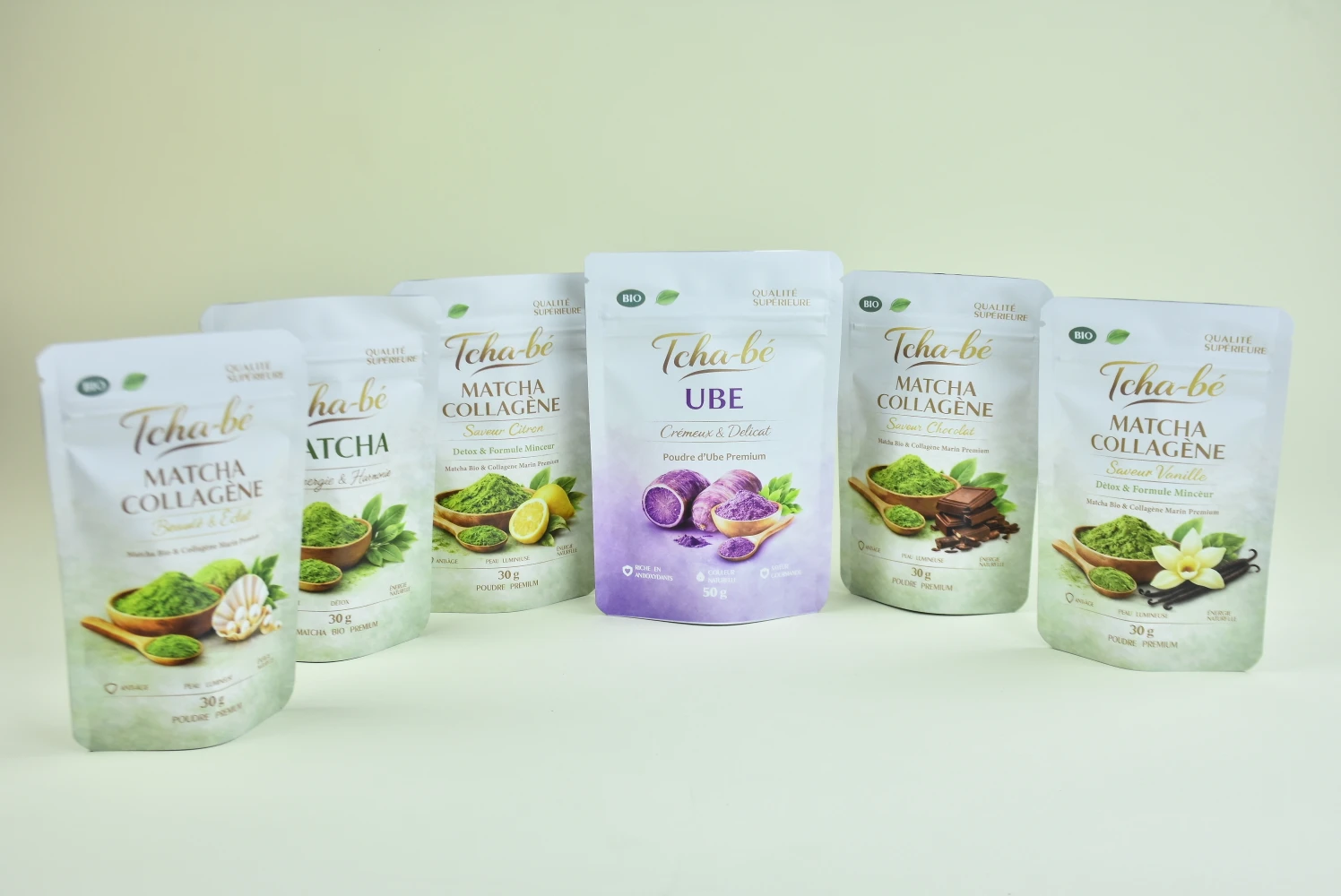
The complete Tcha-bé matcha collagène range — each variant custom printed at JINYI with a unified matte finish and high-barrier PET/AL/PE laminate structure.
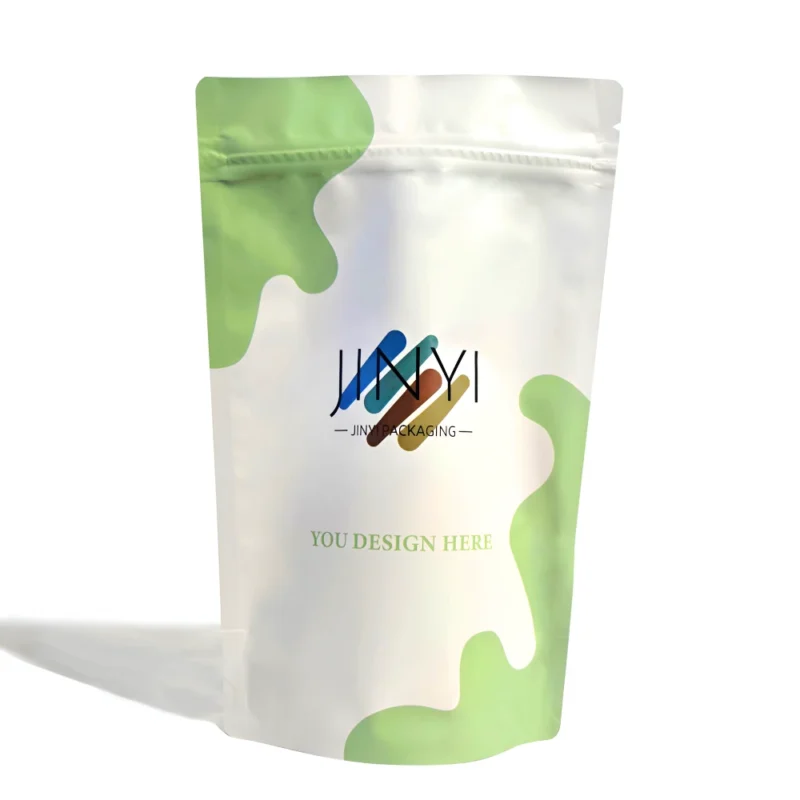
The stand-up pouch is the dominant format across the supplement powder category — used by the majority of brands from launch through scale. It stands upright on shelf and on the counter, ships flat when empty, and works across a wide range of fill weights from 30g single-SKU wellness shots to 500g bulk protein pouches. The bottom gusset expands on fill to create a stable base. For brands launching multiple SKUs simultaneously — different flavours, formulations, or product variants — the stand-up pouch is the most practical starting format because it carries the lowest MOQ and supports digital print at volumes as low as 500 units per SKU, making a full product range launch financially achievable without committing to large runs on each variant.
The flat bottom bag provides a more structured, box-like standing profile that reads more premium on shelf and in tabletop photography. The flat base gives it a stability and visual weight that the stand-up pouch’s rounded bottom can’t match — which is why premium wellness and beauty supplement brands increasingly use this format when retail shelf presence and brand photography are the priority. The trade-off is a higher unit cost and typically a higher MOQ than the standard stand-up pouch.
Single-serve stick packs work for brands whose product lends itself to daily portion control — collagen shots, greens blends, matcha latte portions, travel formats. The per-gram cost is significantly higher than a stand-up pouch, but the format drives strong subscription behaviour and works well in hospitality and gifting contexts. Stick packs are rarely a brand’s primary format; they are typically a companion SKU that serves a specific consumption occasion. For brands in the matcha supplement space specifically, our custom matcha packaging buying guide covers format and material decisions in more depth.
Format
Best For
Typical Fill Weight
Key Trade-Off
Stand-up pouch
Multi-SKU launches, DTC, retail, e-commerce
30g – 500g
Most cost-efficient — slightly softer shelf profile
Highest per-gram cost — strong for subscription DTC
Tip: If you are launching with multiple SKUs — different flavours, formulations, or sizes — and your total volume per SKU is modest, the stand-up pouch via digital print is your most financially sound starting point. You can run each variant at 500 units without plate fees, validate which SKUs perform, and scale those to gravure once demand is confirmed. This is significantly more flexible than committing to 3,000+ units per variant on your first order.
Materials and Barrier Specs for Powder Packaging
The material spec is where most first-time supplement brands make mistakes — either by under-specifying the barrier to save on unit cost, or by not understanding what the numbers on a spec sheet actually mean for their product’s shelf life. The core parameters to understand are OTR (oxygen transmission rate) and MVTR (moisture vapour transmission rate). Lower is better. For supplement powder, you want both as close to zero as possible.
Material Structure
OTR
Shelf Life Target
Best For
PET / AL / PE (Full Foil)
~0.01 cc/m²/day
18–24 months
Recommended for most supplement powders
PET / VMPET / PE (Metalized)
0.5–1.5 cc/m²/day
12 months
Lower barrier powders with faster turnover
Kraft / AL / PE
~0.01 cc/m²/day
18–24 months
Natural / organic brands where material aesthetic matters
Matte OPP / BOPP
Medium
3–6 months
Not recommended for most supplement powders
For the overwhelming majority of supplement powder brands, PET/AL/PE full foil laminate is the correct starting spec. The aluminium foil core delivers near-zero oxygen and moisture transmission, protecting your formulation’s potency and physical integrity through the full shelf life window. It supports matte lamination, gloss, soft-touch, and spot UV finishes on the outer PET layer — so your material choice doesn’t limit your branding options.
Kraft + foil laminate is worth considering for brands in the natural, organic, or clean beauty supplement space where the material aesthetic is part of the brand language. It delivers equivalent barrier performance to full foil while the kraft outer layer communicates a clean, natural positioning that resonates strongly in the European wellness market in particular.
Note: If your brand carries an organic certification or clean-label claim, confirm that your supplier’s food-contact inks and adhesives carry the relevant certifications — ECO PASSPORT by OEKO-TEX or equivalent. For supplement brands selling into the EU, this documentation is required for compliance and should be provided by your supplier as standard, not as a special request.
Surface Finish and Branding for Health and Wellness Products
In the health and wellness supplement category, finish is one of the most powerful branding tools available to you — and one of the most frequently misused. The premium end of the supplement powder market has converged on matte and soft-touch finishes for a reason: they communicate restraint, quality, and intentionality in a way that gloss simply does not. A gloss bag on a premium wellness product immediately reads as mass-market, regardless of what the ingredient list says.
Finish
What It Communicates
Best For
Matte lamination
Premium, clean, considered — the standard for health and wellness brands
Bright, accessible — standard for mass-market sports nutrition
Value-positioned protein powders, mass retail channels
For brands in the health and beauty supplement space — collagen powders, matcha blends, adaptogen formulations, clean protein — matte lamination is the baseline. It photographs cleanly for DTC and social media, it holds its visual integrity in retail environments with varied lighting, and it sits comfortably alongside the premium brands your buyer is already considering. Soft-touch matte is the next step up for brands where tactile experience matters — the velvet feel adds a dimension that flat matte cannot replicate.
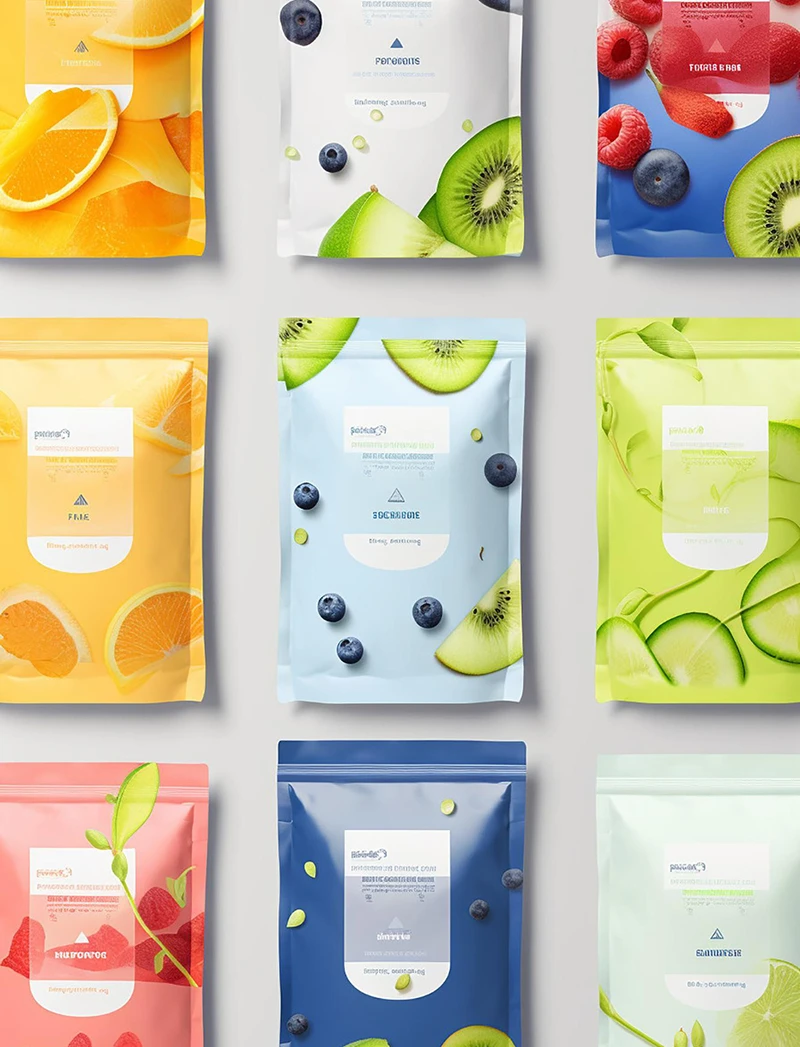
Tip: If you are launching multiple SKUs simultaneously, consider using finish as a consistent brand element across the range rather than varying it by variant. A unified matte finish across all flavours or formulations creates a cohesive range identity on shelf and in photography — and simplifies your production spec across the order.
MOQ and Pricing: What to Expect on Your First Order
MOQ is one of the first questions supplement brands ask — and one of the most misunderstood. It isn’t a fixed number. It varies by format, print method, film structure, and pouch size. For brands launching with multiple SKUs, understanding how MOQ works across a range is particularly important: the right supplier and print method can make a full multi-variant launch financially viable at volumes that would be impossible with gravure printing alone.
Format
Print Method
Typical MOQ
Best For
Stand-up pouch
Digital print
500 pcs per SKU
Multi-SKU launches, market testing, new brands
Stand-up pouch
Gravure print
3,000 – 5,000 pcs
Established brands with confirmed volume per SKU
Flat bottom bag
Digital or gravure
1,000 – 3,000 pcs
Premium retail brands with higher confirmed volume
Stick pack
Digital or gravure
2,000 – 5,000 pcs
Subscription DTC, sampling, hospitality
For supplement brands launching with multiple variants — different flavours, formulations, or sizes under the same brand — digital printing at 500 units per SKU is the most financially sound approach. There are no plate fees, no minimum per-SKU commitment beyond 500 units, and no requirement to bet your entire launch budget on a single variant performing well. You launch the full range, learn which SKUs move, and scale those to gravure once volume justifies it. This is exactly the path that makes a multi-product launch viable for brands that are not yet at scale.
When comparing quotes across suppliers, always confirm what is included. MOQ, print method, film structure, plate fees, sample costs, and material documentation are all part of the real total cost. A supplier quoting a lower unit price may be excluding plate fees or certification documentation that adds significant cost once the order is placed.
Tip: If you have five flavours but only want to test two initially, ask your supplier whether they can run the two test SKUs at 500 units each via digital print — then add the remaining variants once you have market validation. Most reputable suppliers will accommodate this approach without requiring you to commit to the full range upfront.
Lead Times and How to Plan Your Launch
Most custom packaging suppliers quote 4–6 weeks for production alone. At JINYI, orders without a sample requirement are dispatched within 7–15 days from artwork approval — shipping time not included. That timeline applies to stand-up pouches and flat bottom bags across digital and gravure print runs, including multi-SKU orders where several variants are produced simultaneously.
Stage
Without Sample
With Sample
Quote and spec confirmation
1 – 3 days
1 – 3 days
Dieline and artwork approval
2 – 5 days
2 – 5 days
Sample production and review
Not required
7 – 10 days
Production and dispatch
7 – 15 days
7 – 15 days
Total to dispatch
10 – 23 days
17 – 33 days
For multi-SKU orders, JINYI produces all variants concurrently — meaning a five-SKU digital print order does not take five times as long as a single SKU. The timeline above applies to the full order. The most common source of delay at any supplier is artwork revision loops. Each round of changes on the dieline or print file adds 2–5 days per SKU. Getting all variant artwork finalised and approved simultaneously — rather than sequentially — is the most effective way to keep a multi-SKU order on schedule.
Tip: If your launch date is fixed and time is tight, skip the sample and go straight to production — JINYI dispatches within 7–15 days from artwork approval. For first-time orders or new formulations, a sample round adds 7–10 days and gives you a final checkpoint on colour accuracy, zipper function, and seal integrity before committing to the full run.
JINYI Client Case Study: Tcha-bé — A French Wellness Brand Launching a Full Range
Tcha-bé is a French wellness brand built around matcha-based supplement powders — a category where packaging has to work at two levels simultaneously: protecting a delicate, light-sensitive, moisture-sensitive formulation, and communicating a premium positioning to a European wellness consumer who is increasingly sophisticated about both ingredients and aesthetics. They came to JINYI with a full product range: multiple SKUs across matcha collagen, pure matcha, and UBE powder variants, each with distinct artwork and branding.
The challenge wasn’t producing a single bag. It was producing a coherent range — across multiple flavours and formulations — at volumes that made commercial sense for a brand at their stage. Tcha-bé’s order volumes per SKU were modest, as is typical for a brand launching a full range simultaneously rather than scaling a single proven product. Most gravure-focused suppliers would have required them to commit to 3,000+ units per variant — a total commitment that doesn’t match the economics of a launch-phase brand testing multiple SKUs at once.
The full Tcha-bé product range — matcha, matcha collagène, and UBE variants — all produced at JINYI in a single multi-SKU order, demonstrating what factory-direct digital print makes possible for growing wellness brands.
Tcha-bé’s custom supplement powder range — produced at JINYI’s factory across multiple SKUs via digital print.
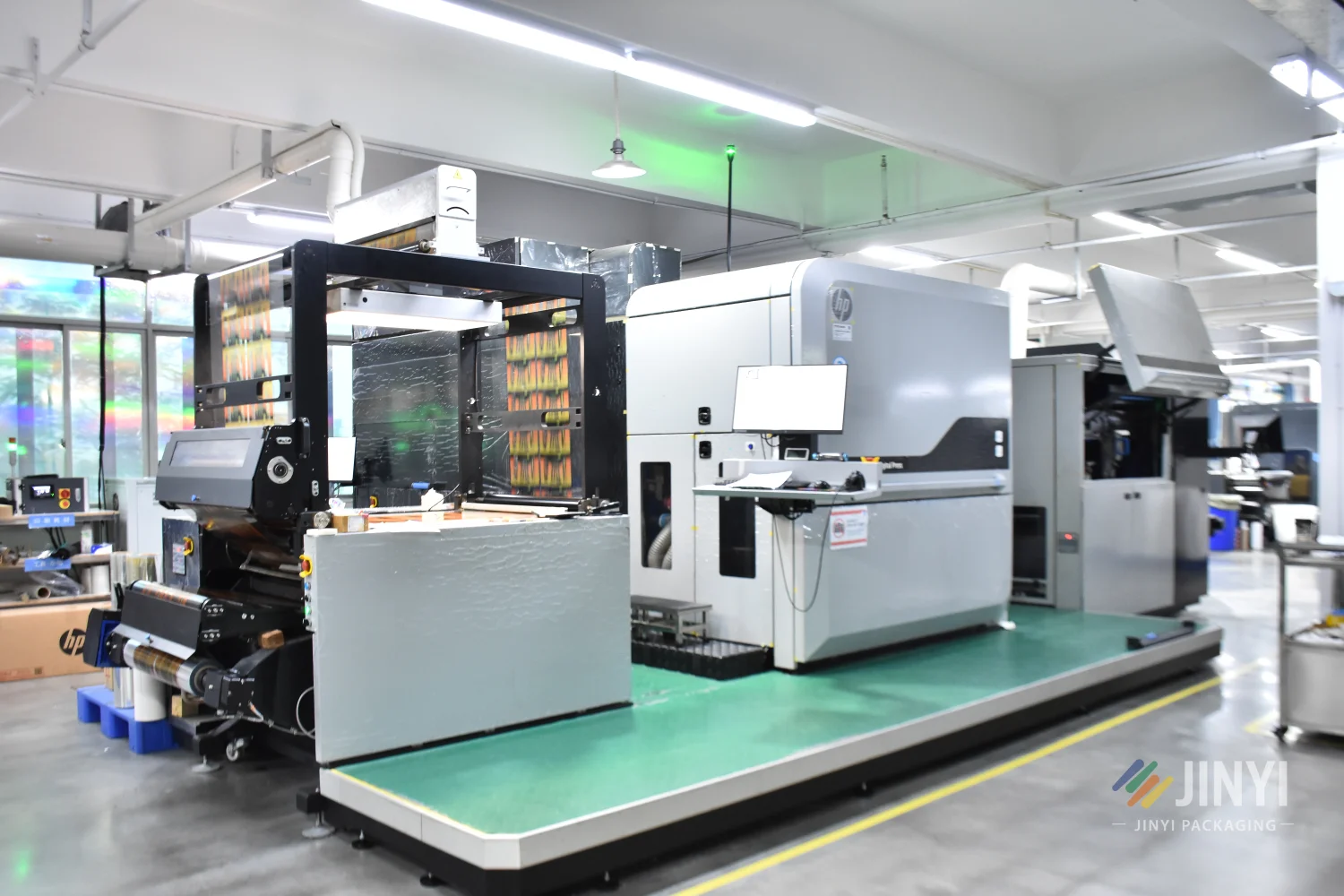
JINYI’s HP digital print capability solved this directly. Each SKU in the Tcha-bé range was produced at 500 units with no plate fee — giving the brand the ability to launch their full range commercially, validate which products resonated with their market, and scale those variants in subsequent orders without having over-committed to slow-moving SKUs on day one. The PET/AL/PE high-barrier laminate specified for the range provides the full barrier performance their matcha and collagen formulations require, while the matte finish and premium design execution position the brand where it belongs in the French wellness market.
This is the JINYI advantage for multi-SKU brands: the ability to launch a full range at commercially viable volumes, with the same barrier spec and production quality that larger-scale orders receive — and the flexibility to scale selectively once the market has spoken.
Supplement powder packaging sits at the intersection of performance, compliance, and brand communication in a way that most other categories don’t demand. The barrier spec has to be right. The documentation has to be in order. And the finish has to position your brand correctly in a market where the consumer reads packaging as a proxy for product quality before they read a single ingredient. Getting all three right — simultaneously, from day one — is the difference between a brand that earns its price point and one that has to discount its way to sales.
JINYI is built for exactly this: full barrier spec, complete material certification as standard, digital print capability that makes multi-SKU launches viable, and a 7–15 day dispatch timeline that keeps your launch on schedule. From film to finished — done right.
Source Your Custom Supplement Powder Packaging Factory-Direct
Tell us your format, formulation type, target shelf life, surface finish, number of SKUs, and volume per variant. We will come back with a full spec recommendation, material documentation, and a factory-direct quote — within 24 hours.
JINYI is a source factory for custom flexible packaging with 15+ years of production experience, serving supplement, food, matcha, pet food, and consumer goods brands across 150+ countries. Our facility runs HP digital print systems alongside multiple gravure printing lines — giving brands a clear path from small multi-SKU launch orders to full-scale production without changing suppliers.
Every client receives full material specification documentation with their order as standard — film structure, barrier data, and food-contact certifications included. That is what From Film to Finished — Done Right means in practice.
Elsa
Business Development Manager · JINYI Packaging
Elsa leads business development and customer order management at JINYI. With 8 years in foreign trade across Yiwu and Dongguan, she has a sharp understanding of market demand and what buyers actually need — turning real customer insight into the right packaging decisions.
Customer needs Order management Business development
What is the best packaging material for supplement powder?
PET/AL/PE full foil laminate is the recommended spec for most supplement powder brands. The aluminium foil core delivers near-zero oxygen and moisture transmission, protecting your formulation’s potency and physical integrity through an 18–24 month shelf life window. For natural or organic brands where material aesthetic matters, kraft + foil laminate delivers equivalent barrier performance with a cleaner visual.
Can I order custom supplement pouches with multiple SKUs at low MOQ?
Yes. Via JINYI’s HP digital print, each SKU can be produced from 500 units with no plate fee — making a full multi-variant launch commercially viable without committing to large runs per variant. This is the recommended approach for brands launching several flavours or formulations simultaneously before volume per SKU is confirmed.
How long does custom supplement powder packaging take to produce?
At JINYI, orders without a sample requirement are dispatched within 7–15 days from artwork approval — for both single-SKU and multi-SKU orders. Including a sample round adds 7–10 days. Total time from first contact to dispatch is typically 10–33 days. Shipping time to your location is additional.
What finish should I use for a premium supplement powder brand?
Matte lamination is the baseline for premium health and wellness brands — it communicates restraint and quality, photographs cleanly, and positions your product correctly at a premium price point. Soft-touch matte adds a tactile premium dimension for brands where the unboxing and handling experience matters. Avoid gloss on premium supplement products — it reads as mass-market regardless of what the label says.
Do I need food-contact certification for supplement powder packaging sold in the EU?
Yes. Food-contact certification for the inner layer, ink migration test reports, and adhesive certifications are required for supplement products entering the EU market. A reputable supplier will provide this documentation as standard with every order. If a supplier cannot provide it on request, do not proceed with production.
What is the difference between digital printing and gravure printing for supplement pouches?
Digital printing has no plate fees and works from 500 units per SKU — the right choice for new brands, multi-SKU launches, and market testing. Gravure printing delivers superior colour consistency and a lower per-unit cost at scale (typically 3,000+ units), making it the right choice once demand per SKU is confirmed. Most supplement brands start with digital and transition to gravure on their bestselling variants as volume grows.