JINYI shares practical packaging guidance for your decisions.
Blue Buffalo is the largest natural pet food brand in the United States. Founded in 2003 with a straightforward promise — real meat first, no by-product meals, no corn, wheat, or soy — the brand has grown into one of the most discussed names in the premium pet food category, distributed through every major retail channel from Petco and PetSmart to Walmart, Amazon, and Chewy. Their packaging is as recognisable as their brand promise: colourful, ingredient-forward design that signals natural quality on shelf. This breakdown covers what Blue Buffalo packaging is actually made of across their product lines, how their formats and film structures are matched to SKU weight and product category, and what those choices mean for any pet food brand sourcing comparable packaging factory-direct.
What Makes Blue Buffalo’s Packaging Strategy Different
Blue Buffalo occupies a specific position in the pet food market that shapes every packaging decision they make. They are not a veterinary diet brand — that is Royal Canin and Hill’s territory. They are not a mass-market brand competing primarily on price. They are a natural ingredient brand competing on transparency: real meat first, named ingredients, visible quality signals, and a clean label that pet owners can read and understand without a nutrition degree.
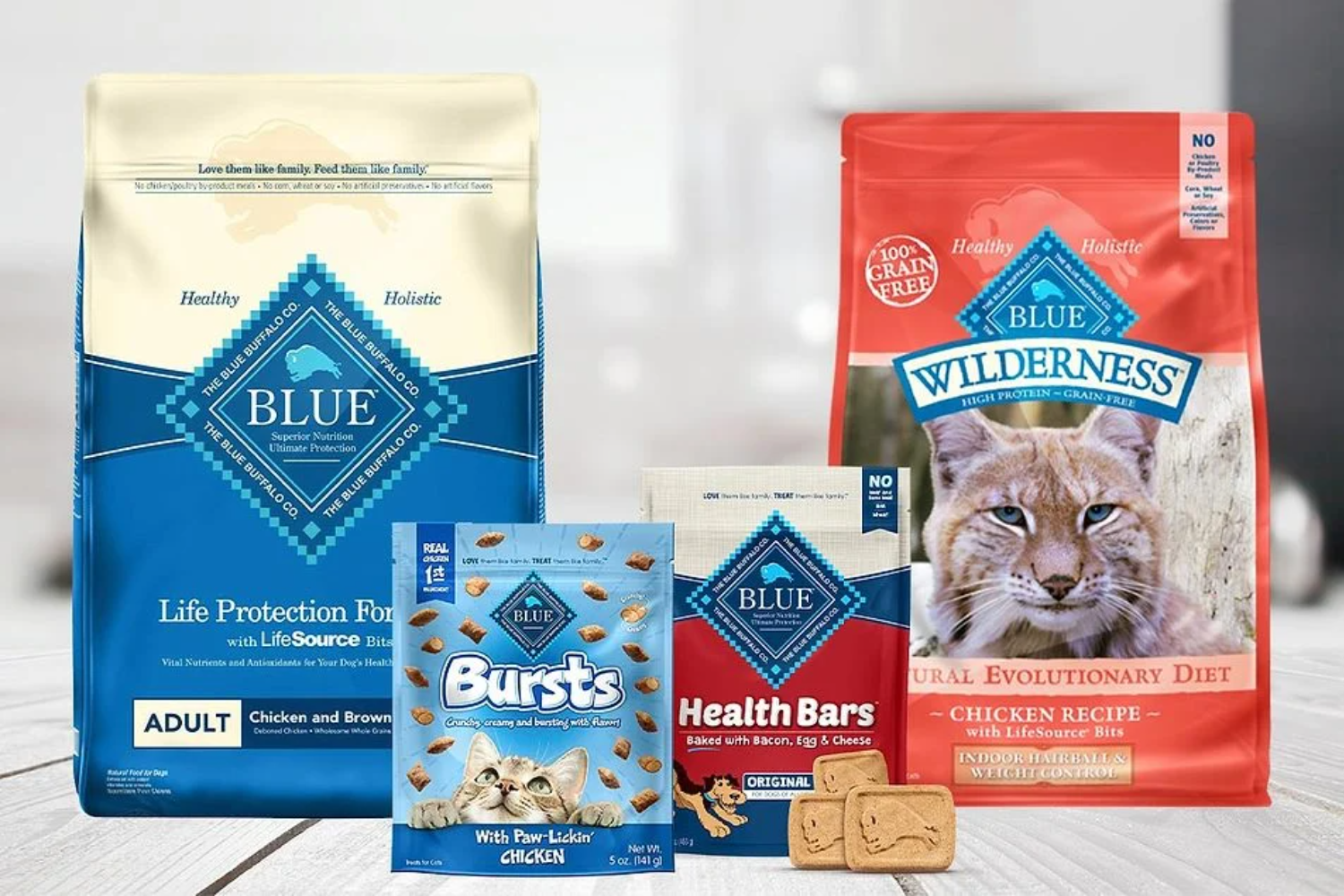
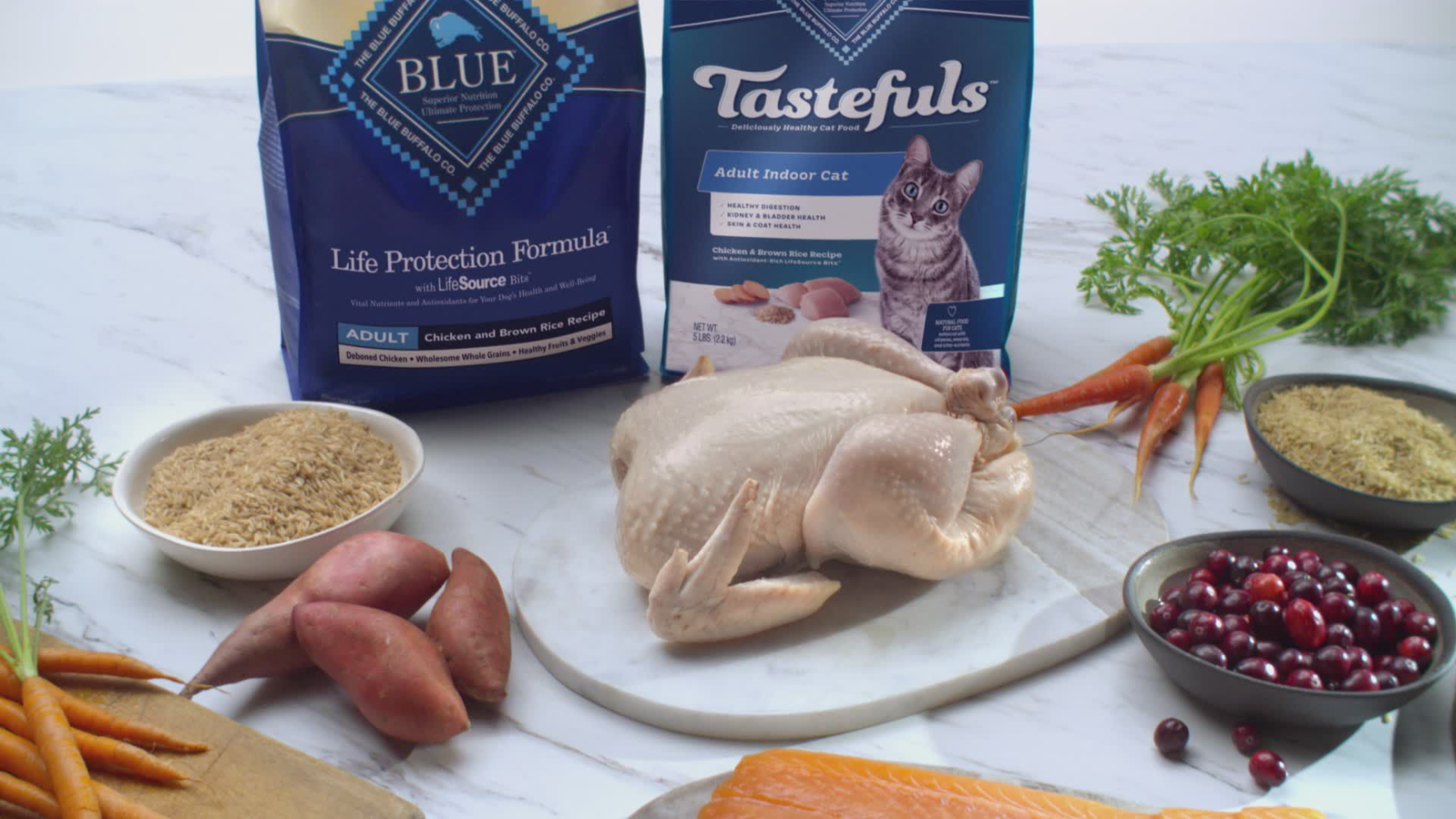
Their packaging design reflects this positioning directly. Blue Buffalo bags are colourful, ingredient-rich, and visually busy — the opposite of Royal Canin’s clinical white minimalism. Photography of real ingredients, bold typography calling out what is not in the food (no by-products, no corn, no wheat, no soy), and the distinctive LifeSource Bits medallion are all front-panel elements designed to communicate natural quality at a glance. In a grocery or pet specialty store, a Blue Buffalo bag is identifiable from ten feet away — which is exactly the point.
Blue Buffalo’s product portfolio is organised into four main lines, each with a distinct positioning and a distinct packaging visual language. Life Protection Formula is their original, broadest-appeal line — grain-inclusive, accessible pricing, wide distribution. Wilderness is their high-protein, grain-free line for performance-oriented pet owners. Freedom is entirely grain-free and positioned toward dogs with sensitivities. Basics is a limited-ingredient diet line for pets with allergies or digestive issues. Each line has its own colour coding and visual identity — but all share the same underlying packaging format and film specification logic.
The grain-free segment — covered by both Wilderness and Freedom — deserves specific attention from a packaging standpoint. Grain-free pet food formulas typically carry higher fat content than grain-inclusive recipes, because fat-dense ingredients replace the caloric contribution of grains. This has a direct implication for packaging specification: higher fat content accelerates the risk of fat migration through the inner seal layer over the product’s shelf life, which means grain-free pet food packaging needs to be specified with a heavier inner PE layer than standard kibble formulas. Both Wilderness and Freedom bags carry a noticeably darker, more dramatic visual palette than the blue-toned Life Protection Formula line — the design language communicates the product’s premium, protein-first positioning before the consumer reads a single word of copy.
Blue Buffalo Basics — their limited-ingredient diet line — takes a different visual approach. The packaging uses cleaner, more restrained design with simplified ingredient call-outs, reflecting the product’s core proposition: fewer ingredients, clearly identified. For pet owners managing their animal’s food sensitivities or allergies, the Basics packaging communicates transparency and simplicity rather than abundance. The film specification for Basics is consistent with the rest of the Blue Buffalo dry food range — PET/VMPET/PE — but the design brief is notably different from the high-saturation density of Life Protection Formula or Wilderness.
Note: Blue Buffalo was acquired by General Mills in 2018 for approximately $8 billion — one of the largest pet food acquisitions in history. The acquisition gave Blue Buffalo General Mills’ supply chain, distribution, and marketing infrastructure while maintaining the brand’s independent identity. Their packaging decisions now operate at a scale that informs what the broader natural pet food category looks like.
Dog Food Bag Formats — Matched to SKU Weight and Channel
Blue Buffalo’s dry dog food range spans from 5 lb introductory sizes through to 30 lb and 34 lb bulk bags, across all four product lines. The format logic follows the same weight-based pattern as the premium pet food category standard — stand-up pouches at small weights, flat-bottom bags at mid-range, and large-format bags at high volume — but Blue Buffalo applies this logic across a significantly wider product range than most brands, because their four product lines each have their own SKU architecture.
At the smaller retail sizes — 5 lb to 6 lb — Blue Buffalo uses a stand-up pouch format. These are the trial and introductory sizes — the format a new customer picks up when they are switching brands or testing a new formula. The stand-up pouch at this weight provides good shelf stability, a wide front panel for their ingredient photography and claims text, and low logistics cost per unit for a size that frequently ships via e-commerce rather than store purchase. Blue Buffalo’s design density — multiple call-out panels, large product photography, LifeSource Bits branding — means even their smallest bags carry a significant amount of information, and the stand-up pouch format provides just enough panel space to accommodate it.
In the mid-range — 15 lb to 18 lb — the format transitions to a flat-bottom bag. At this fill weight, the flat-bottom structure provides the shelf stability the product needs — a 15 lb stand-up pouch loses its upright posture as it empties, which undermines the shelf presence Blue Buffalo invests significantly in achieving. The flat-bottom bag maintains its shape through the full consumption cycle, and its four printable panels give the brand room to carry the full ingredient communication load that their positioning requires. This is their highest-volume retail size — the bag most repeat buyers purchase most frequently.
At the high end — 30 lb to 34 lb — Blue Buffalo uses a large flat-bottom or side gusset format optimised for bulk purchase. These sizes are primarily sold through Amazon, Chewy, and club stores like Costco, where the purchase decision is driven by value per pound rather than shelf-level visual merchandising. At these weights, the packaging needs to handle filling, transit, and consumer handling stress — a 34 lb bag is a significant physical load, and the bag structure must support that weight through the distribution chain without seal failure.
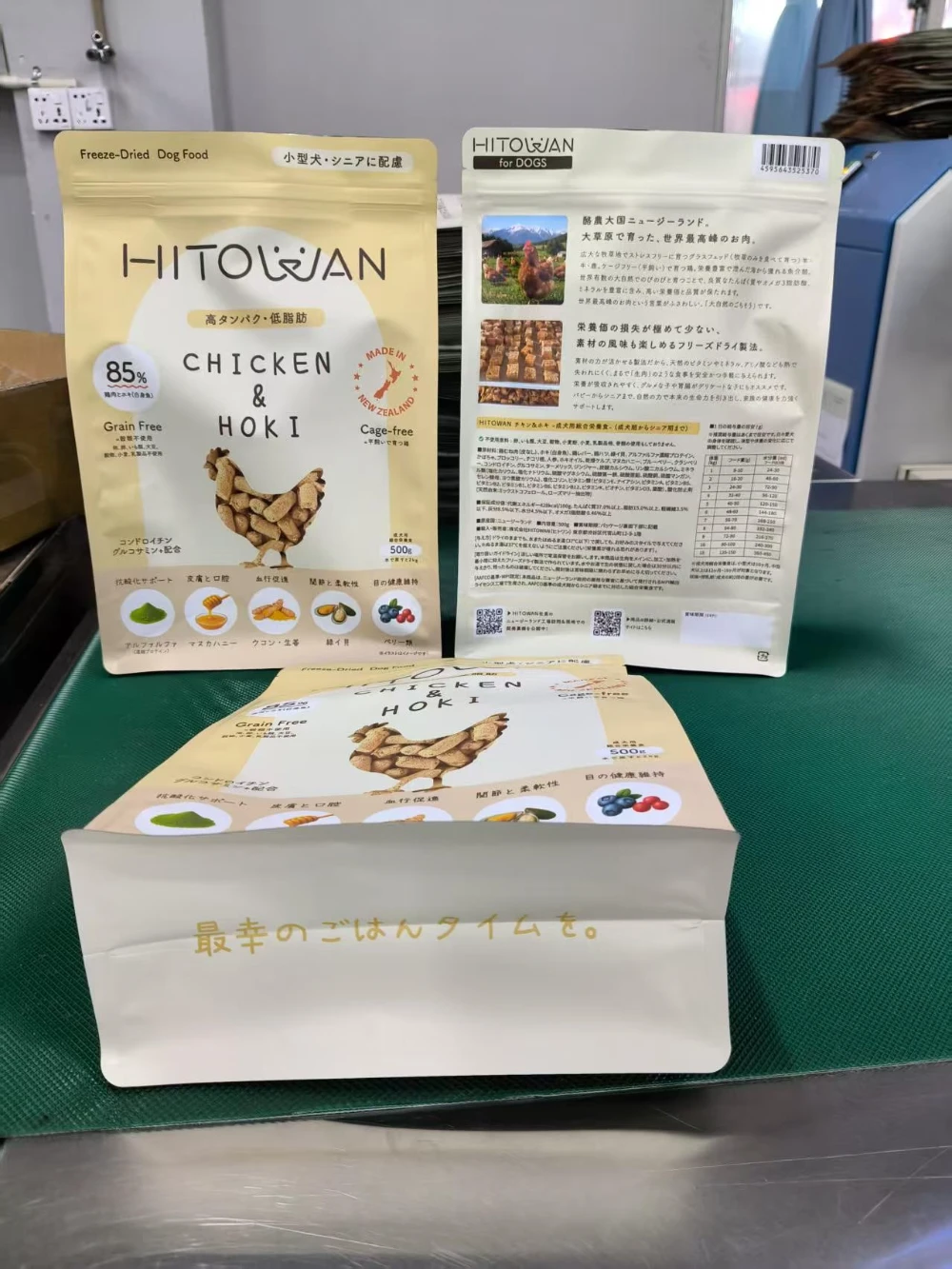
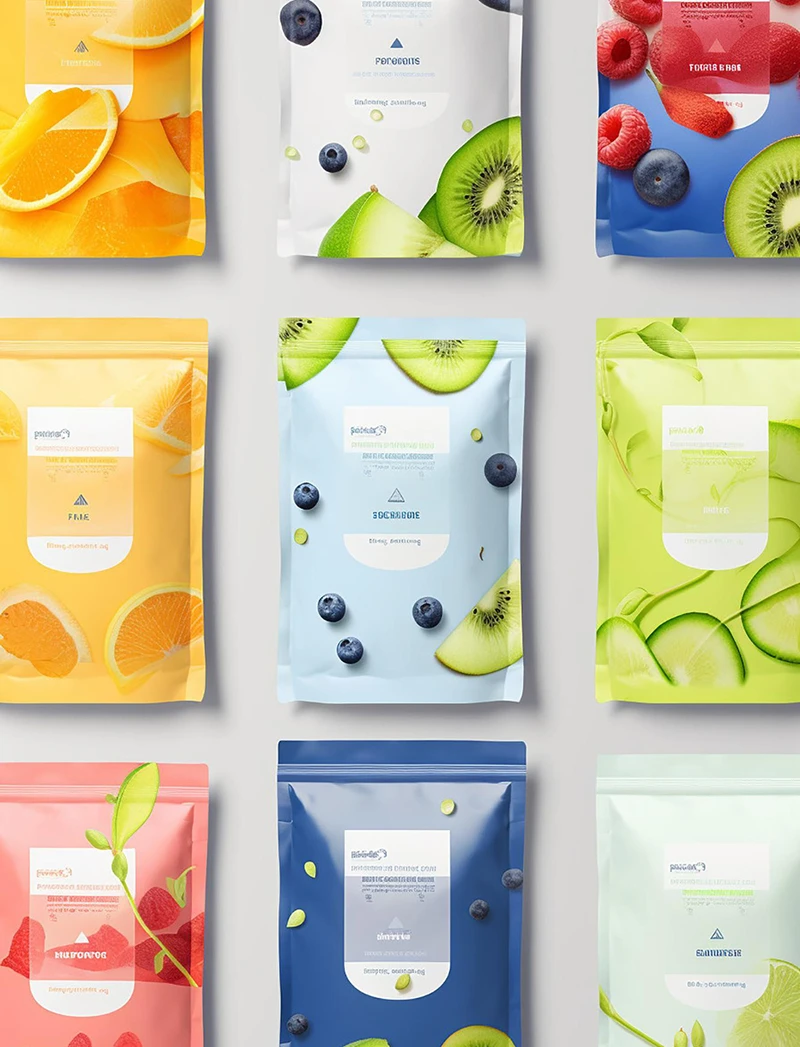
HITOWAN Chicken & Boki flavour pouches produced at JINYI — premium Japanese pet food packaging with matte white finish and full-colour illustration print
SKU Weight
Bag Format
Primary Use Case
Main Channel
5 lb – 6 lb
Stand-up pouch
Trial / introductory / e-commerce
Pet specialty, DTC, Amazon
15 lb – 18 lb
Flat-bottom bag
Primary repeat purchase SKU
Pet specialty, grocery, Amazon
30 lb – 34 lb
Large flat-bottom / side gusset
Bulk / value purchase
Amazon, Chewy, club stores
Tip: Blue Buffalo’s three-format SKU architecture — stand-up at small, flat-bottom at mid, large format at bulk — is the model most successful natural pet food brands eventually build toward. If you are launching with a single SKU format, the flat-bottom bag in the 1.5 kg to 5 kg range covers the highest-volume repeat purchase window and provides the shelf presence your brand needs to compete in specialty retail.
Cat Food Bag Formats — A Parallel Structure at Smaller Scale
Blue Buffalo’s dry cat food range follows the same format logic as their dog food line but operates within a tighter weight range — primarily 3 lb, 7 lb, and 15 lb SKUs. Cat food household consumption is generally lower than dog food, so the very large format bags (30 lb+) that appear in the dog food range are absent from the cat food portfolio. The 3 lb and 7 lb SKUs use stand-up pouches. The 15 lb SKUs use flat-bottom bags.
Blue Buffalo’s cat food line also includes wet food in single-serve cans and multi-pack formats, and a growing range of wet food pouches for individual meal serving. These wet food formats operate under retort packaging requirements — the bag or container must withstand the high-temperature sterilisation process used to achieve ambient shelf stability — which is a fundamentally different packaging specification from the dry food flexible bags covered in this breakdown.
SKU Weight
Dog Food Format
Cat Food Format
Small (3–6 lb)
Stand-up pouch
Stand-up pouch (3 lb – 7 lb)
Mid (15–18 lb)
Flat-bottom bag
Flat-bottom bag (15 lb)
Large (30+ lb)
Large flat-bottom / side gusset
Not common in cat food range
Film Structure — What’s Inside the Blue Buffalo Bag
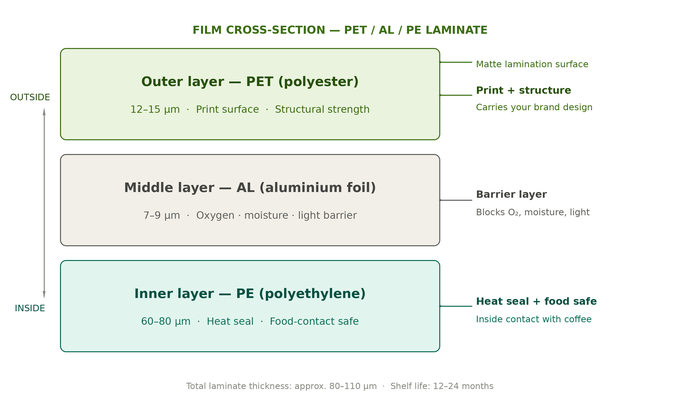
Blue Buffalo’s dry food bags are opaque — full-coverage print on an opaque substrate, with no transparent window on the main retail line. The film structure across their dry food range is a standard high-barrier pet food laminate: PET / VMPET / PE. The outer PET layer provides the print surface for their high-saturation, multi-colour artwork. The metallised PET (VMPET) middle layer provides the barrier performance — protecting the kibble against oxygen, moisture, and UV light through the retail shelf life cycle. The inner PE layer provides the heat-seal surface and food-contact safety.
The choice of VMPET rather than aluminium foil is consistent with the dry kibble application. Blue Buffalo’s standard shelf life is 18 months from manufacture date — achievable with the OTR range of PET/VMPET/PE (0.5 to 1.5 cc/m²/day) under standard retail storage conditions. The VMPET structure also supports Blue Buffalo’s full-colour high-saturation print — the metallic reflectivity of the VMPET layer contributes to the vibrancy of the printed colours when viewed through the transparent PET outer layer, which is part of why Blue Buffalo bags read as visually striking on shelf.
Their Wilderness grain-free line — a higher-protein, higher-fat formula — may use a slightly higher-gauge inner PE layer to improve puncture resistance and seal integrity for formulas with elevated fat content. Higher fat content increases the risk of fat migration through inadequate seals over the product’s shelf life, which is why premium high-protein formulas often specify a heavier inner seal layer than standard kibble formulations.
Barrier against oxygen, moisture, and UV · colour vibrancy enhancement
Inner
PE (Polyethylene)
Heat seal layer · food-contact safe · fat migration resistance
Note: For pet food brands launching a high-protein or high-fat formula — raw-coated kibble, freeze-dried toppers, or recipes with elevated meat content — specify at least a 70-micron inner PE layer to manage fat migration risk through the seal area over the product’s shelf life. Thinner inner layers save a small amount on material cost but create a higher risk of seal degradation in high-fat applications over a 12 to 18 month shelf life window.
Blue Buffalo’s Design Language — And What High-Saturation Print Demands
Blue Buffalo’s packaging design is one of the most print-intensive in the pet food category. Their bags carry large-format ingredient photography, multiple colour call-out panels, illustrated backgrounds, branded elements (the LifeSource Bits medallion, the product line logo), and extensive claims text — all on a single front panel. This is the visual opposite of Royal Canin’s white minimalism and Blue Bottle Coffee’s typographic restraint. Where those brands use design to signal restraint, Blue Buffalo uses design to signal abundance — the bag communicates that everything you need to know about what’s in the food is visible on the packaging.
This design approach makes specific demands on the printing process. High-saturation multi-colour artwork with photographic elements requires accurate colour reproduction across every production run — a shift in the saturation of the food photography, a registration error in the fine text areas, or an inconsistency in the background colour across two bags from different production batches would be immediately visible to a consumer standing in front of a shelf comparing options. Blue Buffalo’s brand recognition depends partly on colour consistency — the distinctive blue of their Life Protection Formula line is a brand asset that must be reproduced accurately at every press run.
Brand
Design Approach
Print Demand
Brand Signal
Blue Buffalo
High-saturation, ingredient photography
Multi-colour accuracy, photo reproduction
Natural ingredients, abundance, transparency
Royal Canin
White minimal, breed/condition-coded
White base coat consistency, typography accuracy
Science, precision, veterinary authority
Purina Pro Plan
White base, animal imagery, colour accents
Consistent colour coding across 175+ formulas
Science, performance, vet-recommended
Tip: If your pet food brand uses ingredient photography or lifestyle photography as a primary design element, require a physical colour proof on your actual film specification before confirming your production run. What reproduces accurately on a digital file does not always translate identically to the printed substrate — especially skin tones, food colours, and saturated backgrounds. A proof on the real material eliminates print surprises before they become production problems.
How to Source the Same Packaging Structure Factory-Direct
The packaging formats Blue Buffalo uses across their dog and cat food range — stand-up pouches, flat-bottom bags, large side gusset bags — in PET/VMPET/PE high-barrier laminate are standard flexible packaging production specifications. They are not proprietary to Blue Buffalo, and you do not need their scale to access them. At JINYI, the same formats are available from 500 units via HP digital print with no plate fee — including the full-colour, high-saturation print quality that Blue Buffalo’s design approach demands.
Our HP Indigo digital print fleet — managed through the ESKO Automation Engine — delivers accurate colour reproduction for high-saturation pet food packaging artwork, including ingredient photography and multi-element design layouts. Pantone colour accuracy is managed through calibrated ICC profiles across all four press systems, and every job goes through a preflight check before press to catch file issues before they reach production. For brands whose packaging design uses photographic elements or heavily saturated colour systems, a physical proof on the actual film specification is available before production confirmation.
For grain-free pet food brands — whether launching a single grain-free SKU or building a full grain-free product line — JINYI produces PET/VMPET/PE flexible bags with the heavier inner PE layer specification that high-fat, grain-free formulas require. The film specification, inner layer gauge, and seal integrity parameters are all documented in the material specification sheet provided with every order, giving you the documentation you need to support any grain-free or limited-ingredient claims your brand makes in retail or on-pack. For natural pet food brands in particular — where ingredient transparency and label claims are central to the brand value proposition — having verifiable packaging documentation is as important as having accurate on-pack claims.
Brands scaling from a launch-volume digital print run to higher-volume gravure printing can do so within JINYI without changing their film specification, their bag format, or their supplier relationship. The same PET/VMPET/PE structure, the same flat-bottom or stand-up format, the same inner layer gauge — all transition from HP Indigo digital print at 500 units to gravure printing at 3,000 units and above, with a meaningful reduction in per-unit cost that improves margin as volume grows. This is the scale path that natural pet food brands building toward mainstream retail distribution need — and it is available factory-direct without the distributor margin that intermediary suppliers add at every step.
For a complete guide to the pet food packaging options available — by format, barrier specification, and product category — our pet food packaging solutions page covers the full range. Our breakdown of Purina Pro Plan’s packaging and Royal Canin’s packaging cover comparable format and film decisions from two other major brands in the same category, with different positioning and design approaches. For brands supplying Asian markets — particularly Japan — our guide to custom pet food packaging for the Japanese market covers the specific requirements that apply. For a complete understanding of how the bags you order are actually made, our guide to how custom stand-up pouches are made covers every production stage in detail.
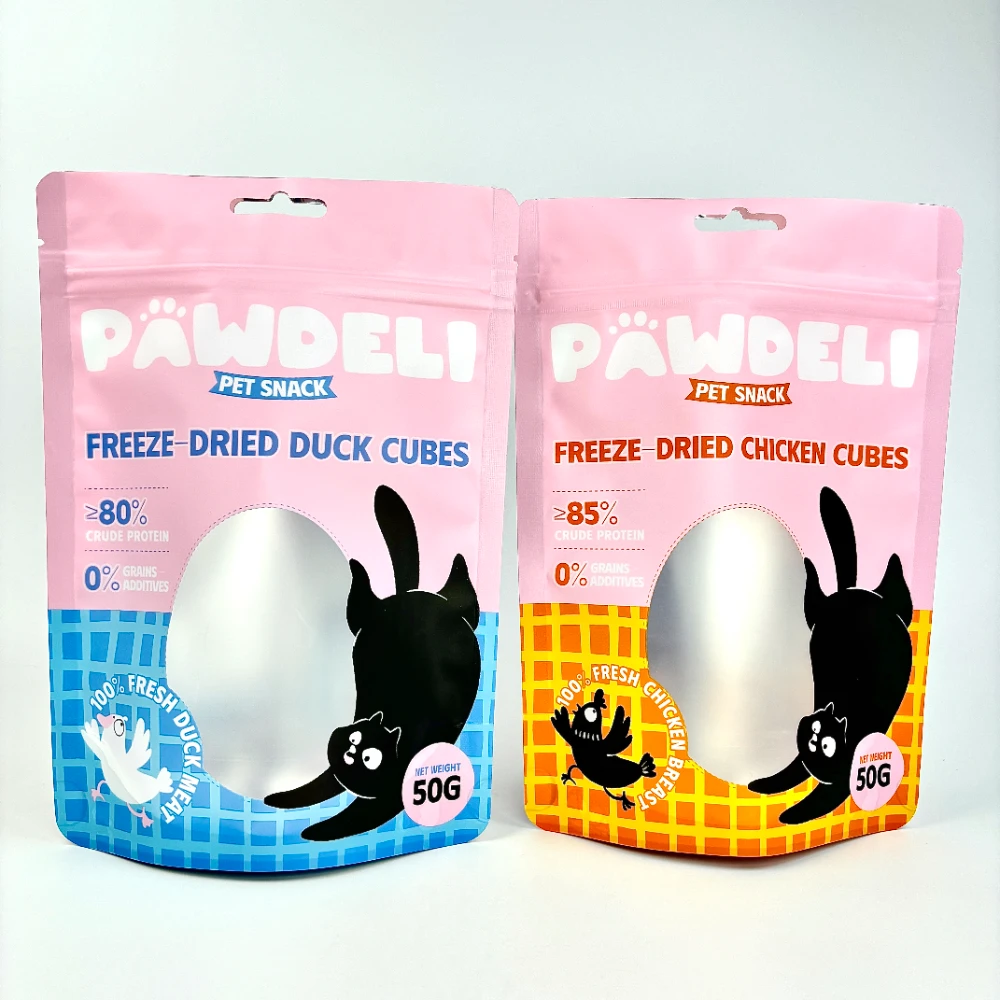
Custom pet food stand-up pouches produced at JINYI factory — high-saturation full-colour print on flexible packaging for natural dog food and cat food brands, available factory-direct from 500 units
Spec
Platform / Intermediary
JINYI Direct Factory
MOQ
1,000–3,000 units typical
From 500 units (digital print)
Plate / setup fee
Often included in unit price
None for digital print
Colour proof on actual film
Varies by supplier
Available before production confirmation
Material spec document
Rarely provided as standard
Included with every order
Scale path
Platform pricing, limited flexibility
Digital → gravure at volume, unit cost drops
Get a Factory-Direct Quote for Your Pet Food Packaging
Tell us your bag format, fill weight, design approach, and quantity. We will come back within 24 hours with a full specification recommendation, material documentation, and factory-direct pricing.
JINYI is a source factory for custom flexible packaging with 15+ years of production experience, serving food, supplement, coffee, pet food, and consumer goods brands across 150+ countries. We produce stand-up pouches, flat-bottom bags, and side gusset bags in PET/VMPET/PE, PET/AL/PE, and other barrier specifications — via HP Indigo digital print from 500 units and gravure printing at volume.
Every client receives full material specification documentation with their order as standard. That is what From Film to Finished — Done Right means in practice.
Elsa
Business Development Manager · JINYI Packaging
Elsa leads business development and customer order management at JINYI. With 8 years in foreign trade across Yiwu and Dongguan, she has a sharp understanding of market demand and what buyers actually need — turning real customer insight into the right packaging decisions.
Customer needs Order management Business development
What bag format does Blue Buffalo use for dry dog food?
Blue Buffalo uses stand-up pouches for their smaller retail SKUs (5 lb to 6 lb), flat-bottom bags for their primary repeat purchase SKUs (15 lb to 18 lb), and large flat-bottom or side gusset bags for their bulk sizes (30 lb to 34 lb). The format transitions are matched to fill weight, shelf stability requirements, and the primary purchase channel for each size point.
What film material is Blue Buffalo dog food packaging made from?
Blue Buffalo dry food bags use a PET/VMPET/PE multi-layer laminate — a polyester outer layer for their high-saturation full-colour print, a metallised polyester middle layer for barrier performance against oxygen, moisture, and UV light, and a polyethylene inner layer for heat sealing and food contact. This structure delivers an OTR of approximately 0.5 to 1.5 cc/m²/day, sufficient for an 18-month shelf life under standard retail conditions.
What is the difference between Blue Buffalo Life Protection Formula and Wilderness packaging?
Both lines use the same flexible packaging formats and PET/VMPET/PE film structure. The primary difference is in design — Life Protection Formula uses a distinctive blue colour palette with ingredient photography, while Wilderness uses darker, more dramatic tones to signal the high-protein, grain-free positioning. Wilderness formulas may specify a heavier inner PE layer due to the higher fat content in high-protein recipes, which requires better seal integrity to manage fat migration over the shelf life.
How does Blue Buffalo packaging compare to Royal Canin and Purina Pro Plan?
All three brands use the same flexible packaging formats — stand-up pouches, flat-bottom bags, and side gusset bags — in comparable PET/VMPET/PE or PET/AL/PE film structures. The key difference is in design language: Blue Buffalo uses high-saturation ingredient photography to signal natural quality; Royal Canin uses white clinical minimalism to signal scientific precision; Purina Pro Plan uses a structured white-base system across 175+ formulas to signal consistency and range. The underlying packaging specification is comparable across all three.
Can I get the same pet food packaging as Blue Buffalo factory-direct with low MOQ?
Yes. The stand-up pouches, flat-bottom bags, and side gusset bags that Blue Buffalo uses are standard flexible packaging formats available at JINYI from 500 units via HP digital print with no plate fee. High-saturation full-colour print is available as standard. Full material specification documentation — OTR, MVTR, film layer breakdown, and food-contact certifications — is included with every order. A physical colour proof on your actual film specification is available before production confirmation.