JINYI shares practical packaging guidance for your decisions.
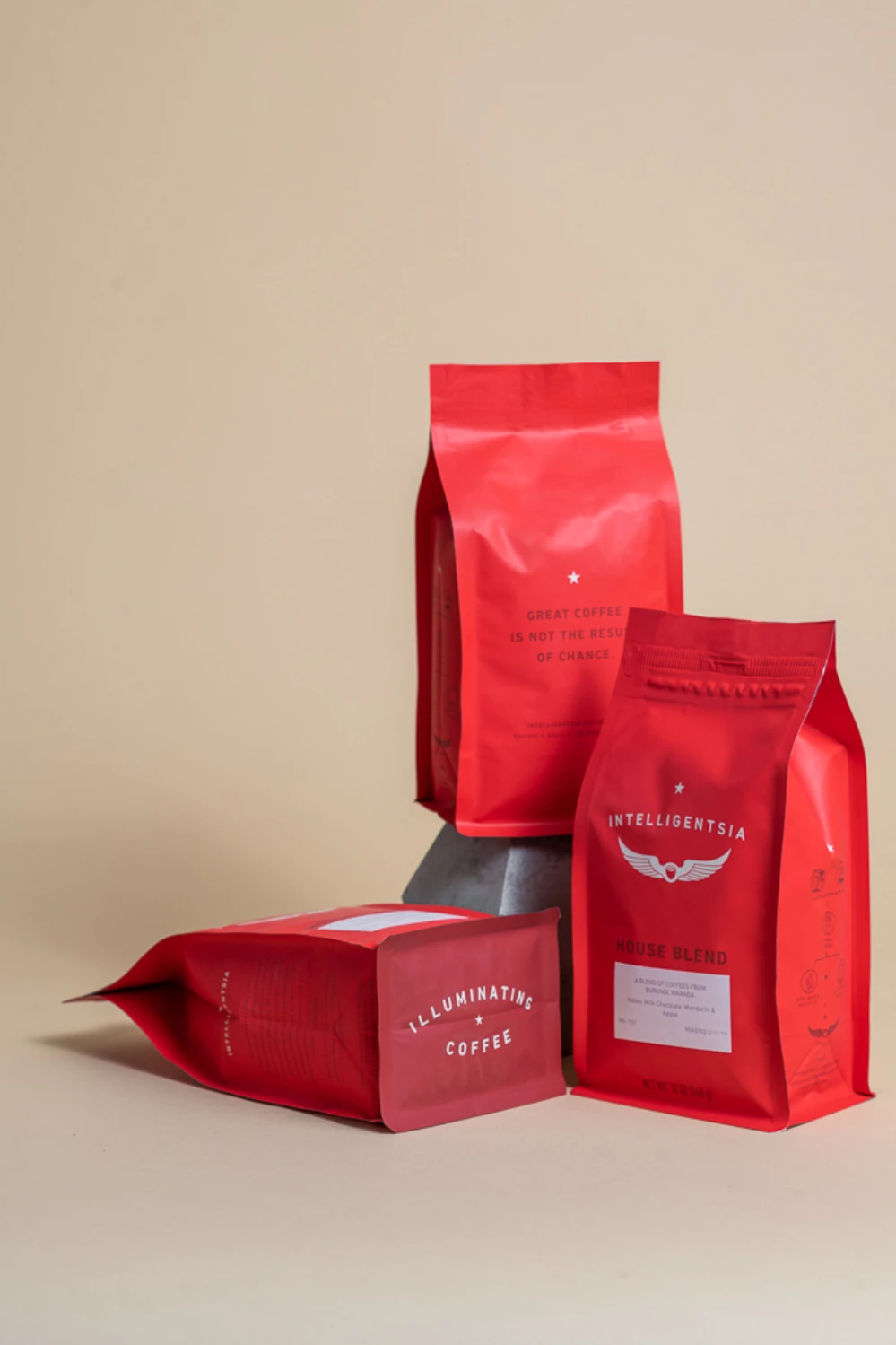
Intelligentsia Coffee was founded in Chicago in 1995 by Doug Zell and Emily Mange. It is one of the brands most responsible for defining what is now called the third wave of specialty coffee in North America — the movement that reframed coffee as an agricultural product with terroir, provenance, and seasonality rather than a commodity to be standardized. Intelligentsia pioneered the Direct Trade sourcing model, traveling directly to origin farms, paying prices above Fair Trade minimums, and building long-term relationships with producers in more than 14 countries. The company roasts lighter than industry average, a deliberate choice that preserves origin character at the expense of the roast-forward flavors most consumers were trained to expect. Today Intelligentsia operates coffee bars across Chicago, Los Angeles, and New York, sells through major retail including Target, and maintains a direct-to-consumer subscription business.
That combination — specialty positioning, direct trade sourcing, light roast philosophy, and a retail footprint that spans independent café counters and mass-market grocery shelves — creates a packaging brief of unusual complexity. The bag has to communicate farm-level provenance information to a specialty buyer in a café, and signal premium differentiation to a shopper scanning a grocery aisle in three seconds. It has to work in a display context where the brand controls the narrative, and in a retail context where a hundred other bags compete for the same attention. And it has to do all of this while maintaining a film specification appropriate for a light-roast whole bean or ground coffee with a meaningful shelf life across a distribution chain that spans multiple channels and retail environments.
The solution Intelligentsia arrived at — through two major packaging redesigns, the most recent completed in late 2024 — is a three-tier design system where each tier has its own visual language, its own color identity, and its own information architecture. Understanding how that system works, and why it was built this way, is useful for any specialty coffee brand building a packaging portfolio that needs to perform across more than one context.
Why Intelligentsia’s Packaging Has to Carry More Information Than Most Coffee Bags
A standard commodity coffee bag carries a brand name, a roast level descriptor, and a flavor suggestion. That is all most buyers need or want. Intelligentsia’s packaging carries something different: a complete argument about where the coffee came from, who grew it, how it was sourced, and what it should taste like — compressed into a bag that needs to communicate this story at multiple distances and to multiple audiences simultaneously.
The Direct Trade model creates a specific information obligation. When a brand has spent years building a sourcing relationship with a specific farmer in a specific region — and when the quality premium of that coffee is directly connected to the specifics of that relationship — the packaging needs to make those specifics visible. Not just “Ethiopia” but which farm, which producer, how many years of partnership, what the cup profile reflects about the growing conditions. This is the level of provenance detail that third wave coffee buyers expect, and it is fundamentally different from the provenance information most packaging systems were designed to carry.
At the same time, Intelligentsia’s retail footprint includes Target — a mass-market environment where the buyer is not a specialty coffee enthusiast and the purchase decision happens in a few seconds of shelf scanning. That buyer needs a different set of signals: brand recognition, quality cues, roast level clarity, and a visual differentiation from the commodity coffee bags on either side. The packaging has to serve both contexts without becoming incoherent in either.
The 2024 redesign introduced a 9-point Roast Profile indicator on all bags — a numeric scale that places each coffee on a single continuum from lightest to darkest roast. This is a direct response to the retail shelf problem: specialty roasters have traditionally described roast level in relative terms (“light,” “medium-light”) that vary by roaster and confuse buyers who are comparing across brands. A numbered scale gives a shopper something concrete to anchor to, regardless of their specialty coffee knowledge. It is a packaging design decision that encodes the brand’s light-roast philosophy into a universally legible format.
From a production standpoint: A packaging system that needs to carry variable provenance information across a rotating SKU calendar — new single origins arriving seasonally, producer partnerships changing year to year — requires a production model that can update content efficiently without rebuilding the entire print file. Intelligentsia’s label-on-bag system, where a separately printed sticker carries the origin-specific information, is a direct response to this production constraint.
The Format Decision: Three Bag Structures Serving Three Different Contexts
Intelligentsia uses three bag formats across its product range, each chosen for a specific combination of fill weight, retail context, and brand positioning requirement. The format decision is not uniform across the portfolio — different tiers and different use cases get different structures.
The standard stand-up pouch handles smaller retail sizes — typically 10oz and 11oz packages for Single Origin and some Signature Blend offerings. The standard stand-up pouch with a bottom gusset is appropriate at these fill weights: the gusset expands sufficiently to allow the bag to stand on shelf, the format is cost-efficient for the fill quantity, and the five-panel printable surface (front, back, sides, and bottom gusset) gives enough space for the brand’s information architecture. For a 10oz single-origin coffee with a rotating label, the standard stand-up pouch is a sensible production choice.
The side gusset bag serves larger format sizes — typically 12oz and above — where the fill weight requires a format that distributes the product’s weight across a wider base. The side gusset bag’s block-bottom structure, created by the gusseted side panels folding out at the base when filled, provides a stable standing surface that does not rely on the bottom seal to bear the product weight. For whole bean coffee at 12oz or more, the side gusset format is structurally appropriate and has been the industry standard for large-format specialty coffee for decades.
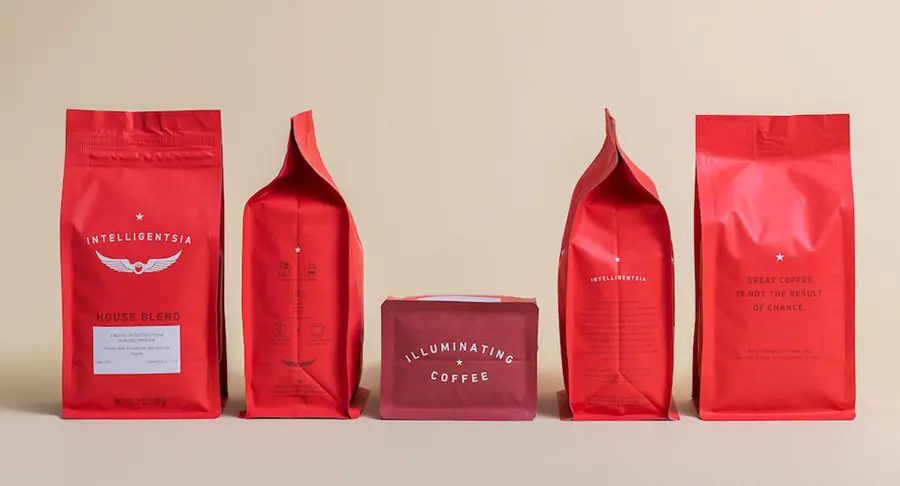
The eight-side seal flat-bottom bag is Intelligentsia’s most structurally distinctive format — used for the Black Cat espresso line and select premium offerings where packaging presence on the retail shelf and café counter is a brand differentiator. The eight-side seal construction creates a true flat base through eight individual seal points along the bottom and lower corners of the bag, giving the bag a precise geometric stability that a standard flat-bottom bag cannot fully achieve. When filled and placed on a surface, the eight-side seal bag stands squarely and holds its rectangular profile — it does not lean, does not bow at the sides, and does not show the bottom-panel dimpling that can affect standard flat-bottom bags. This structural precision communicates quality through the bag’s physical presence before a single word of copy is read. The five printable panels — front, back, two sides, and a dedicated bottom panel — give additional real estate for brand and origin information that narrower formats cannot accommodate.
All three formats include a one-way degassing valve — an essential specification for freshly roasted whole bean coffee. Roasting drives CO₂ into the coffee cell structure; after sealing, that CO₂ continues to off-gas for days. Without a valve, pressure builds inside the sealed bag and either stresses the seals to failure or forces the roaster to wait before packaging — compromising freshness. A one-way degassing valve allows CO₂ to escape without admitting oxygen, making it possible to seal freshly roasted coffee immediately and maintain seal integrity throughout the product’s shelf life. All three formats also include a resealable zipper for consumer convenience after opening. For a comprehensive overview of coffee bag formats and specifications, the complete coffee bag packaging guide covers the full format decision framework.
What Film Structure Does Intelligentsia’s Bag Most Likely Use — and Why Light Roast Changes the Specification
Intelligentsia has not published a formal material specification for their packaging film. The following analysis is based on the brand’s light roast positioning, the aromatic complexity of their coffee profiles, and the barrier performance standards applicable to specialty whole bean and ground coffee at a standard 6 to 12 month shelf life.
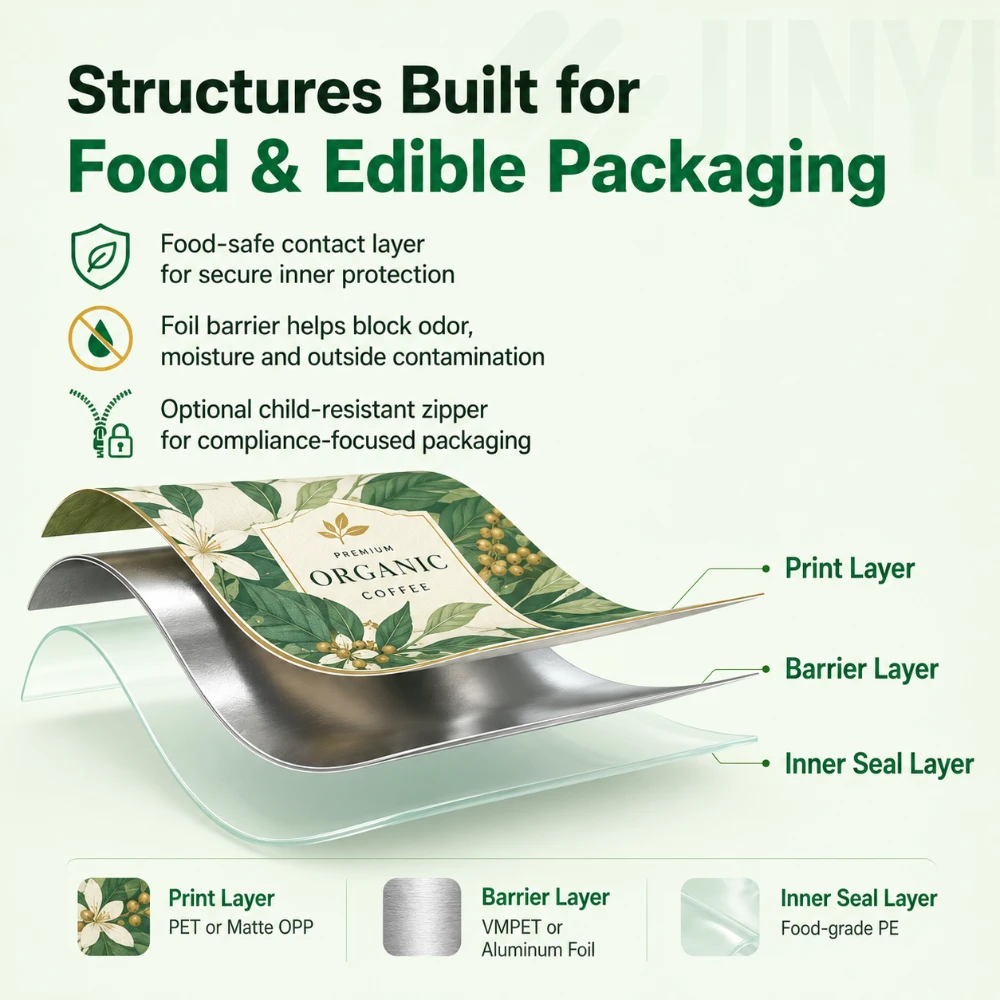
The estimated film structure for Intelligentsia’s bags is a standard three-layer laminate:
Layer (Outside → Inside)
Estimated Material
Function
Print Layer (outside)
PET, 12–15 μm
Reverse-print substrate for solid color-field and gradient graphics; structural stiffness for eight-side seal and side gusset forming; abrasion resistance for retail handling and DTC shipping
Barrier Layer (middle)
AL (aluminum foil) or VMPET, 7–9 μm
AL: near-zero OTR (est. ≤0.01 cc/m²/day), near-zero MVTR, complete UV and light block — protecting volatile aromatic compounds in light-roast coffee. VMPET: OTR ~0.5–2.0 cc/m²/day, viable for darker roast profiles with shorter shelf life targets
Inner Seal Layer (inside)
Food-grade PE, 60–80 μm
Heat-seal surface for all bag formats; food contact compliance; compatible with degassing valve installation and zipper integration
Note: Film structure is estimated based on Intelligentsia’s light roast positioning, observable bag properties, and industry-standard specifications for specialty coffee packaging. Intelligentsia has not published official material documentation.
The light roast positioning is the key specification driver that separates Intelligentsia’s packaging requirement from a standard dark roast commercial coffee. Light roast coffee retains a significantly higher concentration of volatile aromatic compounds — the fragile, heat-sensitive molecules responsible for the floral, fruit, and terroir-specific notes that specialty buyers are paying for. These compounds are lost through the packaging film over time through two mechanisms: oxidation (chemical reaction with oxygen that degrades aromatic molecules) and permeation (direct migration of volatile compounds through the polymer film matrix into the ambient environment).
A dark roast coffee has fewer of these volatile compounds to lose — the roasting process has already driven them off — and the dominant flavors are roast-derived compounds that are more chemically stable. For a dark roast commodity coffee, a VMPET barrier layer providing OTR in the range of 0.5 to 2.0 cc/m²/day is often adequate. For a light roast single-origin coffee where the cup profile is defined by fragile, origin-specific aromatics, the same OTR specification represents a meaningful quality risk over a 6 to 12 month shelf life. An aluminum foil barrier providing near-zero OTR and complete UV exclusion is the technically appropriate choice for Intelligentsia’s light roast positioning — it is the specification that gives the aromatics the best chance of surviving the time between roasting and the consumer’s cup.
The Three-Tier Design System: Black Cat, Signature Blends, and Single Origin
Intelligentsia’s 2024 packaging redesign — the brand’s most significant visual update in years — maintained the color identities that had become recognizable over the previous design generation while sharpening the differentiation between tiers and modernizing the visual language for both physical retail and digital touchpoints. The result is a three-tier system where each tier has a defined visual personality, a specific information hierarchy, and a distinct relationship with the buyer it is most directly addressing.
Black Cat — the flagship tier. The Black Cat line is Intelligentsia’s most iconic product — a signature espresso blend that has defined the brand’s bar program since the beginning. The packaging reflects this status: a near-black base with gold and deep green accents, in the eight-side seal flat-bottom format that communicates premium positioning through structure before color is even processed. The 2024 update retained the legendary black and gold colorway while adding deep greens to add depth to what had been a starker, two-tone identity. The Black Cat bag is recognizable from across a café counter — it reads as premium, iconic, and serious before a buyer engages with any of the text. For a brand that has been building this equity since 1995, the packaging’s job is to protect and amplify a brand asset, not to introduce the brand to a new audience.
Signature Blends — the accessible anchor. The Signature Blend bags use Intelligentsia’s classic red as the base color, reimagined in the 2024 update with a gradient that transitions into orange — a visual signal of energy and warmth that differentiates the blends from both the Black Cat’s severity and the Single Origin’s natural imagery. Signature Blends are the year-round, consistent products: the entry point for new buyers, the reliable daily driver for established ones, and the range with the widest retail distribution. The packaging communicates stability and approachability without abandoning the brand’s premium positioning. The gradient distinguishes these bags from the flat color fields of the other tiers — a visual shorthand for “blended complexity” that the brand uses consistently across the portfolio.
Single Origin — the provenance tier. The Single Origin bags use a palette of lush greens and rich reds drawn from the imagery of coffee’s agricultural context — the foliage of the coffee plant and the color of ripe coffee cherries. The 2024 update reframed these bags around the journey from seed to fruit, celebrating the agricultural specificity that Direct Trade sourcing makes possible. This color system does something specific: it signals that what is inside this bag came from a specific place that looked like this, and that the cup profile will reflect those growing conditions in a way that a blend cannot. The greens and reds are not arbitrary — they are the colors of the origin story the brand is telling.
The three-tier system is designed to be navigable at a portfolio level — a buyer standing in front of an Intelligentsia display can locate the tier they want by color field before reading a word. This is a similar logic to how other specialty coffee brands structure their visual differentiation, but Intelligentsia’s execution is more formally codified than most. Compare the approach of Blue Bottle Coffee, which uses minimal visual differentiation between SKUs in favor of a unified brand presence, or Death Wish Coffee, which uses a single, maximally aggressive visual identity across its range without tier differentiation. Intelligentsia’s three-tier approach reflects a portfolio at a scale where tier navigation has become a genuine consumer need — the brand sells over 50 single origins and blends annually, and the design system has to help buyers orient in that range without requiring them to read every bag.
On gradient printing: The Signature Blend gradient — transitioning from red to orange across the bag surface — requires tight ink laydown control to achieve a smooth transition without visible banding. On a matte PET substrate, gradient reproduction depends on both the print resolution and the ink density profile across the gradient zone. A physical pre-production sample is the only reliable way to confirm whether a gradient reads cleanly on the actual substrate before production is approved.
The Direct Trade Label System: How a Sticker Carries the Whole Origin Story
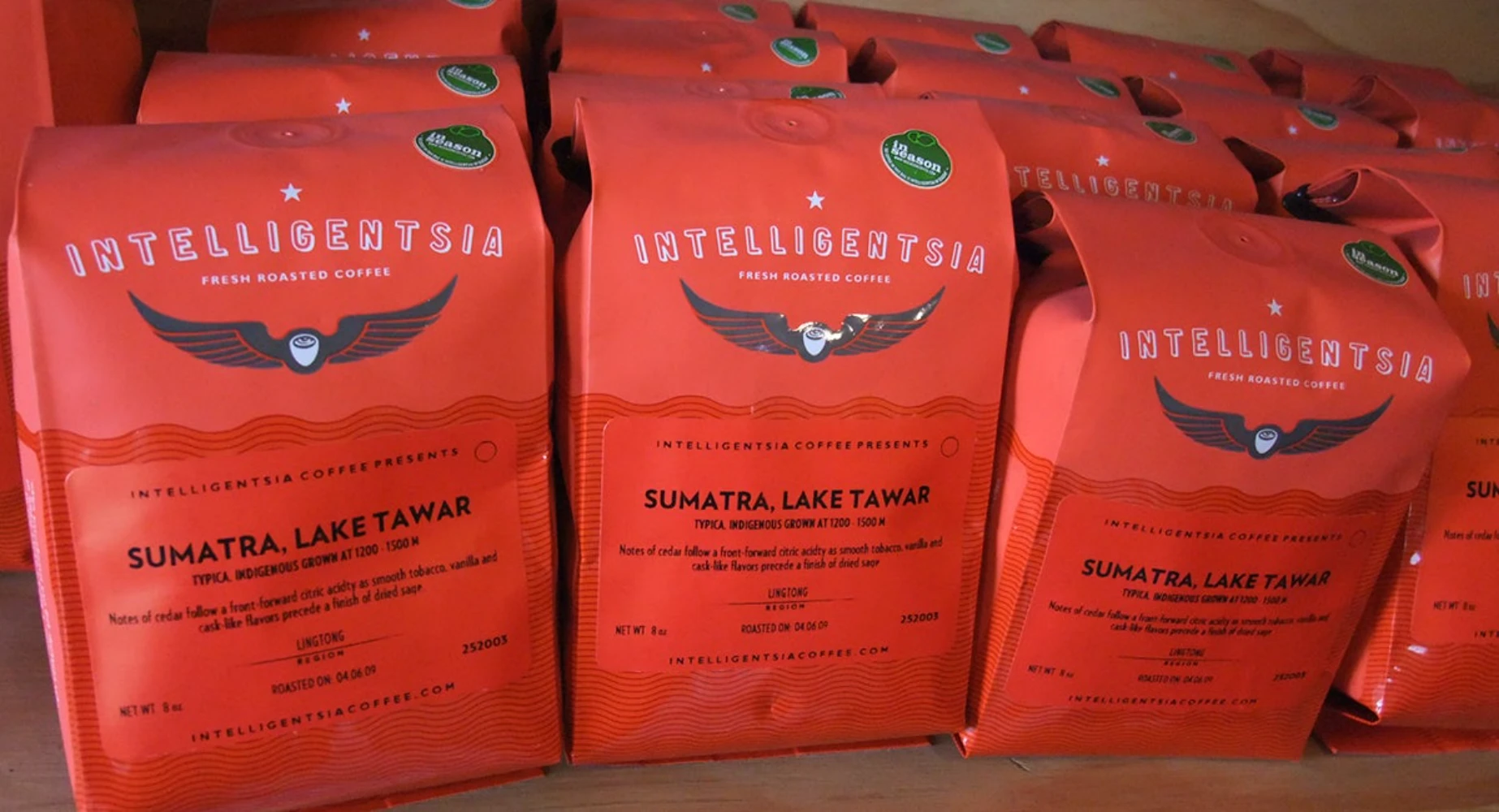
One of the most operationally interesting decisions in Intelligentsia’s packaging system is the use of a separately printed sticker — applied to the Single Origin bags — to carry the origin-specific information that changes with every new coffee release. The main bag carries the tier identity, the brand mark, the format information, and the Roast Profile indicator. The sticker carries the producer name, the farm or cooperative, the region and country, the number of years Intelligentsia has maintained a Direct Trade partnership with that specific producer, the flavor notes, and any special release notes.
This two-layer information architecture solves a specific production problem. Intelligentsia releases more than 50 single-origin coffees annually — new arrivals from different farms in different seasons, each with its own specific provenance story. If all of this information were printed directly onto the bag film, each new release would require a new print file, new plates or cylinders, and a minimum production run of the new bag — which is economically impractical for short-run seasonal releases where the available volume may not justify a full production run.
The sticker system solves this by separating the stable brand elements (printed on the bag in volume) from the variable origin elements (printed on the sticker in shorter runs, applied to the bag at the roasting facility). The Single Origin bag becomes a platform — a consistent, high-quality branded container that can carry any single-origin coffee with a simple label change. This is a production logistics decision that has direct packaging design implications: the sticker needs to be positioned, sized, and designed as an integrated element of the bag’s visual system, not as an afterthought applied over the main print.
Intelligentsia’s sticker is applied to a specific zone on the front panel, in a format and color (deep red with white and pink copy) that reads as part of the design system rather than an external addition. The years-of-partnership figure is prominent — a single number that communicates the depth of the sourcing relationship in the most efficient possible format. A buyer who understands Direct Trade knows that a 12-year partnership represents a quality standard and a sourcing commitment that a coffee without that number cannot make.
From a factory production standpoint, the sticker system creates a specific requirement: the bag’s print zone needs to be designed with the sticker placement in mind, and the sticker’s adhesive specification needs to be compatible with the bag’s surface finish. On a matte-finish PET surface, sticker adhesion behaves differently than on a gloss surface — peel force, permanence, and cold-temperature performance all need to be confirmed in the pre-production sample stage rather than assumed from generic adhesive specifications.
What Specialty Coffee Brands Need from a Factory When Packaging Is Part of the Story
Intelligentsia’s packaging system illustrates what a mature specialty coffee packaging specification actually requires — and why it cannot be reduced to a standard coffee bag purchase from a commodity flexible packaging supplier. The system has to perform at the film level (protecting light-roast aromatics over a meaningful shelf life), at the format level (three different bag structures for three different use contexts), at the print level (a three-tier color system with gradient reproduction requirements), and at the information architecture level (stable brand elements on the bag, variable origin elements on a separately managed sticker).
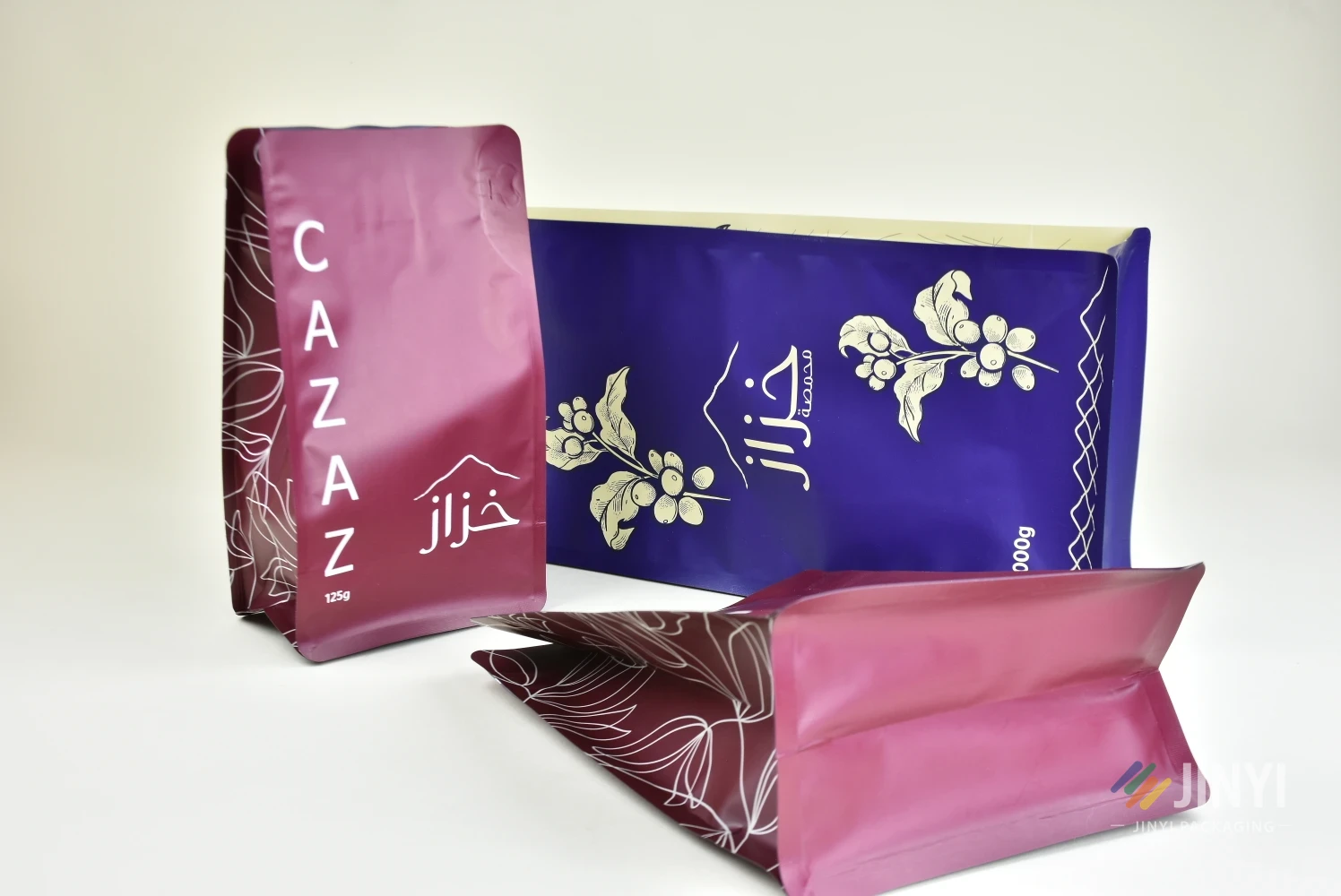
Custom flat bottom coffee bags produced at JINYI’s factory — three sizes shown, each with full matte finish and brand-specific artwork. Available from 500 units via digital print.
For specialty coffee brands building a tiered packaging portfolio, the factory capabilities that matter most are: the ability to produce multiple bag formats within the same barrier laminate specification, so that the film performance is consistent across the range regardless of bag structure; degassing valve installation with accurate positioning documented on a confirmed dieline, before production cylinders or plates are committed; color management that holds gradient reproduction consistently across production runs — particularly important for a brand where gradient versus solid field is a functional SKU differentiator; and physical pre-production samples for every new format and every significant design update, where sticker placement, gradient reproduction, and valve position can be evaluated on the actual formed bag.
For brands at an earlier stage of portfolio development — building toward a tiered system but not yet operating at Intelligentsia’s SKU count — the most important single decision is whether the packaging system is designed to scale. A bag that works for three SKUs should be a platform that can carry thirty without requiring a complete design rebuild. Building the information architecture (what goes on the bag, what goes on a label) into the initial packaging brief is significantly easier than retrofitting it after the brand has grown.
JINYI’s coffee packaging solutions cover the full format range for specialty coffee — stand-up pouches, side gusset bags, and eight-side seal flat-bottom bags in PET/AL/PE and PET/VMPET/PE barrier specifications, with degassing valve options, resealable zipper configurations, and complete material documentation as standard. Among the brands in our production portfolio is a Belgium-based specialty coffee roaster — ONZE — whose flat-bottom bag specification reflects a similar light-roast, high-barrier approach to the one Intelligentsia’s portfolio demands. For a detailed walkthrough of how the production process works from film specification through finished bag, the guide to custom pouch production covers each stage before the first factory conversation.
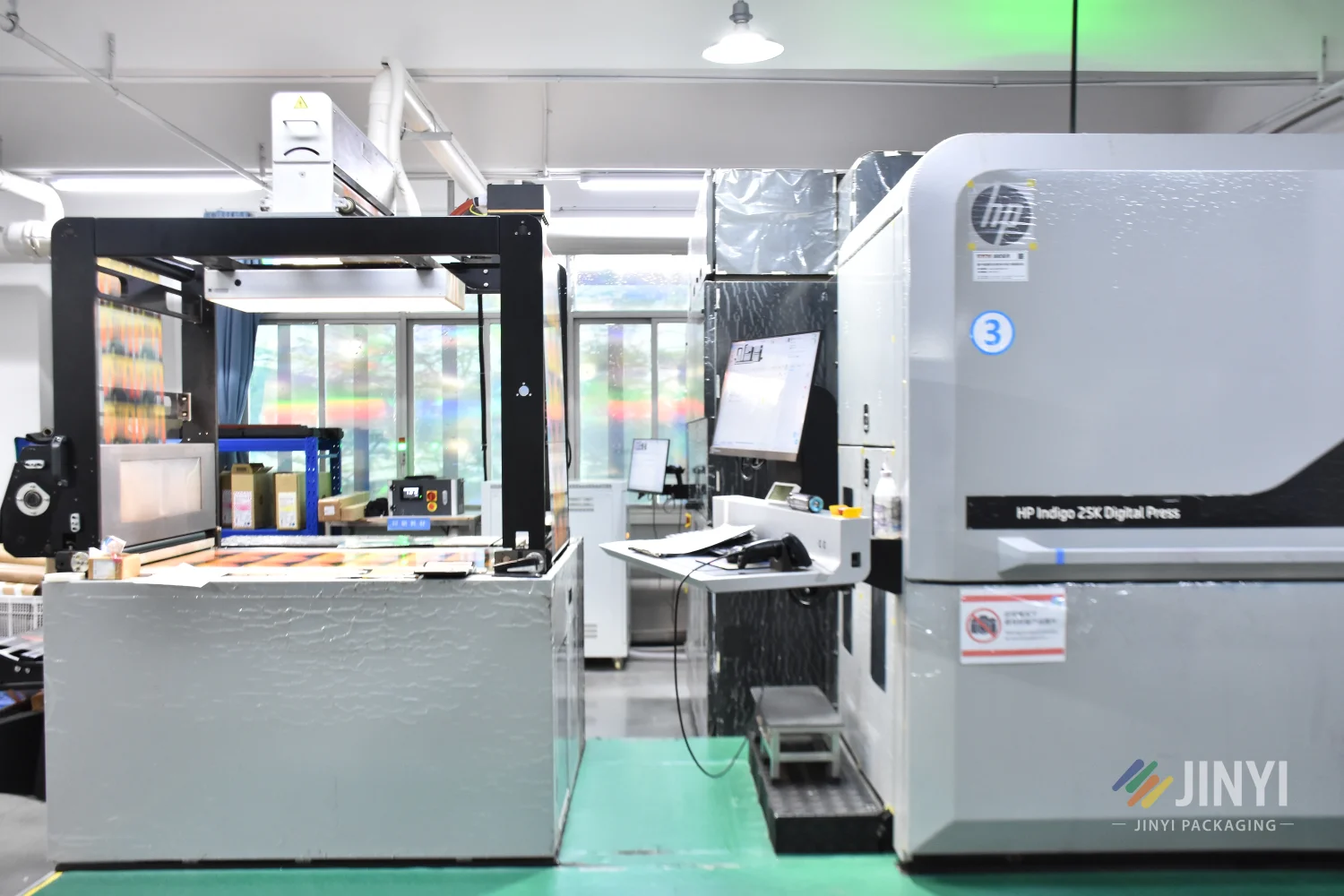
HP Indigo 25K at JINYI — consistent colour output across all press systems via ESKO Automation Engine
Building a Tiered Coffee Packaging System That Performs Across Every Context?
JINYI produces stand-up pouches, side gusset bags, and eight-side seal flat-bottom bags in high-barrier laminate specifications — with degassing valve installation, resealable zipper options, gradient print capability, and complete material documentation as standard. The conversation starts with your roast profile and shelf life target, not the design file.
JINYI is a source factory for custom flexible packaging with 15+ years of production experience, serving food, supplement, coffee, pet food, and consumer goods brands across 150+ countries. We produce stand-up pouches, flat-bottom bags, pillow bags, and side gusset bags in PET/AL/PE, PET/VMPET/PE, and other barrier specifications — via HP Indigo digital print from 500 units and gravure printing at volume — with full material documentation included as standard with every order.
That is what From Film to Finished — Done Right means in practice.
Elsa
Business Development Manager · JINYI Packaging
Elsa leads business development and customer order management at JINYI. With 8 years in foreign trade across Yiwu and Dongguan, she has a sharp understanding of market demand and what buyers actually need — turning real customer insight into the right packaging decisions.
Customer needs Order management Business development
Intelligentsia uses three formats across its product range: a standard stand-up pouch for smaller Single Origin sizes (10oz), a side gusset bag for larger format sizes, and an eight-side seal flat-bottom bag for the Black Cat espresso line and select premium offerings. The eight-side seal construction creates a geometrically precise flat base through eight individual seal points, giving the bag a structural stability and shelf presence that standard flat-bottom formats cannot fully achieve. All three include a one-way degassing valve and a resealable zipper.
What film structure does Intelligentsia’s coffee bag most likely use?
Intelligentsia has not published an official material specification. Based on their light roast positioning and the aromatic sensitivity of their single-origin coffees, the estimated structure is a standard three-layer PET/AL/PE laminate: PET print layer on the outside, aluminum foil barrier layer in the middle (est. OTR ≤0.01 cc/m²/day), and food-grade PE inner seal layer. The aluminum foil barrier is the appropriate choice for light roast specialty coffee, which retains a higher concentration of volatile aromatic compounds than dark roast coffee and is more sensitive to oxidative degradation over the shelf life.
How does Intelligentsia’s three-tier design system work?
Intelligentsia’s packaging is organized into three tiers with distinct visual identities. Black Cat uses a near-black base with gold and deep green accents — the brand’s flagship espresso line in its most premium format. Signature Blends uses the classic Intelligentsia red with an orange gradient — the accessible, year-round anchor of the portfolio. Single Origin uses greens and reds drawn from coffee plant imagery — communicating agricultural provenance and origin specificity. Each tier uses color as the primary navigation signal, allowing buyers to locate their preferred tier by visual field before reading any text.
Why does Intelligentsia use a separate sticker on its Single Origin bags?
Intelligentsia releases over 50 single-origin coffees annually, each with its own provenance information — producer, region, years of Direct Trade partnership, flavor notes. Printing this information directly on the bag film would require a new print file and minimum production run for every new release, which is economically impractical for short-run seasonal coffees. The sticker system separates stable brand elements (printed on the bag in volume) from variable origin elements (printed on the sticker in shorter runs, applied at the roasting facility). The Single Origin bag becomes a platform that carries any coffee with a label change rather than a bag change.
Why does light roast coffee require a higher barrier film than dark roast?
Light roast coffee retains a higher concentration of volatile aromatic compounds — the fragile, heat-sensitive molecules responsible for the floral, fruit, and terroir-specific notes that specialty buyers value. These compounds are lost through the packaging film over time through oxidation and direct vapor permeation. Dark roast coffee has fewer of these compounds — the roasting process drives them off — and its dominant flavors are roast-derived compounds that are chemically more stable. A VMPET barrier with OTR in the range of 0.5 to 2.0 cc/m²/day may be adequate for a dark roast with a shorter shelf life target. For a light roast single-origin with a 6 to 12 month shelf life, an aluminum foil barrier providing near-zero OTR is the appropriate specification.
What is an eight-side seal flat-bottom bag and why does it stand better than a standard flat-bottom bag?
An eight-side seal flat-bottom bag creates its base through eight individual seal points along the bottom and lower corners of the bag, compared to the four-point sealing of a standard flat-bottom bag. The additional seals create a more geometrically precise base panel with greater structural rigidity — the bag stands squarely without leaning, bowing at the sides, or showing the bottom-panel dimpling that can affect standard flat-bottom formats when filled with heavy products like whole bean coffee. The five printable panels (front, back, two sides, bottom) also provide additional real estate for brand and origin information.
How does Intelligentsia’s packaging compare to other specialty coffee brands?
Intelligentsia’s three-tier system is more formally codified than most specialty coffee packaging portfolios. Blue Bottle Coffee uses a unified, minimalist visual identity across its range without strong tier differentiation — the brand presence is consistent but navigation across SKUs relies more on text than on visual field. Death Wish Coffee uses a single aggressive visual identity across its range without tiering. Intelligentsia’s system reflects a portfolio at a scale where tier navigation has become a functional consumer need — over 50 SKUs annually require a design system that helps buyers orient in the range without reading every bag. For detailed breakdowns, see our analyses of Blue Bottle Coffee packaging and Death Wish Coffee packaging.