JINYI shares practical packaging guidance for your decisions.
Stumptown Coffee Roasters was founded in Portland, Oregon in 1999 by Duane Sorenson. It is one of the brands most directly responsible for establishing the third wave of specialty coffee in North America — the movement that reframed coffee as a product of specific farms, specific processing methods, and specific relationships between roasters and producers. Stumptown pioneered the Direct Trade sourcing model in 2003: paying prices tied directly to quality, maintaining relationships with producers across multiple consecutive years, and building transparency into the supply chain rather than purchasing through commodity brokers. By 2024, over 90 percent of Stumptown’s purchases came through partnerships of three or more consecutive years. The company has held B Corp certification since 2018. In 2025, Stumptown’s parent company changed from JDE Peet’s to Keurig Dr Pepper, completing a transition within the premium coffee category’s increasingly consolidated corporate landscape.
What makes Stumptown unusual from a packaging standpoint is not just what they have chosen for their bags — it is how publicly they have documented each decision. Three significant packaging updates in 25 years, each accompanied by a detailed public explanation of why the previous bag was being replaced, what the new bag does differently, and what the trade-offs are. For a brand in a category where most packaging decisions are made quietly, this level of transparency creates a useful record that connects packaging specification to brand values in an unusually direct way.
What Stumptown Is and Why Its Packaging Has Evolved More Publicly Than Most
Most coffee brands update their packaging without announcing why. The new bag appears on shelves, the old one disappears, and no public explanation connects one to the other. Stumptown has consistently done the opposite: each of its three significant packaging transitions has been accompanied by a blog post, a FAQ page, or a press statement explaining the specific reasons for the change — the technical shortcomings of the old bag, the specific improvements the new bag provides, and the trade-offs that remain unresolved.
This transparency is not incidental. It is consistent with the brand’s Direct Trade sourcing philosophy, which is built on the same principle: make the decisions visible, explain the reasoning, and accept accountability for the gaps. When Stumptown launched “Our Better Bag” in 2025 — its current PCR film construction — the brand’s support page explicitly acknowledged that the bag is not curbside recyclable, explained what post-consumer recycled content actually means, and pointed buyers toward the specific third-party services that can process it. That is a different level of honesty than the greenwashing-adjacent claims common in sustainable packaging communications.
The packaging history is also useful as a case study in how a specialty coffee brand’s bag specification changes as the brand’s values evolve. The progression from a utilitarian kraft bag to a colorful illustrated system to a PCR film construction reflects three different moments in the brand’s development — and three different sets of priorities about what the bag is supposed to do. Understanding that progression is useful context for any specialty coffee brand making similar decisions today. For a comparison with how another third-wave pioneer approaches its packaging system, the breakdown of Intelligentsia’s three-tier design system covers similar ground from a different brand angle.
From a production standpoint: A brand that documents its packaging decisions publicly creates a useful reference for its own suppliers — and for competitors and observers. Stumptown’s public FAQ on “Our Better Bag” contains more technically specific information about their packaging material choices than most brands publish in five years of supplier communication. That transparency is also a commitment: once you have told your customers what your bag is made of and why, reverting to a less sustainable specification becomes publicly visible.
The Format: Side Gusset Bag, Degassing Valve, and What the Structure Is Actually Doing
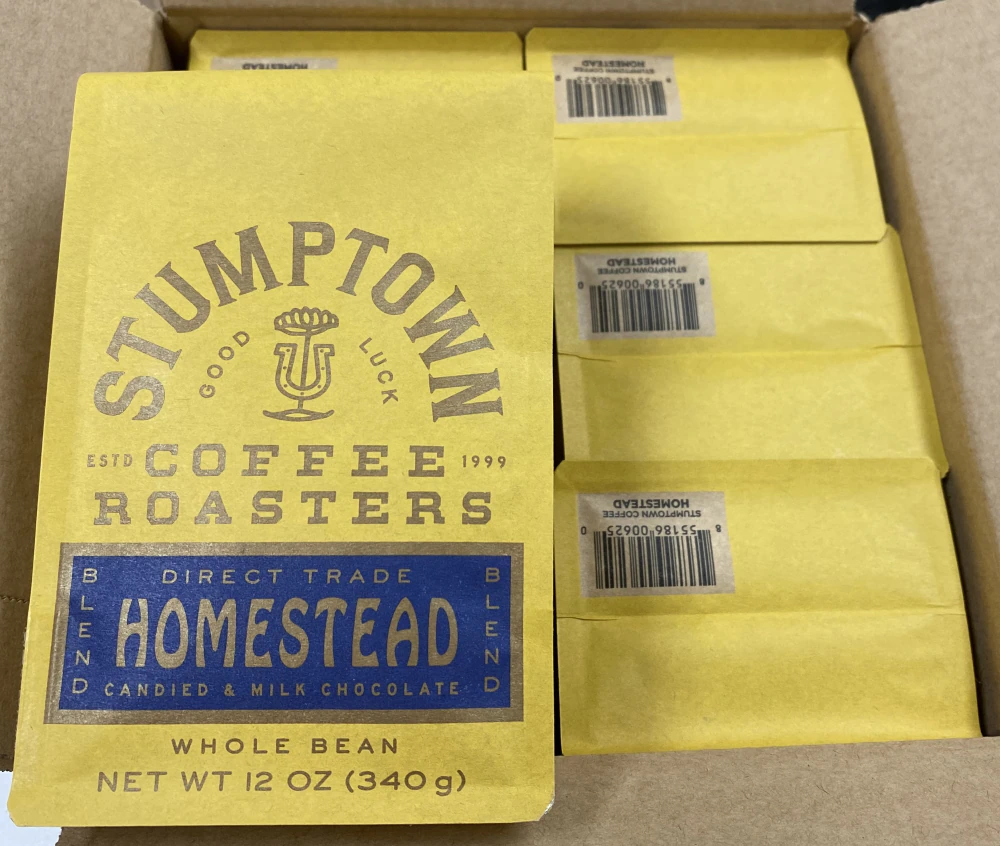
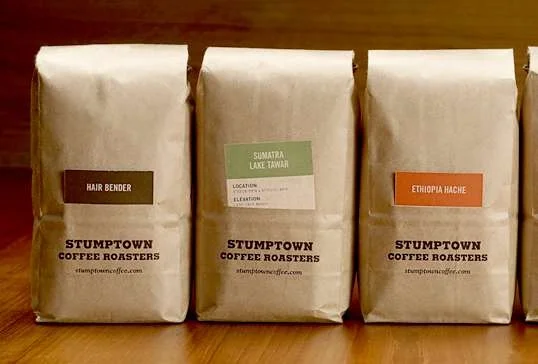
Stumptown’s primary retail packaging format is a side gusset bag — a structure with gusseted side panels that expand as the bag fills, creating a block-bottom base that allows the bag to stand on a shelf without leaning. This is the standard format for specialty whole bean and ground coffee at the 12-ounce retail size, and for good reason: the side gusset structure distributes the product’s weight across the entire base surface rather than concentrating it at the bottom seal, which is important for a bag that will be stacked, shipped, shelved, and handled multiple times before it is opened.
The 12-ounce size is not arbitrary. It reflects a calculated balance between household consumption rate and freshness retention. A 12-ounce bag of whole bean coffee, consumed at a rate of two cups per day for two people, lasts approximately two weeks after opening. That two-week window aligns reasonably well with the flavor retention period of freshly roasted coffee after the hermetic seal is broken — the resealable zipper slows but does not stop the staling process once the bag is open. A smaller bag would require more frequent purchases; a larger bag would extend the post-opening exposure period beyond what the zipper can meaningfully protect against.
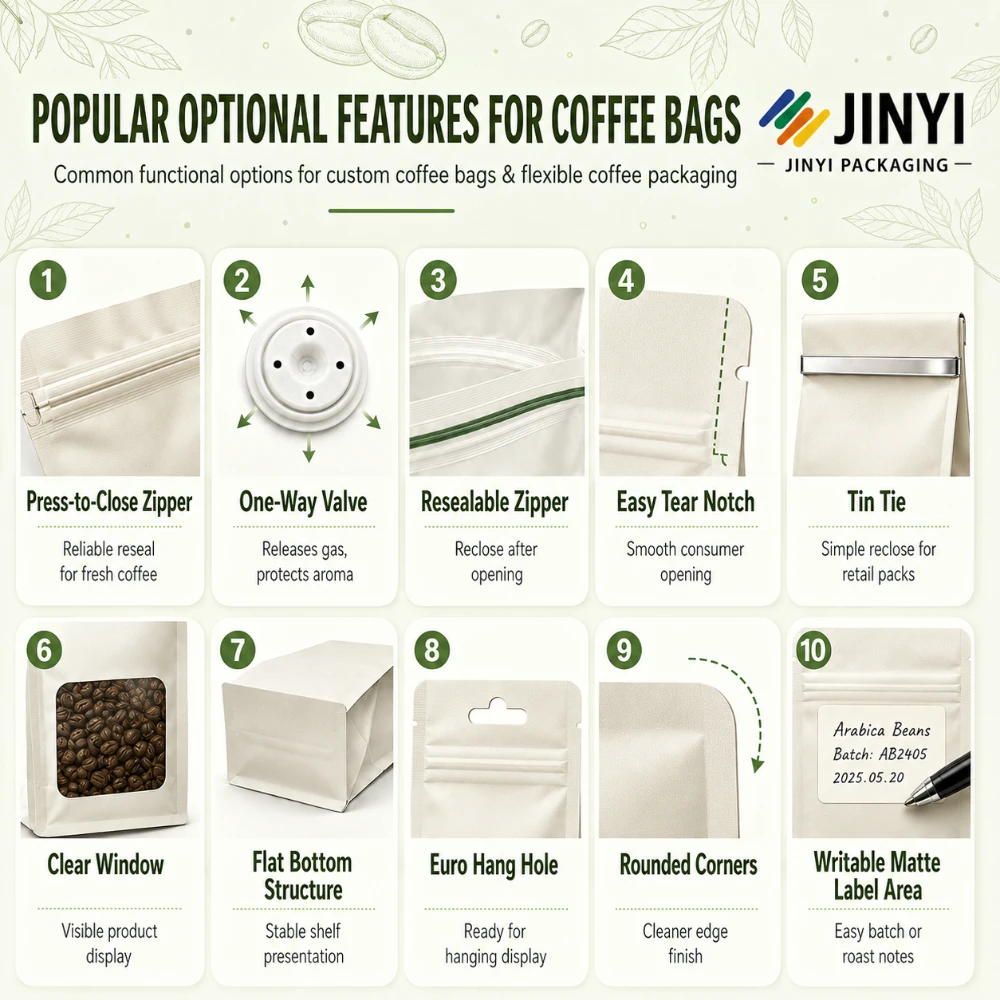
The one-way degassing valve is the most functionally critical structural element of any freshly roasted whole bean coffee bag. Coffee releases CO₂ continuously after roasting — the gas is produced as a byproduct of the Maillard and pyrolysis reactions that occur during roasting and continues to off-gas for days to weeks afterward. Without a one-way valve, a sealed bag of freshly roasted coffee will build internal pressure sufficient to stress the seals and, in a worst case, rupture them. The valve allows CO₂ to escape without admitting oxygen — which is what makes it possible to seal coffee immediately after roasting rather than waiting for a multi-day off-gassing period that would compromise freshness. For Stumptown, which roasts to order for its direct-to-consumer subscription channel, the valve is what makes the freshness proposition of the subscription model technically achievable.
The resealable press-to-close zipper at the top of the bag serves the post-opening freshness function. Once the hermetic seal is broken, the zipper becomes the primary barrier between the coffee and ambient air. Its functional performance — specifically, whether it maintains reliable closure force after repeated opening and closing over a two-week period — is a meaningful quality variable for the consumer experience. A zipper that loses closure tension after the first week of use does not serve the freshness function it was designed for. For brands specifying a zipper closure on a side gusset coffee bag, the zipper’s reclose force specification and its resistance to coffee oil contamination of the closure channel are worth confirming at the pre-production sample stage. JINYI’s coffee packaging solutions cover side gusset bags with degassing valve and zipper configurations across multiple film specifications — with valve position confirmed on the physical pre-production bag before production is committed.
For brands building a similar specialty coffee packaging format, JINYI produces side gusset bags in barrier laminate specifications appropriate for specialty coffee — with one-way degassing valve installation, resealable zipper options, and complete material documentation as standard.
Three Generations of Film: Kraft Paper, Biotrē, and the New PCR Construction
Stumptown’s packaging has gone through three distinct film specifications in 25 years — each representing a different set of priorities and a different understanding of what the bag is supposed to do beyond hold coffee. Understanding the progression is useful because it illustrates how the tension between freshness performance and environmental impact plays out in a real brand’s decision-making over time.
Generation one — the kraft bag (2006–2017). Stumptown’s original modern bag was a utilitarian kraft paper exterior over a multi-layer plastic interior. The kraft exterior communicated the brand’s values at the time: unpolished, direct, anti-marketing, aligned with the farmer rather than the consumer lifestyle. The bag did not have a one-way degassing valve or a resealable zipper in its early form — it used a tin-tie closure and relied on the customer to use the coffee quickly after opening. As Stumptown’s distribution expanded beyond its Portland cafés and into grocery retail, the limitations of this format became more apparent: the kraft exterior was not recyclable due to its plastic lamination, the absence of a valve complicated the freshness proposition, and the bag’s shelf presence on grocery shelves was modest compared to competitors with more considered retail packaging.
Generation two — Biotrē (2017). In 2017, Stumptown partnered with Pacific Bag Inc. to transition to Biotrē bags — a film construction that included a one-way degassing valve and a freshness seal, with improved barrier performance over the kraft bag. The 2017 redesign simultaneously introduced the color-coded design system developed by Austin-based studio LAND. The new bags were described as more environmentally sustainable than the previous construction, though Stumptown later acknowledged that the Biotrē bag was not biodegradable, recyclable, or compostable — it was an improvement in barrier performance and in the brand’s visual system, not a solved sustainability problem.
Generation three — “Our Better Bag” PCR film (2025). After approximately two years of research, testing, and sourcing, Stumptown launched a new bag construction containing a minimum of 30 percent post-consumer recycled content. The new bag is lighter — total package weight reduced by more than 12 percent across all sizes — and the brand states it has lower oxygen permeability than the previous bag. It is recyclable through fee-based third-party collection services such as Ridwell and Green Century, but not through standard curbside recycling.
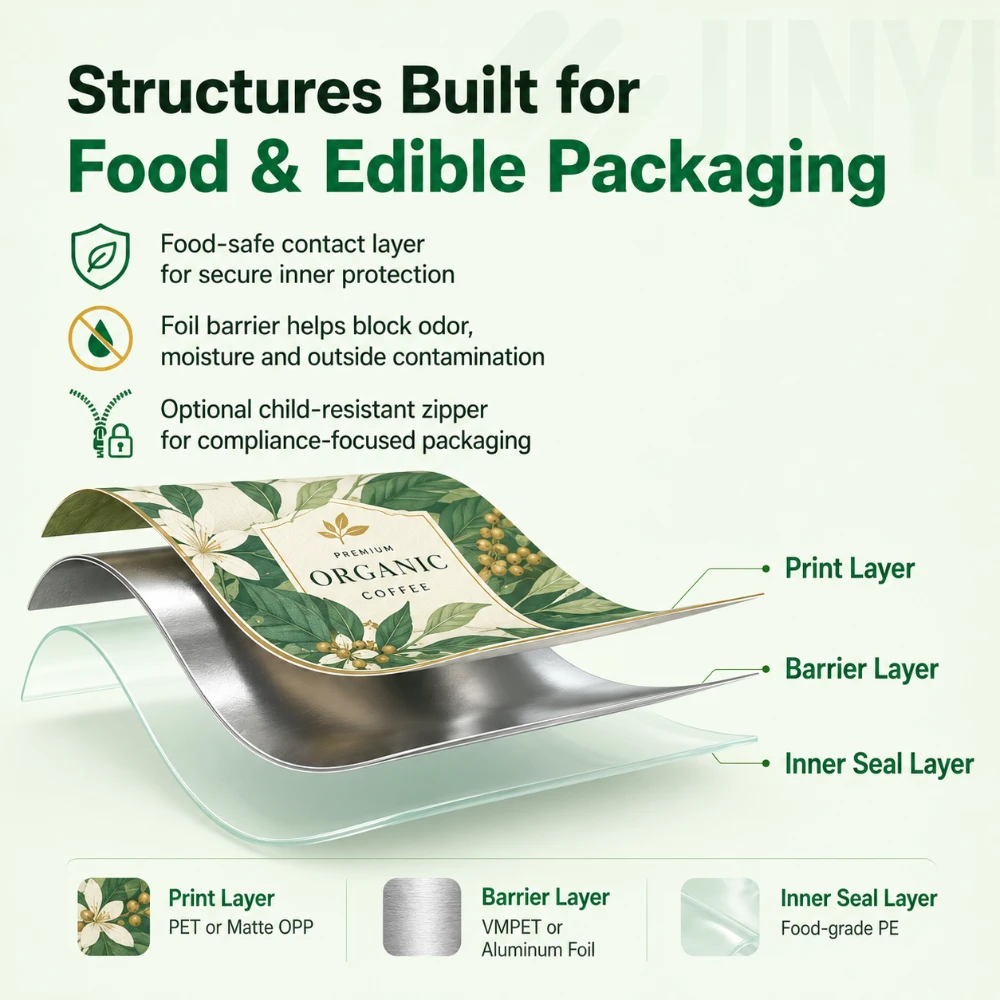
The film structure of the new PCR bag has not been formally published by Stumptown. Based on the stated recyclability through polyethylene film collection streams — which requires a PE-compatible material — and the absence of aluminum foil (which would make third-party recycling impossible), the estimated structure is a PCR-content multi-layer PE-based film rather than the standard PET/AL/PE laminate used by most specialty coffee brands. This is an important technical distinction. A standard PET/AL/PE laminate provides an OTR of approximately 0.01 cc/m²/day or below — effectively a complete oxygen barrier. A PE-based multi-layer film without an aluminum foil layer provides meaningfully higher OTR — the specific value depends on the film’s construction and any barrier coating applied, but it will be higher than an aluminum foil laminate regardless of PCR content. Stumptown’s claim of “lower oxygen permeability” compared to the previous Biotrē bag is plausible if the previous bag was also a non-foil structure — but it does not mean the new bag provides equivalent freshness protection to a standard aluminum foil coffee bag. For brands choosing between film structures for specialty coffee, the complete coffee bag packaging guide covers the barrier performance comparison across structure types, and the format selection guide covers the format decision from a product requirements angle.
Film Type
Est. OTR
Recyclability
Best Suited For
PET / AL / PE (standard)
≤0.01 cc/m²/day
Not recyclable
Maximum freshness protection; long shelf life; light and medium roast specialty coffee
PET / VMPET / PE
~0.5–2.0 cc/m²/day
Not recyclable
Good barrier at lower cost; dark roast or shorter shelf life targets
PCR PE-based film (estimated — Stumptown new bag)
Higher than AL; specific value depends on construction
Third-party PE stream (Ridwell etc.)
Sustainability-prioritized brands; shorter distribution chains; faster consumption turnover
Note: Stumptown’s PCR bag film structure is estimated based on recyclability pathway and PCR content claims. OTR for the PCR construction is not published by Stumptown.
The Color-Coding System: How One Visual Rule Carries the Whole Portfolio
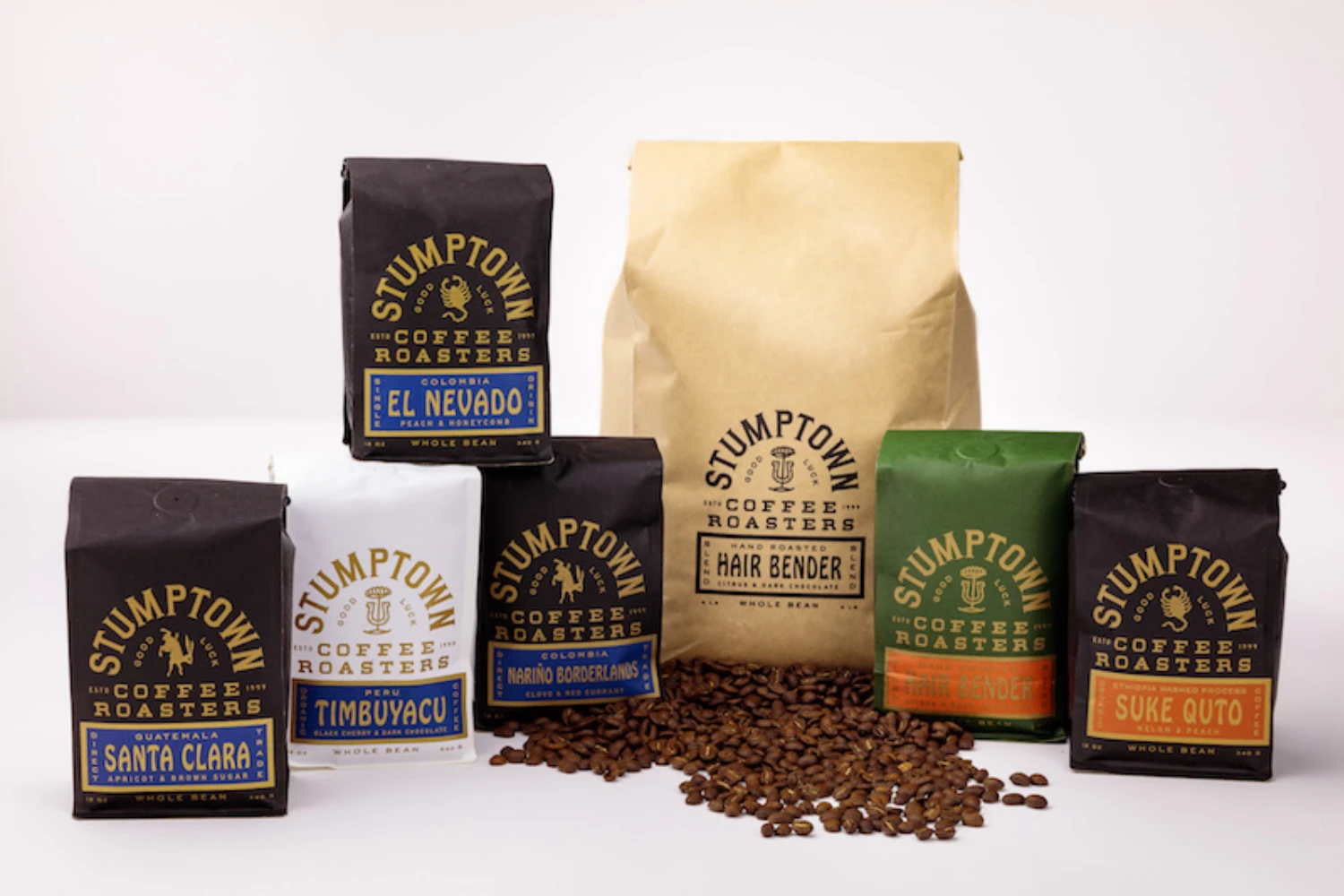
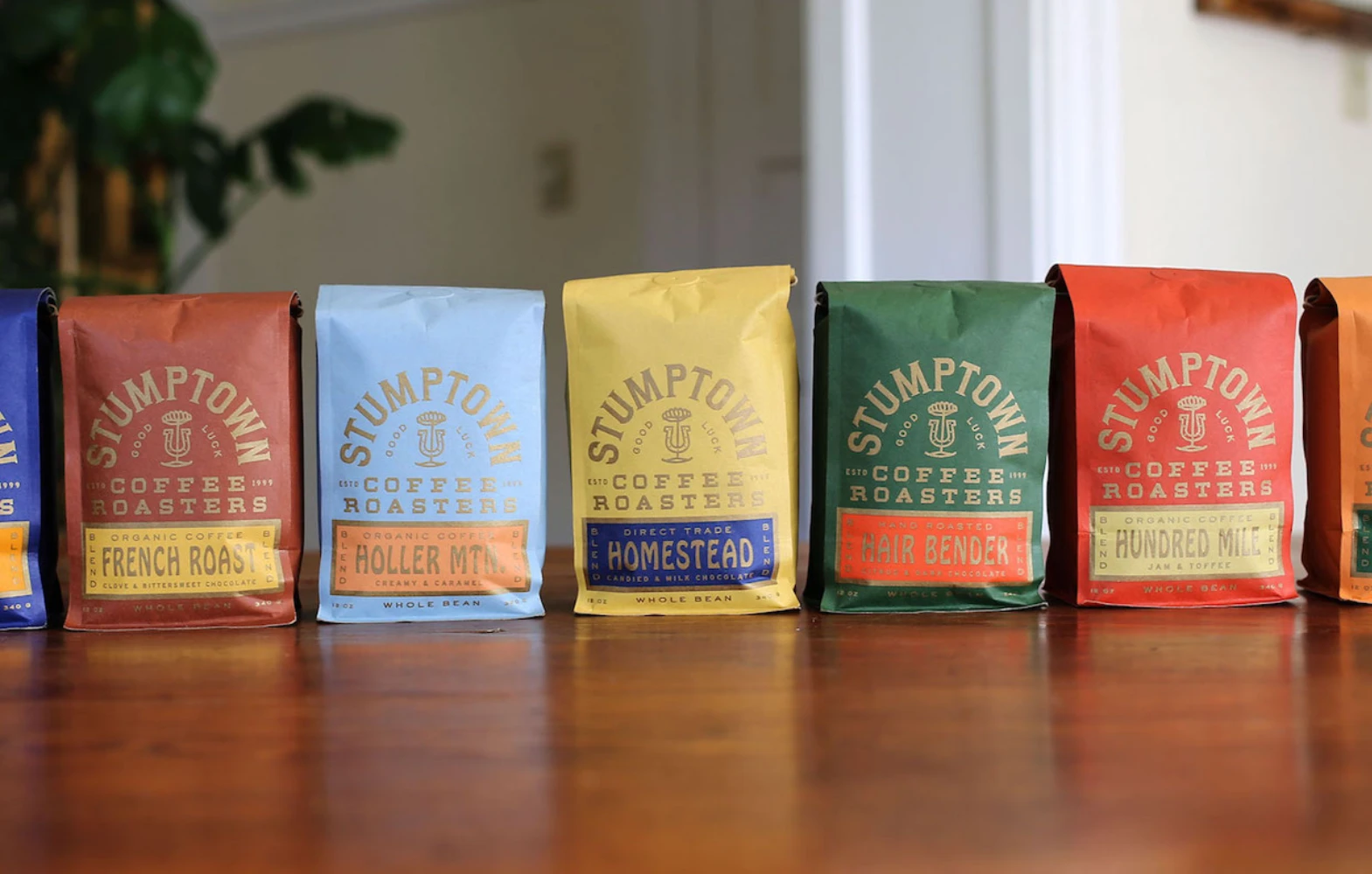
The design system LAND developed for Stumptown in 2017 is built on a single, immediately legible rule: black base color means single origin, colorful base color means blend. This binary distinction is the foundation of the entire visual navigation system — a buyer who knows this rule can tell at a glance which type of coffee they are looking at, from across a grocery aisle, before reading a word of copy. Within that binary, the color palette does additional work.
For blends, the color of the panel backing the coffee’s name is coded to represent the primary growing region: blue for Latin America, red for Africa, and green for Asia. Three additional colors — orange, yellow, and brown — indicate organic certification or direct trade status. The system creates multiple layers of information within a single color field: a buyer reading the bag’s color is simultaneously receiving information about the blend or single-origin status, the primary growing region, and the sourcing relationship — all before engaging with the typography.
The design also uses the Hobo typeface — a rounded, playful display font that became something of a cult object in graphic design circles precisely because of its unfashionable associations. Using Hobo for a premium specialty coffee brand was a deliberate subversion of the serious, minimal typography common in the category. It communicates the bohemian Portland personality of the brand through a typographic choice that is unexpected enough to be memorable. This is a different approach to brand personality expression than the restrained, authority-signaling typography of Blue Bottle or the dramatic, image-led dark field of Intelligentsia — Stumptown’s typography says something specific about the brand’s relationship to convention.
The illustrations on the bags — depicting plants, animals, and cultural imagery associated with each coffee’s origin — add a layer of visual richness that communicates the sourcing story without requiring the buyer to read the provenance copy. A bag with Ethiopian imagery signals African single origin before the buyer reads the flavor notes. The illustration style is loose and playful rather than ethnographically precise — it evokes place without claiming to represent it literally, which is the appropriate register for a brand whose relationship with origin cultures is built on Direct Trade partnership rather than exotic marketing.
From a print production standpoint, a large palette of solid color fields across a portfolio of 20 or more SKUs creates a specific challenge: color consistency run-to-run and SKU-to-SKU needs to be actively managed rather than assumed. The blue that identifies Latin American blends needs to read as the same blue across every production run, every bag size, and every reorder over multiple years. On a matte film substrate, ink absorption characteristics affect color density in ways that differ from print-on-paper assumptions. A physical pre-production sample, printed to a confirmed color target with defined Delta E tolerances, is the only reliable way to verify that a specific color field will read consistently on the actual formed bag. For context on how another specialty coffee brand approaches a similarly complex multi-SKU color system, the Peet’s Coffee packaging analysis covers a related set of decisions from a different brand perspective.
On managing large color palettes in production: A design system that uses six or more distinct solid color fields requires that each color is defined in LAB values — not just CMYK or Pantone references — and that the production process includes a color measurement step at the beginning of each run to confirm the target is being hit before the full job is committed. Brands that specify color by Pantone number alone without LAB confirmation typically accumulate perceptible color drift across a SKU portfolio over successive production runs.
The PCR Upgrade: What “Our Better Bag” Actually Means for Barrier Performance and Recyclability
Stumptown’s “Our Better Bag” represents a genuine step forward in the brand’s sustainability journey — and a genuine engineering trade-off that the brand has been relatively honest about, which is worth examining clearly.
Post-consumer recycled content means that at least 30 percent of the plastic in the film was previously used in another product — collected through recycling programs, reprocessed into pellets, and incorporated into the new film alongside virgin plastic. Using PCR content creates demand for recycled plastic, supports the economics of plastic recycling collection, and reduces the amount of new petroleum-derived plastic required to produce each bag. These are real benefits. The weight reduction of 12 percent across bag sizes reduces total material consumption and lowers the carbon footprint of transportation. These are measurable sustainability improvements.
The recyclability claim requires careful reading. The bag is not curbside recyclable — it cannot go into the standard blue bin. It is recyclable through fee-based third-party collection services like Ridwell or Green Century, which operate in select US markets and collect flexible film plastic for processing through specialized recycling streams. This is a meaningful improvement over a bag that is not recyclable through any pathway, but it is not the same as curbside recyclability. A buyer in a market not served by Ridwell or similar services has no practical recycling option for the bag regardless of its PCR content. Stumptown has acknowledged this limitation in their published FAQ, which is the appropriate level of honesty about a partial solution.
The barrier trade-off is the technical dimension that matters most for coffee freshness. By moving away from an aluminum foil laminate construction — which is what allows third-party PE stream recycling — Stumptown has accepted a higher OTR than a standard PET/AL/PE coffee bag provides. The brand states that the new bag has lower oxygen permeability than the previous Biotrē construction, which is plausible if the Biotrē was also a non-foil structure. But the new PCR bag’s OTR is almost certainly higher than a standard aluminum foil laminate, which means the freshness protection per unit of shelf time is somewhat lower.
This is not a criticism of the decision — it is the correct engineering trade-off for a brand whose distribution model includes significant DTC subscription volume, where consumption turnover is faster and bags spend less time on retail shelves compared to the worst-case scenario of a bag sitting in a grocery warehouse for months. A faster-consumption channel can tolerate a somewhat higher OTR without the consumer noticing a quality difference. The trade-off that makes sense for Stumptown’s distribution model may not make sense for a brand with longer retail shelf times or lighter roast profiles with more fragile aromatic compounds.
The broader principle here is worth stating directly: multi-layer aluminum foil laminates are not an environmentally inferior choice by default — they are the appropriate engineering choice for products requiring maximum barrier performance over extended shelf lives. The choice between a high-barrier non-recyclable laminate and a lower-barrier recyclable construction is a product-specific decision that depends on the coffee’s roast profile, the distribution channel’s shelf time, and the brand’s relative priorities between freshness and environmental footprint. Both structures have valid applications. The mistake is applying one framework universally without considering the product requirements that should drive the specification.
What Specialty Coffee Brands Need from a Factory When Sustainability Is Part of the Brief
Stumptown’s packaging journey illustrates the full complexity of a specialty coffee packaging specification when sustainability is a genuine requirement rather than a marketing overlay. The specification involves format decisions, valve and closure engineering, film structure selection, color management across a large SKU portfolio, and a defensible sustainability position that survives honest scrutiny. Getting all of these right simultaneously requires a factory that can engage with each dimension as a specification question rather than a catalog selection.
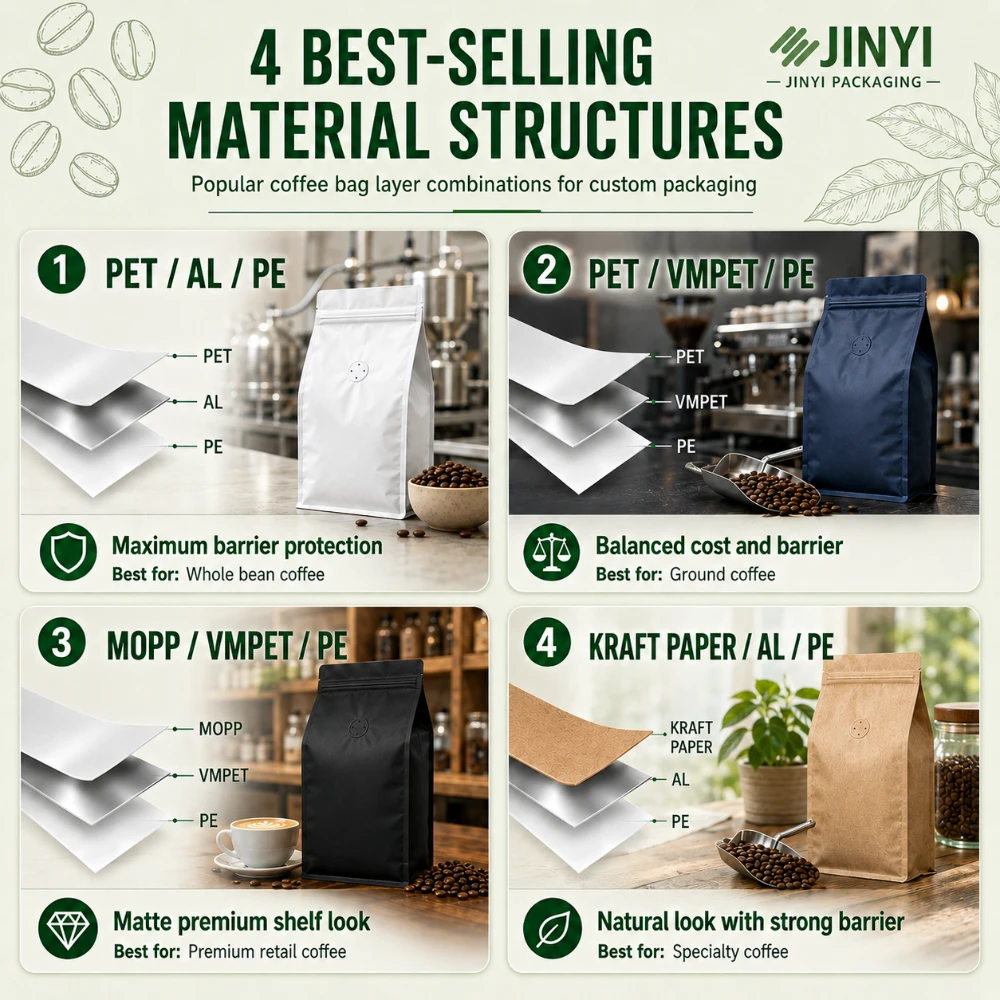
For the film specification, the practical choice for most specialty coffee brands today sits between three options: a PET/AL/PE laminate for maximum freshness protection at the cost of recyclability; a PET/VMPET/PE laminate for good barrier performance at lower cost and the same recyclability limitation; or a PCR-content PE-based film for a recyclability pathway at the cost of some barrier performance. The right choice depends on the roast profile, the distribution channel’s shelf time, and the brand’s specific sustainability commitments. A factory that can provide published OTR data for each option — not just material type descriptions — gives the brand the information needed to make a specification decision that is defensible on both freshness and sustainability grounds.
For the valve specification, accurate installation position on the bag panel needs to be confirmed on the physical pre-production sample — not assumed from the dieline. A valve positioned in a location that overlaps with the gusset fold zone or the label application area creates production problems that are easier to prevent than to fix at the quality inspection stage after production.
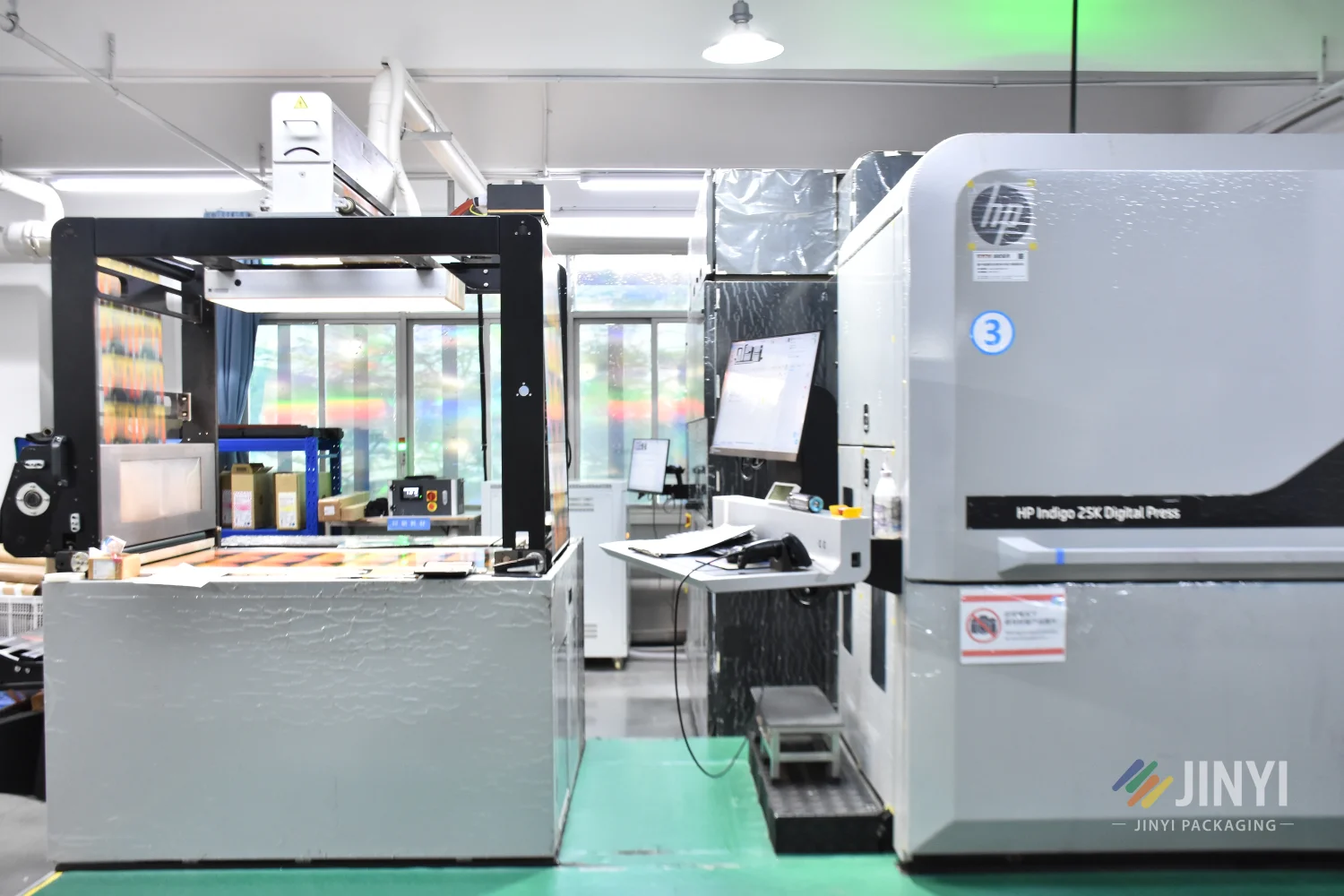
For the color management requirement — particularly for brands running a color-coded multi-SKU system like Stumptown’s — consistent output across the portfolio and across successive production runs requires a defined color target for each SKU and a measurement protocol that confirms the target is being hit at the start of each production run. JINYI’s color output across our HP Indigo digital press line is managed through ESKO Automation Engine, applying the same color profile to every job and making run-to-run consistency measurable. For a specialty coffee brand whose color system is a functional SKU navigation tool — where the color carries information the consumer uses to identify their preferred coffee — color drift between runs is not an aesthetic problem, it is a usability problem.
JINYI’s coffee packaging solutions cover the full format range for specialty coffee — side gusset bags and flat-bottom formats in PET/AL/PE and PET/VMPET/PE barrier specifications, with one-way degassing valve installation, resealable zipper options, and complete material documentation as standard. Among the brands in our production portfolio is a Belgium-based specialty coffee roaster — ONZE — whose flat-bottom bag specification reflects a similar light-roast, high-barrier approach. For a detailed walkthrough of how the full production process works from film specification through finished bag, the guide to custom pouch production covers each stage before the first factory conversation.
HP Indigo 25K at JINYI — consistent colour output across all press systems via ESKO Automation Engine
Building a Specialty Coffee Bag That Works Across Freshness and Sustainability Requirements?
JINYI produces side gusset and flat-bottom coffee bags in PET/AL/PE and PET/VMPET/PE barrier specifications — with one-way degassing valve installation, resealable zipper options, color-managed multi-SKU output, and complete material documentation as standard. The conversation starts with your roast profile, shelf life target, and distribution channel — not the design file.
JINYI is a source factory for custom flexible packaging with 15+ years of production experience, serving food, supplement, coffee, pet food, and consumer goods brands across 150+ countries. We produce stand-up pouches, flat-bottom bags, pillow bags, and side gusset bags in PET/AL/PE, PET/VMPET/PE, and other barrier specifications — via HP Indigo digital print from 500 units and gravure printing at volume — with full material documentation included as standard with every order.
That is what From Film to Finished — Done Right means in practice.
Elsa
Business Development Manager · JINYI Packaging
Elsa leads business development and customer order management at JINYI. With 8 years in foreign trade across Yiwu and Dongguan, she has a sharp understanding of market demand and what buyers actually need — turning real customer insight into the right packaging decisions.
Customer needs Order management Business development
Stumptown uses a side gusset bag as its primary retail format — a structure with gusseted side panels that create a stable, block-bottom base when filled. The bag includes a one-way degassing valve for freshness after roasting and a resealable press-to-close zipper for consumer convenience after opening. The primary retail size is 12 ounces, available in whole bean and ground versions across single origin and blend lines.
What is Stumptown’s “Our Better Bag” and what makes it different?
Launched in 2025, “Our Better Bag” is Stumptown’s current packaging construction, incorporating a minimum of 30 percent post-consumer recycled content. The bag is lighter than its predecessor — package weight reduced by more than 12 percent — and the brand states it has lower oxygen permeability than the previous Biotrē bag. It is recyclable through fee-based third-party collection services such as Ridwell and Green Century, but not through standard curbside recycling. The film structure has not been formally published, but its recyclability pathway suggests a PE-based multi-layer construction rather than a standard aluminum foil laminate.
How does Stumptown’s color-coding system work?
The system uses a single rule: a black base color identifies single-origin coffees, while a colorful base color identifies blends. Within the blend category, the color of the panel backing the coffee’s name indicates the primary growing region — blue for Latin America, red for Africa, and green for Asia. Three additional colors (orange, yellow, brown) indicate organic certification or direct trade sourcing status. The system was designed by Austin-based studio LAND in 2017 and allows buyers to identify the type and origin of a coffee from a distance, before reading the label copy.
Is Stumptown’s coffee bag recyclable?
The current “Our Better Bag” is not curbside recyclable, but can be recycled through fee-based third-party flexible film collection services such as Ridwell and Green Century in markets where those services operate. The previous Biotrē bag was not recyclable, compostable, or biodegradable through any standard pathway. Stumptown has been transparent about these limitations in its public communications, acknowledging that the current bag is a step forward but not a complete solution.
Does using PCR film affect coffee freshness compared to a standard aluminum foil bag?
Almost certainly yes, to some degree. A standard PET/AL/PE coffee bag provides an OTR of approximately 0.01 cc/m²/day — near-zero oxygen transmission. A PE-based film without an aluminum foil layer provides higher OTR, with the specific value depending on the film’s construction and any barrier coating applied. Stumptown’s claim of “lower oxygen permeability” compared to the previous Biotrē bag is plausible, but does not mean the PCR bag matches the barrier performance of an aluminum foil laminate. For brands choosing between film structures, the trade-off between freshness protection and recyclability depends on the roast profile, the distribution channel’s shelf time, and the brand’s consumption turnover rate.
Why does a specialty coffee bag need a one-way degassing valve?
Freshly roasted coffee releases CO₂ continuously as a byproduct of the roasting process, and continues to off-gas for days to weeks after roasting. Without a one-way valve, CO₂ builds pressure inside a sealed bag and either stresses the seals to failure or forces the roaster to wait for a multi-day off-gassing period before packaging — which compromises freshness. A one-way valve allows CO₂ to escape without admitting oxygen, making it possible to seal coffee immediately after roasting. For DTC subscription models where coffee is roasted and shipped to order, the valve is what makes a genuine freshness proposition technically achievable.
How does Stumptown’s packaging compare to other specialty coffee brands?
Stumptown’s packaging is distinctive in the specialty category for its color-coded multi-SKU navigation system and its public documentation of packaging decisions. Intelligentsia uses a more formally codified three-tier design system (Black Cat / Signature Blends / Single Origin) with a separate label-on-bag system for variable origin information. Blue Bottle uses a minimal, unified visual identity across its range without strong tier differentiation. Stumptown’s approach sits between these — more color and visual richness than Blue Bottle, a less formally structured tier system than Intelligentsia, and a stronger public sustainability narrative than either. For detailed breakdowns, see our analyses of Intelligentsia’s packaging system and Blue Bottle’s packaging approach.